
For site selectors, that means the South.
If you think sunshine made John Denver happy, just wait until you see what national site selection consultants had to say in the 2026 Site Selectors Survey.
When legendary folk singer Denver wrote the classic song “Sunshine On My Shoulders” in 1971, he said he wrote it because when “you’re waiting for the sun to shine, you remember how sometimes just the sun itself can make you feel good.”
If that is true, then site consultants must be humming that tune a lot as once again they’ve voted the sun-splashed locations of the South as their favorite destinations for business facility projects for what is now a record 15 years in a row.
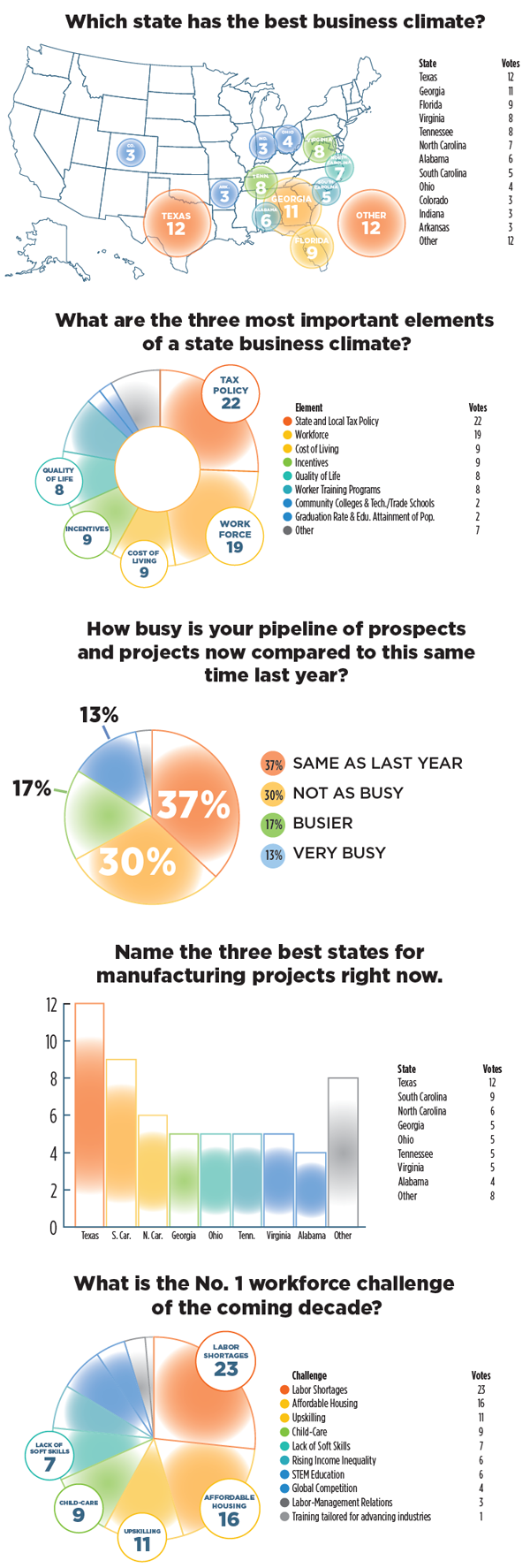
Just how dominant are Sunbelt cities and states in the minds of site consultants? When we surveyed 30 of the country’s leading national site consultants this year, Texas yet again received the most votes for Best Business Climate in America. The remainder of the top five are also Southern states: Georgia, Florida, Virginia and Tennessee.
When we asked the consultants to pick the best three states for manufacturing projects, they named Texas, North Carolina and South Carolina, in order, as their favorites. And when we polled them on which cities they favor for corporate headquarters projects, the South won again, with Nashville, Atlanta, Charlotte and Dallas taking the top four spots, followed by a four-way tie between Richmond, Tampa, Kansas City and Houston.
This year’s Site Selectors Survey presented 14 questions covering topics ranging from favorite business climates and most important location factors to workforce challenges and the impact of federal policies on corporate decision-making.
Among the more significant findings were these:
- Two-thirds of all respondents said that a state’s overall business climate is “extremely important” when they are evaluating locations. One-third said it is “somewhat important.”
- The top five most important elements of a state business climate, per the respondents, are: State and Local Tax Policy; Workforce; Cost of Living; Incentives; and Quality of Life and Worker Training Programs (tie).
- The No. 1 Workforce Challenge of the Coming Decade is the Labor Shortage (23 votes). Affordable Housing came in second (16); while Upskilling was third (11).
- The top two non-U.S. countries most ripe for new investment now are Mexico and Singapore, followed by Germany, Portugal, the United Kingdom and Vietnam.
- As it did last year, California received the most votes for the Worst Business Climate in America (13). The next highest vote-getter was New Jersey with 3.
We also asked respondents how busy they are right now with project activity. The findings contrast with current media reports citing an economic slowdown. The question we put to consultants was: “How busy is your pipeline of prospects and projects now compared to this same time last year?”
While two-thirds said “about the same” or “not as busy,” 30% said they were busier or “bursting at the seams with project activity right now.”
Leading Consultants Speak Out
We reached out to several consultants for commentary on the 2026 Site Selectors Survey. John Boyd Jr., principal of The Boyd Company Inc., said several factors over the past year improved Florida’s business climate. “These include several tort reform measures supporting the insurance industry, more insurance companies entering the Florida market, the full elimination of the business rent tax, and home prices moderating,” he noted.
“Above and beyond these business climate and relocation considerations is how winning is contagious,” he says. “The word is out with respect to Florida’s impressive in-migration figures, numerous high-profile business attraction wins, and famous celebrities moving to Florida — many from California and New York City.”
Speaking of California, Tracey Hyatt Bosman, managing director of Biggins Lacy Shapiro & Co., offered her analysis on why site selectors often label the Golden State as the worst business climate in the country. “California is a beautiful state with wonderful people,” she says. “It is world class in terms of technology, innovation and business startups. However, it is also undeniably high in bureaucracy, and the cost of housing is a challenge for retaining employees cost-effectively.”
Bosman adds that “it is important to recognize that California is an extremely large state and is not monolithic. There are areas where local governments work hard at being business friendly.”
Kornelia Kostka, research manager for Global Location Strategies, analyzed why Texas and the Carolinas scored at the top of the poll as favorite manufacturing locations. She said that the first and foremost reason is because these three states consistently win the most manufacturing projects.
“Year to date, Texas has recorded the highest number of manufacturing projects (73), followed by North Carolina (57) and South Carolina (51), according to FDI Markets data,” Kostka says. “These numbers underscore the strong competitiveness of these three states in 2025. Collectively, they account for 23% of all manufacturing investment in the U.S.”
Site Selection’s Conway Projects Database, which qualifies corporate end-user facility investment projects if they involve at least $1 million invested, 20 new jobs or 20,000 new sq. ft. of space, corroborates Kostka’s findings, but with bigger numbers and other states vying for the top: Texas is indeed far and away No. 1 with 371 projects year to date in 2025 involving a manufacturing component. Georgia — No. 2 in our Site Selectors Survey — comes in No. 2 for manufacturing projects at 154, followed by North Carolina at No. 3 with 127 qualifying projects. Then come Illinois and Ohio with 122 projects apiece. South Carolina is No. 9 with a healthy 95 projects … though year-end totals there and elsewhere are likely to rise.
Kostka adds that “consultants may be perceiving the Carolinas and Texas as the current centers of growth for the next wave of manufacturing investment, which we believe may be concentrated in defense, life sciences and other mission-critical industries with national security implications. Texas and the Carolinas consistently show up as cost-effective options for our manufacturing clients. While non-financial considerations like speed and access to specialized talent remain important, investors are also facing more pressure on costs amid higher interest rates, tighter capital markets, inflation on construction and labor, and tariff implications.”
Tariffs Producing Uncertainty
If there is one thing virtually all respondents agreed upon, it is the uncertainty being produced by ever-changing U.S. tariff policy. We asked this open-ended question: “How are current U.S. federal trade and immigration policies impacting site selection processes by both U.S. and foreign corporations?”
The following responses were typical:
- “Creating a lot of hesitation on when and how much investment to make.”
- “Slowing down decision making.”
- “Fear of the unknown is delaying decisions.”
- “Significantly negative.”
- “I am seeing some manufacturing explore coming to the U.S. based upon the tariffs, but they are not blue-collar worker jobs. They require higher education and are highly automated. Everyone is complaining that the tariffs are causing their supply chain to be much more expensive. It is dampening investment.”
- “Federal trade policies and tariffs are pushing investment to look at the U.S., but immigration policies are making it challenging to find the labor needed to make these projects successful.”
- “No predictability for a while. FDI inbound is difficult too. A close reading of the political and cultural conditions [is] required.”
- “Tariffs are destroying investment because no one wants to invest until they know the costs.”
- “Trade policies are causing hesitation for FDI into the U.S.; and immigration policies are negatively impacting labor availability in the U.S.”
- “The current U.S. policy is significantly delaying decision making. Some companies are trying to get ahead of the tariffs, but most are scared by the unpredictable nature of the U.S. government’s decision making.”
There were many similar comments but suffice to say that site selection consultants don’t like tariffs, and they are unanimous in stating that their corporate clients — at home and abroad — really don’t like them.
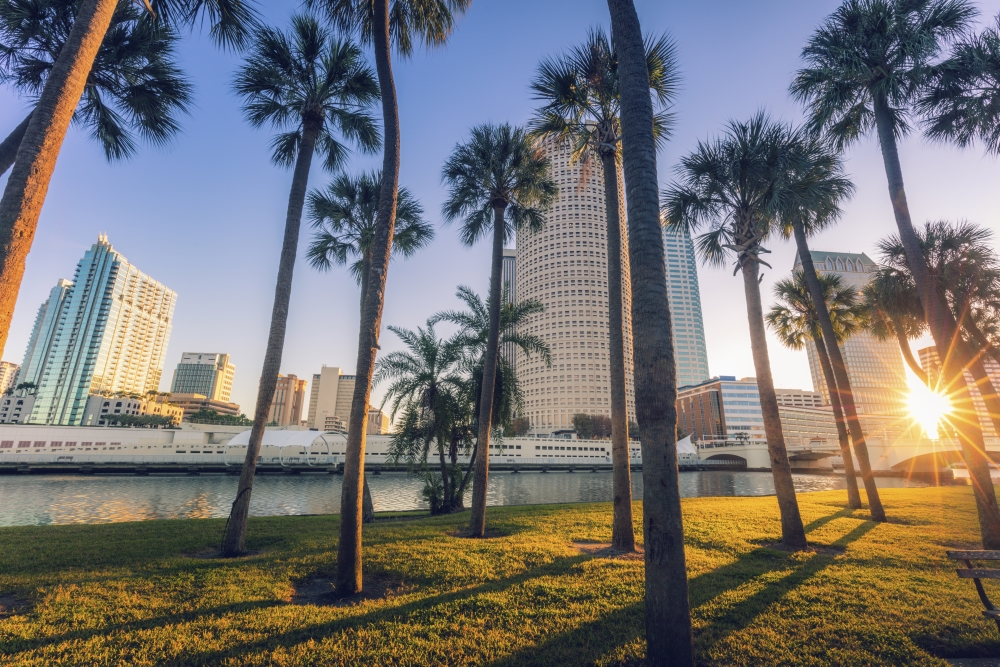
Tampa is rapidly emerging as a headquarters city favorite for site selectors and corporate executives.
Photo courtesy of Tampa EDC
Turning On the Southern Charm:
Charlotte, Tampa Ascending
Plan a road trip from Charlotte to Tampa, and the 580-mile drive will take you about 9 hours. Evaluate these two Southern cities as HQ locations, and you’ll find they have a lot in common.
Over the 15 years of Site Selection’s annual survey of site selection consultants, one consistent trend is that site selectors love the South. What has changed recently, however, is how much their preference has shifted toward formerly secondary markets that now compete head-to-head for projects with the largest cities in the country.
While longtime favorites Atlanta, Dallas and Nashville continue to get a lot of love, two rapid risers in the South now compete for some of the most-prized corporate facility projects. For the second year in a row, Charlotte finished second when we asked site selectors to name top locations on their shortlist for HQ deals. Tampa finished fifth after not even making the top 10 last year.
For both cities, decades of hard work are paying off. Mitchel Allen, senior vice president of economic development, Tampa Bay Economic Development Council, says Tampa is winning because of its favorable tax climate; its diverse and highly skilled workforce; its ability to continue to lead the nation in talent in-migration; and its warm, sunny, waterfront lifestyle.
Tampa has the results to prove it. AquaFence, a Norwegian company, went from saving Tampa General Hospital from flooding during Hurricane Helene last fall to this year selecting Tampa to become the company’s second major U.S. office location.
When I asked Patrik Hansson, chief revenue officer for AquaFence, why they chose to make the move, he said that “after hurricanes Helene and Milton in 2024, we decided that our next office would be somewhere in Florida. We already had existing clients in Tampa. Every time we came back to Tampa, we felt more and more at home.”
The company currently maintains a head U.S. office in Hoboken, New Jersey, but leaders say the American headquarters eventually will shift to Tampa.
“Since 2007, we’ve been based in Hoboken,” says Hansson. “In January 2025, our CEO in Oslo spent a lot of time on the Florida West Coast. We spent a lot of time between Naples and Tampa. There are close to 5 million people in the Tampa Bay area, but Tampa still has a small-town feel. The businesses here genuinely wanted to help. They all asked, ‘What can we do to help you?’ Right off the bat, we felt at home. That made it easy for us to decide that this will be our next home.” — Ron Starner