

In September 2025 the Georgetown University Center on Education and the Workforce (CEW) released “Falling Behind: How Skills Shortages Threaten Future Jobs.” By special arrangement with CEW we present here an adapted excerpt of that report. — Ed.
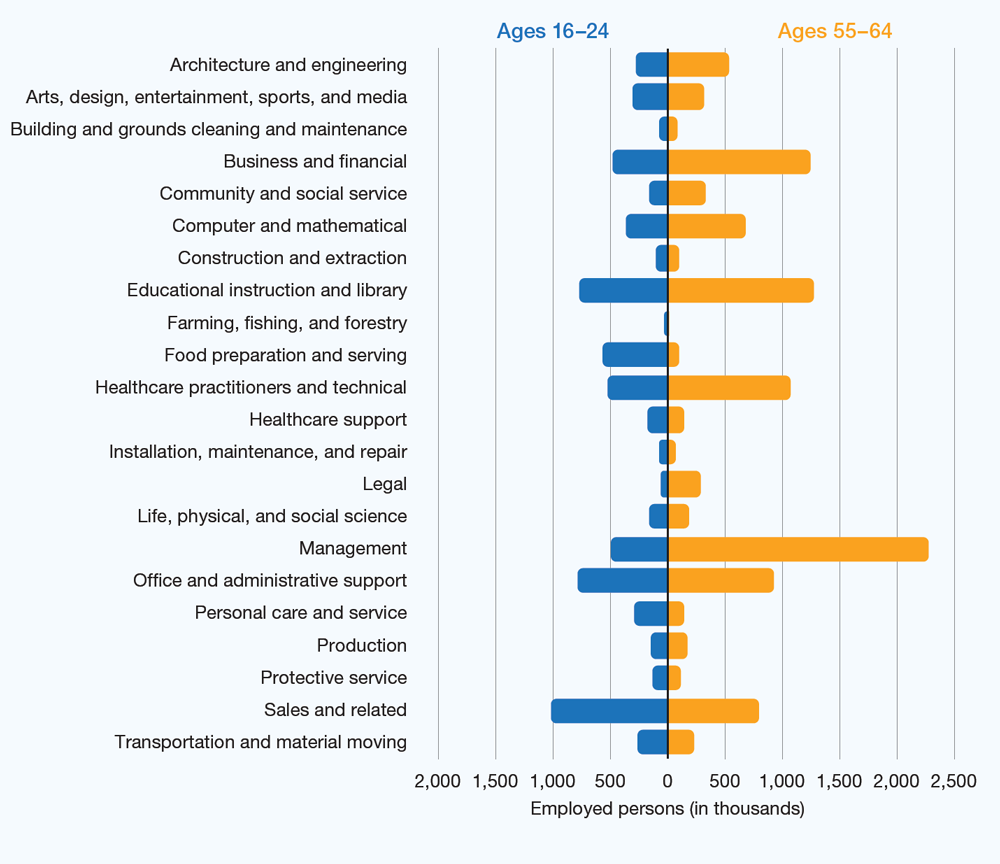
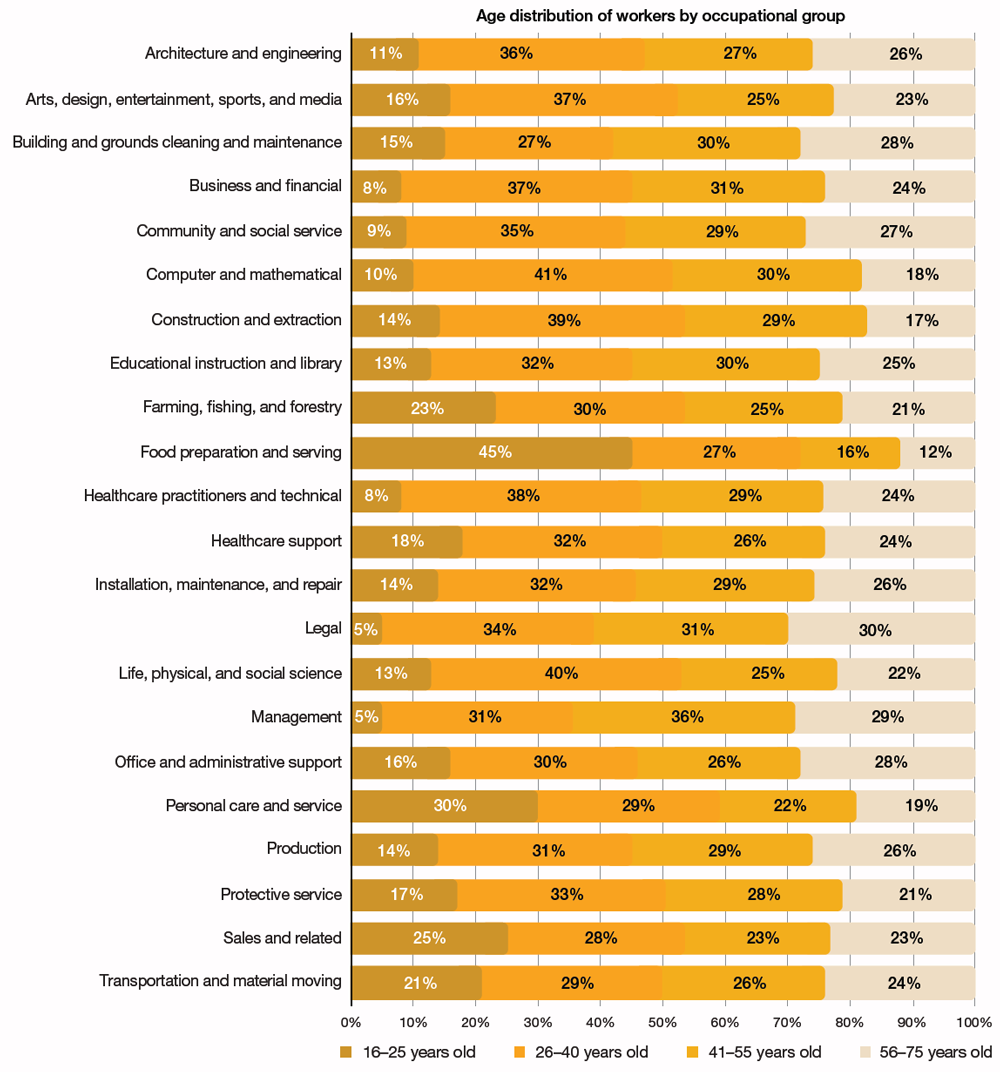
The U.S. economy is facing a skills shortage crisis in critical occupations. From 2024 through 2032, 18.4 million experienced workers with postsecondary education are expected to retire, far outpacing the 13.8 million younger workers who will enter the labor market with equivalent postsecondary educational qualifications. Compounding the problem, the U.S. economy is expected to add 685,000 new jobs requiring postsecondary education and training over the same period. CEW’s research projects that the nation will need an additional 5.25 million workers with postsecondary education through 2032, 4.5 million of whom will need a bachelor’s degree or higher.
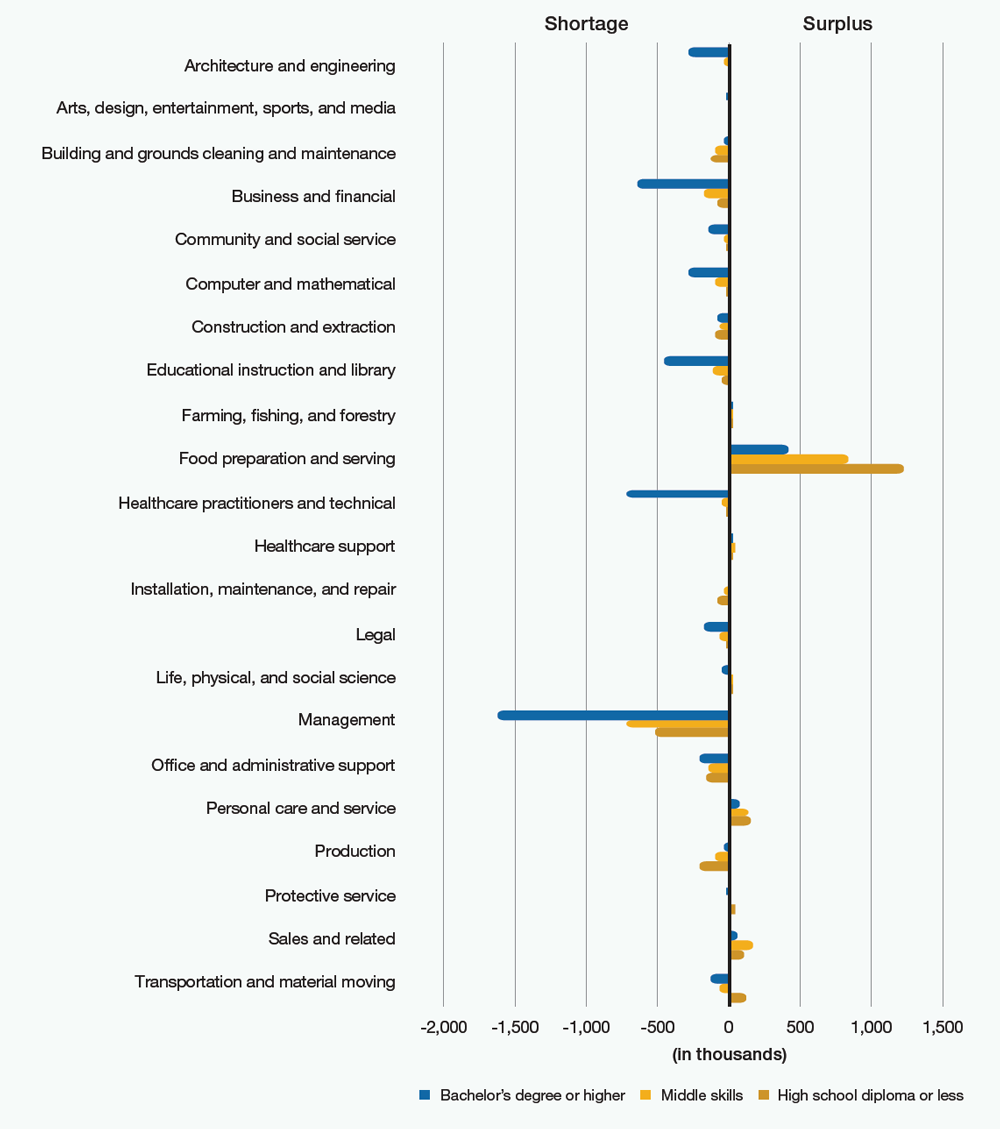
The shortage also includes 750,000 workers with middle skills, including those with an associate’s degree, a postsecondary vocational certificate or some college but no degree. At the same time, we will see a surplus of 131,000 workers with a high school diploma or less.
The factors contributing to the skills shortage include:
- Too few young Americans attaining postsecondary credentials to replace the educated exiting retirees
- Growing educational demand from employers that outstrips the educational attainment of potential workers
- Uneven improvements in K–12 graduation rates and declining academic preparation for college
- Declines in college enrollment and low completion rates for the fastest-growing population groups
- Declining labor-force participation rates among workers at all levels of educational attainment
- A decline in immigration, with the likelihood of further restrictions that will limit the availability of skilled foreign-born workers
- Uncertainty over whether generative AI will ease or worsen existing skills shortages.
While demographic shifts and educational attainment patterns are primary contributors to the skills shortage, changes in demand by occupation are also a factor. About one-third of the overall increase in educational requirements comes from shifts in economic growth toward industries and occupations that tend to require more education. The other two-thirds of the increase comes from rising skill requirements within existing occupational categories — a phenomenon known as “upskilling.”
We anticipate that upskilling, and with it the demand for higher levels of education, will continue to grow, intensifying longstanding trends: In the early 1980s, the American economy featured more jobs for workers with less than a high school education than for college graduates — only 32% of jobs required any postsecondary education and training beyond high school in 1983. By 2022, that share had climbed to 68%. We project that 72% of jobs in 2031 will require at least some postsecondary education and/or training.
Workers with a Bachelor’s Degree or Higher
Source: Georgetown University Center on Education and the Workforce analysis of data from the US Bureau of Labor Statistics and the US Census Bureau, American Community Survey, 2022
Key Occupations
Nine occupations will be particularly affected by skills shortages: accountants, attorneys, construction workers, doctors, engineers, managers, nurses, teachers and truck drivers.
“Without massive and immediate increases in educational attainment, 171 occupations of the 561 we analyzed will face skills shortages through 2032,” said Nicole Smith, lead author and chief economist at CEW, noting that “both teacher and nursing shortages are pressing concerns with far-reaching implications for the nation’s education and health care systems. Addressing these shortages must be a priority.”
CEW projects a shortfall of 611,000 teachers, 362,000 nurse practitioners and registered nurses, and 42,000 licensed practical nurses through 2032. High turnover rates due to burnout from the COVID-19 pandemic and declining college enrollments in related preparation programs have exacerbated these shortages.
The largest projected shortage through 2032 will be in management positions (2.9 million), a broad category that includes CEOs, construction managers, facilities managers, financial managers, general and operations managers, and sales managers. While no single path or credential leads to management jobs, a majority (56%) of workers currently in management positions hold a bachelor’s degree or higher and 82% have education beyond a high school diploma.
Shortages in key occupations that don’t require bachelor’s degrees, such as drivers/sales workers and truck drivers (402,000) and construction workers (200,000), may be driven in part by the characteristics of jobs in these occupations, including inflexible hours and industry norms that may deter younger workers.
The U.S. also faces a skills shortage in engineering (210,000). “Engineers drive innovation, technological advancements and infrastructure development, so the engineering shortage hinders the nation’s ability to maintain economic growth and global competitiveness,” said Smith. “Not enough young people are both qualified and interested in these careers. In addition, there is tremendous political pressure to reduce immigration, despite the fact that the U.S. has increasingly relied on immigrants to fill advanced technical occupations. Current initiatives aimed at bolstering the engineering workforce aren’t keeping pace with these trends.”
While the immigration debate often centers on those who enter the country illegally or outstay the terms of their visas, trends in legally sanctioned immigration have a substantial influence on the population and the labor force. In 2024, 14.3% of the U.S. population was foreign born, up from 4.7% in 1970. Thirty-five percent of foreign-born adults over the age of 25 have a bachelor’s degree or higher.
U.S. immigration policies could help alleviate skills shortages if they allowed the entry of more highly skilled workers. The H-1B visa program, which allows companies to hire highly skilled foreign workers, is capped at 85,000 visas per year — far below what businesses actually need. Big tech companies like Amazon, Microsoft and Google rely on these workers to fill critical roles, but increasingly burdensome restrictions and long wait times have made hiring much more difficult. Because of this, many companies struggle to find enough qualified professionals to fill a growing number of positions.
Jobs for highly skilled workers are not the only ones affected by immigration restrictions, however. Immigration policies have made it harder to fill essential roles in industries like agriculture and disaster recovery.
Largest Projected Shortfall of Workers, through 2032
Source: Georgetown University Center on Education and the Workforce forecast using data from the US Census Bureau and Bureau of Labor Statistics, Current Popultation Survey(CPS); US Census Bureau, American Community Survey (ACS); and the US Bureau of Labor Statistics, Employment Projections, 2023.
Running Out of Time
Increasing workforce participation is one promising strategy that could help address skills shortages. If the U.S. could bring the labor-force participation rate (LFPR) back to its historic high (67.3% in 2000) and the unemployment rate to 4.1% (as it was in the same year), the workforce would increase by 12 million, more than double the number of workers needed to fill projected shortages through 2032. However, many of these 12 million potential workers would likely need more education and training, as current projections indicate that 52% would not have any education or training beyond high school.
We are running out of time to create the educational and training programs necessary to reach these potential workers and convey the skills they need to succeed — and meanwhile, the economy is missing out on their talents. Every year, more than 500,000 students from the top half of the high school class do not go on to complete a college credential, whether they never enroll in college or enroll and don’t complete.
Further complicating the issue, the skills crisis is emerging at a time of profound skepticism about the value of postsecondary education. Growing student loan debt is one factor driving this skepticism, and the large number of college students who never finished a degree has played an outsized role in the massive increase in student loan debt. Meanwhile, high unemployment rates among recent college graduates are generating speculation that a slow economy combined with growing adoption of artificial intelligence may be tamping down the demand for workers with college degrees.
Workers Distribution by Age
Source: Georgetown University Center on Education and the Workforce analysis of data from the US Bureau, American Community Survey (ACS), 2023.
Ways of Moving Forward
U.S. college enrollment rose continuously for 40 years, from 8.6 million students in 1970 to 21 million students in 2010 — a rate of growth that was more than 5.5 times the rate of population growth for 18-to-24-year-olds. But that trend has changed, influenced by factors that include rising tuition, the impact of the COVID-19 pandemic and changing perceptions of the value of a college education. College enrollment declined for 11 consecutive years after 2010, dropping to 18.7 million in fall 2021. The U.S. Department of Education projects another reversal of this trend, with college enrollment expected to increase by 8.4% from 2021 to 2031. But even if total enrollment reaches 20.2 million in 2031 as projected, it will still be lower than it was in 2010.
There are serious gaps in college enrollment and completion by race/ethnicity. About 74% of Asian/Asian American students and 64% of white students graduate within six years of entering a bachelor’s degree program, but completion rates are far lower for Hispanic/Latino students (54%) and Black/African American students (40%). In the near future, colleges will face an important challenge: The racial/ethnic groups that historically have had the highest college completion rates are the same groups experiencing declining enrollments, and the racial/ethnic groups that historically have had among the lowest completion rates are the ones experiencing rising enrollments. By 2030, college enrollment is expected to increase by just 3% for white students while decreasing by 7% for Asian/ Pacific Islander students. The largest increases in postsecondary enrollment through 2030 are expected among Hispanic/Latino students (21%) and Black/African American students (19%).
“Skills shortages present an opportunity for millions of workers, particularly those from low-income households and marginalized racial/ethnic groups, to gain better access to economic opportunity, and for American industries to connect with enormous untapped talent,” said report co-author and CEW Director Jeff Strohl.
In the face of a potential crisis fueled by the skills shortage, action across the government, businesses, education and training providers, and workers themselves will be necessary to maintain American competitiveness and economic might. Without such action, American workers will be unprepared for the future of work, and the American economy will be unable to keep pace with foreign competitors.
“Falling Behind: How Skills Shortages Threaten Future Jobs” can be accessed online at cew.georgetown.edu/skills-shortages.