

By special arrangement with IMD – International Institute for Management Development in Lausanne, Switzerland, we present here an adapted excerpt of the 2026 IMD Smart City Index (SCI), released in March 2026. The World Competitiveness Center at IMD defines a Smart City as one that strikes a good balance between its economic prowess, applied technology, environmental concerns and inclusiveness to facilitate a high quality of life for its citizens. — Ed.
The IMD Smart City Index (SCI) 2026 assesses the perceptions of residents on issues related to structures and technology applications available to them in their city. This edition of the SCI ranks 148 cities worldwide by capturing the perceptions of 120 residents in each city. The final score for each city is computed by using the perceptions of the last three years of the survey, with the weight of 3: 2: 1 for 2026: 2025: 2024. There are two pillars for which perceptions from residents are solicited: the Structures pillar referring to the existing infrastructure of the cities, and the Technology pillar describing the technological provisions and services available to the inhabitants. Each pillar is evaluated over five key areas: health and safety, mobility, activities, opportunities and governance.
Cities are often judged by their technological sophistication, particularly if they self-label as “smart.” And yet, the 2026 IMD Smart City Index (SCI) suggests that urban performance rests on a deeper set of relationships — namely, mutually reinforcing interactions between institutions, residents and the infrastructure that emerges from them both.
Trust in the institutions that manage increasingly complex urban systems — often built on personal data — is not a given. The conundrum is telling; never has information been so abundant and granular for policymakers and urban planners. But still, public confidence in local governments and regulators remains fragile. In 2026, the central question around urban planning is no longer “Can we build a Smart City?” but rather “Should we trust the ones being built?”
Urban policy is no longer a backwater of public administration; it is the operating system of national competitiveness, shaping whether cities attract the talent, capital and creativity necessary to drive growth and prosperity. The SCI provides a unique perspective on this challenge by focusing on how residents experience their cities.
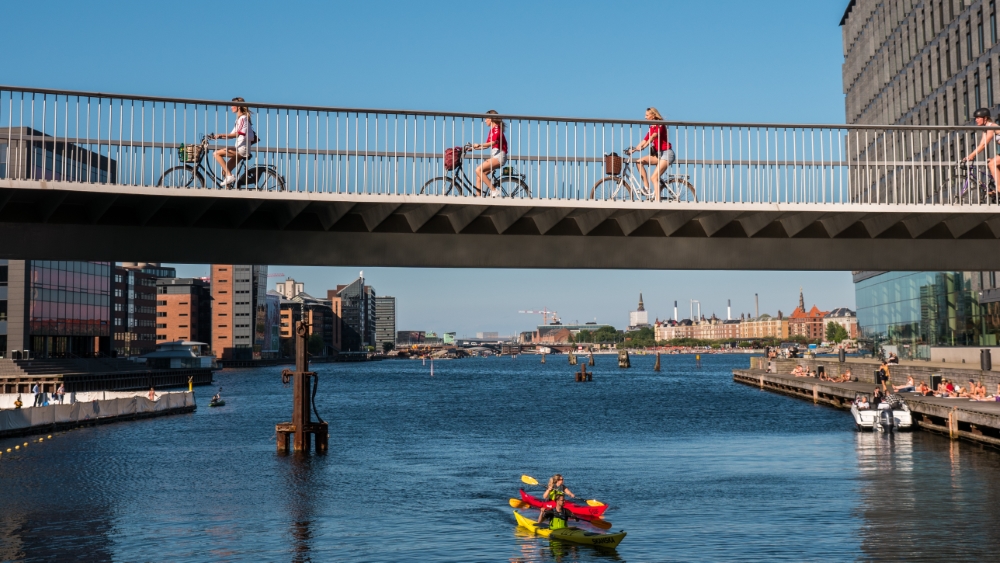
Copenhagen photo by Daniel Rasmussen courtesy of Visit Copenhagen
Structures Align with Smart
The SCI offers a valuable tool for understanding how top-performing cities such as Zurich (first), Copenhagen (fifth), Singapore (ninth), and Abu Dhabi (10th) succeed not only because of their technological innovation but also because they maintain alignment between policy priorities, technological development and public expectations. Seen this way, smartness does not arise solely from technology. It emerges when government structure, infrastructure investments and public values evolve together. The data behind the Index reveals something more precise.
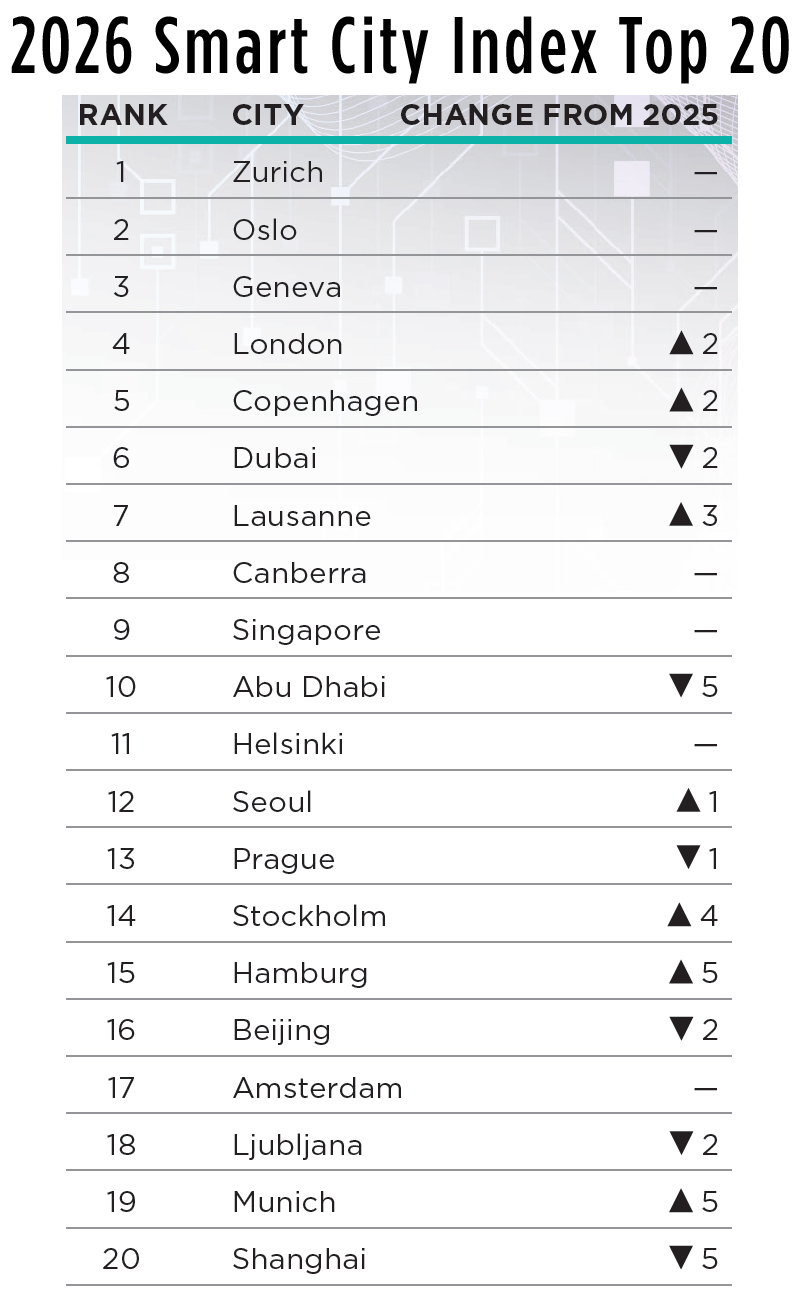
Across the 148 cities surveyed, scores in the Structures pillar are a stronger and more consistent predictor of overall smart performance than scores in the Technology pillar. Tellingly, almost every city among the bottom 20 of the 2026 ranking has a higher average Technology score than a Structures score. The inverse is true at the top: Zurich, Oslo (second), Geneva (third) and Copenhagen all lead on institutions, infrastructure and structures-related indicators, with technology-related indicators faring less strongly. This pattern suggests an important dynamic: Cities with stronger institutions and infrastructure tend to report higher levels of citizen trust.
The best-performing cities have discovered that effective governance is less about centralizing power and more about facilitating cooperation. They create platforms and processes that allow different stakeholders to share information, coordinate investments and pursue common goals without sacrificing the flexibility needed for local innovation.
The data highlights this with striking consistency. In Zurich, ranked first overall, the Structures score (0.725) comfortably leads the Technology score (0.621). More than three-quarters of its surveyed residents agree that information on local government decisions is easily accessible, and Zurich records the highest citizen participation score among all top 20 cities in 2026. Geneva and Copenhagen replicate the pattern almost exactly. Seoul, by contrast, sits 12th overall with the largest technology-over-structures gap in the top 20. Its residents benefit from world-class digital services, yet the city’s corruption perception score (0.32) is among the lowest in the upper echelon, a reminder that digital capability and institutional credibility are not synonymous and cannot substitute for one another.
Singapore illustrates the premium that accumulates when digital infrastructure is embedded in credible institutions. Its Structures and Technology scores are the most balanced of any city in the top 10 (0.715 and 0.697, respectively), and nearly nine in 10 residents agree that online information has increased their trust in authorities. Dubai (sixth) and Abu Dhabi tell a related but distinct story: Both score above 0.76 on the Technology pillar and record exceptional trust in online services (95.7% and 89%), demonstrating that the Gulf model of state-directed digital investment can generate genuine civic confidence when service delivery is high and of good quality.
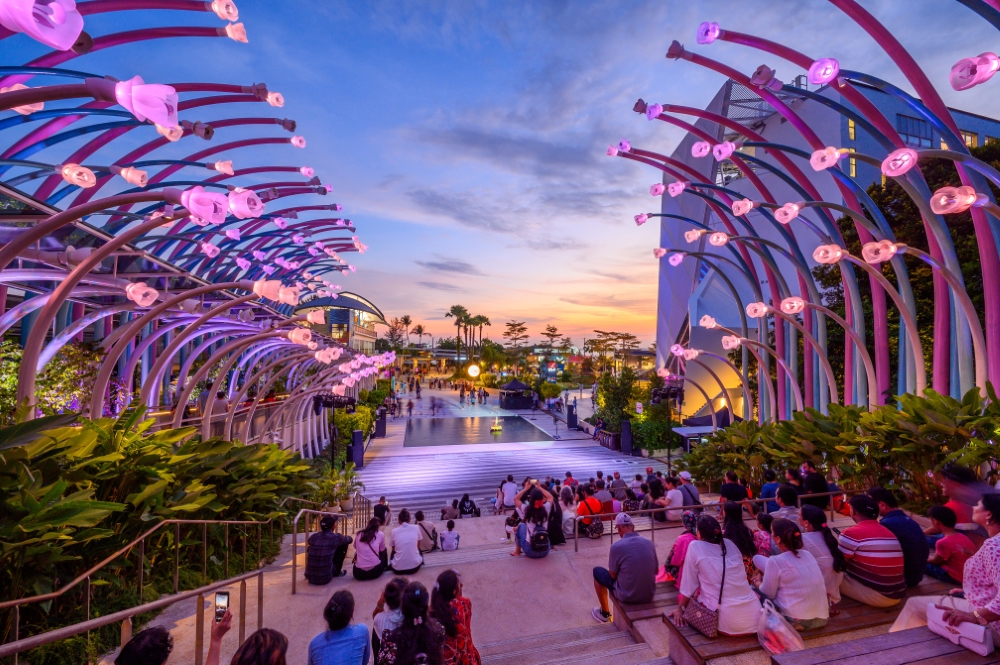
Singapore photo courtesy of Singapore Tourism Board
What the 2026 Smart City Index ultimately reveals is a circular logic at the heart of urban intelligence: Trust enables investments in institutions, infrastructure and public services that improve quality of life. When this improved quality of life is delivered transparently and equitably, trust is naturally reinforced. Further down the line, deeper trust creates the political and civic conditions for continued investment. Structures scores, in this reading, are not merely an input into Smart City performance; they are also its most important output, the accumulated evidence of whether a city has kept its side of the bargain with the people who live in it.