When your best asset is your people, scaling a portfolio of economic development successes comes naturally.
South Carolina knows the value of showing — not telling — corporate leaders the capabilities of a diversely skilled workforce. It helped the state capture its third-highest year for industry recruitment in 2025, introducing $9.12 billion in fresh capital investment and 8,100 direct new jobs. The momentum is far from concentrated, as 46% of overall project investment and 44% of disclosed jobs poured into the state’s rural regions.
A closer look at the 82 announced projects reveals the Palmetto State became the ideal location for first-time facility investments, while the state’s IT & software development; wood and paper products; and automotive industries delivered a robust investment punch.
The opportunity to sit down with South Carolina Secretary of Commerce Harry M. Lightsey III shed light on the legwork that went into ensuring significant economic development growth carried a statewide impact.
Site Selection: What are some of the key factors to which you attribute the nearly $1 billion capital investment increase over the year prior?
Secretary Lightsey: Last year was a very good year for us. It really shows us that we continue to be a great destination for people to come do business, magnifying our “Launch to Legacy” brand. Our promise to any company that comes to South Carolina is that we will be your partner from the minute you launch to the time you become a part of the legacy fabric of our state. We’ve announced a strategic framework that, really for the first time, said we’re going to prioritize [several] sectors — advanced energy, life sciences, biotechnology, R&D and headquarters. We did well in those areas, in addition to our long legacy industries like automotive and aerospace continuing to attract a lot of investment. I think all of those things working together really helped us with our results last year.
South Carolina’s rural regions were a standout in 2025. What are you hearing from corporate leaders about what these communities are getting right? Do you expect this momentum to last?
Lightsey: Rural South Carolina is being discovered. Our main metro areas — Greenville, Spartanburg, Columbia, Charleston — have long been pretty well known around the world. But this last year was a real turning point for our rural areas. What we’ve seen is many businesses are drawn to these areas because they have a relatively low cost of living, yet they have great quality of life. In a small rural community, there is more of a sense of belonging. A company could come in there and make a huge impression and identify with the community quickly. Several years ago, we launched a strategic planning initiative that focused on our rural areas. Now, we meet with our rural counties and help them craft strategic plans for how they want their community to grow, and we offer a $250,000 grant to implement identified projects.
Gaffney (T9), Orangeburg (T25) and Seneca (T25) each held a top spot within Site Selection’s 2025 Top Micropolitans rankings. To what do you credit these regions’ successes?
Lightsey: They are great examples of what we were talking about in our rural areas. All of them are in close proximity to our urban areas. That’s one of the things about the rural areas of South Carolina — being a small state geographically, you can live rural but still be within a short drive to one of our urban centers for shopping and other big town conveniences. All three of those typify that. They have low cost of living, and they have a high quality of life.
Of the 82 announced projects last year, over 25 of those were first-time facility investments, whether it be in the state itself or in the U.S. — what is South Carolina’s secret to capturing this phenomenon?
Lightsey: First of all, South Carolina is just blessed in terms of our natural, God-given position. We’re exactly in the middle of the East Coast of the country, halfway between New York City and Miami. We have a beautiful and great port in Charleston, but we also have access to the Port of Savannah. We also have international airports in Charleston and Atlanta that are close by. Our quality of life is incredibly good in South Carolina: We have mountains, the beach and everything in between within a small geographic area. Our cost of living remains relatively low, 7% below the national average, and lower than our neighboring states of North Carolina and Georgia.
In what ways has South Carolina been marketing itself on the international stage, especially as so many states are competing for fresh foreign investment?
Lightsey: When we launched our new brand two years ago, that encapsulated what we wanted to convey to businesses that were thinking about locating in the state. The “Launch to Legacy” brand really is the message of partnership. We’ll be your partner and help your business succeed as long as you’re here and invested in our state. It’s been a very successful campaign focused on storytelling. One the things I like about it is it’s not just a bunch of statistics or claims of how easy it is to do business in our state. We had some CEOs and leaders in our top companies talk about their experience of doing business in South Carolina and it connected with decision-makers around the world. We put this campaign out in international markets and phase one was tremendously successful. Now, we’re launching phase two this year where we’ll be doing a lot more targeting. We’ve had international offices around the world for a long time. We’re celebrating the 50th anniversary of our Europe office this past summer. We opened new offices in London and Dublin, joining offices in Seoul, Taipei and Tokyo. They’re there to tell our story as we try to build our global partnerships. We signed a joint development agreement with Germany last year, becoming the first U.S. state to make such an agreement with Germany. We also launched a landing pad program to help growth-phase companies that come to South Carolina, helping small and medium-sized businesses enter and expand in an international market.
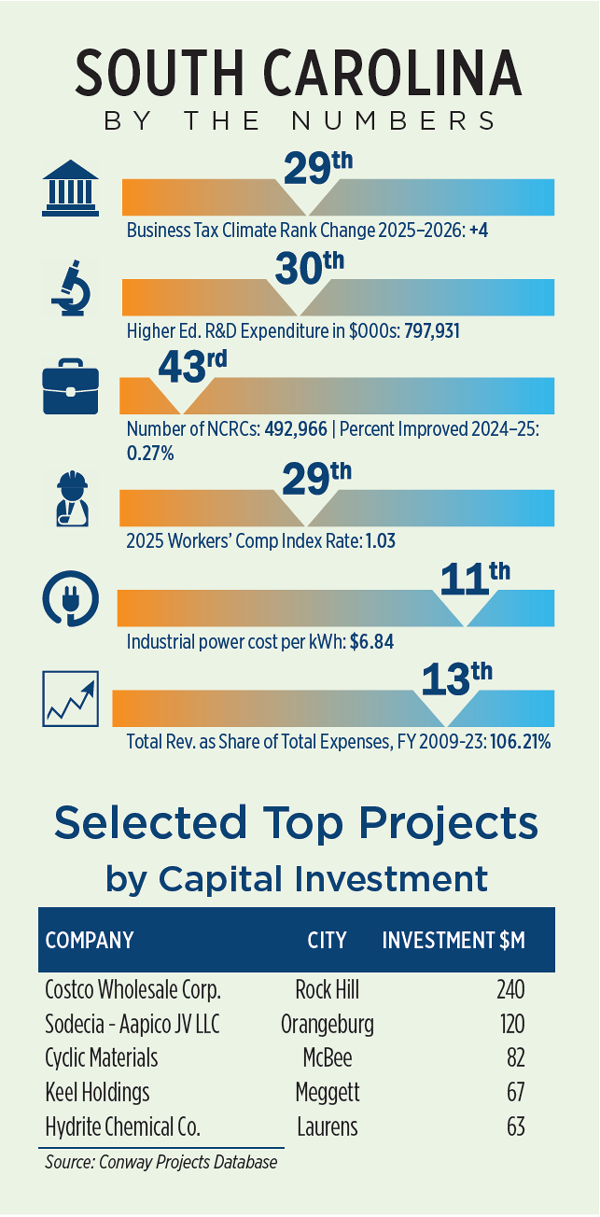
Data center investments from Cielo Digital Infrastructure and NorthMark Strategies delivered an investment punch during 2025 — how is the state approaching its data center development strategy? And on a greater level, how does this play into supporting future energy demands?
Lightsey: Decisions where data centers choose to locate are really made at the local level. It’s very important for them to engage with the local communities to determine what types of property tax incentives they can receive, because property taxes are one of their largest expenses. Energy is also a key determining factor for those types of facilities, so from the state perspective we’re not often directly involved. For the state, we need to make sure that we have enough energy available to support strong growth as we look toward the future. That’s not just for data centers, but our manufacturing companies and new manufacturers that want to come here. That industry has become a very energy-intensive area, so we’ve been working to start building out energy infrastructure. We applied for and were very gratified to receive designation by the U.S. Department of Commerce for one of the only Tech Hubs focused on advanced energy, SC Nexus. We’re building real-world test beds in partnership with the University of South Carolina, Clemson University and the Savannah River National Laboratory, where companies in the energy space can come and test new technologies and products.
Does the state anticipate any industries on the rise this year? What are your goals in terms of industry attraction?
Lightsey: Automotive and aerospace are two advanced manufacturing sectors that we’re tremendously strong in and continue to build. In our strategic plan, we decided to focus on life sciences, and biotech is one of those sectors we wanted to focus on. That has actually been our fastest growing sector in South Carolina for the last two or three years, so we’ve had success in that. Advanced energy with SC Nexus is now a resource, and we think we’re going to be really the only place in the world that has these diverse, real-world test beds available in that close proximity. We really want to focus on high-paying, high-quality jobs. We’re at a place where South Carolina is very close to a full employment economy. We want to be very purposeful about the types of companies that we recruit to our state to make sure that we’re bringing in quality jobs that will enhance the quality of life for our citizens.
Are there any workforce challenges the state is looking to address this year?
Lightsey: Our businesses are not having workforce recruitment issues. We continue to work with our technical colleges and four-year universities to communicate what types of skill sets our employers are looking for, while figuring out ways to make sure our talent and educational institutions are aware of job opportunities available in our state. Our technical college system is globally recognized, and it’s a real jewel for South Carolina. We have a program called readySC, where we provide training to qualifying businesses that come to our state free of charge.
We also have a robust apprenticeship program, having close to 700,000 apprenticeship opportunities. Last year through SC Nexus, we started working with the technical college system and our K-12 schools to start to focus on ways we can make students aware of opportunities that will become available in advanced energy and training our students to have the skill sets to be employable in that sector. We have a mobile lab traveling around the state where students can go in and explore different career opportunities in advanced energy. In addition, we put advanced energy curriculum in our K-12 schools all the way through our technical colleges and universities to make sure that curriculum translates across all levels of learning. We think of it like a pilot.