The idea is simple: To draw a bead on where the hottest tech hubs are located, marry the most granular tech infrastructure data (internet exchanges, dark fiber, undersea cable connectivity, etc.) with tech talent metrics and corporate facility project numbers from tech-aligned industry sectors such as software development, data centers and telecommunications.
So, thanks to continuing partnership with CBRE, CompTIA and TeleGeography and the meticulous analytics and calculations carried out by Site Selection Director of Programming and Analytics Daniel Boyer, we present here the results of the second annual North American Tech Hub Index.
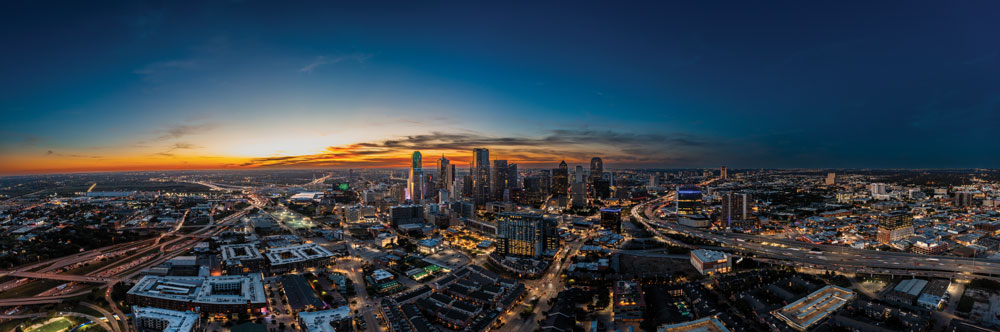
Dallas-Fort Worth-Arlington, Texas, jumps from No. 2 last year to the top spot this year. Austin, up one slot to No. 7 this year, gets all the glitz and glamor, but as one industry insider told me on learning this news, the DFW metroplex never went anywhere since its own growth spurt decades ago. Instead, it’s steadily attracted people and companies (see the recent spate of financial services and stock exchanges activity otherwise known as “Y’all Street”) while also steadily building out the infrastructure to support them.
“Being recognized as the top North American Tech Hub underscores the strength of the entire Dallas–Fort Worth region as a center of innovation and next-generation technology,” says Fort Worth Economic Development Partnership President & CEO Robert Allen. “Fort Worth’s momentum is being demonstrated by new major investments from new tech manufacturing leaders like Wistron and Siemens and shows how our regional talent, infrastructure and collaborative business climate are powering the future of tech.”
That’s not all Texas has to offer: Among the top 25, Houston is among the biggest upward movers, shooting to No. 10 this year from No. 16 last year. San Antonio makes the top 25 as well. Other climbers include Greater Seattle (up four spots to No. 8), Greater Kansas City (up 10 spots to No. 13) and Des Moines, Iowa, the biggest upwardly mobile tech hub of all at No. 14 this year from No. 29 last year.
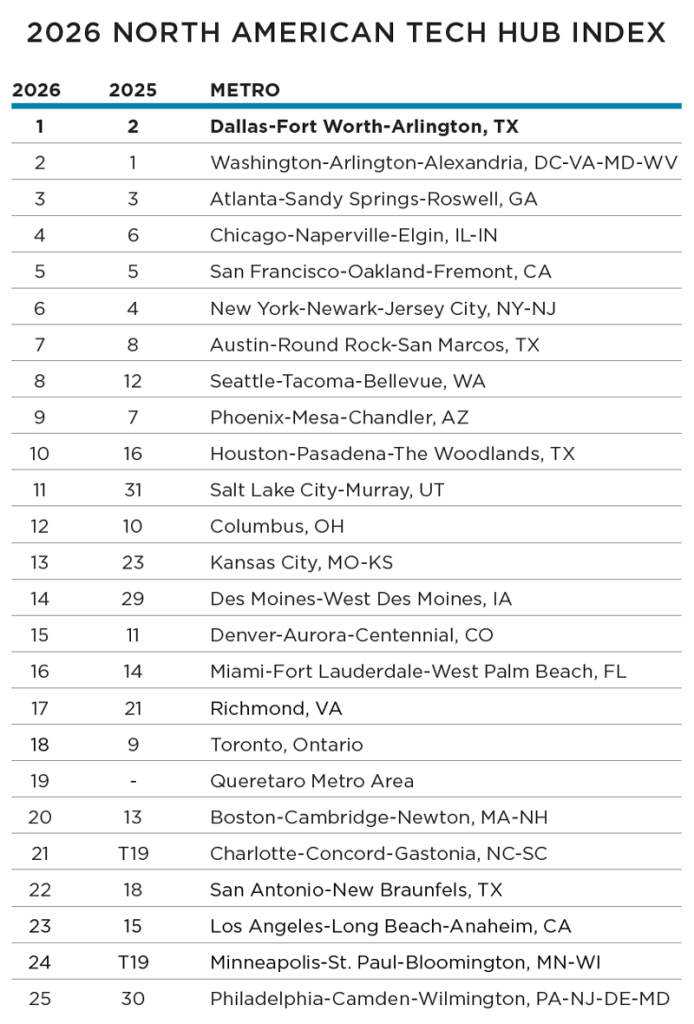
Methodology: The Site Selection North American Tech Hub Index includes the following sources and weighted criteria: TeleGeography: Market Connectivity Score (data center development, internet exchanges, cloud regions, subsea cables and more); CompTIA: Tech Employment; Tech Employment Per Capita (our calculations); Tech Job Growth 2024; Tech Job Growth 2024 per capita (our calculations); Tech Job Growth 2025 (projected); Tech Job Growth 2025 per capita (projected; our calculations); Site Selection: Projects since Jan. 2024 in tech-affiliated NAICS codes (software, IT, data centers, etc.); Projects per capita; Jobs and capex affiliated with those projects (cumulative and per capita); CBRE 2025 Tech Talent Scorecard Data (50 top markets).
Major data center investments from a number of investors have made a difference in Greater Des Moines, beginning with the billions of dollars invested in the region by Meta and by Microsoft, whose largest global data center campus at over 5 million sq. ft. has continued to grow in Altoona. Similar data center investment has driven Queretaro, Mexico, into our top 25 this year at No. 19.
CBRE’s 12th annual Tech Talent Scorecard, which ranks the top 50 tech labor markets in the U.S. and Canada, is one of the components in our annual index. In a webinar about the latest results held in the fall, Colin Yasukochi, executive director of CBRE’s Tech Insights Center, pointed out the ubiquity of tech jobs in today’s economy: “Sixty percent work for other industries besides tech,” he said. “In today’s world, every company needs tech talent,” especially as companies across all sectors implement some variation of AI in their daily processes. “Of all the tech talent job postings out there,” he said, “20% are related to AI, which is double the share we saw during the peak of the hiring boom in 2022.”
The Bay Area, New York and Seattle (Nos. 5, 6 and 8 in our Index) account for 35% of all AI tech talent, he said. His Bay Area colleague Caroline O’Laughlin pointed out that AI companies currently occupy 6 million sq. ft. of the region’s 90-million-sq.-ft. office market.
More tech job hiring occurred in Canada than in the U.S., Yasukochi said, which partially explains Greater Toronto’s No. 18 ranking this year in our Index. The highest-ranking talent metro on CBRE’s scorecard is the Greater Waterloo, Ontario, area at No. 7 in their ranking, the biggest upward mover among all 50.
Plotting high-quality software engineering graduates against average salaries for that profession, the CBRE team found the most value for the dollar can be had in Vancouver, Toronto and Waterloo in Canada and in Pittsburgh, Madison, Wisconsin and Chicago (No. 4 in our Index) in the United States. Meanwhile, DFW added more tech jobs — 47,100 between 2022 and 2024 — than any of CBRE’s top 50 tech talent metros. On the degree side, New York, Los Angeles, Boston and Washington, D.C., (in that order) lead the way, with the nation’s capital (No. 2 in Site Selection’s Index) showing the greatest discrepancy between tech degrees earned (37,679) and tech jobs added (2,190).
Which sector added the most tech talent last year? Financial services, Yasukochi said. CBRE colleague Sascha Zarba in New York noted, “It’s no secret that financial services has been one of the leading sectors in New York the past several years and continues to lead today. By the end of 2024, tech companies alone leased 3 million square feet of space, the highest annual total since 2019.” In 2020, AI companies comprised 3% of pure tech companies’ presence in the Big Apple market, he said. “Year to date in 2025, they make up over 17% of that sector.”
Financial services, of course, leads right back to the No. 1 tech hub this year, the Dallas-Fort Worth metroplex, where oil and telecommunications may have set the foundation decades ago but finance and the tech infrastructure supporting it rule today.
“This ranking affirms what we’ve long seen on the ground — Dallas-Fort Worth is a top-tier technology and innovation center,” says Dallas Regional Chamber Senior Vice President of Research & Innovation Duane Dankesreiter. “Our region’s scale, talent base and diverse strengths in applied AI, enterprise operations, financial technologies through Y’all Street and a rapidly growing life sciences industry continue to set DFW apart as a national leader.”
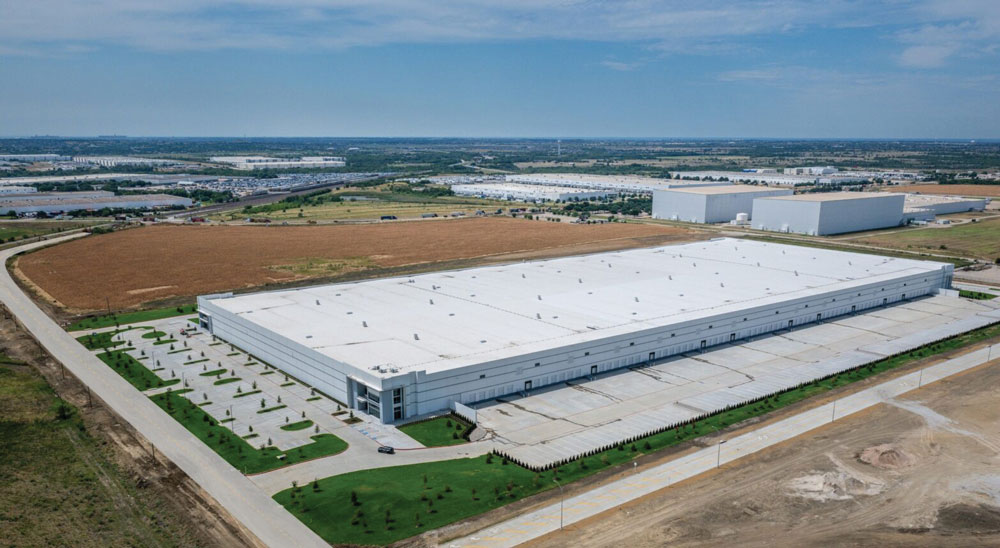
Electronics manufacturer Wistron in August announced plans to establish two AI supercomputing facilities at Hillwood’s 27,000-acre AllianceTexas development in Fort Worth with a total investment of $761 million that will create more than 800 full-time jobs.
Photo courtesy of Hillwood