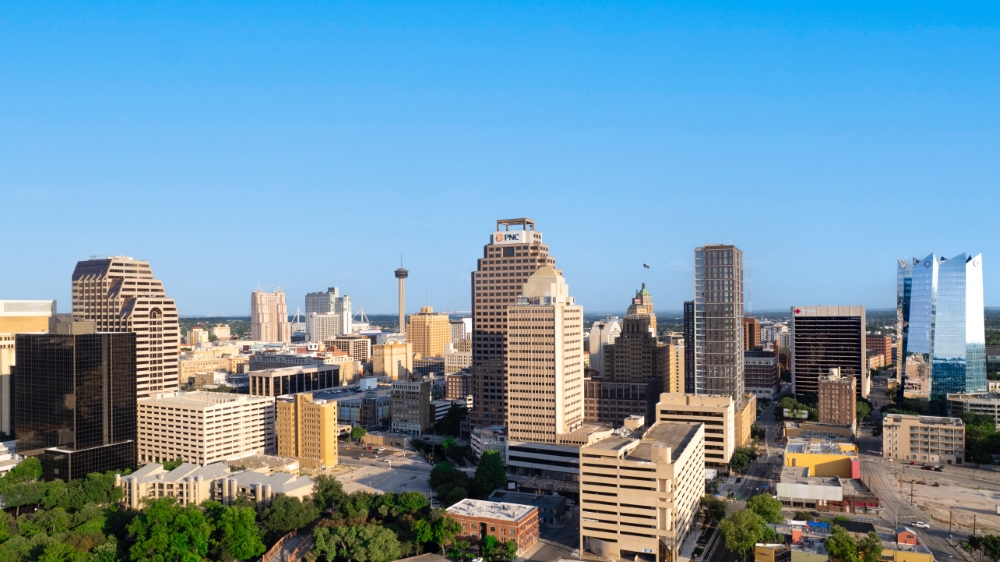
How Texas topped competitors to land the biggest U.S. auto plant deal of 2026.
When Toyota announced July 6 that it will invest $3.6 billion to expand its massive truck plant in San Antonio and create 2,000 jobs to increase production in Alamo City, one could almost hear the echoes of 2003.
That’s when then-Toyota Motor Manufacturing North America Senior Vice President Dennis Cuneo told Site Selection that San Antonio went from being “only a long shot” to choice No. 1 for Toyota’s original pickup truck plant investment in the community. Back then, Toyota’s interest in San Antonio was rekindled after a pivotal late-in-the-process meeting with then-Governor Rick Perry.
Fast-forward to 2026, and it looks like the global Japanese automaker likes Texas just fine, as the new expansion entails a shift of production from the company’s plant in Baja California, Mexico.
How Texas won this project sheds light on what this means for the ever-growing Texas automotive industry moving forward.
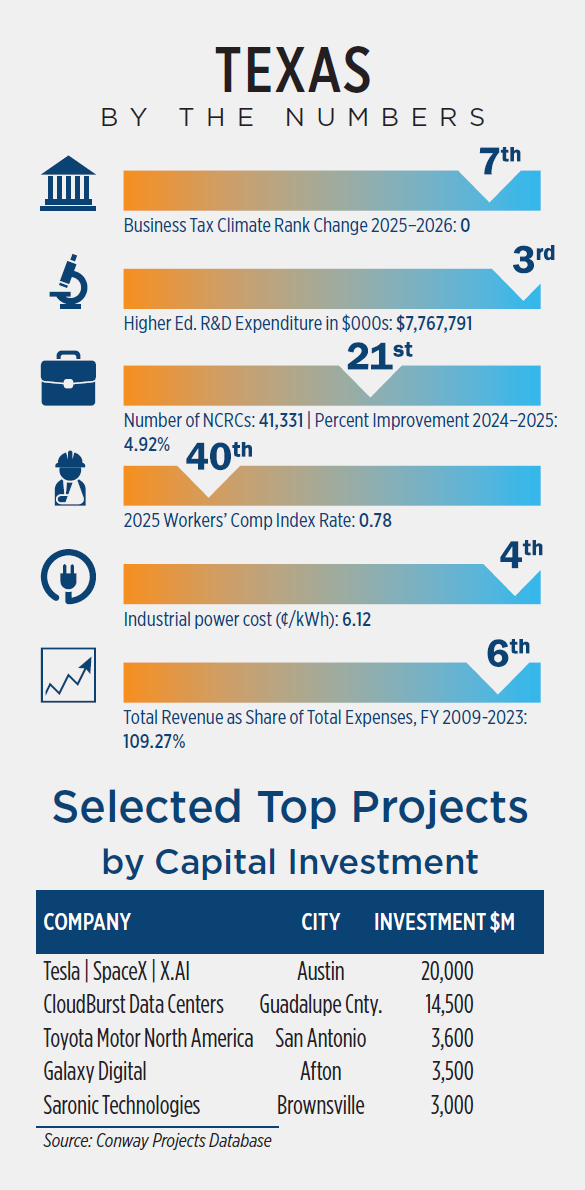
By selling 5.39 million vehicles in the first half of 2026, Toyota retains its lead as the top-selling automaker in the world, with global market share of 12.4%, well ahead of Volkswagen’s 9.4%. With 2.9 million vehicles sold last year in the U.S., Toyota ranks second only to General Motors in cars and trucks sold in America. Globally, Toyota recorded net revenues of US$335.7 billion in FY2025. By shifting considerable production from Mexico to Texas, Toyota is signaling that it intends to close the gap with GM and widen its global lead.
The deal in San Antonio calls for Toyota to add 2.5 million sq. ft. of space, doubling the size of its existing plant by 2030. Toyota Motor North America will transition Tacoma production from Baja California to the expanded Toyota Texas plant over four years.
“Toyota’s continued investment in North America is a testament to our confidence in the region’s workforce, innovation and long-term growth potential,” said TMNA President Ted Ogawa. “By expanding our San Antonio plant, we are deepening our commitment to American manufacturing, creating meaningful and sustainable jobs, while advancing our mission to deliver high-quality vehicles that meet the changing needs of customers today and into the future.”
‘A Highly Competitive Process’
The expansion brings Toyota’s total investment in San Antonio to $8.3 billion since first breaking ground in 2003. In a press release announcing the move, Toyota said the site selection decision was the result of “a highly competitive process.”
Melinda Higgins Louden, manager of corporate communications for Toyota Motor North America, tells Site Selection that the new production line in San Antonio will have a capacity of up to 150,000 units, bringing total production to 350,000 units per year on site. She adds that “several factors went into this decision: meeting the need of our customers; workforce availability; manufacturing efficiencies; proximity to our suppliers; and furthering our commitment to build where we sell and buy where we build.”
The deal marks the second-largest capital investment by Toyota in America over the last five years. Only the $13.9 billion commitment into the Toyota Battery Manufacturing North Carolina campus in Liberty in Randolph County is bigger. The deal also comes on the heels of a $531 million investment being made by Toyota into a 500,000-sq.-ft. rear axle plant on the San Antonio campus that will begin production this fall.
Louden adds, “Incentives are one of many factors in any investment decision.” In Texas, that includes a Texas Enterprise Fund grant of $20 million and a $50,000 Veteran Created Job Bonus to Toyota. The office of Gov. Greg Abbott notes that “the expansion is also a qualified project under the Texas Jobs, Energy, Technology and Innovation program.”
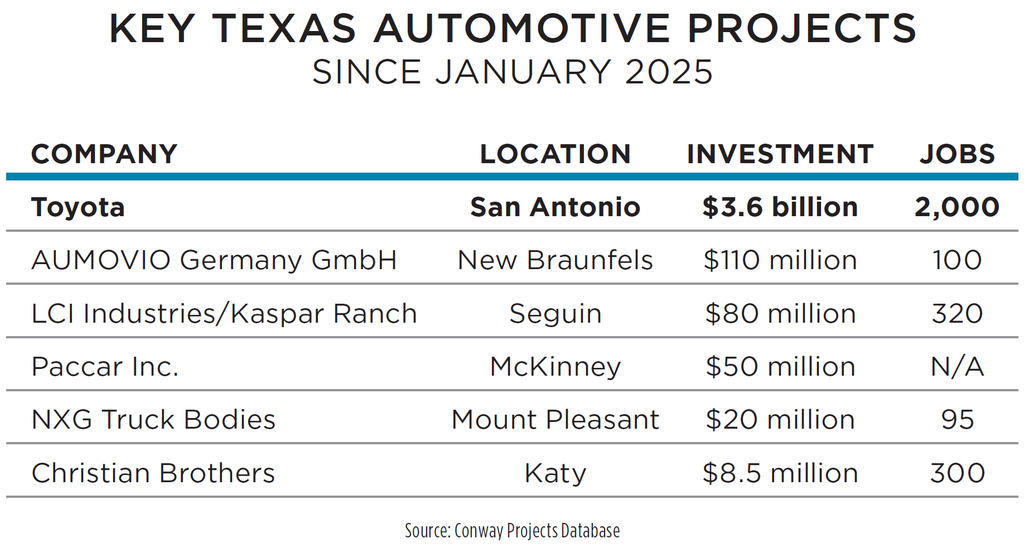
The deal comes 23 years after Toyota broke ground on the 2.2 million-sq.-ft. plant that began production in San Antonio in 2006. Upon buildout of the new plant, Toyota will assemble Tacoma and Tundra pickups and Sequoia SUVs at the site and employ 6,100 workers. This is in addition to the 5,600 people employed at 23 on-site suppliers.
Another 6,600 Toyota employees work at the company’s North American headquarters in Plano in North Texas, where a $1 billion corporate campus opened in 2014. Nationwide, Toyota employs 48,000 workers.
Site selection experts watching the San Antonio move say the production shift could be at least partly due to ever-changing U.S. tariff policy by the Trump Administration. “This move protects Toyota and its highly profitable truck lineup from new tariffs,” says John Boyd Jr., principal of The Boyd Company Inc. “San Antonio is now the hub for Toyota’s truck production — another signal of the Austin-San Antonio corridor becoming the gateway to the continental U.S. consumer and supplier market.”
Boyd says workforce development initiatives and the Southwest Research Institute in San Antonio are key regional assets favored by Toyota. “The Southwest Research Institute is a leader in the types of robotics and automation advanced manufacturers like Toyota are rapidly deploying,” he says. “I see similar opportunities for Monterrey — one of North America’s highest concentrations of auto manufacturers and other advanced manufacturers — to move up Mexican Federal Highway 85 to Central Texas.”
A Deal Two Years in the Making
Adriana Cruz, executive director of the Texas Economic Development & Tourism Office, says the new Toyota investment “confirms our ability to attract world-class manufacturing. This was a very competitive process. We were competing with other Toyota manufacturing sites in the U.S. It was not a given that San Antonio would win. It took a lot of coordination with the state, Greater SATX Regional Economic Partnerships and others. Texas Department of Transportation got involved and engaged. Because this is a major expansion of Toyota’s existing footprint, highway support was needed.”
Cruz says coordination between key parties in Texas “got all the team members working together in the same direction to bring this to San Antonio. We pride ourselves on moving at the speed of business. We showed Toyota that Texas was going to compete for this.”
Sarah Carabias Rush, president and CEO of Greater SATX, says her organization began working on this project in 2024. “When we got the follow-up call about them looking at a significant investment in North America, we wanted to make sure that San Antonio was competitively positioned to land it,” she says. “We’ve been working hard on it ever since.”
Rush says Toyota’s non-negotiables were workforce, the ability of the plant to deliver a quality product, having the right infrastructure in place, providing utilities at scale, solving transportation challenges to the site and delivering the rear axle plant on time. For the plant on the south side of San Antonio in Bexar County to beat out competing Toyota factories in Indiana, Kentucky, Mississippi, Alabama and Ontario, every one of these factors had to be addressed and satisfied.
Doing everything on time mattered a lot, says Rush. “Speed to market is probably the No. 1 driver of decisions today. I worked with the company when they relocated their North American headquarters to Plano,” she says. “Toyota sets very aggressive timelines. To be able to open in 2030 with certainty was absolutely critical. It took regional coordination and responsiveness to win.”
Part of that included a robust incentives package. In addition to state incentives, local entities worked together to craft special tax abatements, offsite infrastructure funding and other local community and county incentives to seal the deal, says Rush. “We got a package that made the site competitive,” she notes.
Aaron Demerson, president and CEO of the Texas Economic Development Corp., says, “Toyota had some options. They could have gone to other states, and they chose Texas. That speaks volumes about our workforce, our business environment and our longtime relationship with Toyota. They are investing where they know they can succeed.”
Demerson says the Toyota win positions Texas to land other automotive investments. “In the automotive sector, we often say that we are just getting started. From Tesla in Austin to GM in Arlington and Toyota in San Antonio, the biggest automakers in the world know they can innovate and grow in Texas,” he says. “Plus, Texans love their trucks.”
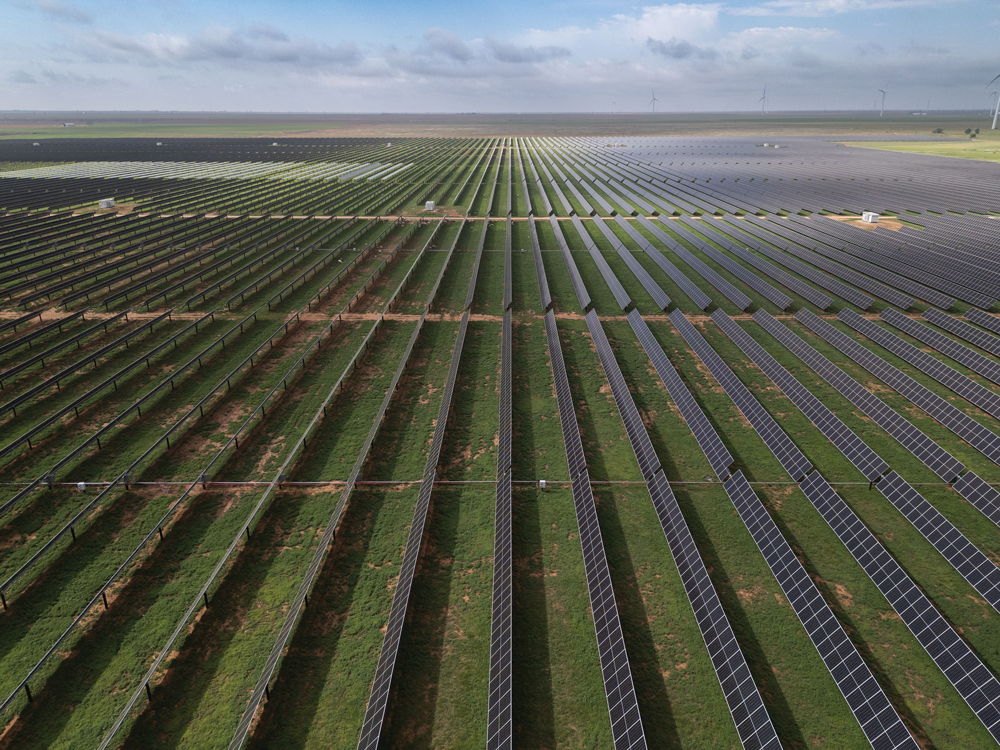
Vesper Energy broke ground in Swisher County, Texas, on its new Nazareth Solar site on June 24, adding yet another project to the state’s sunny portfolio.
Photos courtesy of Vesper Energy
Sunny Side Up
IN THE LONE STAR STATE
Texas ranks second only to California when it comes to overall state solar energy production. In terms of utility-scale solar generation capacity in the U.S., Texas is No. 1. The state has 53,568 megawatts (MW) of total solar installed, an energy storage capacity of 29,163 MWh and enough solar-generated energy to power over 6.5 million homes, according to the Solar Energy Industries Association.
Throw a rock at a map of Texas and you will likely hit the sprawl of a solar project. On June 24, Vesper Energy broke ground on Nazareth Solar, adding yet another project to the state’s sunny portfolio. The 201-MW utility-scale project will locate in Swisher County in the northern region of the state, bordering the 600-MW Hornet Solar facility also developed by Vesper Energy that completed construction in April 2025.
“Swisher County was a natural fit for Nazareth Solar because of the strong relationships Vesper Energy has built in the region over several years,” says Zach Wald, vice president, EPC, at Vesper. “Through the development and successful operation of our Hornet Solar project, we’ve had the opportunity to work closely with local landowners, community leaders and county officials who have been supportive partners throughout the process.”
In its first operational year, Hornet Solar has produced more than $5 million in local tax revenue and contributed 1.5 million megawatt-hours to the ERCOT (Electric Reliability Council of Texas) grid.
Wald adds that “more broadly, Texas continues to be one of the nation’s leading markets for utility-scale solar development, with abundant solar resources, strong energy demand and the infrastructure needed to bring new generation online. Building Nazareth in Swisher County allows us to expand on an established foundation in a community where we’ve already demonstrated our long-term commitment.”
Nazareth Solar will stretch across about 1,000 contiguous buildable acres, generate $34 million in long-term tax revenue for the county and will generate enough electricity to power more than 53,000 homes in the state each year. The site is designed as a single, continuous project (as opposed to a patchwork of separate parcels) and will include approximately 406,000 solar panels, associated inverters, electrical equipment and interconnection infrastructure to deliver power to the grid. Commercial operations are expected to start in fall 2027.
“Nazareth Solar represents another important step in Vesper Energy’s continued growth. As one of the company’s newest utility-scale projects, it builds on the experience we’ve gained from every project we’ve developed and constructed to date,” Wald explains. “Each project strengthens our technical expertise, refines our development and construction processes and positions us to execute future projects more efficiently. Our goal is to grow responsibly while helping meet the country’s increasing demand for reliable, domestically produced energy. Every successful project becomes a building block for the next.”

“Texas continues to be one of the nation’s leading markets for utility-scale solar development”
— Zach Wald, Vice President, EPC, Vesper Energy
Swisher County was a logical location for Nazareth Solar and an adjacent site partner to the company’s existing Hornet Solar facility was a natural next step, with stakeholders eschewing the decision to split up the positioning of the two solar projects.
“Rather than choosing between competing locations, Nazareth advanced because it was the right project, in the right place, at the right stage of development. While Vesper continues to pursue projects across the country, Nazareth was the clear choice for this phase of the company’s growth,” says Wald.
Hornet Solar is unique. It’s a large site that covers 3,900 acres and ranks as one of the largest solar installations in the United States. It contains 1.36 million solar modules. Vegetation on the solar farm is tended to by over 2,600 sheep in a land management approach called “solar grazing.”
In 2025, the U.S. solar industry installed 43 gigawatts (GW) of new capacity. According to a market insight report from the Solar Energy Industries Association on last year’s solar energy activity, solar accounted for 54% of new electricity-generating capacity added to the U.S. grid in 2025. Texas is no outsider to this line dance — solar-generated electricity surpassed coal generation for the first time ever this year in the state. Wind and solar energy sources have also eclipsed coal-derived power in Texas since 2024.
Meta, Google and AT&T are major corporate clients driving some of that energy demand (and consequently, solar generation boom) in Texas. All signed long-term power purchase agreements supporting the buildout of large solar projects in the state, which produced about 13% of the country’s total energy in March 2026.
According to the Conway Projects Database, qualified corporate end-user facility projects recorded between June 15, 2025, and June 15, 2026, included a total of 63 energy sector-related projects in Texas alone, with sites located in Harris County (32), Montgomery County (5) and Jefferson, Travis and Midland Counties (3 each). — Kelly Barraza
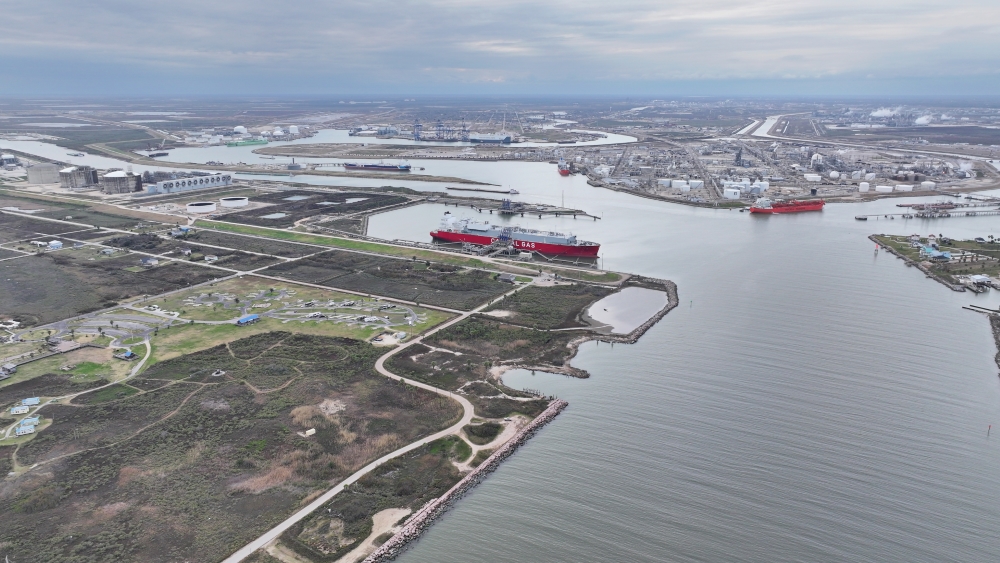
The Freeport Harbor Channel Improvement Project was authorized by Congress under Section 7002 of the Water Resources Reform and Development Act of 2014.
Photo courtesy of Port of Freeport
TEXAS PORTS DEEPEN THEIR IMPACT
IN MORE WAYS THAN ONE
In July 2026, the U.S. Army Corps of Engineers (USACE) Galveston District and Port Freeport celebrated another milestone for the Freeport Harbor Channel Improvement Project. The $295 million project received authorization from Congress in 2014, supported by a $165 million federal investment and $130 million backed by the Port through a voter-approved bond package.
The goal is to deepen the current 46-foot channel to depths of 51 to 56 feet, which once complete would position Port Freeport as the deepest port on the Gulf Coast.
USACE began construction back in April 2021, completing its first segment in seven months. This work focused on Reach 3, a section of the channel adjacent to the Port’s Velasco Container Terminal, deepening the segment to 51 feet to enable larger, deep-draft vessels into the Port. Soon after, the team moved to widen the channel’s narrowest section, referred to as Reach 2, to 400 feet. The recent milestone celebrated Reach 4 being deepened to 26 feet. Moving forward, aside from bringing depths in Reach 2 to 51 feet, the USACE will begin tackling the final segment of Reach 1.
Reach 1 is the largest segment of the channel, serving as a vessel’s entrance and exit point into the Gulf. Activity here will bring the Reach 1 Outer Bar to 58 feet and the Reach 1 Jetty and Main Channel to 56 feet. The addition of enhancements to the Port’s upper turning basin and lower channel bend easing are designed to support modern vessels that could not previously navigate the Freeport Harbor Channel, opening up opportunity to welcome a wider range of global ships. This activity will scale up current cargo activity at the state’s No. 4 ranked port, which handled 39.3 million tons of international cargo in 2025, an 8.7% increase over 2024.
“Delivering this project required years of disciplined engineering, construction and close coordination between the Galveston District, Port Freeport and the maritime community,” said USACE Galveston District Commander Colonel David W. Dake. “The result is safer navigation, greater vessel flexibility and lasting infrastructure that’ll serve Port Freeport, its customers and the surrounding communities for generations.”
A few weeks prior to Port Freeport unveiling its project milestone, the USACE, NextDecade and the Port of Brownsville marked the completion of the Brazos Island Harbor Channel Improvement Project. This 10-foot deepening initiative brought the Port’s entrance and jetty channels down to 54 feet, while its main channel was brought to 52 feet. Like Port Freeport, the Brownsville Ship Channel can now allow larger vessels carrying heavier cargo into the port, while improving navigation and reducing vessel transit times.
Austin-based Saronic Technologies has decided to take advantage of the Port of Brownsville’s momentum. In July 2026, the company announced an over $3 billion investment to construct what is expected to be the nation’s largest shipyard, known as Port Alpha. Saronic plans to begin manufacturing medium and large-class autonomous and autonomy-capable vessels for defense and commercial fleets. Among the reasons Texas was selected for this project — which include infrastructure readiness, land scale, logistics and expansion potential — workforce availability was vital as the company looks to fill 10,000 new positions in the region.
“America’s maritime future depends on our ability to build again,” said Saronic Co-Founder and CEO Dino Mavrookas. “Port Alpha is our commitment to that mission. Built from the ground up to deliver ships at a speed and scale not seen since World War II, this investment is about more than constructing a shipyard. It is about rebuilding the industrial capacity, workforce and manufacturing advantage required to ensure American maritime leadership for decades to come. The State of Texas and City of Brownsville give us the foundation to turn that vision into reality.” — Alexis Elmore
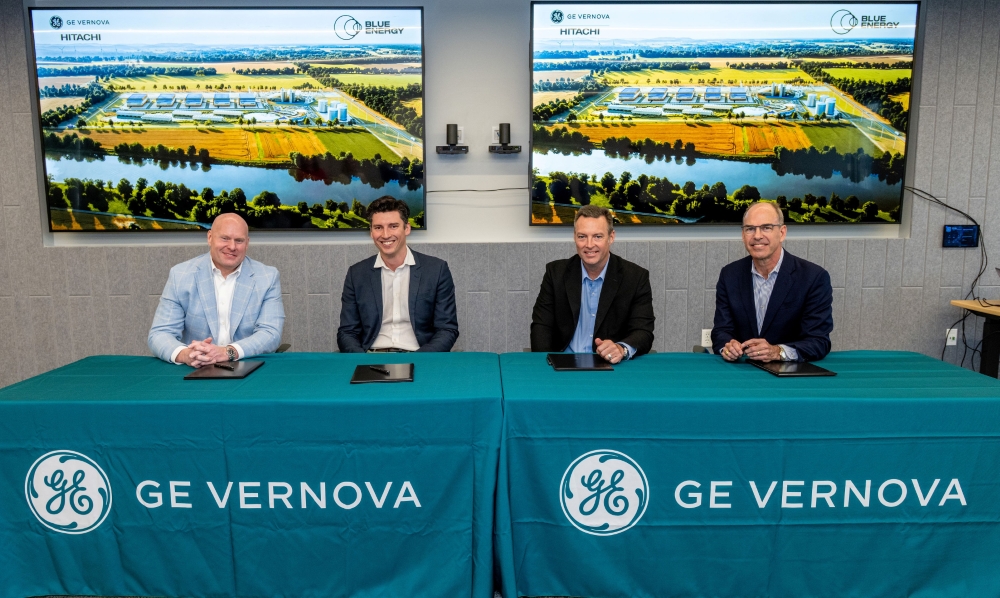
A 2.5-GW gas-plus-nuclear power plant in Port of Victoria, Texas, from Blue Energy and GE Vernova Hitachi Nuclear Energy figures to be the world’s first gas-to-nuclear conversion.
Rendering courtesy of Blue Energy
BEHIND THE METER
FRONT & CENTER
Two new Texas projects aim to generate more than 5 gigawatts (GW) of power, primarily from natural gas, to provide behind-the-meter power to two new hyperscale data centers.
This summer the projects reached key milestones as they seek to further ramp up a sector that to date has tallied 150 data centers qualifying for the state’s tax break, according to the Texas Comptroller of Public Accounts. Ninety of those are considered “large,” defined as 250,000 sq. ft. or bigger.
The two new projects appear to qualify as large, and so do the power generation projects expected to light them up.
In June, Chevron Corporation announced that Energy Forge One LLC, a wholly owned subsidiary, had signed an agreement with Microsoft Corp. to develop a co-located power facility in West Texas that will provide dedicated electricity to a Microsoft-operated data center under a 20-year power purchase agreement. McGuireWoods served as legal advisor to Chevron in negotiating the agreement.
While the announcement did not specify the power facility’s location, a separate blog posted on the same date by Microsoft President, Cloud Operations and Innovation Noelle Walsh identified Pecos in Reeves County, located in the oil and gas nexus of the Permian Basin, as the site of a new 2-GW data center expected to create 6,000 construction jobs.
“The rapid growth we’re experiencing in AI and cloud, driven by customer demand, requires energy infrastructure that can scale quickly and reliably,” said Walsh. “Our agreement with Chevron helps ensure we’ll have dedicated, large-scale power to support the evolution and reliability of advanced compute.”
The 2.67-GW power facility, known as “Project Kilby,” is the first of several “power foundries” that Chevron and GE Vernova plan to deploy to serve co-located data centers in the U.S. Southeast, Midwest and West regions using seven American-made GE Vernova 7HA natural gas turbines. “Power generation is not designed to flow initially through the existing transmission grid,” the companies said, “reducing the risk of increasing electricity prices for consumers.” Additional capacity will be provided by Caterpillar subsidiary Solar Turbines. A final investment decision is anticipated by the end of 2026. Kilby is expected to generate more than $10 billion in state and local tax revenue and support almost 2,000 jobs.
In August, Maryland-based Blue Energy, a vertically integrated deployment platform for financeable, prefabricated nuclear power plants, and GE Vernova Hitachi Nuclear Energy, announced the signing of an agreement that launches the next phase of their collaboration to deploy a 2.5-GW gas-plus-nuclear power plant in Port of Victoria, Texas.
Blue Energy states it will “initially power a nearby data center with approximately 1 gigawatt of power using two GE Vernova gas turbines in 2030 and then add another 1.5 gigawatts of power from up to five GE Vernova Hitachi SMRs [small modular nuclear reactors] beginning in 2032.” A final investment decision is expected in 2027. — Adam Bruns