
Two examples of best practices are found at Toyota and Cooper Steel.
One of the most common barriers to workforce entry is the rising cost of child care. In a groundbreaking study just released by the Federal Reserve Bank of Atlanta, research findings from an analysis of child-care costs in just two states, Florida and Georgia, show that many working families and single parents can no longer afford to go back to work because they lack the resources to afford quality child care.
In the report titled “Too Costly to Work? The Childcare Burden on Household Earnings,” the Fed found that in several of the country’s fastest-growing metro areas, the cost of adequate child care is now out of reach for many families. “The analysis reveals that child care costs consume a disproportionate share of household income, particularly for single-earner families and those employed in lower-wage occupations essential to community functioning,” the report finds. “Child care affordability varies dramatically by occupation and family structure. Regional variations in costs and wages create differential impacts across metropolitan areas.”
The report adds that “employers, workforce intermediaries, and other community social service organizations can use this analysis to better understand the potential financial constraints for workers with young children and consider strategies that might help attract and retain employees by addressing child care affordability challenges. Community and state leaders focused on economic development, economic mobility and strategies for meeting the talent needs of employers can use this analysis to better understand and address the potential child care affordability constraints that can affect labor force participation.”
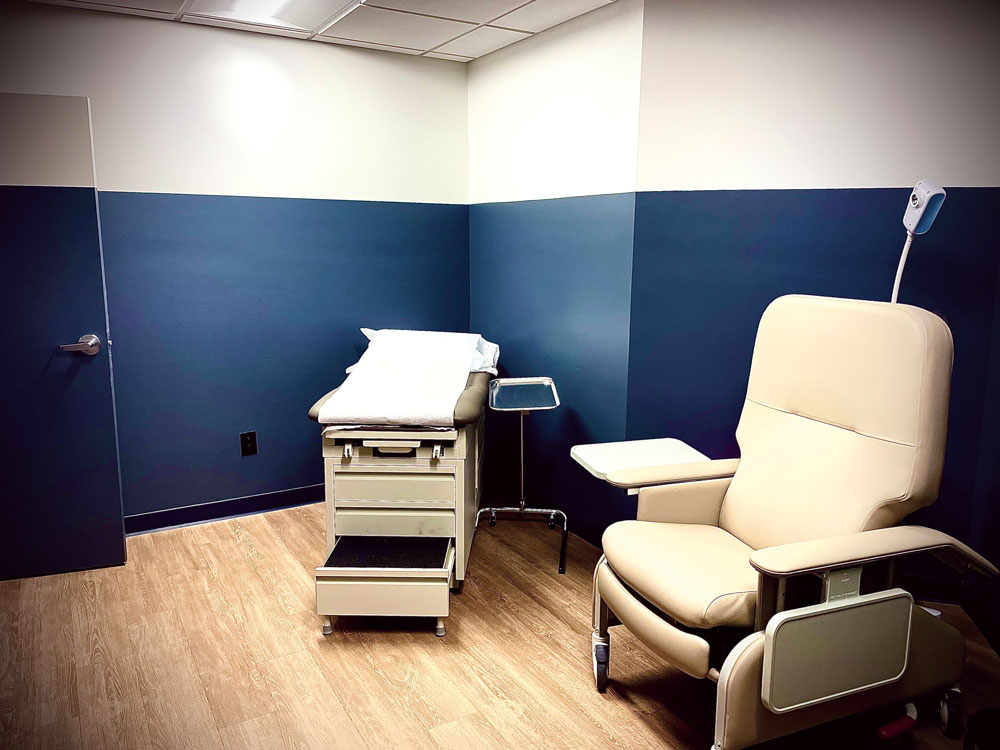
Cooper Steel’s new onsite medical clinic offers free health care to all employees and their families.
Photo courtesy of Cooper Steel

Photo courtesy of Cooper Steel
One key barrier is the fact that most child care workers are paid so poorly that they cannot afford to send their own children to day care. The study authored by Brittany Birken, John Rees and Jacob Walker notes that “The Center for the Study of Child Care Employment collects wage information for over one million formal and informal childcare providers nationwide. At just $24,240, the average annual salary is extremely low compared to other occupations. More than 15% of all child care workers are below the poverty line in 41 states. Almost half of workers use public assistance programs such as the Children’s Health Insurance Program (CHIP), Supplemental Nutrition Assistance Program (SNAP) and Temporary Assistance for Needy Families (TANF).”
How Toyota USA is Driving Change
Against this backdrop, a growing number of employers are resorting to creative methods to meet this critical need for their workers and their families. Toyota USA recently announced the opening of four new child care centers at the company’s manufacturing plants in Liberty, North Carolina; Blue Springs, Mississippi; Huntsville, Alabama; and Buffalo, West Virginia. With this launch, announced in August 2025, Toyota builds upon a program that saw the earlier launch of two child care facilities at Toyota plants in Kentucky and Indiana.
“At Toyota, we know it is paramount for working parents to have access to quality child care, and manufacturing is not always a 9-to-5 job,” said Denita Neville, vice president of Toyota’s Corporate Shared Services. “Offering child care motivates and empowers our team members, makes our industry more inclusive and helps our smallest learners of today become our biggest leaders of tomorrow.”
The new child care centers have already opened in North Carolina and Mississippi. A total of 550 children are now receiving professional child care services at these locations at the expense of the workers’ employer. The Alabama center will open in 2026 and provide care to up to 274 children. The West Virginia center will open in 2027 and care for 240 children.
In a release, Toyota noted that “all centers will introduce an age-based curriculum for children ages 6-weeks to 5-years, promoting learning through motor development, as well as physical, cognitive and social-emotional growth. They will be equipped with a commercial kitchen, STEM room, movement matters space and an outdoor playground.”
This is not the first time that the world’s largest automaker has done this. In 1993, the Japanese car company opened an onsite, 24-hour-a-day care center at its largest global site in Georgetown, Kentucky. That facility currently provides care for more than 270 children of parents who are employed at that plant. The center in Indiana opened in 2003 and is now being expanded to accommodate up to 366 children.
“As a working mom, it’s been such a relief to have child care that supports my work schedule,” said Patricia Pastrana Arroyo, a group leader at Toyota Indiana. “The early education program is exceptional. The teachers are nurturing, attentive and genuinely caring toward each child. They keep parents informed with daily reports, pictures and updates, which helps me feel connected to my son even when I’m not there.”
Recent data from Child Care Aware of America (2024) reveals that the average annual price of childcare in the United States reached $13,128 in 2024, with costs continuing to rise faster than overall inflation — a 29% increase in childcare prices from 2020 to 2024 compared to a 22% rise in overall prices. This burden represents 10% of median household income for a married couple and 32% of the median household income for a single parent.
Source: The Federal Reserve Bank of Atlanta
Toyota adds: “All sites will go through the National Association for the Education of Young Children (NAEYC) accreditation process which establishes standards for quality child care programs. Beyond onsite child care centers, Toyota also offers benefits through Bright Horizons. Their services help employees find ongoing child care, make plans for known and unexpected gaps or arrange temporary care for family members.”
How Cooper Steel Cares for the Whole Family
Beyond providing onsite child care centers, other employers around the country are tackling one of the biggest needs of working parents: locating and affording quality health care for their kids. One firm taking the lead in this area is Cooper Steel in Monroe, Virginia.
A medium-sized manufacturing company that employs 85 workers in rural Amherst County along U.S. Highway 29 in Central Virginia, Cooper Steel recently celebrated the grand opening of an on-site medical clinic that offers all of its services free of charge to Cooper employees and their families.
The Tennessee-based company is a third-generation, family-owned business that was founded in 1960 and specializes in structural steel fabrication and erection. The firm operates in 18 states.
The human resources manager for the company’s plant in Monroe says it is an investment in employee recruitment, retention and long-term well-being — and the proof, she says, is in the outcomes for families who take advantage of this benefit: employees needing less time off for sick days because they bounce back quicker; workers needing to call out from work less often to take care of sick kids at home and children missing fewer school days because they are receiving better and more regular health care.
The program has been so successful that Cooper is now rolling it out at plants in multiple states. Kaleigh Giles, human resources manager for Cooper Steel in Monroe, says that “we have an employee health clinic on site where employees’ children can come and receive free health care. Our corporate headquarters is in Shelbyville, Tennessee, and they have provided an onsite clinic there for their employees and their dependents. With our new site remodel, we included plans for the same thing in Monroe. That allows our employees to be seen for primary care and sick visits, as well as their spouses and children at no cost. Cooper absorbs the cost of each visit.”
Giles says the program launched on August 4. “Out of our 85 employees, all of them have been seen for our annual biometric screenings,” she says. “And the families — at least half are taking advantage of this program and bringing their children to be seen for sports physicals and sick visits.”
When asked how this is benefiting the Cooper employees, Giles says, “First, I think we are giving our employees an opportunity to have a focused one-on-one time with a medical professional. We partner with Collaborative Health Partners in Virginia to have that one-on-one attention for each patient. That is unique for our program. That allows some people who otherwise would not seek out medical care to receive quality care.”
But that’s not all Cooper plans to do, she adds. “In 2026, we will launch health education every other month for our employees. We will offer a nutritionist, medical staff, etc., to teach on heart health, diabetes prevention and awareness, etc. The focus will be on the whole individual.”
When I asked Giles if she had advice for other employers considering a similar venture, she said: “We are turning a page in employee development and what the workforce is looking for in an employer. They are looking for the whole package. To be able to provide this for the whole family is a testament to what is important to us — the overall well-being of everyone and their families. This has been a great addition for our employees and a great recruiting tool. It is pretty momentous for us. If you are able to do it, it is awesome.”