
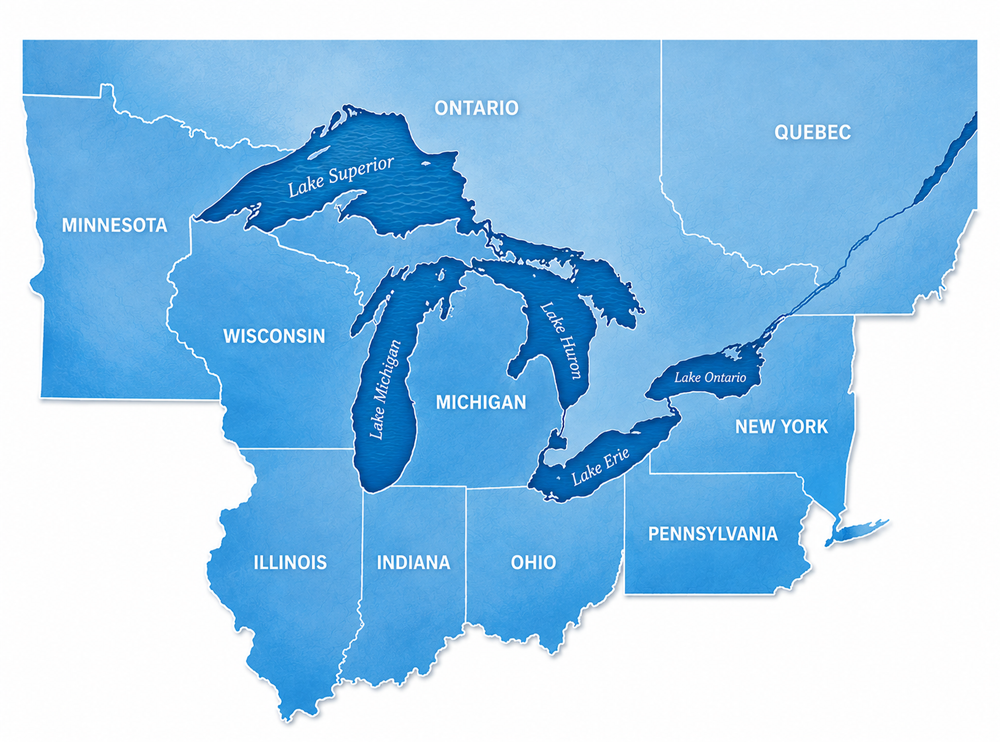
From advanced manufacturing and life sciences to technology and logistics, the Great Lakes Region remains one of North America’s most competitive destinations for business investment.
by Savannah Yawn
Stretching across eight U.S. states and two Canadian provinces, the Great Lakes region has long been one of North America’s economic engines. Its established manufacturing centers remain central to the economy, even as new technology and advanced research clusters take shape. Access to major markets on both sides of the U.S.-Canada border gives companies another strong reason to invest in the region.
The profiles that follow offer a quick look at each state’s or province’s economic footprint.
Illinois
Illinois combines a large, diverse economy with extensive transportation infrastructure and access to markets throughout North America. Rivian reinforced the state’s advanced-manufacturing base in 2025 with a $120 million supplier park in Normal, expected to create nearly 100 direct jobs and support its expanded vehicle operations.
Indiana
Indiana’s central location and established production workforce support continued growth in life sciences and advanced manufacturing. In 2026, Eli Lilly announced an additional $4.5 billion investment in two Lebanon manufacturing sites, bringing its planned Indiana investment since 2020 to more than $21 billion.
Michigan
Michigan remains a center of automotive and advanced manufacturing while also building its defense and mobility sectors. American Rheinmetall announced a $31.7 million Michigan investment in 2025 that is expected to create 450 jobs supporting military-vehicle development and production.
Minnesota
Minnesota’s diversified economy includes strong concentrations in medical technology, food production and corporate services. Boston Scientific’s $139 million Maple Grove expansion, announced in 2025, is expected to add nearly 84,000 sq. ft. and create approximately 440 jobs.
New York
New York’s economy extends well beyond finance, with major strengths in life sciences, technology and advanced manufacturing. Corning announced a $315 million investment in its Canton semiconductor-glass facility in 2025, with plans to create up to 130 permanent manufacturing jobs.
Ohio
Ohio’s central location, transportation assets and broad industrial base continue to support manufacturing and life-sciences growth. Hikma Pharmaceuticals announced a $267 million expansion of its Columbus and Bedford operations in 2026, expected to create 350 jobs.
Pennsylvania
Pennsylvania combines access to major East Coast markets with strengths in energy, life sciences, logistics and technology. Amazon announced plans in 2025 to invest at least $20 billion in cloud-computing and AI campuses across the state, creating at least 1,250 high-tech jobs.
Wisconsin
Wisconsin’s economy is rooted in production, engineering and food-related industries, with growing capabilities in advanced technology. Milwaukee Tool announced a $42 million Wisconsin expansion in 2025 expected to create 300 skilled jobs.
Ontario
Canada’s largest provincial economy supports major concentrations in financial services, technology, manufacturing and life sciences. AstraZeneca announced an $820 million investment in Ontario in 2025 to expand its research operations and Canadian headquarters, creating more than 700 jobs.
Québec
Québec’s economy draws on strengths in aerospace, digital technology and clean-energy manufacturing, supported by abundant hydroelectric power. Hitachi Energy announced an additional C$270 million investment in its Varennes transformer plant in 2025, an expansion expected to nearly triple production capacity and create more than 500 jobs.
Sources: U.S. Census Bureau; Statistics Canada; Ontario Ministry of Finance; Institut de la statistique du Québec; U.S. Bureau of Economic Analysis; Office of the U.S. Trade Representative; U.S. Bureau of Labor Statistics.