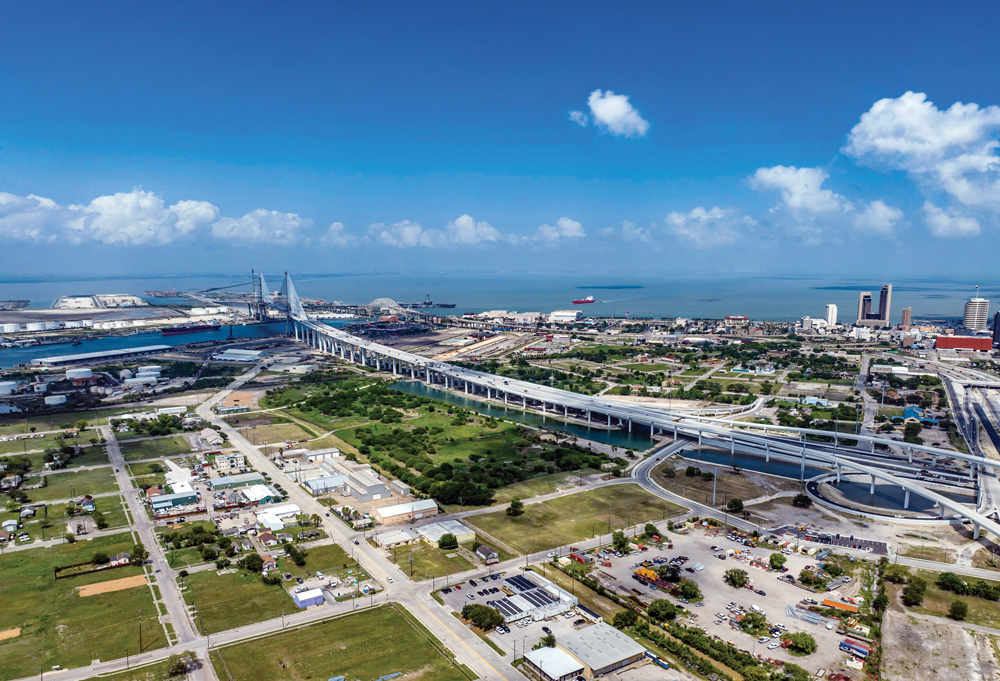
If you don’t think officially designated U.S. Foreign-Trade Zones literally energize the economy, you haven’t looked at the energy industry profile in the nation’s top FTZs.
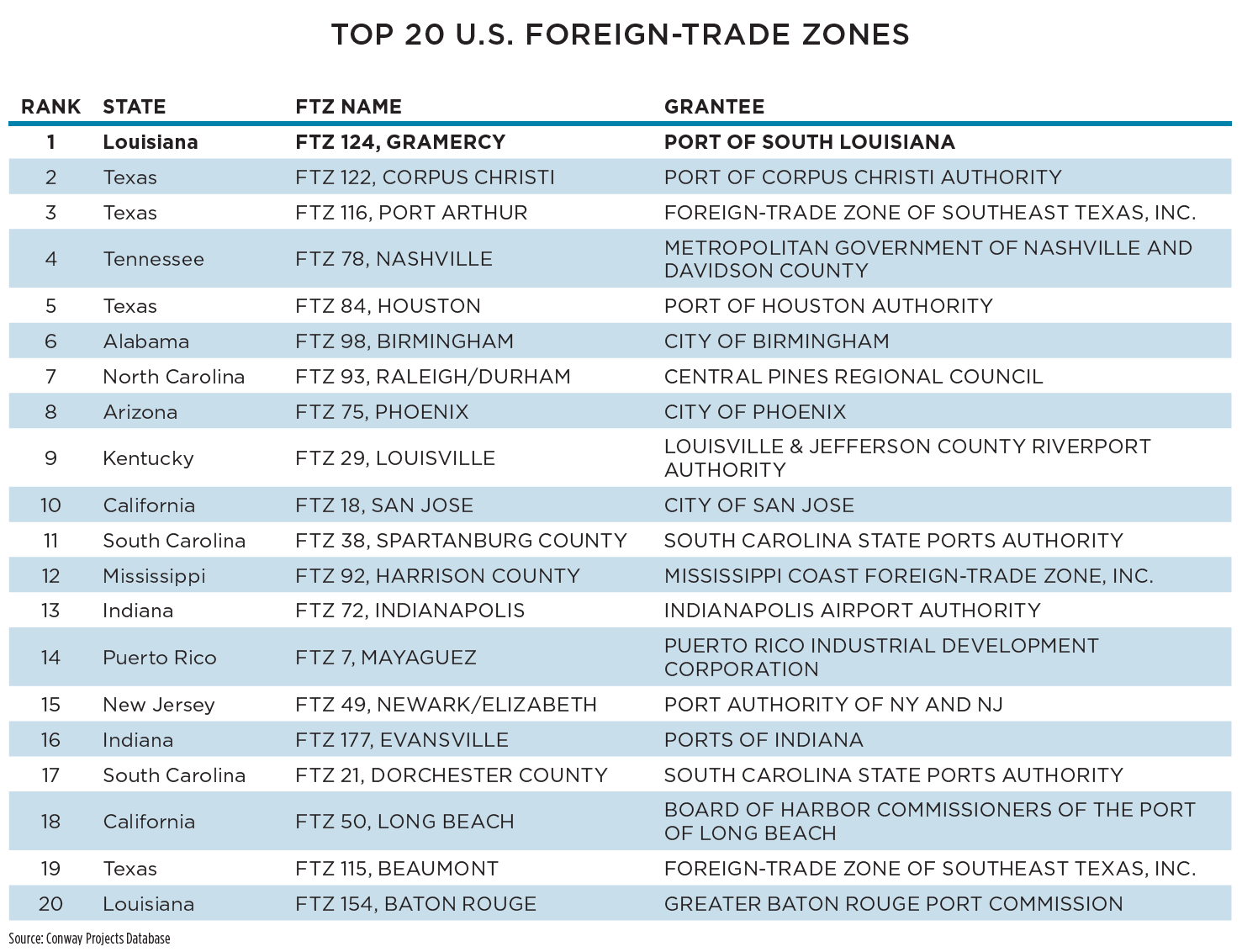
Using data sets found in the 86th Annual Report of the Foreign-Trade Zones Board to the Congress of the United States, Site Selection here presents the top 20 FTZs in the nation based on a blend of metrics such as value of merchandise received, value of exports and number of employees.
FTZ No. 124, located at the Port of South Louisiana but extending well beyond that district’s footprint, repeats at No. 1 this year, based on 2024 data. No. 2 — up from No. 5 last time — is the Port of Corpus Christi in Texas, freshly armed with assets that extend in opposite directions: a new, taller $1.3 billion Harbor Bridge and a channel newly dredged to 54 feet.
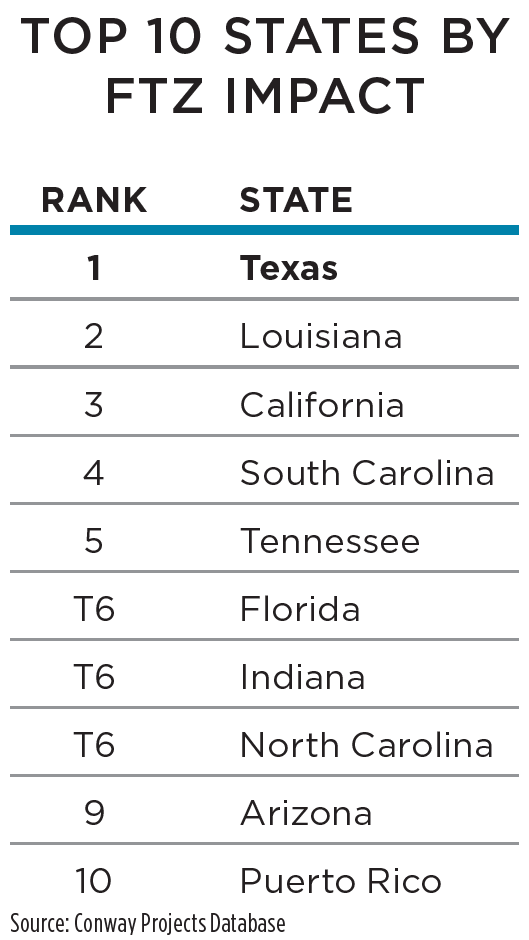
That port and others in the state (No. 3 at Port Arthur and No. 5 at Port Houston among them) are why Texas repeats as the No. 1 state by FTZ impact, followed by Louisiana, California, South Carolina and Tennessee.
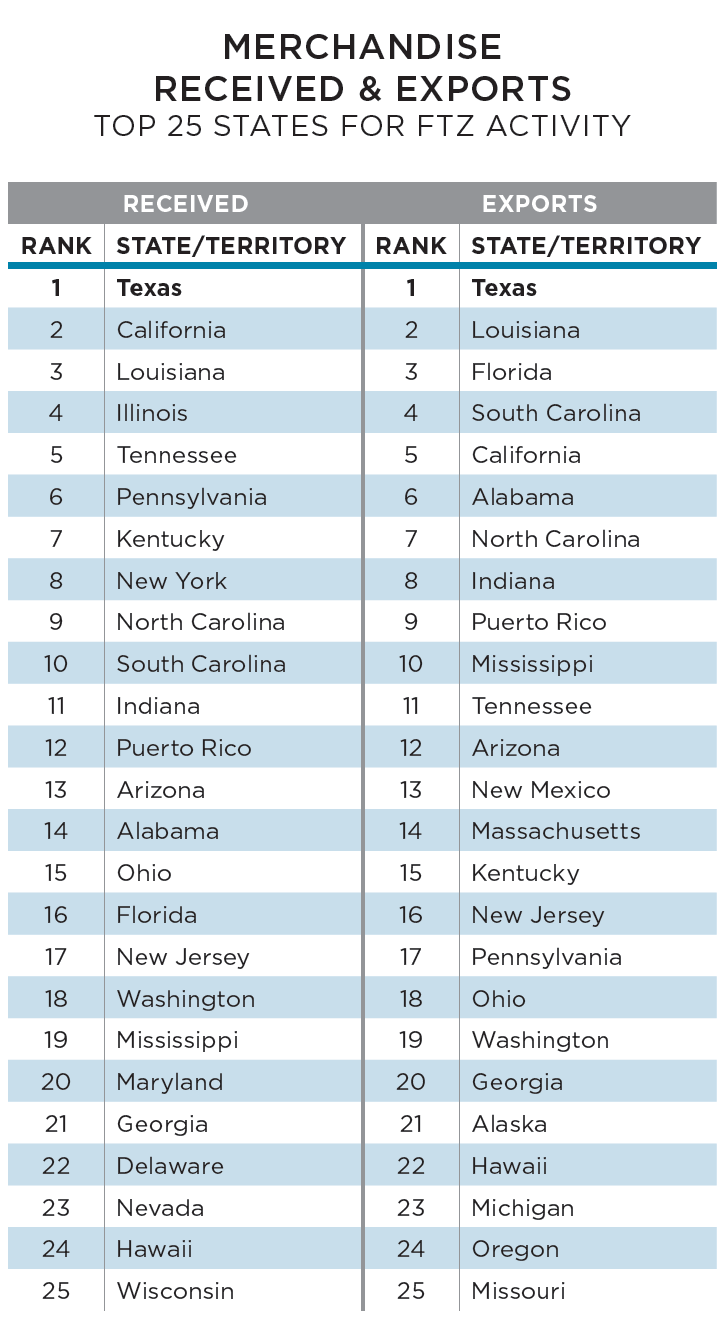
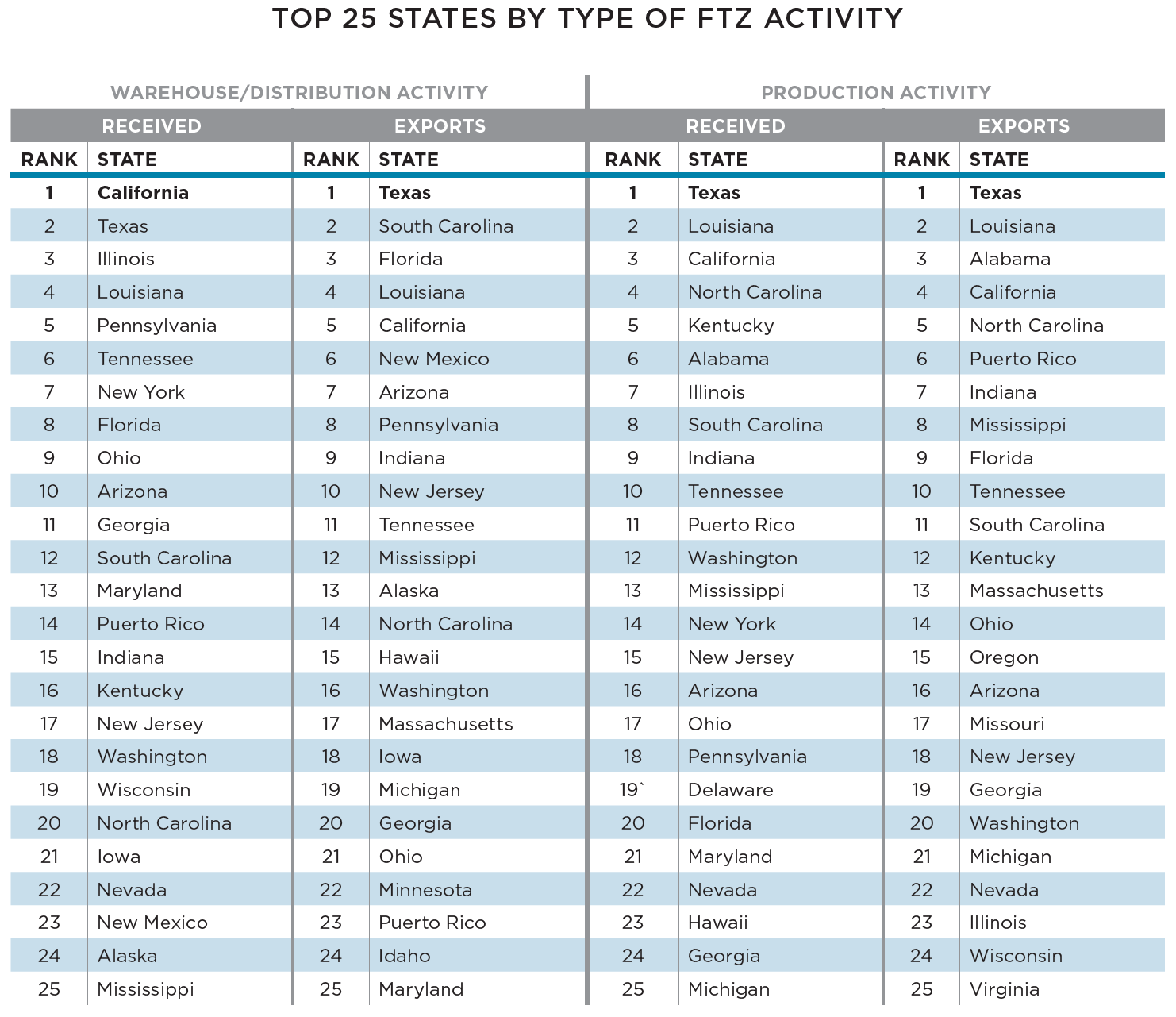
Examining the same data, a report from Kroll finds that the $963.8 billion in merchandise received at all FTZs was the second highest value on record, while 82% of the approximately 543,000 U.S. jobs associated with FTZs were directly tied to production. “Texas, Arizona and California lead in employment,” Kroll stated. “South Carolina and Florida excel in export intensity. Ohio and Pennsylvania stand out in logistics depth.”
FTZs also continue to play a role in helping companies navigate the ever-changing tariff picture. A year-end survey conducted by the National Association of Foreign-Trade Zones (NAFTZ) found that nearly 49% of responding private-sector FTZ users/operators (manufacturers, distributors and logistics companies) reported increased zone activity in 2025. And more than 80% of grantee respondents (local economic development orgs / community agency administrators) expect applications and zone activity to rise in 2026. A NAFTZ release stated U.S. FTZs “are evolving from cost-savings tools to risk-management infrastructure. While duty deferral (72%) and duty savings (51%) remain core program benefits for users, companies increasingly credit FTZs for stabilizing inventory, improving compliance accuracy and reducing supply chain volatility.” Tariff uncertainty, meanwhile, is driving renewed demand, the survey found.
In February the U.S. Supreme Court ruled a large swath of recently instituted tariffs unconstitutional. The U.S. Customs and Border Protection agency then announced that “FTZ users will no longer be required to pay tariffs assessed under IEEPA authorities.” NAFTZ Director of Advocacy Melissa Irmen spoke days later with Site Selection’s Ron Starner for an Online Insider story. “My advice is to use your U.S. FTZ,” she said. “It is an opportunity to get the goods in the country and take a pause and consider your options. If you export those goods, you don’t have to pay tariffs in the U.S. That duty deferral aspect is useful as well for cash flow positivity.”
Unparalleled Industrial Corridors
One of the most salient things to know about No. 1 foreign trade zone in this year’s ranking of U.S. FTZs is that it has 19 subzones … with a 20th likely on the way. Established in 1985 and affiliated with the 54-mile port district known as the Port of South Louisiana (founded in 1960), FTZ No. 124 encompasses territory in eight different parishes, even though the port district’s jurisdiction itself only encompasses three.
The second largest port in the Western Hemisphere, the Port of South Louisiana is home to seven grain transfer facilities, four major oil refineries, 11 petrochemical manufacturing facilities and several other facilities, including the Executive Regional Airport. A forthcoming $5.8 billion Hyundai Steel plant has been announced, as well as an ECI Gulf Coast Parts and Service facility — the company catalyzing the request for that new subzone. According to a December 2025 report by the Big River Coalition, the Port of South Louisiana combines with four other deep-draft ports on the Mississippi River Ship Channel (Baton Rouge, New Orleans, St. Bernard and Louisiana Gateway) with $99.7 billion in annual trade value based on unified volumes, or $273.1 million daily. (FTZ No. 154 in Baton Rouge ranks at No. 20 this year.) Oil and petrochemicals are prominent in the Texas FTZ mix as well, but one niche stands out at the Port of Corpus Christi: liquefied natural gas (LNG). The port reported that customers moved 54.5 million tons of commodities through the Corpus Christi Ship Channel in the first quarter of 2026, “marking the strongest first‑quarter performance in the Port’s history.”