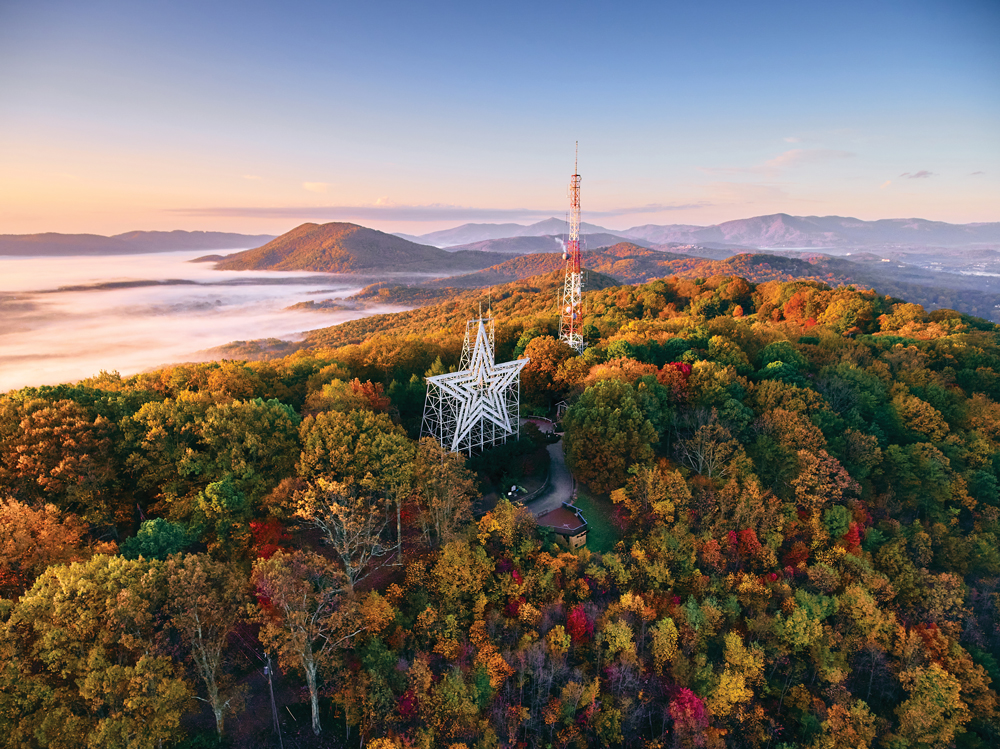
New governor hits the ground running in economic development.
Virginia Gov. Abigail Spanberger went to work quickly on pressing economic development issues the moment she won election to the state’s highest office last year. What followed was a flurry of new policies aimed at making the Old Dominion a national and global leader in new sources of energy.
On September 30, along with the offices of Virginia Energy and Commerce & Trade, she unveiled a comprehensive Virginia Energy Plan that maximizes development of renewable power sources, including nuclear energy.
Lowering energy bills for consumers, while ensuring there’s an adequate supply of new energy to power up expanding companies, are her top priorities. From Blacksburg to Hampton Roads, she said, Virginia needs to be a place where the most cutting-edge advancements in energy technology take place — and they must be affordable for all.
We recently caught up with Gov. Spanberger for this revealing Q&A:
What is the significance of landing the Defense Maritime Solutions investment project in Chesapeake?
Gov. Abigail Spanberger: I am really excited about this. It is such a substantial investment. This $30 million investment will expand the work they do in Virginia. We have a strong defense presence. We have an even greater and stronger supply chain for shipbuilding propulsion systems. That contributes to manufacturing growth in Virginia. This win means a lot for a variety of things. First, Virginia has a great workforce, and it makes clear that Virginia is the heart of the defense industry in many ways, from aviation and shipbuilding to virtually all other sectors.
One of your top priorities as governor is to improve Virginia’s public schools. What are the major pillars of your strategy, and what would a success look like?
Spanberger: Virginia is a strong place for business because we are viewed as a great place for talent. You get that by investing in the strength of K-12 education. It is about academic excellence and setting the bar high, providing targeted resources and realizing we need to support our schools. Every student in Virginia should exit high school prepared for college or a skilled job or a military career. My education budget includes record funding for K-12 education. It includes access to tutoring services. It is focused on providing coaching and technical assistance to students. We are providing the necessary student support to make sure they are able to learn.
That includes, much to the chagrin of my own children, a bell-to-bell ban on cellphone use in school. We know that cell phone use can preclude students from being fully engaged in learning.
We also know that a high percentage of students are food insecure. Kids can’t learn if they’re hungry. That’s why we’ve invested substantial dollars to reimburse schools for those costs. Then, as students reach graduation, we want to make sure those career pathways exist. I’m a proud graduate of Virginia schools. So, in addition to career pathways, we’re focusing on growing our internships program and our registered apprenticeships program. Across a variety of skillsets, from soft skills to advanced manufacturing, we’re making sure those registered internships and apprenticeships are fully funded.
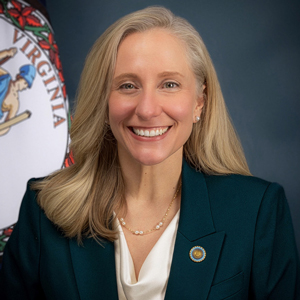
“While we are in a strong position as a state today, we cannot let our foot up off the gas.”
— Virginia Gov. Abigail Spanberger
Improving public safety is a major goal of your administration. What are the problems you intend to target, and what are the solutions you’re proposing?
Spanberger: My career began as a federal law enforcement officer and then as a CIA case officer. I had experience on the law enforcement side and in mitigating threats before I ever got into politics. I’m making sure that our communities are better equipped to handle incidents in public safety. We must make sure they have the ability to do the job. Over 925 first responders in law enforcement, firefighting and EMS will come together for our first statewide Unified Ready Summit. This is the first of its kind in the country to build out a statewide readiness program. We will be focused on delivering practical solutions for flood response; multi-jurisdictional pursuit of someone wanted for arrest; school safety, etc. My motto is be proactive.
Furthermore, I signed bills designed to limit gun violence. We recognize that we need to strengthen red flag laws. Far too often, when firearms are left unsecured in the home, children are harmed. Gunfire is the No. 1 cause of death of children in America. We are supporting law enforcement in this battle. Some localities were frequently having guns show up on the streets and in the hands of teenagers. Communities wanted the ability to have some sort of organized process to control that. We created a give-back or sell-back program. Some communities have already implemented that in Virginia. If you have a firearm in your home and you don’t know how to safely get rid of it, you can either give it back to us or sell it back to us.
Virginia is often perceived by readers of Site Selection as having a favorable business climate. What do you think are the characteristics that persuade site selectors to invest in your state? Do you think there are any areas where Virginia needs to improve?
Spanberger: We are a top business climate because of the basic mechanics of who we are. We have a world-class port that we just widened and deepened. We are centrally located on the East Coast. We have a highly educated workforce and a very strong higher education system at all levels — from public universities and community colleges to the many highly rated private colleges and universities around the state. We have strong workforce training programs. We are heavily diversified in military service and agriculture and manufacturing. Through the Virginia Economic Development Partnership (VEDP), we are able to build a pipeline through our Talent Accelerator Program. We also have a very high rate of military veterans who choose to stay and work in Virginia. That work experience is a valuable recruitment tool.
And while everyone is struggling to keep up with affordability, we are competitive in housing costs and overall cost of living. We are the No. 3 State for Business in the new CNBC rankings, up from No. 4 last year. Our general disposition as a state is that we have built a stable, steady and predictable level of infrastructure as a place to do business.

Hitachi Energy in June announced a $427 million, 825-job expansion at its South Boston site in Halifax County.
Photo courtesy of VEDP
That’s true because of the way we set up VEDP. Many states handle their business recruitment in different ways. We always have a one-term governor. We have a separate entity at VEDP that works steadily year after year to recruit businesses and FDI to Virginia. VEDP falls under my administration and under the Secretary of Commerce and Trade. The steadiness that exists at VEDP provides a level of insulation from political changes. We also have a very strong Chamber of Commerce in Virginia, along with the Greater Washington Partnership that strengthens the business environment in Northern Virginia, Washington, D.C., and Maryland. And our Secretary of Commerce and Trade works aggressively with the other Cabinet-level officers and departments.
My goals for the coming year are to improve our strong educational system; attend the Paris Air Show next year and make sure that more people know that Virginia is the place to go; improve on our No. 3 ranking in CNBC’s Top States for Business; and build on our strong position in all of our key competitive areas. Virginia has done a lot to recruit life sciences and biotech operations, but we can further diversify and strengthen that sector. While we are in a strong position as a state today, we cannot let our foot up off the gas.
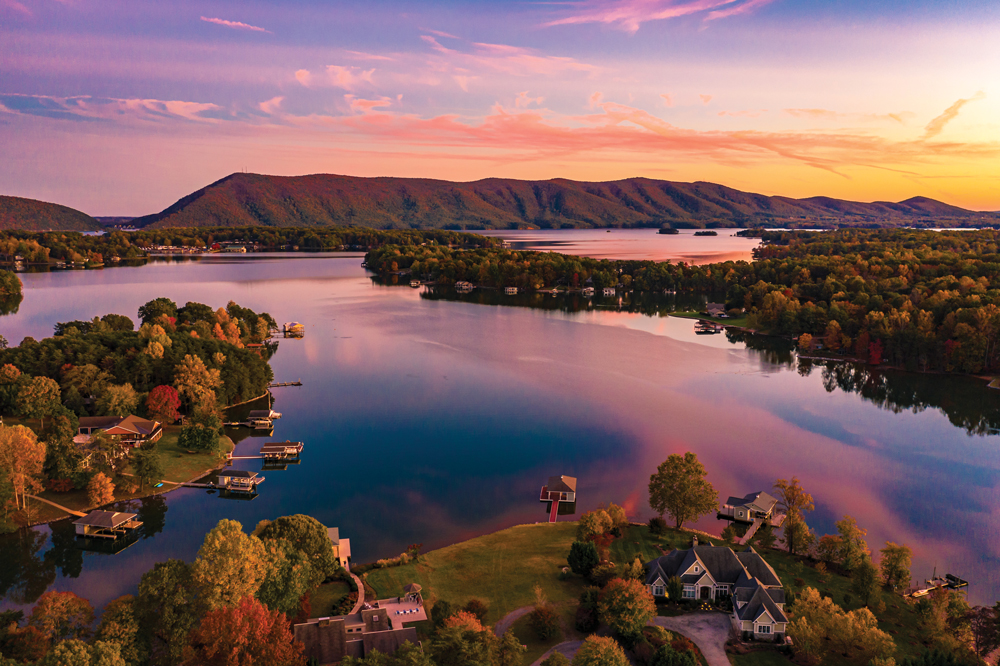
Smith Mountain Lake is in the Roanoke region, where Virginia Transformer Corp. is among the players transforming the energy ecosystem infrastructure in the Old Dominion.
Photo courtesy of VEDP
Virginia’s Magnetic Pull Energizes Big Investors
When Commonwealth Fusion Systems announced two years ago that it would invest $2.5 billion to build a new plant in Chesterfield County in Greater Richmond, Virginia, the news cemented the Old Dominion’s leadership position in the development of alternative new power technologies.
As the nation’s thirst for new sources of energy increases exponentially, innovative companies like CFS are stepping up to lead the new wave of investment into nuclear power generation, including fusion.
Chesterfield planning officials last year gave their approval to what could become the world’s first grid-scale commercial nuclear fusion power plant, capable of producing 400 megawatts of energy. The Massachusetts-based fusion energy firm that spun out of an MIT research project plans to build the plant on 94 acres in the James River Industrial Center owned by Dominion Energy.
Known as ARC, the 400-MW plant would commence construction later this decade and become operational in the early 2030s. The fusion power plant will use magnetic fields to create a heat exchange. CFS currently employs more than 1,000 workers and has many notable investors, including Jeff Bezos, Bill Gates and Tiger Global Management. Greater Richmond leaders consider this one of their signature economic development wins of the decade.
“They will use super-magnets to create fusion energy in Chesterfield County,” says Jennifer Wakefield, president and CEO of the Greater Richmond Partnership. “Google and CFS have already entered into an agreement for Google to use fusion power at three data centers in Greater Richmond.” Google signed a deal last year to buy 200 MW of power from CFS as part of Google’s commitment to invest $9 billion into building out its digital infrastructure in Virginia.
“Energy is one of two emerging industry clusters in this region,” says Wakefield. “The other is aerospace and defense.”
Big Deals Cement State’s Status
Jason El Koubi, president and CEO of the Virginia Economic Development Partnership, calls CFS a landmark win for the state. “Commonwealth Fusion Systems is a great example of a sector that is very exciting right now,” he says. “When you look at the investment in innovative energy technology in Virginia, you can see that there are a number of nice things in the pipeline. Energy, aerospace and defense, and life sciences are all active in Virginia.”

“We are off to a great start with the new administration. She [Gov. Abigail Spanberger] has already completed her first overseas mission. We went to Farnborough with her. We have announced some great projects with her over the last eight months, and there are more to come.”
— Jason El Koubi, President & CEO, Virginia Economic Development Partnership
He cited a few of the bigger projects to land in Virginia recently:
Avio USA, an Italian aerospace and defense company, broke ground September 29 on an 860,000-sq.-ft. plant in Hurt in Pittsylvania County, where the firm plans to hire more than 1,000 high-wage employees across Southern Virginia.
Defense Maritime Solutions (DMS) is investing more than $30 million to expand its operations in Chesapeake and create 32 new jobs in southeast Virginia.
Eli Lilly and Company will invest $5 billion to build a new pharmaceutical manufacturing facility in Goochland County in Greater Richmond.
Merck & Co. is investing $3 billion to build a 400,000-sq.-ft. facility to serve as Merck’s Center of Excellence for Pharmaceutical Ingredients and Small Molecule Manufacturing in Elkton in Rockingham County, located in the Shenandoah Valley.
The Merck announcement was the third major biopharmaceutical announcement in Virginia in just over a month. Together, the new investments from Merck, Eli Lilly and AstraZeneca will total $12.5 billion and generate 1,750 new jobs.
“We are off to a great start with the new administration,” El Koubi says of VEDP’s work under new Virginia Gov. Abigail Spanberger. “She has already completed her first overseas mission. We went to Farnborough with her. We have announced some great projects with her over the last eight months, and there are more to come.”
Reaction to Nuclear is Positive
Rapidly growing industry clusters are booming around the state. In the Lynchburg region in south central Virginia, the nuclear energy field is experiencing a robust renaissance.
Aerofin, an industrial manufacturer of heat exchangers, is expanding its nuclear energy work in Lynchburg, says Megan Lucas, CEO and chief economic development officer for the Lynchburg Regional Business Alliance.
“AEP is doing a small modular nuclear reactor next to that site in Lynchburg,” she notes. “They’re in the environmental phase of that project now. They selected a site at Joshua Falls next to BWXT in Campbell County. And BWXT is going to build a nuclear power plant for the U.S. Army. The first one will be deployed at Fort Campbell,” located between Hopkinsville, Kentucky, and Clarksville, Tennessee — one of five SMRs the Army plans to deploy at bases around the country.
Of the six active projects that LRBA is working now, says Lucas, more than half are in the energy sector. “They are large projects,” she adds. “These are energy and nuclear-driven projects, and they all want to stay in Virginia.”
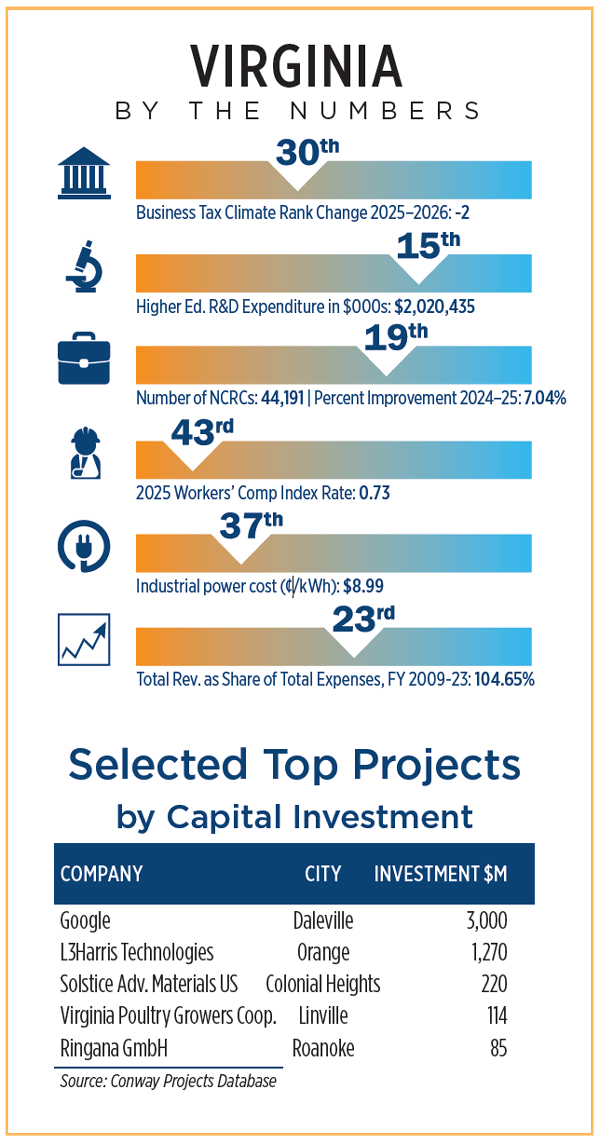
From Radford to Richmond, that is a theme heard often in the Old Dominion. Large, tech-driven industrial companies either originate or relocate in Virginia, and then they never want to leave. Whether it’s the $203 billion data center corridor of Northern Virginia or the $161 billion that Amazon has invested to date into all aspects of its business empire across the state, Virginia is not just earning its recent No. 3 ranking in CNBC’s Top States for Business; it is outperforming notable heavyweights such as Texas, Georgia, Florida and Tennessee.
In Site Selection’s annual Business Climate Rankings for 2026, Virginia checks in at a lofty No. 5, ahead of Florida, Tennessee, Ohio and Arizona. Lucas says Virginia earns this status because “we are the center of the nuclear and data supply chain. When you consider the energy infrastructure required to power America, we are at the forefront of designing, developing and building that infrastructure right here in Virginia.” — Ron Starner