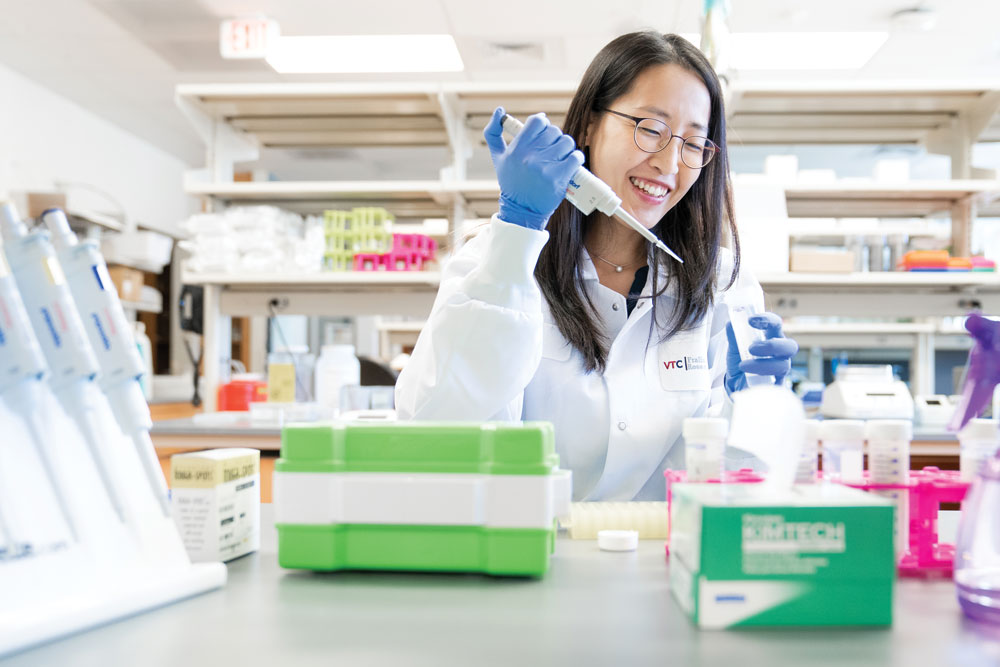
In September and October 2025, Virginia landed $12.5 billion in biopharma manufacturing investment from three of the industry’s giants. Merck & Co. is building a $3 billion Center of Excellence for Pharmaceutical Ingredients and Small Molecule Manufacturing in Rockingham County. AstraZeneca is investing $4.5 billion to build two manufacturing facilities in Albemarle County — one for new drug substance manufacturing and one dedicated to antibody-drug conjugates focused on therapies for oncology indications, according to the company. And Eli Lilly & Company is investing $5 billion in a new facility in Goochland County producing critical drug components and finished medicines.
It’s not a coincidence, and it doesn’t signal sudden success in the pharmaceutical manufacturing sector, which already employs nearly 61,000 Virginians. These companies are tapping into an advanced life sciences ecosystem that in recent years has seen heightened state, federal and private investment aimed at consolidating biopharma manufacturing and supply chains in the U.S., and in Virginia specifically.
“Around the time of COVID, there were increasing concerns around drug shortages, the quality of products manufactured overseas and the need to make supply chains more local,” says Grace Festa, industry director, biopharmaceuticals, at the Virginia Economic Development Partnership (VEDP). “Federal policies and tariffs have accelerated those issues, resulting in companies investing billions of dollars in new U.S. facilities.”
Why Virginia?
“The pharmaceutical industry is very glued to certain manufacturing hubs, and it requires very specialized infrastructure and talent,” says Festa. “Their expectation is that services and resources provided to them are specialized for biopharma manufacturing. They want people actually doing pharmaceutical engineering or technician-level training specifically for the pharma industry.”
Virginia has a long history of innovative technologies from its six R1 universities, adds Festa. “But in the past several years there has been a tremendous amount of effort, attention and investment into building the ecosystem around biopharmaceutical manufacturing and drug discovery.”
Locally Sourced Medications
One example is formation of the Alliance for Building Better Medicine (ABBM), a consortium of government agencies, higher education, economic development organizations, workforce training offices and industry participants to build a biopharmaceutical ecosystem to create a resilient drug supply. It began with a focus on the Richmond-Petersburg region but has since expanded statewide. Federal, state and philanthropic funding of $1.6 billion has been invested in the Alliance in recent years around building drugs better, faster and cheaper, says Festa. It’s funding technician level training at community colleges for pharmaceutical manufacturing companies like Civica, a contract manufacturer of lower cost insulin and other medications in Petersburg. Another is Phlow Corporation, a contract manufacturer and drug reengineering company in Richmond.
“We’re looking at the entire education pipeline, developing new degree programs and making sure there are steppingstones and formalized pathways in place so students can get credit for studies they’ve done if they want to move on to an associate or bachelor’s degree.” Festa explains. More than 10,000 pharmaceutical manufacturing-related degrees and certificates already are awarded annually.
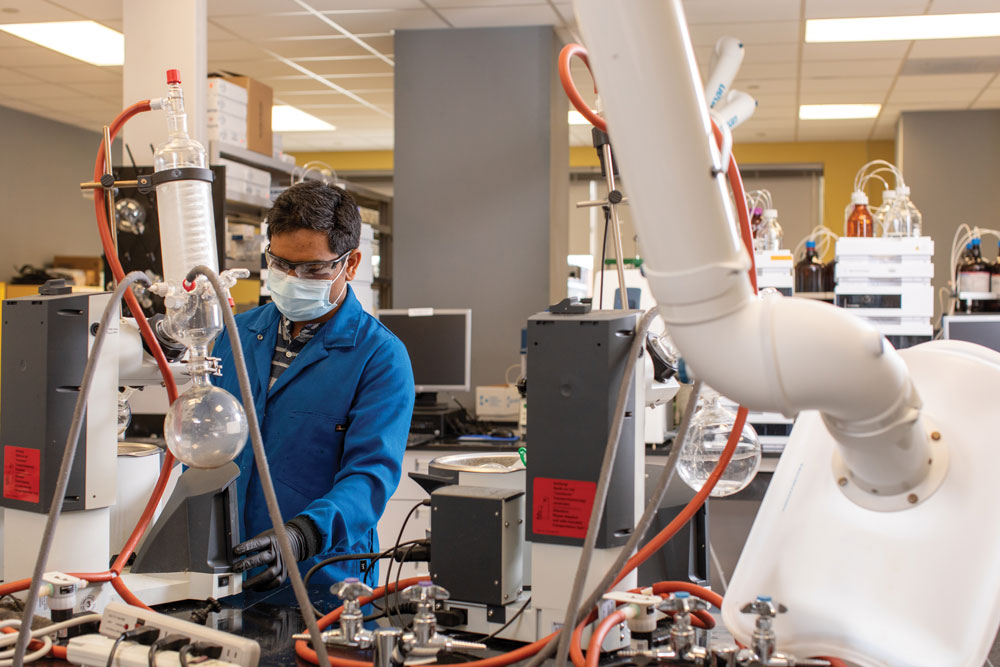
The Medicines for All Institute at Virginia Commonwealth University and its commercial spinoff, Phlow Corporation, received a $354 million contract from the U.S. Biomedical Advanced Research Development Authority to start the first Strategic National Pharmaceutical Ingredient Reserve.
Photo courtesy of Medicines for All Institute
A key member of ABBM is the Medicines for All Institute at Virginia Commonwealth University, which was founded in 2017 with funding from the Bill & Melinda Gates Foundation. Its mission is to “improve access to high-quality medications across the globe by driving down production costs. M4ALL optimizes active pharmaceutical ingredient production and provides access to manufacturers around the world to enhance the security of medicine supply chains.”
Locally Trained Expertise
In October, Governor Glenn Youngkin announced a partnership with AstraZeneca, Eli Lilly and Company, and Merck that commits up to $120 million of private industry investment toward developing the Virginia Center for Advanced Pharmaceutical Manufacturing, his office announced. The three biopharma companies entered into a Memorandum of Understanding with the Commonwealth of Virginia; Virginia Innovation Partnership Corporation, which will manage operations of the Center; five Virginia universities; and the Virginia Community College System to develop the facility, a neutral, industry-led workforce training and education center. It’s forecast to produce 2,000 trained pharmaceutical professionals annually.
“Virginia is building a world-class training hub for advanced pharmaceutical manufacturing and AstraZeneca is proud to help power it,” said AstraZeneca Chief Executive Officer Pascal Soriot. “This partnership will unlock a diverse pipeline of highly skilled talent, strengthen U.S. supply chains, and accelerate the delivery of innovative medicines to patients. By working with Virginia’s leading universities and community colleges, we’re creating clear pathways from classroom to career while also advancing health for patients across America.”
The Commonwealth of Virginia, too, provides workforce training and a range of other resources through its Virginia Talent Accelerator Program. Launched in 2019, VTAP has played a critical role in helping companies get their new facilities operational by providing job recruitment media, pre-hire training and assessments, compliance and skills training, organizational development and leadership skills training, among other offerings. The program costs nothing for participating companies and is highly customizable to meet their requirements.
“What looks like overnight success,” says Festa, “we’ve been building the pieces of for years.”
This Investment Profile was prepared under the auspices of the Virginia Economic Development Partnership. For more information, visit vedp.org.