An industrial boom has unfolded in southern Dallas County, Texas, and the City of Wilmer — first established as a railroad stop 155 years ago — is in the thick of it.
The investments have come from diverse sectors, including logistics, advanced manufacturing, data centers and clean energy. Now it’s time for commercial, retail, healthcare and quality-of-life amenities to kick in, even as the industrial economy continues to roll.
One manufacturing operation set to see productivity continue is Austin-based solar module and battery company T1 Energy, which finds itself in the enviable position of ramping up solar module production to help the U.S. catch up to China in a Wilmer facility it purchased from China-based Trina Solar several years ago. Today, T1 is set to gain competitive advantage from an August decision by the Trump Administration, following an extensive Section 232 investigation, to take steps to prevent market dumping and manipulation and strengthen the U.S. domestic solar industry.
“This is a win for advanced American manufacturing and investment in domestic energy supply chains,” said Dan Barcelo, chairman and CEO of T1 Energy. “For too long, America forgot how to build. Now, we’re building energy again, which is foundational to prosperity.”

Photos courtesy of T1 Energy
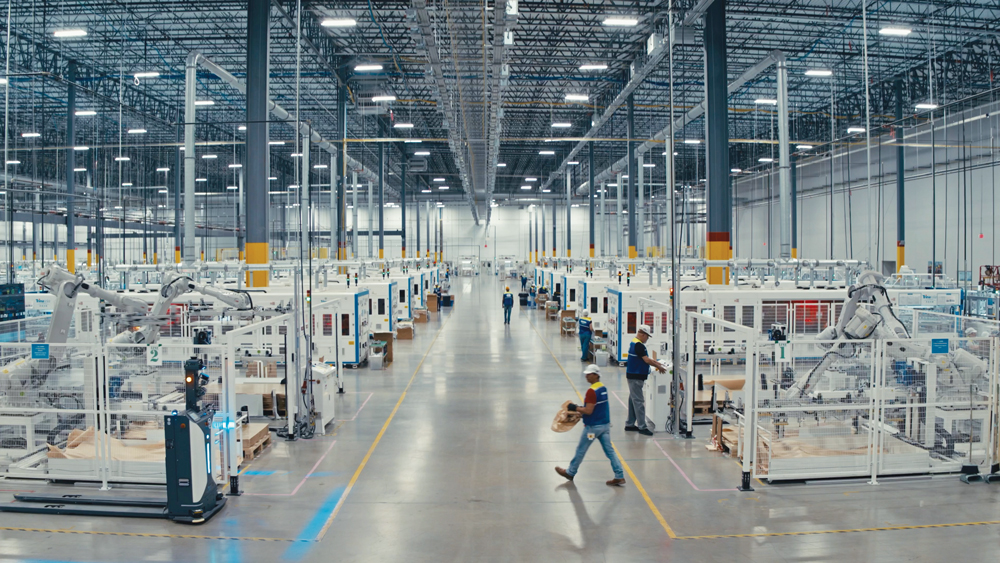
With contracts in place for American polysilicon and wafers from Hemlock Semiconductor and Corning in Michigan, T1’s 5-GW, 1.35-million-sq.-ft. solar module facility in Wilmer, known as G1_Dallas, can continue to produce enough solar modules annually to generate electricity equivalent to the usage of more than 1 million American homes. T1’s 2.1GW solar cell fab, G2_Austin, is under construction and expected to produce its first solar cells in Q1 2027. The company also figures to help the solar power sector do its part to meet the unprecedented need for power to fuel the growing buildout of AI and hyperscaler digital infrastructure.
At the time of its Q1 2026 earnings call, T1 Energy’s G1_Dallas facility was supporting more than 1,200 jobs. When I spoke to T1 COO Jaime Gualy in August, that number was up to 1,600, with all seven lines running 24/7 nearly every day of the year, producing over 22,000 modules daily. “The goal is to be the largest PV-based American manufacturer,” he says. And that begins in Wilmer. “We have a multiplier effect, providing a lot of earning potential to the whole area, not just Dallas County,” he says. The multiplier effect is community-focused too, including growing efforts to recruit military veterans and to interact with the area’s community colleges, technical high schools and STEM elementary schools.
The veteran renewable energy and finance executive says T1 is helping to lead “the U.S. solar market rebirth.” While the company is global and national in its supply chain, “we’ve had conversations with frame manufacturers and solar manufacturers looking at the Dallas area,” he says, in order to serve T1 and others in the region.
Gualy knows the Texas highways well, as he’s based in Houston and routinely travels the “Texas Triangle” to visit the company’s sites in Wilmer and the Austin-area community of Rockdale. He says Wilmer’s logistics setup is top notch: I-20, I-35 and I-45 in proximity; a 3.5-hour drive to the Port of Houston (or rail via the UP intermodal hub nearby); and DFW’s robust logistics ecosystem. “We have a lot of warehouses used to house our modules,” Gualy says, part of a logistics boom in Wilmer and neighboring communities that includes major investments from the likes of Medline and Walmart. “There are probably six large logistics companies building,” he says.
“Throughout the buildout, ramp-up and hiring, the City of Wilmer, Dallas County government and the City of Lancaster have really been open arms in identifying what we need and helping us get there,” says T1 Energy Senior Vice President of Government Relations and Public Affairs Jason Eberstein, who puts the size of the facility in terms all Texans understand: 26 football fields. The technical terms are well understood too, even by schoolchildren. T1 Energy Director of Communications Emily Buczynski thought a tour group from STEM elementary school Eddie Bernice Johnson STEM Academy might be bored, “but it was the exact opposite,” she says. “They were borderline begging for more time, and thought the robots were really cool” in the 95% automated facility. “They saw that ‘Hey, this is an actual career you can have when you grow up.’ ”
Wilmer is growing up right alongside them, with such new amenities as a new Parkland Regional Hospital, two Marriott hotels and 10 acres of multifamily development. Eberstein has seen increasing interest from national and regional restaurant and hospitality chains the area hasn’t had before. “I can tell a difference in just two years,” he says. “I think Wilmer really has a bright future.”

“In these smaller cities, the permitting process is not as cumbersome as in a large metro city.”
— Mike Rader, President, Prime Rail Interests LLC and Prime 45 Development LLC
Ready for More
So does longtime Dallas-area developer Mike Rader, president of Prime Rail Interests LLC and Prime 45 Development LLC, whose resume includes Sunridge Business Park, Prime Pointe Park, and the $100 million Union Pacific intermodal facility — a catalyst for the 75,000-acre Dallas County Inland Port’s expansion nearby. Over 25 years his efforts have catalyzed plenty of industrial build-out around the area’s intermodal capabilities. “We have all the best land for logistics in North Texas,” he says, aided by the minimized drayage time the inland port provides. Development in Wilmer and adjacent communities has made South Dallas “the fastest-growing industrial area in Texas” over the past five years, he says.
“In these smaller cities, the permitting process is not as cumbersome as in a large metro city. They’re all receptive in trying to grow their cities and tax bases.” As a consequence, he says, “The tax base has grown immensely, the population has been growing, and now we’re getting commercial along the interstate. It’s taken state, county and city assistance, working with cities to put together incentive packages. It’s been a comprehensive effort to bring development to the corridor.”
There’s more to come, says Laura Freeland, executive director of Dallas County Inland Port (DCIP), thanks in part to intentional work to help labor get to the development.
“Thanks to the partnership between our public transit partners (DART and STAR Transit), residents within Wilmer and within the region can use the microtransit transportation service to get to the doorsteps of the Inland Port employers,” she says. Between 2021 and 2023, the Inland Port went from 30,000 direct jobs to 46,000 and from $2.2 billion in labor to $6.2 billion. “We expect similar growth when we receive the 2025 number,” she says.
“DCIP works to move critical infrastructure priorities forward, strengthen the connection between employers and the regional workforce, and prepare the Inland Port for changes in logistics and automation. Its direction is clear: Turn regional growth into coordinated investment, stronger access to opportunity and lasting value for the communities that call the Inland Port home.”
Wilmer is one of those communities, and a place a rising number of people and companies want to call home.
This Investment Profile was prepared under the auspices of the City of Wilmer. For more information, contact Interim Economic Development Director Antoine Long at along@cityofwilmer.net or visit WilmerEDC.com.