Name a sector and pick an industry. Chances are the homebase, or some level of operations, for any top-rated business can be found in Texas.
From 54 Fortune 500 giants to scaling startups, the Lone Star State has a proven record of tackling business needs and attracting companies looking to scale. In over a decade, Texas has become the ideal choice for nearly 330 headquarters relocations.
Corporate leaders aren’t merely taking advantage of the state’s sheer size, but rather it’s low operating costs, strategic U.S. positioning, well-traveled transportation infrastructure network and zero corporate or personal income taxes. The state’s pro-growth business climate has earned accolades — securing Site Selection’s Governor’s Cup for the 14th consecutive year in 2025 — because when you’re moving at the speed of business, it’s enough to advocate for uprooting decades-old operations for good.
“Over the past several years, Texas has made a noticeable effort to embrace the business community. In doing so, it has created a policy and regulatory environment that can allow the company to maximize shareholder value,” said ExxonMobil Chairman and CEO Darren Woods, speaking to the company’s March 2025 announcement of its recommended Texas redomiciliation. “Aligning our legal home with our operating home, in a state that understands our business and has a stake in the company’s success, is important.”
ExxonMobil’s Board of Directors unanimously voted in support of changing the company’s legal domicile from New Jersey to Texas, noting Texas’ regulatory and legal environment, backed by modern business statutes and the Texas Business Court, resolve complex disputes efficiency and support sound decision-making. The Board also pointed out that shareholder rights are comparable between the two states under law, although in some areas, Texas is stronger.
In 1989, the company moved its HQ operations to Spring, Texas. Now, the state is home to 75% of ExxonMobil’s U.S. workforce and 30% of its global employees. If shareholders vote in approval of the redomiciliation proposal at the company’s 2026 Annual Meeting of Shareholders, one of the nation’s largest oil producers will cease 144 years of incorporation in New Jersey.
AECOM, Caterpillar Inc., CBRE, Chevron, and Tesla are among the Fortune 500 companies that have relocated to the state since 2020, all but one coming from California. On a greater scale, of the 200 total HQ relocations from 2020 to 2024, California was the original location for 98 of those moves.
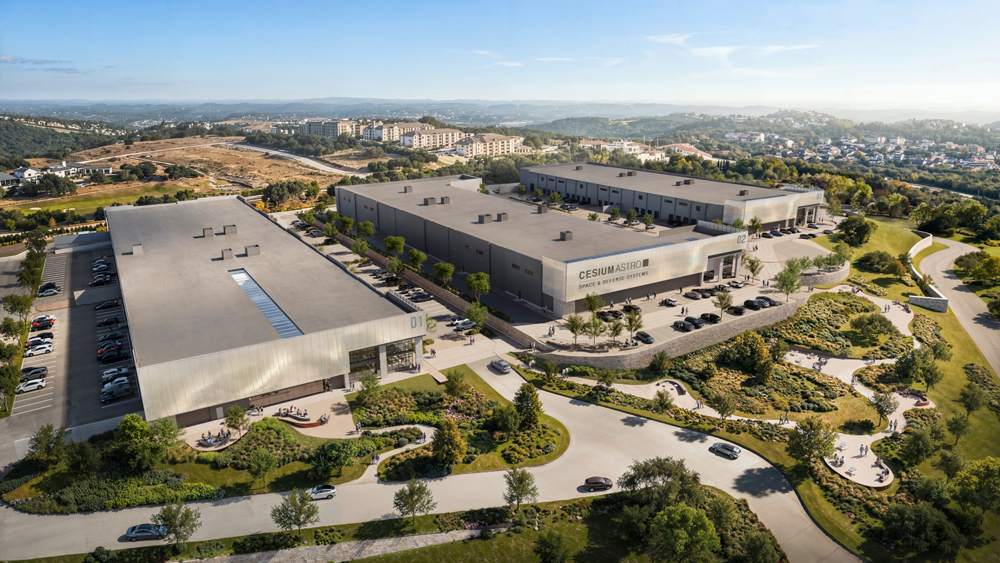
The West Austin Business Park was selected by CesiumAstro to expand its Texas HQ and increase space and defense systems production capacity.
Rendering courtesy of CesiumAstro
When You Get It, You Keep it
When time came to scale operations for homegrown aerospace engineering startup CesiumAstro, there was never a question of whether or not to stay in Texas. Outside of Austin, the company is solidifying its Bee Cave foundation by expanding its new global HQ to the West Austin Business Park, having acquired the property in early 2026.
“Texas has been our home for nearly a decade, and this expansion of our global headquarters in Bee Cave is a natural progression of that commitment to the state and our local community,” says CesiumAstro CFO Kenneth Smith.
The $500 million investment provides the company access to almost 270,000 sq. ft. of advanced manufacturing space and plenty of room to scale within the park. CesiumAstro will focus on precision electronics, spacecraft manufacturing and advanced engineering operations. The facility will allow the company to design, build and test AI-enabled, mission-critical space and defense systems within a single location.
“The region offers what we need to scale,” says Smith. “Deep technical talent, a strong aerospace ecosystem and partners who understand the long-term infrastructure required to lead in space and defense.”
CelsiumAstro’s HQ investment is partly supported by funding from the Export-Import Bank of the United States and the state’s commitment to space innovation and advanced manufacturing, according to the company’s official press release. Operations will roll out in a phased timeline, as welcoming these new capabilities will translate to increased capacity and availability of more than 530 fresh high-tech roles in the region.
“Our employees live here, our operations are here and as we grow, in Austin, from 248 to 782 employees by 2030, we’re building both the physical capacity and the workforce needed to deliver mission-critical systems at scale,” says Smith.
Money Moves Down Y’all Street
The Partnership for New York City recently released a report dubbed, “Texas’s Competitive Edge,” detailing that in 2024, Texas had officially surpassed New York as the state with the most financial services employees, excluding insurance and real estate. At the moment New York’s financial services industry remains more productive, although Texas’ gross regional product rose by 121% in the past decade compared to 72% in New York. The rise of the state’s financial services industry has swiftly turned a new chapter in North Texas. The financial services corridor of Y’all Street continues to transform diverse sector activity within the Dallas metro, attracting global industry giants looking to capitalize on the hub’s impact.
Over 380,000 workers are currently employed on Y’all Street. With the introduction of a $60 million regional hub for The Bank of Nova Scotia in February 2026, an additional 1,020 jobs have hit the region. Scotiabank, one of the largest banks in North America, has said its new positioning in Dallas will enable the multinational financial services provider to strengthen its U.S. platform across an expanding portfolio.
The city will soon welcome the launch of trading for the new Texas Stock Exchange (TXSE) in 2026, serving U.S.-based and international issuers, investors and market participants. TXSE was designed to address cost barriers associated with going and staying public, aiming to provide greater alignment between issuers and investors. The platform provides trading, listing of corporates, Exchange-Traded Products, auctions and a range of data products. Backed by $275 million from investors that include Bank of America, BlackRock, Charles Schwab, Goldman Sachs and J.P. Morgan, TXSE became the most well-capitalized equities exchange in history to be approved by the U.S. Securities and Exchange Commission.
Operations for TXSE are housed at the Texas Market Center, which aside from hosting its executive offices will also showcase TXSE listings’ quotation and trade-visibility services; offer issuer and sponsor co-branding support; serve as a conference center for regional, national and global events; and establish a bell-ringing venue and broadcast center.
The highly anticipated launch of TXSE follows the New York Stock Exchange’s February 2025 decision to reincorporate its Chicago base to Dallas and launch NYSE Texas. The fully electronic equities exchange HQ move is a natural fit to the region, supported by the state’s concentration of NYSE-listed companies. That level of proximity to regional clientele was precisely what led Nasdaq to announce its new regional HQ in Dallas a month later. Two years ago, Nasdaq’s regional management restructuring for its Listings Franchise created a new division covering Texas, the Southern U.S. and Latin America. Of the corporation’s over 2,000 Texas and Southeast U.S. clients, about 800 partners are based in Texas — in addition to the more than 200 Nasdaq-listed businesses headquartered in the state.