
Refreshed report card gives North Carolina outstanding marks.
If you’re ready to graduate your company’s operations to the next level on a foundation of skills and talent, North Carolina is a good place to enroll.
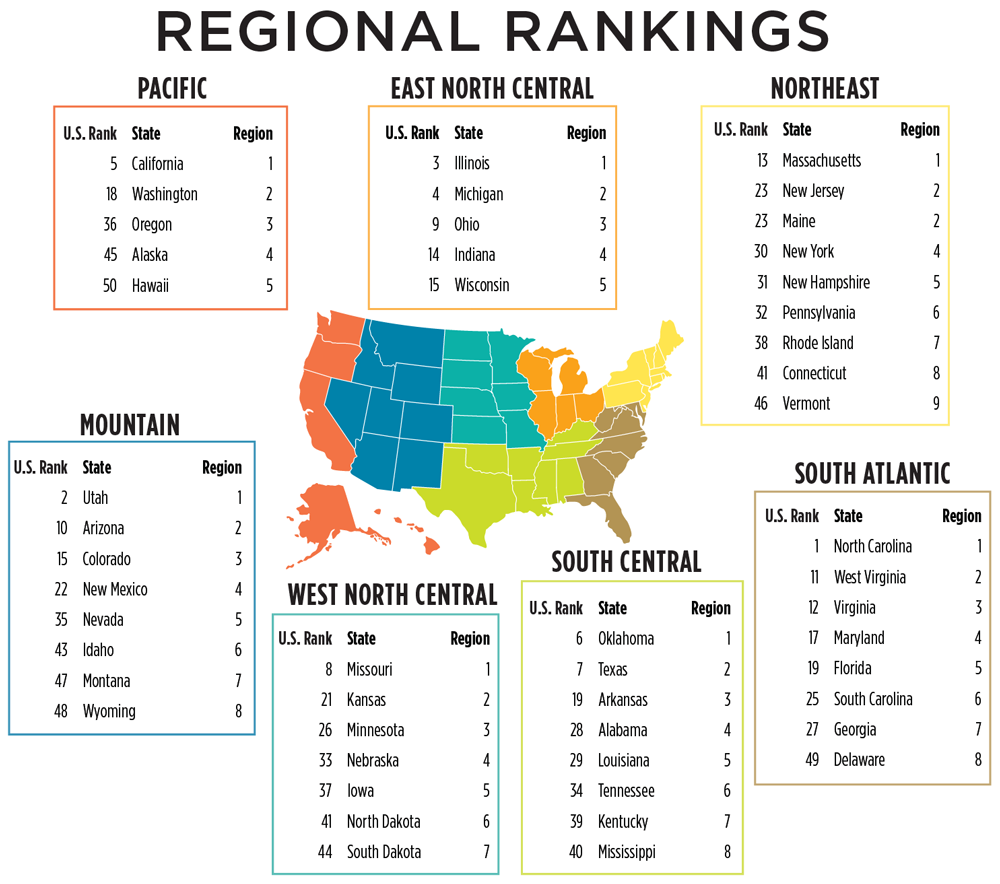
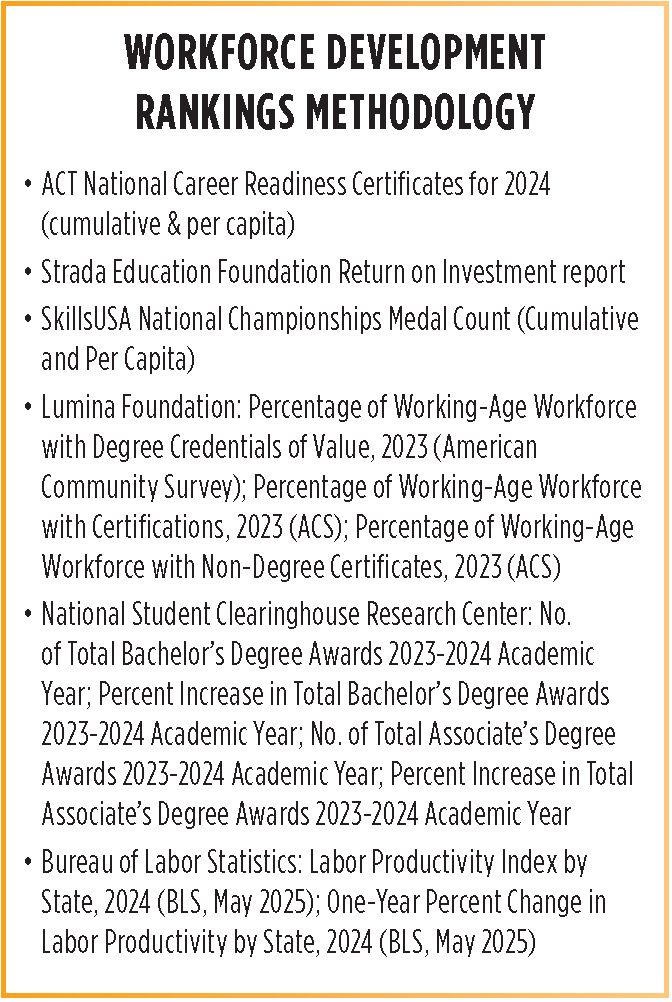
So say the results of Site Selection’s 2026 Workforce Development Rankings, based on an updated index of criteria that, like a good workforce, know how to get after it. We also have introduced more per-capita metrics. Top-performing states hail from all corners of the country.
Site Selection rankings published throughout the year use the publication’s Conway Projects Database of corporate end-user facility investment projects to take the measure of regional economic development agencies. So it only makes sense that any measure of state workforce development take into account that workforce’s prowess, whether measured by credentials, certificates and degrees; technical skills and productivity; or something equally important to employee and employer alike: return on investment.
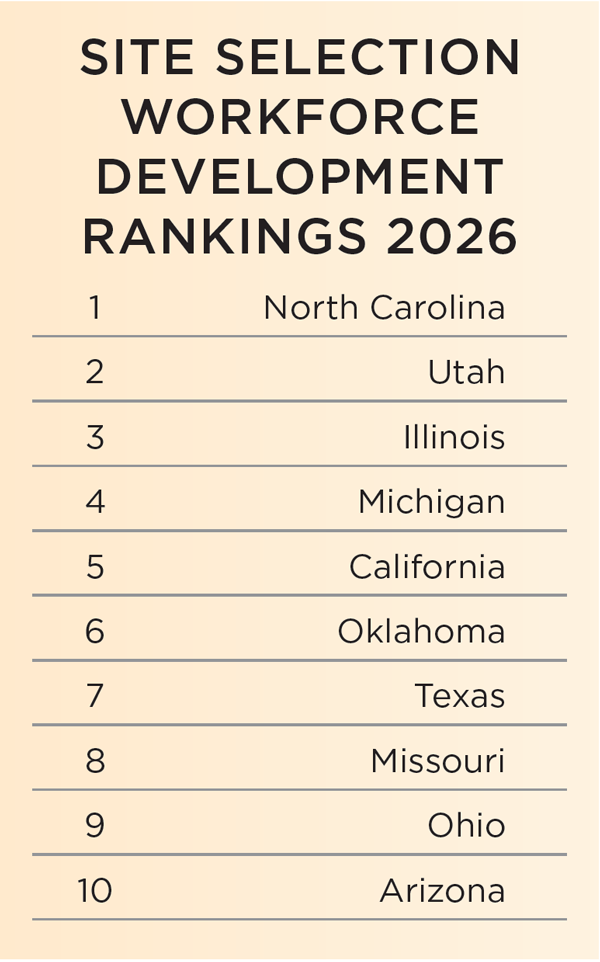
Thanks to partners like Lumina Foundation, ACT and Strada, we have even more metrics that home in on skills and credentials that have ROI and value. And we added BLS workforce productivity measures.
“Site Selection’s revised ranking system underscores what we know to be true: States thrive when their people have the skills and credentials that drive economic growth,” says Lumina’s Data and Measurement Strategy Director Chris Mullin.
What’s North Carolina doing right?
“North Carolina’s strength is our people,” says North Carolina Governor Josh Stein. “Our excellent public schools, community colleges and universities produce hundreds of thousands of talented graduates each year.” Noting that collaboration among businesses, educational institutions and governments was key to 2025 being the state’s best year of job announcements ever, he says, “We will continue to invest in our people and expand pathways that prepare more people for the career opportunities being built here. With strategic leadership from my Council on Workforce and Apprenticeships, North Carolina will not be outworked when it comes to workforce development.”
“North Carolina’s talented people give us our competitive edge, and our workforce system is increasingly aligned with economic development to meet the needs of growing, innovative businesses,” says N.C. Department of Commerce Secretary Lee Lilley, who is also a co-chair of the Governor’s Council on Workforce and Apprenticeships.
“We’ve been intentional about state credit mobility,” said Andrew Gardner, associate vice president of workforce strategies for the North Carolina Community College System. I met him in Durham at the final convening of the Institute for Citizens & Scholars Higher Education Media Fellowship program last summer, a program focused on reporting stories about career and technical education (CTE). Focusing on core skills and leveraging apprenticeship to learn and earn at the same time, the system’s leaders also know that “as you work your way up the career ladder, you need crosswalks,” Gardner said. “We’re trying to be there for the lifelong learner.”
That includes partnering with industry, such as the consortium of energy employers looking to increase diversity among electrical line workers or the system’s NCEdge Customized Training program, which between July 2024 and June 2025 supported 319 total workforce development projects serving 848 new and existing companies. And it includes innovation, such as a baseline AI course developed with input from industry and, beyond that, employing an AI expert, Dr. Lane Freeman, to visit all 58 system colleges to talk about incorporating AI into other coursework.
Success also means getting students in the door. A new program that made its debut with the 2025-2026 school year is NC College Connect, whereby around 62,000 students were informed about where in the state they had already been accepted into college automatically.
Financial support includes $55 million from the state over two years to expand health care programs as well as $36.5 million — the largest private grant ever — from Arnold Ventures to fund Boost, an accelerated college-to-career program. The health care investments helped fund 108 programs across all 58 community colleges, including 32 associate degree in nursing and practical nursing programs, according to Gov. Stein’s office. Last year, the UNC System also invested $29 million in expanding nursing programs at 12 public universities and Area Health Education Centers.
Focused on Talent
There is innovation in funding too in the form of Propel NC, a new model championed by Lt. Governor Rachel Hunt that incentivizes funding programs to meet workforce demand. It’s part of her “Future-Ready North Carolina” platform that also includes tackling child care and early childhood education. However, as of early December, North Carolina was the only state in the country that still had not passed a budget.
“Historically, programs I oversee like short-term training were funded at a different level than 2-year degree programs,” Gardner explained. Propel NC “would give preference to high-wage, high-demand careers like health care, construction, etc. They want it fast, here and now. This is a skills-based era.”
Despite the lack of state budget, something must be working … or rather, a whole lot of someones must be working: Economic development wins in 2025 brought more than 33,000 jobs to the state. Vulcan Elements in November announced it would invest $1 billion and create 1,000 jobs at a new rare earth magnet facility located at the company’s base in Benson in the Raleigh area.
The decision came after a year of multi-state fact-finding. Among the key partners helping the project across the finish line were North Carolina Department of Commerce’s Division of Workforce Solutions, the University of North Carolina System, the North Carolina Community College System and Johnston Community College. Substitute in Durham Technical Community College and you have a recipe for success in financial services firm Aspida’s decision to create its own 1,000 new jobs (along with a $28 million investment) in Durham.
“Vulcan Elements placed a special focus on workforce and talent during the site search, prioritizing regions where it could recruit top talent from relevant industries, across multiple levels of experience — from PhDs to engineers and technicians,” the company stated. “The Town of Benson’s proximity to scores of universities, community colleges and workforce training programs, numerous powder metallurgy and advanced manufacturing facilities, and significant military and veteran communities — including Fort Bragg — distinguished the site and offered clear advantages for the company’s growth plans.”
Show Us Your Skills
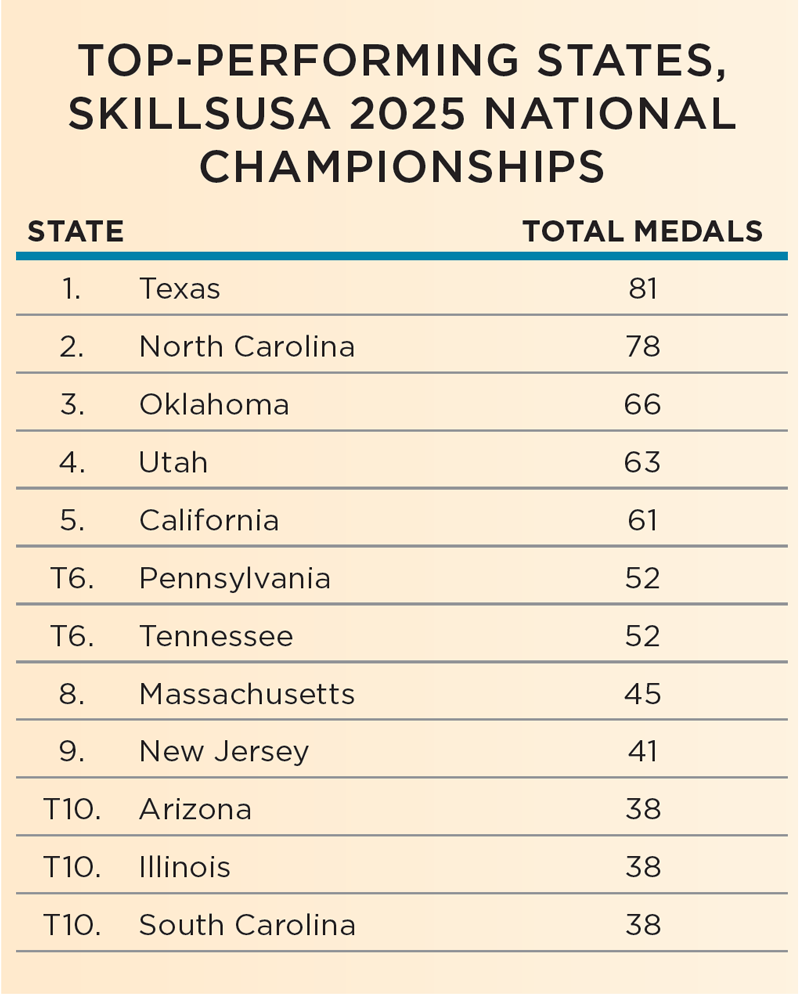
One of the new elements to Site Selection’s Workforce Development Rankings is data from SkillsUSA. The 2025 SkillsUSA National Leadership and Skills Conference in Atlanta last July drew around 18,000 attendees and more than 6,800 entrants in 114 technical skills competitions across specialties from welding, drone piloting and 5-axis machining to baking and barbering. More than 443,000 career and technical education (CTE) students and teachers join SkillsUSA annually. And more than 850 companies support the organization as business and industry partners.
Every year SkillsUSA provides me with the medals data after the competition so I can tally up which states and which institutions earned the most. Seven of the top 10 states and ties for SkillsUSA medals also appear in Site Selection’s overall rankings this year. Measured by gold medals alone, Oklahoma comes out on top with 39, followed by Tennessee with 27. Texas and North Carolina are home to the most institutions earning medals of any kind, with 39 and 27, respectively.
Among institutions, Somerset County Academy for Health & Medical Sciences in New Jersey tops them all with 18 medals, 17 of them gold. Dubiski Career High School in Texas earned 16 medals, while Catawba Valley Community College in North Carolina took third place with 15 medals.
Looking to sophisticated talent metrics to evaluate locations? It may pay to add these straightforward state and institutional tallies to the matrix. And it may be worthwhile to further study how specific programs at these leading institutions match up with your company’s workforce development goals.