Kentucky’s legacy bourbon industry draws billions by playing the long game.
Neat, over an ice cube or served in your favorite mixed cocktail, bourbon is certainly a crowd favorite. It is an American whiskey, derived from corn and aged in newly made oak barrels, and Kentucky is widely recognized as the global center of bourbon production, with 95% of the world’s bourbon made in the Bluegrass State. In its over 200 years of being produced, the amber-gold commodity has seen considerable change and diversification.
“Broadly speaking, two innovation categories are moving Kentucky’s storied distilling industry into new territories,” says Jack Mazurak, director of governmental & regulatory affairs at the Kentucky Distillers’ Association (KDA). “The rise of ready-to-drink cocktails — or RTDs — in the past several years is bringing flavor-consistent, super portable, accessibly priced, low-ABV spirits drinks to thirsty consumers. Second, think of Kentucky’s 17.1 million barrels of aging spirits as a baseline playground for distillers, master blenders, brand wizards and those blessed with supertaster genetics. Then add in extra-aged expressions, cask-strength releases, toasted and double-barreled options, and the galaxy of varieties begins to take shape as the premiumization of Kentucky bourbon continues.”
The state’s distilled spirits industry contributed a record-breaking $10.6 billion in economic output from 2024-2025, which includes $6.9 billion in direct output and $3.7 billion in indirect and induced output, according to a 2026 economic and fiscal impact report prepared for KDA. Still, the industry faces some headwinds due to tariffs and changes in consumer demand.
Kentucky’s distilled spirits industry contributed a record-breaking $10.6 billion in economic output from 2024-2025, which includes $6.9 billion in direct output and $3.7 billion in indirect and induced output.
— Economic and Fiscal Impacts of Kentucky’s Distilling Industry, 2024-25
Distilling the Spirits Market
Asked how Kentucky distillers are adjusting business operations to meet these turns in the bourbon market, Mazurak explains that “zooming out, two factors set the current stage. Across 15 years of capacity increases at heritage distilleries and the founding of scores of new distilleries across Kentucky, the graph line of production’s steady build intersected the past couple years with U.S. demand’s quicker arc. This happened at a time when export markets are flat or down due to trade-related pressures, opposite of earlier projections. So, Kentucky now has a record 17.1 million barrels of spirits aging, 16.1 million of which are bourbon.
“The second factor is that ours is a long-term industry. Barrels filled this year are aimed at shelves in 2030, 2032 and beyond. Understanding those two factors explains why many distilleries are realigning their production and inventories to meet changing markets’ demand.”
Kentucky distilleries saw over $2.5 billion in investment projects announced from 2023 to 2025, according to data from the Kentucky Cabinet for Economic Development.
That includes a significant investment by the Sazerac Company, producer of Buffalo Trace and Eagle Rare bourbon, as well the incredibly sought-after bottles of Pappy Van Winkle and Blanton’s (both Pappy and Blanton’s are made at Sazerac’s Buffalo Trace Distillery in Frankfort, Kentucky). Sazerac, headquartered near New Orleans in Metairie with principal offices in Louisville, Kentucky, announced in October 2025 that it would invest $1 billion to construct new warehouses in Campbellsville, located in central Kentucky. Sazerac also announced a $38-million investment in upgrading its bottling plant in New Albany, Indiana, part of the Louisville metro area.
From a 2025 KDA membership survey published in the 2026 Kentucky bourbon impact report, 55 members answered that they planned to invest capital in distillation ($282.3 million), bottling/production ($320.9 million), warehouses/storage ($675.2 million), visitor centers/tourism ($127.4 million) and office space ($24.5 million) from 2025 to 2029.
Lofted Spirits, the largest distiller of Kentucky custom contract whiskey and manufacturer of Bardstown Bourbon Company and Green River Distilling Co., began construction to expand its bottling plant in Bardstown, Kentucky, in late 2025. The new 4,000-square-foot facility will almost double the site’s footprint and increase annual production capacity from 10 million bottles to 35 million. Presently, the Bardstown plant does contract bottling for bourbon whiskey, vodka, rum, cream liqueurs and RTD products. The improved site is expected to be operational by the second quarter of 2026.
“Our commitment to our customers is unwavering,” says Mark Erwin, Lofted Spirits CEO, when the expansion was announced. “We were built as a contract manufacturing facility, and we continue to demonstrate our dedication to supporting the ambitions of our customers as a grain-to-glass, one-stop-shop for all of their production and bottling needs. While many organizations are pulling back, we are investing to meet the moment and help our customers grow.”
Overcoming Global Challenges
In 2019, the Bluegrass State made $488.6 million on whiskey exports, its highest ever on record. This bubble ebbed the following year in 2020 after a tariff war involving U.S. metal imports resulted in several non-U.S. countries raising or placing retaliatory tariffs on American distilled spirits and other imports, causing a 35% decline in Kentucky distilled spirits exports that year. In 2024, Kentucky whiskey exports totaled $363 million, showing a strong recovery and trending toward its previous record figure.
Though the United States has paused, or in the case of the 2018 import taxes, completely lifted many of these tariffs, the echo of the trade spar still hovers over the American bourbon industry. According to the 2026 KDA impact report, Kentucky whiskey exports declined in June 2025, but improved from July through October after tariff increases were halted.
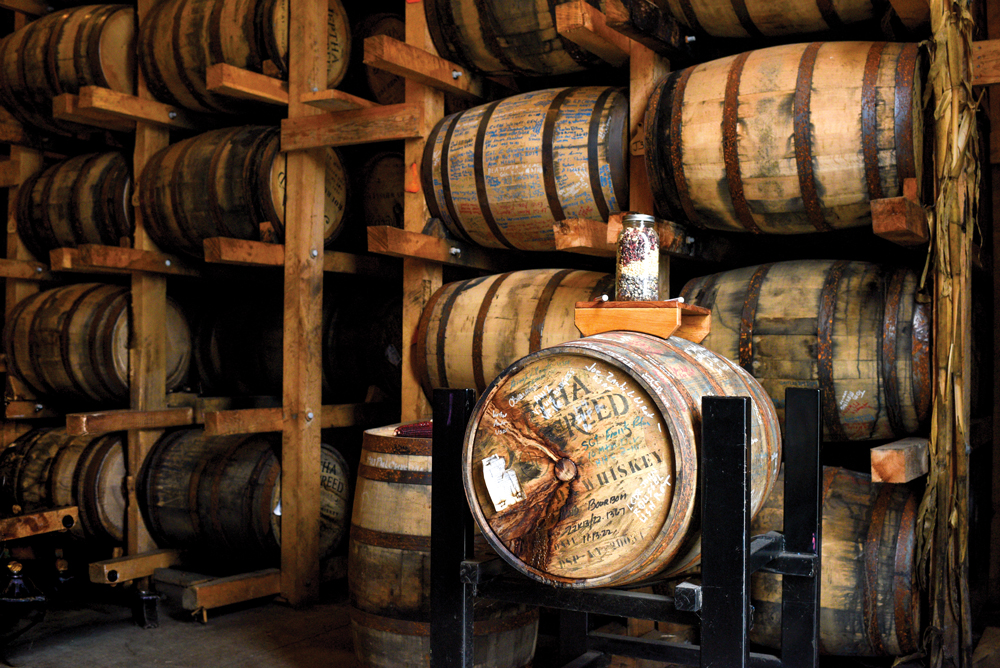
In 2024, Kentucky barrel exports totaled almost $267 million, with the countries of Japan, Canada, Ireland, India, China and the United Kingdom buying the most spent barrels from the Bluegrass State.
Photo by Charity Hedges courtesy of CED
According to the legal requirement of what is considered “bourbon,” the oak barrels used to age the product may only be used one time. The resale market for used Kentucky barrels is immense. In 2024, Kentucky barrel exports totaled almost $267 million, with the countries of Japan, Canada, Ireland, India, China and the UK buying the most spent barrels from the Bluegrass State. While not matching its 2024 figures this past year, this portion of the bourbon industry remains a major factor in the sector’s future growth.
Despite the tariff tussle, bourbon processing techniques are blooming.
“There’s the incredible crescendo of finishes pushing bourbon’s traditional boundaries,” Mazurak says. “Those include whiskies given secondary — and even tertiary — barrel finishes in casks that once held sherry, red wine, Cognac, Port, Armagnac, maple syrup or other flavor-lending products. Similarly, distilleries are creating endless varieties of finishings by transferring bourbon into exotic wood casks — Japanese Mizunara oak, French oak, Brazilian Amburana, Hungarian oak and others — or adding in soaking staves made from alternative wood types, such as cherry, sugar maple and apple.”
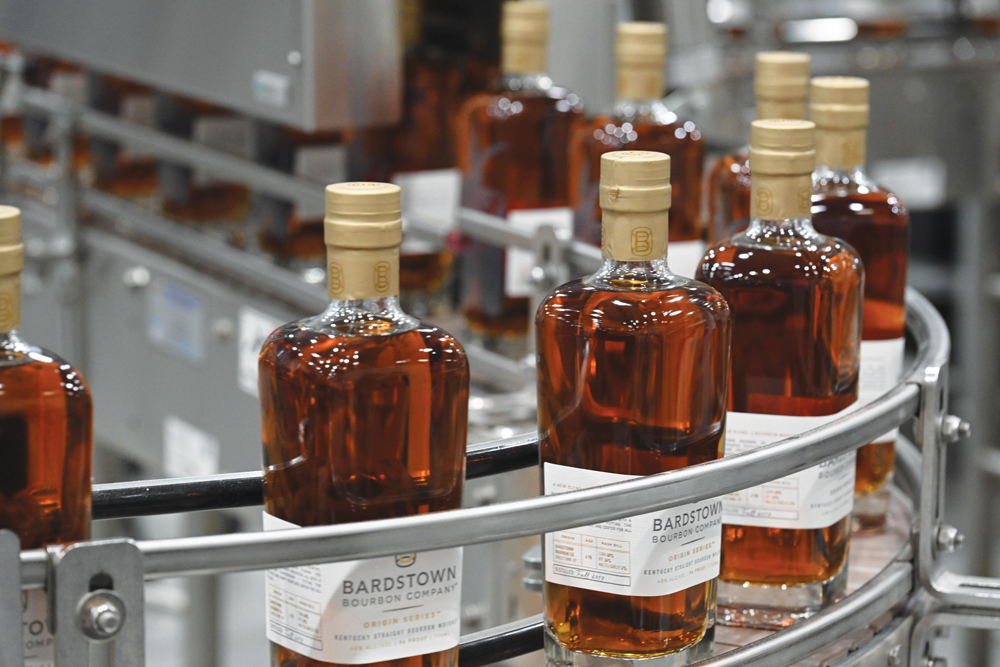
Lofted Spirits, an independent copacker that handles Bardstown Bourbon Company products, announced a $38 million expansion of its Bardstown facility co-packing line with a high-speed, small format line.
Photo courtesy of Lofted Spirits
Trade partnerships are being struck to lift the industry. In February 2026, Kentucky Congressman Andy Barr, co-chair of the Congressional Bourbon Caucus and vice-chair of the Congressional India Caucus, announced a new U.S.-India trade framework that should encourage growth in the Kentucky bourbon industry, which follows India reducing its tariff on American bourbon from 150% to 100% in February 2025.
Meanwhile, tourism around Kentucky bourbon is more popular than ever. The Kentucky Bourbon Trail (KBT) remains a strong driver of the state’s tourist industry.
“With millions of people traveling to the Bluegrass State each year for KBT tours, you see Kentucky’s distilleries deepening their tourism experiences,” Mazurak says. “They’re adding offerings such as live music venues, master-distiller-guided pairings, exclusive-access programs, vintage bourbon portfolios and satellite tasting rooms. Many Kentucky cities, communities and venues are creating bourbon events, theme weeks and festivals that draw crowds from multiple states. With longstanding festivals providing tent poles in the summer and fall, these new regional and local events are increasingly scheduled during shoulder months that attract attendees — and their significant economic impact — in what would otherwise be off-peak times.”