
Longevity is one thing. A living, vibrant legacy aimed toward the future is another level altogether.
Examine the layers of civic and industrial infrastructure across Nashville, the state of Tennessee and the entire mid-South and you’ll find evidence of John Bouchard & Sons (JBS), the machine shop turned multi-division infrastructure and services company that celebrated 125 years in business in 2025. The company’s range of work not only demonstrates the state’s range of advanced manufacturing talent and processes but forms a thread connecting advanced manufacturing operations across multiple industries.
Not to be confused with global protein company JBS Foods, this JBS has spent decades serving food and beverage companies as well as clients across the industrial and organizational spectrum, from Starbucks and Coca-Cola Bottling to Churchill Downs, Memphis International Airport, Oak Ridge National Laboratory, Vanderbilt University, Redstone Arsenal in Alabama and Eastman Chemical Company in East Tennessee.
The range of JBS disciplines resonates with activity by companies such as Wisconsin-based A.O. Smith Corporation, a global leader in water heater manufacturing and water treatment that has operated in the state since its 2001 acquisition of State Industries. In April 2025, the company opened a new $33 million Product Development Center (PDC) in Lebanon, Tennessee, a 60,000-square-foot R&D facility on the Lochinvar campus that aimed to house more than 120 new and existing employees, with room for expansion. “The new center brings together the company’s North America Water Heating commercial engineering and platform electronics functions with Lochinvar engineering to support commercial product development, including heat pump water heaters,” the company said.
“The PDC is a future-focused innovation hub that enables us to design heat pump water heaters and other sustainable products that not only are in demand now but will continue to be a major emphasis for us in the coming years,” said Chief Technology Officer Bob Heideman. “We’re excited about the possibilities that lie ahead, and we know from experience that a facility like this gives innovation a space to thrive.”

“We see advanced manufacturing not as a single industry, but as a network of capabilities they can depend on for reliability, craftsmanship and long-term relationships.”
— William D. Morgan, President, John Bouchard & Sons Co.
“Advanced manufacturing in Tennessee isn’t just about what happens on the factory floor,” John Bouchard & Sons Co. President William D. Morgan told me. “It’s the full ecosystem of infrastructure, skilled tradespeople and mechanical expertise that keeps those facilities running efficiently every day. At John Bouchard & Sons, we’ve spent 125 years building and sustaining the mechanical systems behind high-tech industry, from compressed air systems and pumps to piping and electrical infrastructure and even custom-machined components. In that sense, we see advanced manufacturing not as a single industry, but as a network of capabilities they can depend on for reliability, craftsmanship and long-term relationships.”
Known initially for its iron castings and manhole covers (look for the JBS diamond logo on a manhole cover near you), the company’s divisions today encompass equipment sales and service, iron construction castings, machine services and construction, including full industrial fabrication capabilities and mechanical, electrical, plumbing and fire protection contracting. And it’s all emanated from the same property on Harrison Street in Nashville that still functions as the company headquarters today.
“We’re still here because we hold ourselves to high standards,” fifth-generation owner Lisa Bouchard Morgan said in the anniversary announcement. “Get it right the first time, treat customers as we hope to be treated, tell the truth and be like family to each other. These values organically grew through the mentoring and camaraderie of our great people. The genuine diversity of our capabilities in 10 unique trades evolved to meet customer needs. The agility this brings to our clients is unique.”
Family. Capability. Craft. Reliability. Camaraderie. Agility. The most non-technical, people-oriented concepts in manufacturing may be the most advanced of all.
Lead the Way
Add to that list an innovative mindset.Launched in February 2025 in conjunction with the state’s historic $63 million investment in R&D and innovation, Tennessee’s Office of Innovation serves as “the state’s front door to forward-thinking growth,” according to the Tennessee Department of Economic and Community Development. “By amplifying the flow of talent, capital and collaboration across industries, universities and communities, the Office of Innovation connects sectors including advanced manufacturing, life sciences, mobility, energy and digital technologies—positioning Tennessee to compete and lead on a global stage while creating lasting prosperity at home.”
The state was a global stage when Korea Zinc in December 2025 announced the largest corporate investment in state history: a $6.6 billion critical minerals agreement with the U.S. Department of Commerce and Department of War that will feature a new non-ferrous metal smelter complex known as “Project Crucible.”
To be constructed at the Nystar smelter site in Clarksville, the facility will create 420 jobs and produce 13 products, 11 of them in the “critical minerals” category. In essence, it will advance advanced manufacturing across a long list of industries.
“Korea Zinc’s critical minerals project in Tennessee is a transformational deal for America,” said U.S. Secretary of Commerce Howard Lutnick in December. “Our country will now produce, in volume, 13 critical and strategic minerals that are vital to aerospace and defense, semiconductors, AI, quantum computing, autos, industrials and national security.”
Automotive companies in Tennessee are already operating at an advanced level, from VW in Chattanooga to Nissan in the Greater Nashville area, to General Motors in Spring Hill, where it manufactures a number of Cadillac models, including two EVs. General Motors in summer 2025 announced it will add production of the gas-powered Chevrolet Blazer to the Spring Hill lineup.
Not long thereafter, around 100 members of the National Association of Manufacturers’ Manufacturing Leadership Council toured General Motors’ 11-million-square-foot, 4,000-employee Spring Hill Manufacturing site, which first opened in 1990.
An account of the visit by Council Founder, Vice President and Executive Director David R. Brousell and Council Content Director Jeff Puma noted the factory’s high levels of automation and digitization, including what they called a General Motors first—a robot installing a seat in a car on a moving conveyor without human involvement, thanks to a vision system and LiDAR (light detection and ranging).
The operation is also able to manufacture five different models on one line, thanks to sophisticated machinery and not-so-sophisticated methods: “With five different models moving down the line at the same time, the company has paired automation and AI with a surprisingly simple way for workers to identify each vehicle model,” Brousell and Puma wrote. “A color-coded temporary overlay on the vehicle’s fender signals which vehicle they’ll be working on next.”
Another kind of transportation vehicle altogether will soon be manufactured in Putnam County. In May, LEV (Light Electric Vehicles) Manufacturing announced it would create 288 jobs and invest $7 million to establish its first Tennessee facility in Algood.
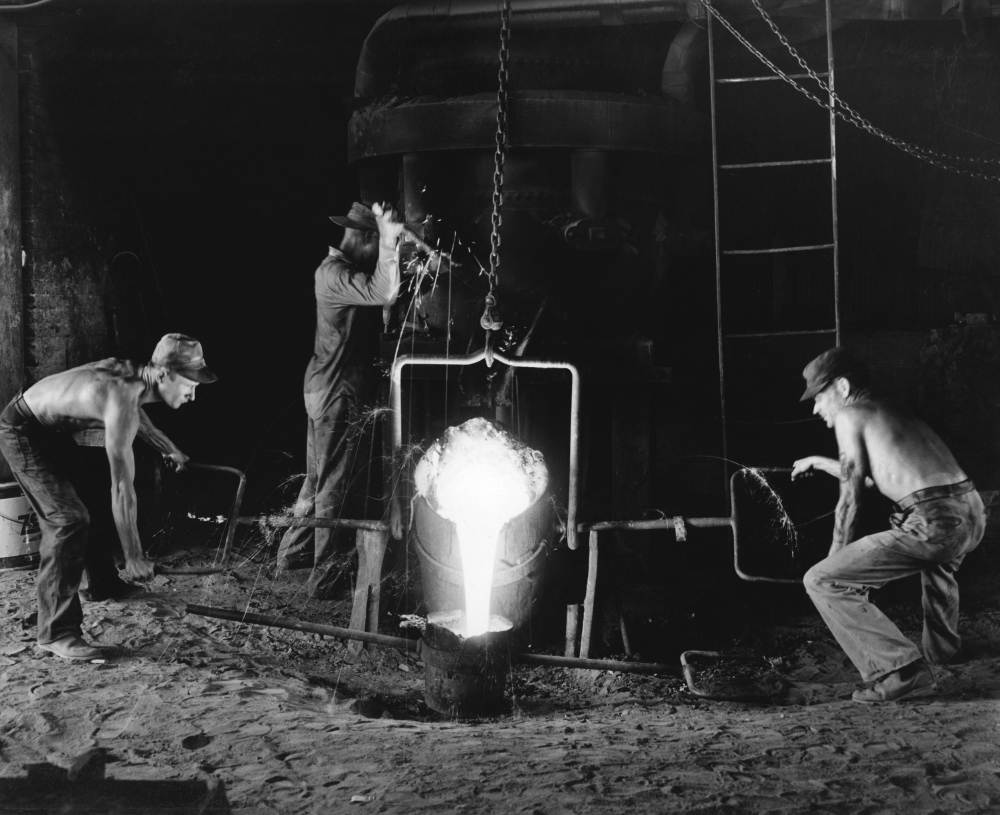
Foundry and machine shop work was the historical foundation for John Bouchard & Sons.
Photo courtesy of JBS
Founded in 2018 in Deerfield Beach, Florida, LEV Manufacturing expanded its platform through the acquisition of Serial 1 Cycle Company, the premium electric bicycle brand originally developed by Harley-Davidson. Beginning this year, the Tennessee operations will assemble and distribute Rad Power Bikes, Serial 1 Cycle and Life EV branded e-bikes.
“One of the top questions Rad receives from our more than 680,000 riders is ‘Where is my e-bike made?’” said Rad Power Bikes CEO and President Jim Brown. “With this announcement, we’re excited that the answer will soon start with ‘right here in the U.S.’ We hope it inspires continued investment across the micromobility industry in American jobs and innovation.”
Always Check In With Oak Ridge
Yet another Tennessee thread that weaves throughout the state’s industrial sector and thereby strengthens it is Oak Ridge National Laboratory (ORNL), whose sterling reputation in energy and computing often overshadows its practical, applicable innovations in manufacturing. A brief tour of the lab’s recent hits:
Scientists have developed a method that uses additive manufacturing, or 3D printing, to fabricate custom canisters for powder metallurgical hot isostatic pressing (PM-HIP), streamlining production of large-scale metal components used in aerospace, energy and medical applications.
“By harnessing the strengths of both additive manufacturing and hot isostatic pressing,” ORNL researcher Pavan Ajjarapu said in May 2026, “we are paving the way for greater design freedom and expanded applications in hydropower and next-generation nuclear reactors.”
The project is supported by the U.S. Department of Energy (DOE)’s Office of Nuclear Energy, Advanced Materials and Manufacturing Technologies program.
“We further enhanced the effectiveness of PM-HIP technology by using a mechanics-based computational model to reduce developmental costs and lead times by eliminating trial-and-error approaches,” said ORNL’s Jason Mayeur. “This model enables more precise predictions, allowing for optimized processing and improved outcomes in manufacturing large-scale parts.”
Also in May 2026, ORNL researchers incorporated gallium nitride semiconductors to create a high-efficiency power converter that is more compact, affordable and efficient. A power converter manages semiconductor switching and transforms current or voltage, so electricity flows smoothly and safely among equipment, power sources and users.
“In the future, these are meant to help in artificial intelligence data center applications, which need many systems with these exact requirements,” said researcher Prasad Kandula. “Size and weight add up quickly when you are looking at four to eight converters for each server, with enterprise data centers using hundreds to thousands of servers.”
And in yet another May 2026 development, Autonomous Resource Corporation (ARC) and ORNL announced a Memorandum of Understanding establishing a strategic public-private partnership to accelerate the on-demand manufacture of qualified, mission-critical components for U.S. national security applications.
Known as the Exascale Foundry, it will combine ORNL’s computing and manufacturing capabilities with ARC’s ARCNet distributed manufacturing platform to create a closed-loop system for AI-enabled materials and manufacturing qualification and autonomous production at defense-relevant scale. ORNL will provide access to high-performing computing expertise for simulation-driven materials characterization and qualification, along with technologies developed at the Manufacturing Demonstration Facility (MDF), the Department of Energy’s only large-scale, open-access advanced manufacturing facility.