What’s shaping Oklahoma’s booming A&D industry?
Oklahoma is a known leader in the aviation and defense industries — its beauteous skies and open terrain give the state natural advantages for flying, landing and repairing planes and other aerial systems.
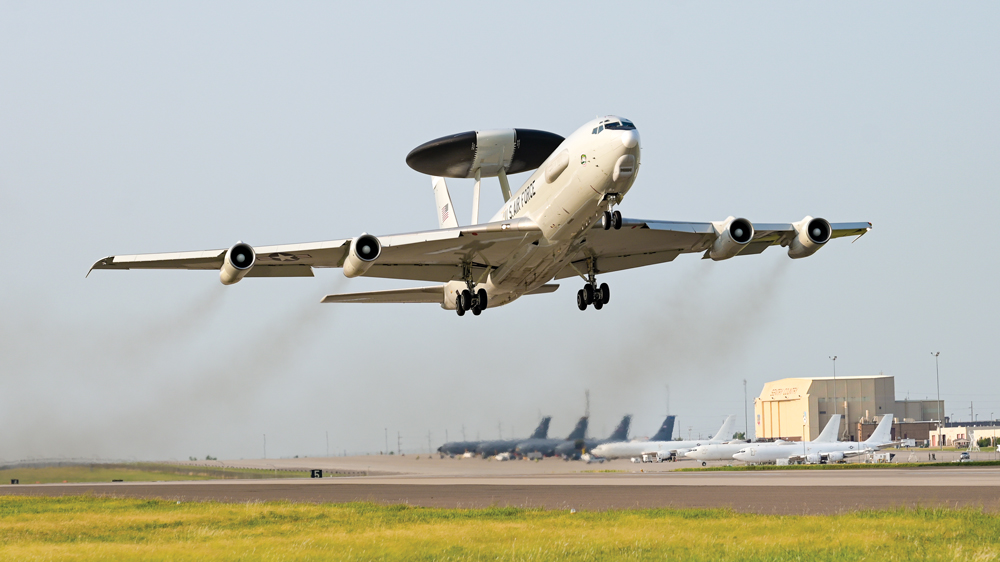
Just over 1,000 aerospace and defense entities call the Sooner State home. American Airlines’ maintenance base in Tulsa, the world’s largest single-site commercial aircraft maintenance, repair and overhaul (MRO) facility, and Tinker Air Force Base in Oklahoma City hold up Oklahoma’s reputation as the MRO Capital of the World. In FY2025, Tinker AFB alone had a statewide economic impact of $8.6 billion.
“We have those two anchors in the MRO industry,” says Oklahoma Department of Commerce Director of Aerospace and Defense Leshia Pearson. “Then we have all the supporting supplier bases surrounding that. There’s a huge aerospace cluster around the Oklahoma City area where Tinker AFB is and in Tulsa right around American Airlines. This includes NORDAM, Boeing, L3Harris and Lufthansa Technik.”
At Tinker AFB’s State of the Base, held in April of this year, Oklahoma’s positioning as the gold standard for supporting military and aerospace capabilities was lauded. Tinker AFB is the largest single-site employer in the state with over 26,000 civilian and military workers.
“Tinker Air Force Base is a powerful engine at the center of Oklahoma’s aerospace sector,” said Col. Cisco Harris, 72nd Air Base Wing and installation commander, at the event. “While other bases are shrinking, Tinker Air Force Base is growing and expanding, and we need to be prepared to work with our community and academia to bring on the next generation to take care of the world’s most complex issues and challenges that can only be solved right here in Oklahoma.”
Acing It with ACES
Oklahoma also received a boost with the passing of the Aerospace Commerce Economic Services (ACES) program, which operates within the Oklahoma Department of Commerce and has helped guide state’s A&D growth strategy since 2018.
“We don’t work in a vacuum,” says Pearson about the effectiveness of the ACES program. “We have amazing partners and resources and assets across the state that help us with our jobs every day.” She notes the $11.2 million the state has invested in ACES since its establishment, highlighting a ROI of $2.46 billion in new capital investment in A&D and 10,000 new jobs.
Project wins under the program since 2018 total 159, with 67% landing in metro areas and 33% in rural areas; 81% of these projects comprised expansions of existing Oklahoma companies.
ACES was formed to acquire aerospace executive expertise and consult with aviation, aerospace and defense firms, government agencies and organizations across Oklahoma. Some top goals of the program include increasing contracts between A&D companies in Oklahoma and the U.S. Department of Defense and key related contractors; supporting pilot training and aviation infrastructure; providing more suppliers for Oklahoma’s military installations and aviation and A&D industries; and enhancing the state’s supply chain utilization in the industry to fill existing gaps in supplier networks.
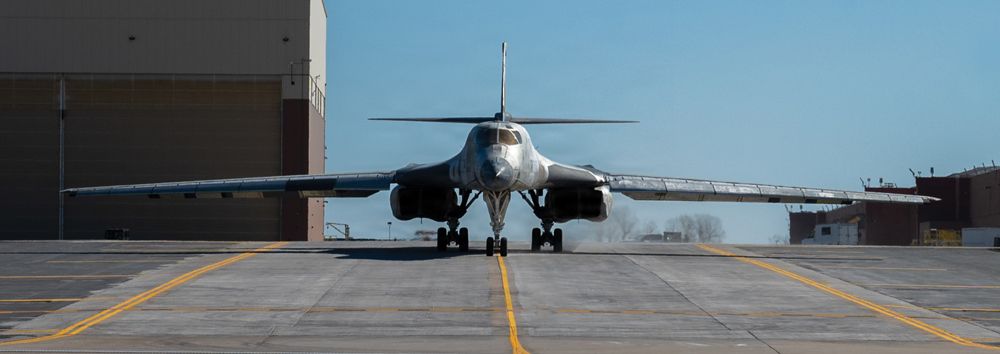
A U.S. Air Force B-1B Lancer undergoes depot maintenance at Tinker Air Force Base in February 2026 after being removed from long-term storage.
Photo by Courtney Landsberger/DVIDS
In 2025, some 37 projects under the ACES program were recorded, with $454 million in investment and 1,325 jobs created. Last year, 60% of project wins were in metro areas and 86% comprised Oklahoma company expansions. Overall, there were 70 open A&D projects in the state with an estimated potential of $6.8 billion in capital investment in the pipeline at the end of 2025.
“We don’t work in a vacuum. We have amazing partners and resources and assets across the state that help us with our jobs every day.”
— Leshia Pearson, Director of Aerospace and Defense, Oklahoma Department of Commerce
Outside of MRO operations, the unmanned aircraft system (UAS) sector in Oklahoma’s aerospace skyscape has seen pickups. As recently reported in Site Selection, the Choctaw Nation of Oklahoma was designated by the U.S. Federal Aviation Administration (FAA) as a new FAA unmanned aircraft systems test site in early 2026, one of two new designated test sites approved in a decade by the federal agency.
“There’s a ton of counter UAS research and activity,” says Pearson about work being done at Oklahoma State University and Fort Sill in Lawton. “Both of our leading research institutions are heavily engaged in that. Beyond the Choctaw Nation, we have about 845,000 acres of testing sites or acreage across the states.”
Tinker Air Force Base is the largest single-site
employer in Oklahoma with over 26,000 civilian and military workers.
Reaching New Heights
Pearson mentions two recent project wins in Oklahoma — San Diego-based Kratos Defense & Security Solutions’ advanced manufacturing facility in Bristow and Dawn Aerospace in Burns Flat. The Kratos project will sit on 20 acres, is expected to expand from an initial 50,000 sq. ft. to 100,000 sq. ft. and will produce GEK (GE Aerospace-Kratos) turbojet engines on five production lines. The facility, which is expected to be operational by end of 2026, will also host three small engine test cells that will be live in 2027, according to a company press release. The initial output at the Kratos site will be 500 engines each year.
“This facility underscores Kratos’ strategy of delivering affordable, high-performance, made-in-America propulsion systems at scale,” said Stacey Rock, president of Kratos Turbine Technologies, when the project was announced in June 2025. “Bristow will be a critical site for delivering mass to the mission and meeting the growing propulsion needs of our defense customers.”
Summer 2025 was a banner season for aerospace activity in Oklahoma. The Oklahoma Space Industry Development Authority (OSIDA), developed in 2009 by the state to operate a spaceport near Burns Flat, was folded into the Oklahoma Department of Aerospace and Aeronautics (ODAA) in July 2025.
“Since that time, we’re wrapping up about $45 million worth of investment infrastructure investment out of the spaceport,” says ODAA Chief of Staff and Chief Financial Officer Chris Wadsworth about OSIDA merging with ODAA. “I don’t think there’s been a week that’s gone by in the past 10 months now that we have not had site visits and space companies in town. It really kickstarted that agency. We’ve given the space side a little bit more stature with our team at the Department of Airspace behind it and operating it. We’ve had that extra manpower. We’ve had that extra expertise. The weight that our agency carries at the capitol with the legislators — we’ve really been able to boost the credibility and the efficiency of that agency since that merger took effect.”
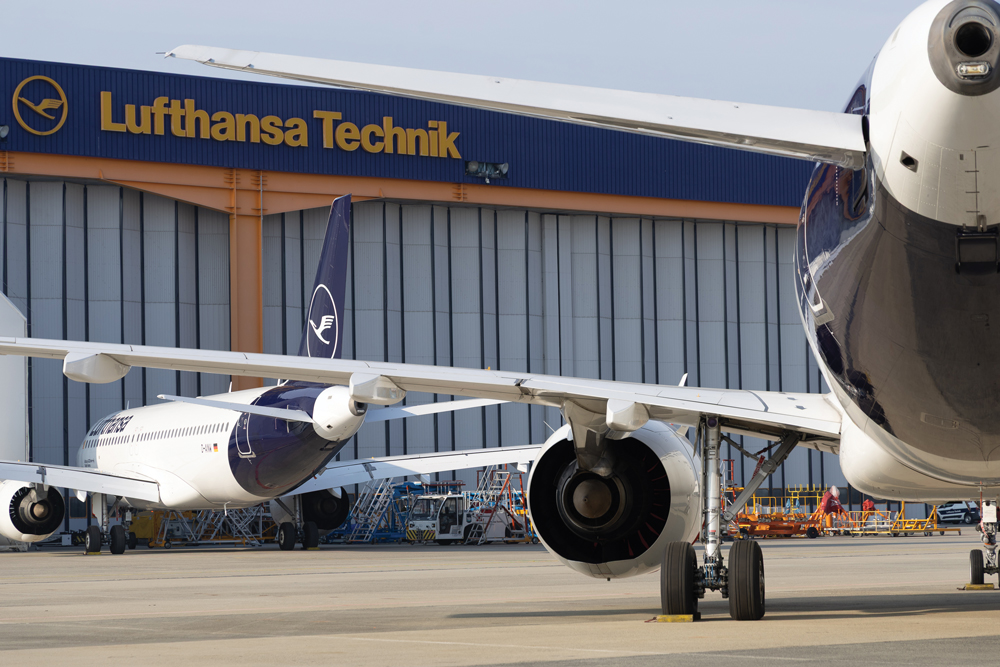
Lufthansa Technik Engine Services, formerly BizJet, was established in Tulsa in 1986. The company has performed engine overhauls and other maintenances for Rolls-Royce Tay 611-8/8C engines used in corporate jets.
Photo courtesy of Lufthansa Technik AG/Jan Brandes.
Dawn Aerospace USA, a New Zealand-based firm, made the Oklahoma Air and Space Port in Burns Flat (now renamed the Infinity One Oklahoma Spaceport) the base of its U.S. operations last summer, partnering with OSIDA to establish operations there to test its Aurora spaceplane. Dawn Aerospace is expected to be fully operational at Burns Flat in 2027.
The Mk-II Aurora spacecraft has already flown 60 times and achieved supersonic status in November 2024. The remote-piloted, rocket-powered aircraft set a “time to climb” world record with its November 2024 flight (118.6 seconds to 20 km. altitude). The Aurora is designed to fly to the edge of space (the Kármán line), which is about 100 km. (62 miles) by international standards. The edge of space is marked at 80 km. (50 miles) by NASA, the U.S. Air Force and the FAA.
In April 2026, Dawn Aerospace and OSIDA announced the opening of applications for the Runway-to-Space Spaceplane Challenge, which will run through September and invites researchers to fly payloads aboard Dawn Aerospace’s Aurora spacecraft. Under this program, up to 25 suborbital flights will be allowed onboard the Aurora, which is designed for runway-based operations with much faster turnaround times (hours versus months) compared to typical suborbital missions, according to a company press release.
“Meaningful access to microgravity typically means going to orbit, which is expensive, slow and often out of reach for early-stage ideas,” said Stefan Powell, Dawn Aerospace’s CEO, when the challenge was announced. “Aurora changes that by giving teams a fast, lower-cost way to access microgravity and iterate within months. It’s not a substitute for long-duration missions, but it enables experiments that would otherwise never leave the ground, turning ideas that might never have flown into viable missions that can ultimately progress to orbit.”
In March 2026, ODAA announced a $505 million investment plan to improve aviation infrastructure and strengthen the industry’s workforce in the state. The FY2027-2031 Airport Construction Program will comprise 95 development projects at airports across the state, which are part of a total group of 176 projects that will boost Oklahoma’s national presence in aerospace commerce. The program funding breakdown is as follows: $149 million from ODAA, $292 million from the Federal Aviation Administration and $64 million from local matching funds.