
How is what’s happening on the ground affecting what’s up in the air?
The popularity and enterprise-making activity of space exploration has catapulted a constellation of related industries to the forefront of contemporary culture.
There was NASA’s historic return to crewed deep-space missions with Artemis II’s circling of the moon in April. Then, at the time this story was being written, SpaceX’s public debut on the Nasdaq made founder Elon Musk the first trillionaire in the world.
Head-turning stock market debuts and lunar missions aside, what has been fueling the site selection process for corporate projects in aerospace?
Finding Space for Aerospace Manufacturing
The push to commercialize aviation technologies has powered the rapid transformation of aviation, with new aerospace clusters and hubs spinning out wherever there’s land, sky and capital.
Dan Carnelly, executive vice president, and Alexandra Paré, director of membership, marketing and communications, at the ICCAIA (International Coordinating Council of Aerospace Industries Associations), talked to me about what aerospace manufacturers are prioritizing and the regulatory changes and industry trends impacting their membership base, which comprises global aerospace manufacturers and service providers.
There are several things that affecting aerospace manufacturers’ decisions when choosing corporate headquarters and sites for research & development, testing and operations, they say. For one, it is increasingly rare for a manufacturer to do everything on one site.
“The footprint of a facility would simply be too large, so sections of aircraft are often produced in smaller, more scattered facilities that can be on different continents,” Carnelly says. “That said, final assembly facilities require an enormous, flat footprint with no major surrounding obstacles.”
The facilities and sites needed to test and build aircraft need a runway measured in miles, large hangars, several service buildings and engineering and sales office space. Headquarters also tend to be co-located on or near aerospace manufacturing sites. Testing onsite requires infrastructure that could facilitate experiential product testing. It also requires areas where pressurization, fueling and engine tests of newly built aircraft can all be performed at a safe distance from other buildings or people onsite.
Another major requirement for aerospace manufacturers during site selection? Easy access to airspace that allows for flight testing, say Carnelly and Paré. Many aerospace manufacturers locate near the coasts in places like Seattle or Savannah, or in locations where transit to the coast is rapid like Toulouse, France, which has access to both the Atlantic Ocean and the Mediterranean Sea. Easy access to vast areas of unpopulated land is a strong asset — Montreal, for example, is an ideal city for those seeking to take advantage of Quebec airspace for test flights.
“Engine manufacturers have similar kinds of constraints since they also need to be able to test and run their products,” Carnelly says. “Engine test facilities are most often located far from population centers or contained within large buildings with extensive sound insulation and protection against some of the more extreme tests. Consequently, footprint is a major consideration here, too, alongside geographic location. For component manufacturers, geography is less of a concern, and those companies choose locations for their facilities in the same way as any other manufacturing business.”
Using NAICS codes 336411, 336412, 336413, 336414, 336415 and 336419, a search in the Conway Projects Database of qualified corporate end-user facility projects and project-affiliated job creation and capital investment data recorded between June 15, 2024, and June 15, 2026, showed 276 aircraft and aerospace-related facilities and offices. Of those, 191 (69%) located in the United States, 20 (7.2%) in India, 13 (4.7%) in the United Kingdom and 7 (2.5%) each in Canada and Mexico.
Among the U.S. projects, 31 (16.2% of the global total and 34% of the U.S. total) were in Texas, followed by Florida (24), California (17), Alabama (14) and Kansas (11), the only state among the top five without a coastline, but with plenty of wide-open airspace and a heritage in the industry.
Aerospace-Grade and Querétaro-Made
A three-hour drive northwest from Mexico City will land you in the Mexican state of Querétaro, a leading global hub for tech investment and aerospace manufacturing. Querétaro was No. 1 in Site Selection’s first ranking of business competitiveness for the country of Mexico earlier this year, and its eponymous capital also placed in the top metros — boosted by the incessant march of new data center projects. Notably, the Querétaro metro also made its debut at No. 19 in Site Selection’s 2026 North American Tech Hub Index.
Querétaro is rolling in aviation manufacturing deals left and right from global companies. Canadian-based Bombardier spent US$18 million expanding its Querétaro site this year, and German aeronautical manufacturer Diehl Aviation inaugurated a $50 million plant in PYME Industrial Park just outside the city last September with plans for a second-phase expansion.
Swiss technology company Oerlikon will find good company then in this aerospace cluster. Dr. Wolfgang J. Schmitz, regional president of the Americas at Oerlikon, provided insight on why his company chose to expand its Querétaro site for manufacturing honeycomb components that go into turbine sealing systems for jet engines and land-based gas turbines.
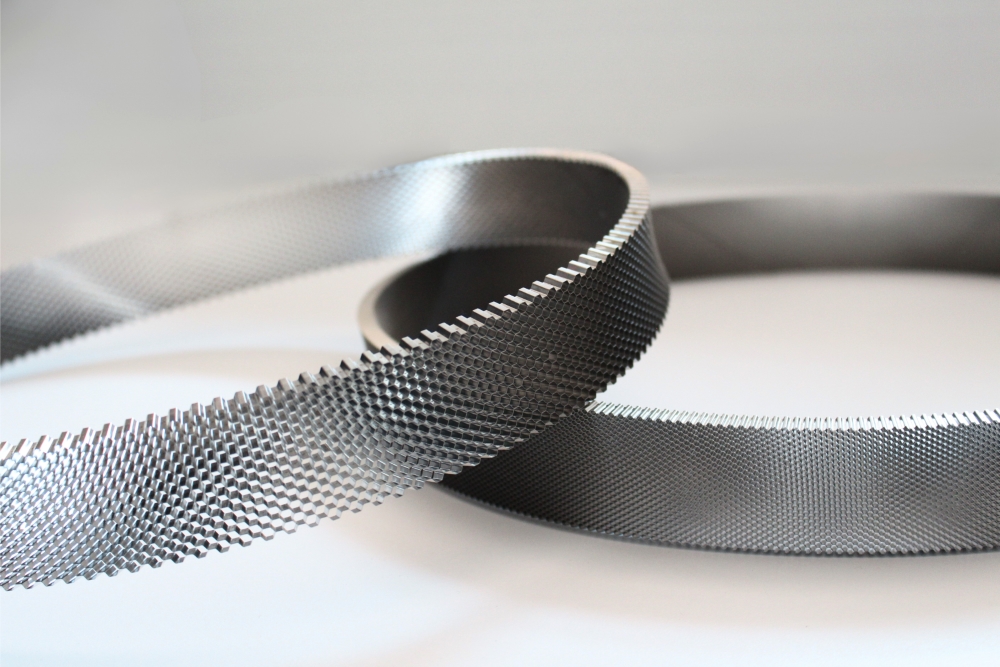
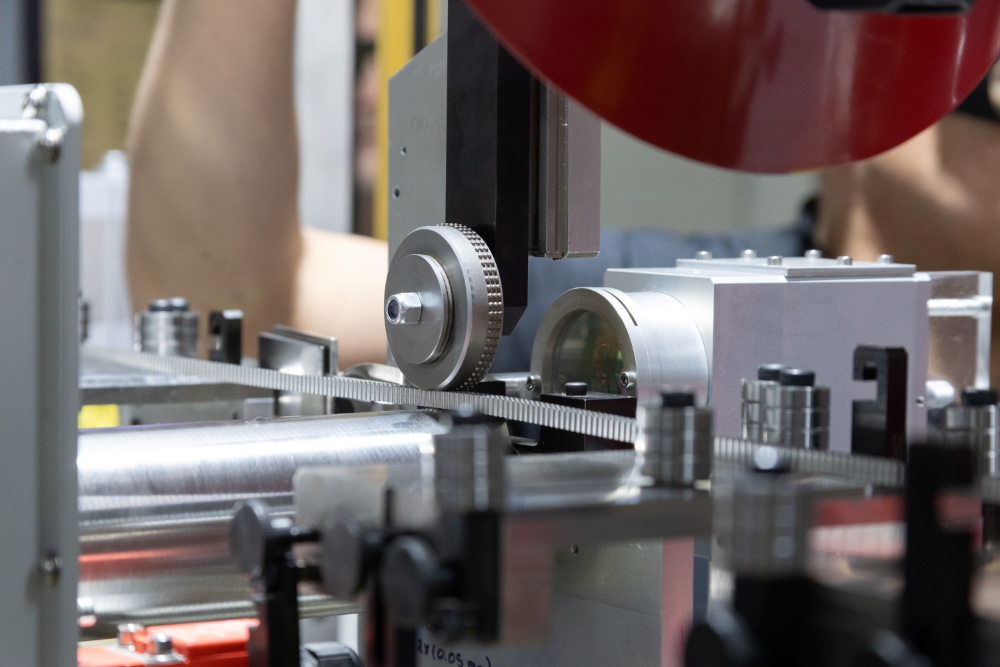
Swiss company Oerlikon produces superalloy honeycomb components used in turbine sealing systems for jet engines and land-based gas turbines. These products are sold to global OEMs and Tier 1 suppliers in commercial aerospace and some energy industry end-users.
Photo courtesy of Oerlikon
“Querétaro was a natural choice due to its strong aerospace ecosystem and proximity to major OEMs, Tier 1 suppliers and MRO [maintenance, repair and overhaul] providers in North America, as well as increasing integration into the North American aerospace value chain,” Schmitz says. “Rather than building a new facility, Oerlikon has expanded its existing Querétaro site — enabling time-to-market by integrating a state-of-the-art honeycomb manufacturing capability for turbine components.”
He says the project combined Oerlikon’s global technology standards with strong local execution in Querétaro. Technologies and equipment for the facility expansion were sourced from European suppliers, and local partners contributed to the installation, infrastructure readiness and operational ramp-up of the newly expanded site.
“In our view, Querétaro offers a compelling combination of industrial capability, skilled talent and a well-established aerospace ecosystem, making it an attractive location for advanced manufacturing,” Schmitz says.
Because of the Querétaro expansion, he says, Oerlikon benefits from proximity to key customers, access to a growing and capable supplier base and a workforce that is increasingly specialized in high-value aerospace manufacturing. For the Swiss company, focusing on building localized manufacturing capabilities closer to the end market was an aerospace industry trend they sought to embody with the expansion.

“In our view, Querétaro offers a compelling combination of industrial capability, skilled talent and a well-established aerospace ecosystem, making it an attractive location for advanced manufacturing.”
— Dr. Wolfgang J. Schmitz, Regional President Americas, Oerlikon
An Inclusive Aerospace Ecosystem
Think California aerospace and your mind may jump straight to Edwards Air Force Base or SpaceX’s 1-million-sq.-ft. manufacturing campus and former corporate headquarters in Los Angeles. But there are other pockets of innovation in the state.
“California’s Central Coast is known for being a hub for advanced air mobility,” says Lavera Alexander, chief growth officer at the Monterey Bay Economic Partnership (MBEP). “We have the highest concentration of operators in the United States. We have Wisk, Joby, Archer, Reliable Robotics. They have all been there working in that space for a long time.”
Alexander leads MBEP’s new enterprise to link together and improve four municipal airports in the California counties of San Benito, Santa Cruz and Monterey, putting the state’s Central Coast on the map as an inclusive aerospace ecosystem championing advanced air mobility (AAM). The airports in question are in Hollister, Marina, Salinas and Watsonville.

“What can we do to punch holes — if not cut — through the paper ceiling on what we know about advanced aviation?”
— Lavera Alexander, Chief Growth Officer, Monterey Bay Economic Partnership
In our conversation about a $7.4 million state grant awarded to MBEP last September to establish the California Advanced Air Mobility Corridors Initiative (CAAMCI), Alexander emphasizes that “we don’t see CAAMCI as starting something — we see this investment into this space as building upon what’s already there, which is a very dynamic, very alive ecosystem that surrounds advanced aviation through advanced air mobility as well as uncrewed aerial systems or what people will commonly just call drones.”
Many AAM initiatives utilize public use, general aviation airports that do not typically receive the funding that commercial airports receive, she explains. This means there is often infrastructure that needs upgrading to participate fully in emergent aerospace sectors.
A number of commercial partnerships exist between the municipal airports in MBEP’s region. Joby Aviation, headquartered in Santa Cruz, doubled its manufacturing footprint at Marina Municipal Airport in recent years and expanded its testing site at Hollister Municipal Airport. Mountain View-based Wisk Aero and Reliable Robotics also test aircraft and automation systems at Hollister Municipal Airport, which has also been a test site for Alef Aeronautics’ electric flying car.
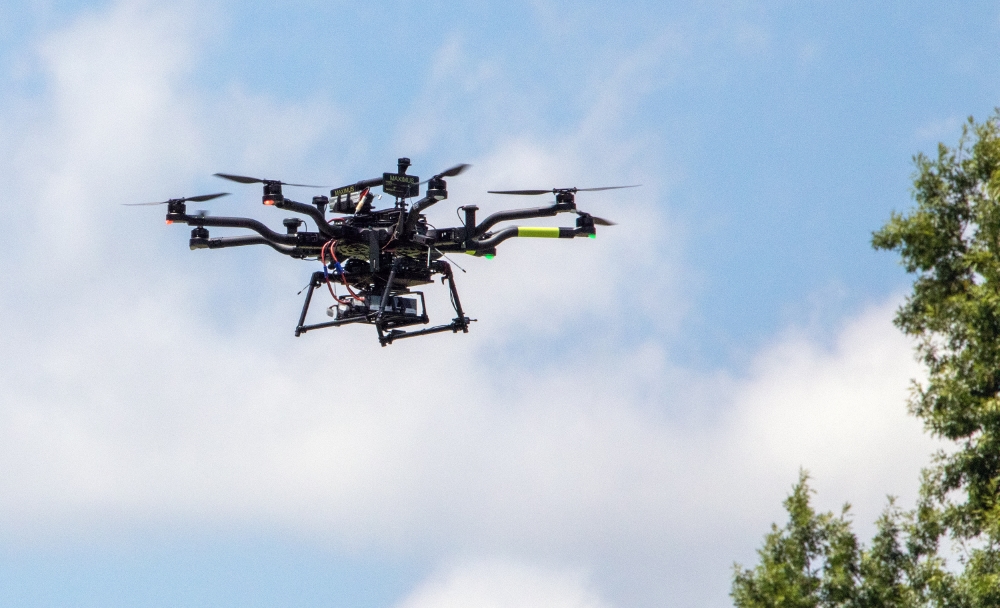
Unmanned aircraft systems (UAS) have gained popularity in the aviation industry. Pictured is an Alta-8 small UAS testbed vehicle above NASA’s Langley Research Center in Hampton, Virginia.
Photo courtesy of NASA
Notably, California has the highest concentration of electronic OEMs and semiconductor companies in the United States, especially in the Silicon Valley corridor (which is located about 70 to 90 miles northwest of the Monterey Bay area).
CAAMCI can be called an economic development vehicle wrapped up in an aviation initiative. The focus of the investment and the other work California is funding across the state is intrinsically tied to building the workforce and economy. Alexander observes that it is also about shaping the path that lies ahead.
“What can we do to punch holes — if not cut — through the paper ceiling on what we know about advanced aviation?” she says.
One takeaway from CAAMCI is to make visible all the work happening on the Central Coast of California and that of MBEP in building the local aerospace ecosystem and critical professional relationships over the past decade. Alexander underscores the community-driven aspect of CAAMCI and MBEP’s goal to strengthen the region as an aerospace and advanced aviation hub.
“CAAMCI is about economic development,” she says. “It’s about aviation, but it’s also about the people. If we are not doing the work that we need to do to bring along community, then CAAMCI, as well as aviation in general when it comes to this emerging technology, will fail. My hope is to make sure that we continue to build out the physical infrastructure and that it becomes the statewide connector that it was always positioned to be.”
The tri-county area of San Benito, Monterey and Santa Cruz is a majority minority region. Last year, MBEP went through an Economic Development District (EDD) designation process by the U.S. Economic Development Administration (EDA) and was shortly after awarded the designation. The designation applies to economically distressed districts and is intended to encourage economic development locally. This marked the first time the EDA awarded EDD designation to the state of California in 15 years.
“It’s important because it reminds folks that we need to continue to bring in investments that will support workforce, create these pathways and help the workers who are the hardest hit see a path forward that is going to allow them to continue to live, play and work in the region — and do so in a way that doesn’t feel as if each and every time they get up and go to bed, they are trying to figure out how to make ends meet,” says Alexander. “For us, inclusive economic development and workforce development — that is at the center of what we do at MBEP, and it’s at the center of what’s happening in the region.”
The Skies Ahead
The last couple of decades have seen big changes in the types of materials used in aerospace. Carnelly and Paré of the ICCAIA explain that airframes are using significant quantities of either composites or more exotic aluminum alloys that maintain strength while reducing weight. To reduce fuel burn, jet engines have increased engine core temperatures to levels where titanium has been switched for ceramic matrix composites.
“Those technologies are still in their infancy, so we can expect developments in materials technologies that are supported by the increasing use of AI,” Carnelly says. “We are already seeing AI being used in materials science to create building blocks of materials with certain properties at the molecular level. We are also beginning to see the progressive use of drones being used to conduct maintenance inspections, which can be very helpful if it means that you don’t need to send a human being 80 feet in the air to inspect the fin of an Airbus A380.”
Demand is also up for aerospace manufacturing. That means production processes will need to accelerate, and the supply chain feeding this industry will have to handle a higher volume of aircraft. Boeing’s 2024 Commercial Market Outlook (CMO) indicated that almost 44,000 new aircraft will be needed by 2043. In that same industry forecast, Boeing also indicated that the commercial aviation industry would require nearly 2.4 million new personnel in the coming decades.
“With the high demand for new aircraft and engines combined with the fact that no manufacturer has the capacity to build everything from scratch on one site, the supply chain is more critical than ever,” says Carnelly. “The cross-border flow is essential; access to essential minerals, metals and composites is essential; capacity of suppliers and their ability to ramp up to match demand is critical.”
Boeing’s 2025 CMO noted that commercial air traffic has tripled since 2000, and the active fleet of planes has doubled. Tourism growth has rebounded since 2020, above where it was before COVID. According to the report, the economic impact of the global aviation industry is about $4 trillion and contributes around 4% to global GDP.
The ICCAIA also represents global civil aerospace manufacturers at the International Civil Aviation Organization (ICAO), a United Nations specialized agency comprising 193 countries (“Member States”) and headquartered in Montreal that sets the regulatory standards for global civil aviation in terms of aerodrome standards, certification, operations and environmental standards. Those regulatory standards then fold into national regulations from the U.S. Federal Aviation Administration, European Union Aviation Safety Agency, the Civil Administration of China and other nations.
“With safety remaining at the heart of everything that the sector does, the next decade will see sustainability become the baseline expectation for aerospace manufacturing, measured across the entire value chain — from materials to end-of-life recycling,” Paré says, adding that some challenges remain, including certifying new technologies, scaling sustainable aviation fuel and hydrogen infrastructure and realizing the practicalities and economics of large-scale transformation.
“By working together to establish forward-looking standards, invest in innovation and create enabling policy frameworks,” she says, “the sector can ensure that the next generation of aerospace manufacturing supports both global connectivity and the transition to a more sustainable aviation future.”
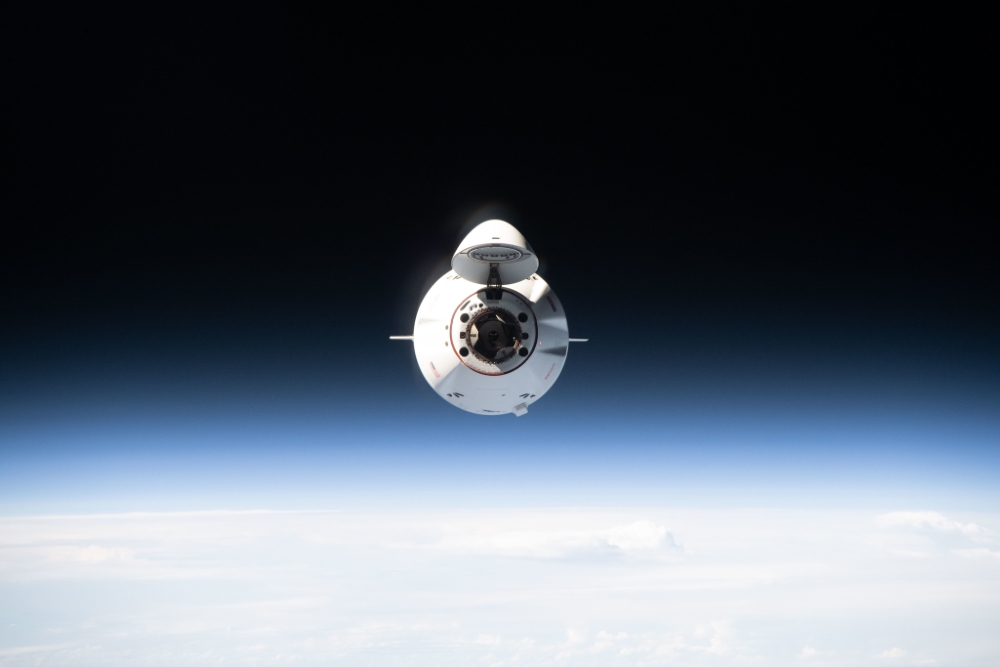
A SpaceX Dragon cargo spacecraft approaches the International Space Station (ISS) carrying nearly 6,500 pounds of food, supplies and equipment for the Expedition 74 crew, which was SpaceX’s 34th commercial resupply services flight to ISS for NASA.
Photo courtesy of NASA
Back to Space Reality
Aerospace and artificial intelligence company SpaceX, started over two decades ago by Elon Musk in El Segundo, California, has well-known launch sites in Texas, California and Florida. The company, which made headlines this summer for raising a staggering $75 billion for its initial public offering (IPO) on June 12, has a surprising source for a large portion of its revenue — its satellite manufacturing site in Redmond, Washington.
In Redmond, the company’s Starlink satellites are pumped out prolifically (to the tune of 70 a week, according to SpaceX’s IPO filing). Starlink comprises a large share of SpaceX’s Connectivity segment, generating over $11 billion in revenue and $4.4 billion in operating income last year — 61% of SpaceX’s overall revenue ($18.7 billion) in 2025. This is more than double the 120 satellites SpaceX was producing each month six years ago.
On June 16, SpaceX announced its $60 billion acquisition of AI coding startup Cursor, an all-stock deal which is expected to be complete in fall 2026. Cursor started in 2022 as an AI coding tool for software development, leveraging AI chat-led reading and editing features, code predictive text capabilities and AI agent task support for programming applications. In November 2025, Cursor raised $2.3 billion in funding and had a valuation of $29.3 billion. The Financial times called the Cursor acquisition “SpaceX’s Instagram moment,” referencing Facebook’s infamous grab of the photo-based social media site in 2012.
It remains to be seen whether SpaceX’s stocks will remain on an upward trajectory or meet turbulence on the stock market. How this will affect the company’s decision to locate future testing and launch sites is also a question that remains to be answered, though the company has plans for a vast satellite manufacturing campus in Bastrop County, Texas. The satellites to be built there will be designed to handle 150 kilowatts of computing power and will inch SpaceX closer toward its goals of having data centers in space and launching 6,500 satellites overall — all by the close of 2027.
On Earth, SpaceX’s presence is indisputable. Based on Conway Projects Database qualified corporate end-user facility projects and project-affiliated job creation and capital investment data since 2020, there have been 18 recorded SpaceX projects total: 14 in Texas, three in Florida and one in Washington state. — Kelly Barraza