Brazil ranks highly when it comes to having some of the highest amount of railroad network in the world, with most of that rail devoted to moving freight. The Latin American country is seeing a boom in renewed investment in this sector, including facility expansions by global transportation equipment manufacturer Wabtec and renewed interest and support in the multibillion-dollar, long-stalled Transnordestina freight railway project in the northeastern part of the country.
Danilo Miyasato, president and regional leader of Wabtec in Latin America, notes that Brazil and Latin America “are experiencing an important moment marked by the modernization and renewed investment in the Brazilian rail sector, fueled by concession renewals, new contracts and major infrastructure projects currently under development.”
The Middle of Minas Gerais
In the southeastern region of Brazil is the state of Minas Gerais (“General Mines”), which borders the states of São Paulo, Rio de Janeiro and Espírito Santo. Together these states generate over half of the country’s national GDP and comprise 44% of the Brazilian population. In 2024, 21 million people lived in Minas Gerais, recognized not only for its rich mining history but also its stunning vistas peppered with mountains, valleys and rivers. Not far from the state capital of Belo Horizonte is the city of Contagem, where U.S.-based Wabtec is investing R$20 million (US$3.8 million) to expand operations at its facility located there.
“Contagem is Wabtec’s hub in Latin America for over 50 years and is home to our locomotive manufacturing plant, which makes the city strategic for our operations and for the development of new technologies,” says Miyasato. “Therefore, we chose to establish the Engineering Center very close to the industrial site to enable this synergy between innovation and our production capabilities.”
Wabtec’s Latin American hub is supported by the powerhouse exports artery of the Brazilian economy, which saw exports total US$348.7 billion in 2025, according to Industrial Info Resources. Manufacturing ($188.68 billion) and extractive/mining industries ($80.43 billion) topped that exports list. In 2024, exports from Minas Gerais totaled $41.9 billion, with a surplus of $24.9 billion (the state ranked third in highest number of exports in Brazil, comprising 12.7% of total exports from the country.)
“The special line is dedicated to new projects, especially for international markets,” says Miyasato about the Contagem site expansion. “In 2025, we manufactured and delivered locomotives to Australia and Uruguay. This enables Wabtec to develop new locomotive models according to customers’ specifications while maintaining its high level of service to regional customers through the main line.”
Miyasato noted that the new locomotive production line will increase the factory’s production capacity by 28%, enabling the site to meet growing demand. Two new logistics centers are also planned in the cities of Governador Valadares and Monte Alto, which aim to expand Wabtec’s shipping capacity while bringing greater agility and efficiency to logistics operations. Miyasato notes that the warehouses “create room for growth in our production areas, enabling us to expand other businesses such as Maintenance of Way, Digital Intelligence and Powersports.”

“Brazil and Latin America present a promising outlook for the rail sector, driven by the growth of freight markets with a natural fit for rail transportation, such as agriculture, mining and pulp and paper. Additionally, we are experiencing an important moment marked by the modernization and renewed investment in the Brazilian rail sector, fueled by concession renewals, new contracts and major infrastructure projects currently under development.”
— Danilo Miyasato, President and Regional Leader of Wabtec in Latin America
When asked why a company would look at Brazil for investment when it comes to transportation, Miyasato replied that “Brazil and Latin America present a promising outlook for the rail sector, driven by the growth of freight markets with a natural fit for rail transportation, such as agriculture, mining and pulp and paper.
“Additionally, we are experiencing an important moment marked by the modernization and renewed investment in the Brazilian rail sector, fueled by concession renewals, new contracts and major infrastructure projects currently under development. The demand for more efficient, sustainable solutions with a focus on operational safety continues to grow steadily, supported by the expectation of increased rail participation in national logistics and by the global decarbonization agenda. This favorable environment has been one of the main drivers behind Wabtec’s expansion of its operations in the region.”
Wabtec’s Contagem site welcomed a Global Engineering Center at the end of 2025, the first of its kind in Latin America for the company. The R&D hub will measure 96,875 sq. ft. (9,000 sq. m.) and will be host to cutting-edge discoveries in rail technology and sustainability. The company plans to hire 300 engineers at the engineering center by 2028, a show of its commitment to workforce development and leadership on a global level.
Unshelving Transnordestina
Brazil’s freight railway infrastructure will also see a big win in the Transnordestina rail project, which is expected to measure over a thousand miles (1,753 km.) in northern Brazil when completed. In development hell for 20 years, the freight railway project received renewed interest and support from the Brazilian government in early 2025 to the tune of $140 million in funding. This followed news from Transnordestina Logística, which is primarily owned by major Brazilian steel producer CSN, announcing an initial investment of R$7 billion ($1.27 billion) in late 2024 to revitalize the project.
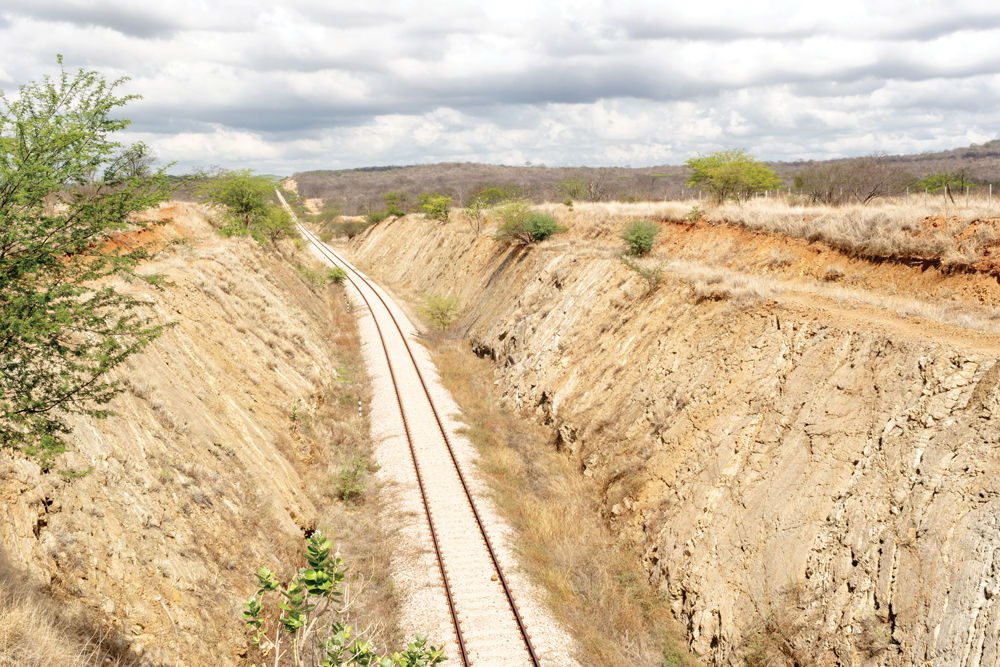
Transnordestina railroad track crossing in the state of Pernambuco, near the cities of Salgueiro and Serra Talhada.
Photo: Getty Images/wagnerokasaki
Phase 1 of the new rail started in the Eliseu Martins municipality in the state of Piauí and will connect to the Port of Pecém; this project will join the Port of Pecém to the Suape Port on the northeastern coast of Brazil. This 751-mile stretch (1,209 km.) will be completed by late 2026 or mid-2027.
Pecém is known for its agricultural and mineral exports and is part of the greater Pecém Complex, which spans over 19,000 hectares (46,950 acres) and hosts more than 20 companies. Located in the state of Ceará, known for its extensive coastline and mountains (which will prove challenging terrain to build rail through), the Port of Pecém benefits from a nearby free trade zone (FTZ), the ZPE Ceará, that started in 2013.
In the state of Pernambuco, Suape Port never closes for business, operating “365 days of the year, 24 hours a day, without tide or weather condition restrictions,” according to the port authority’s site. The Suape Port works with 160 ports across the world, including ports in Europe and North and South America. Both Brazilian ports are seeing forward-looking investments aside from the Transnordestina development. In September 2025, the Port of Pecém partnered with Rostock Port in Germany to develop a green energy corridor in the Pecém Complex over the next two years, focusing on bolstering the local hydrogen industry and supplying Europe with clean energy. The Rostock Port will service energy imports and distribution from Pecém Port. In early 2026, Suape Port and the greater Suape Industrial Port Complex announced its intent to boost its renewable energy use on campus to 50%, up from 36%.
Phase 2 of the Transnordestina project is expected to start in early 2026, to be completed in 2027. Stakeholders predict that the overall rail project in its entirety will be done in 2028 or 2029. Across public and private funding, the freight rail build-out is estimated to cost at least R$15 billion ($2.6 billion to $3 billion) once complete.
Brazilian Rail and FDI
Second only to the United States, Brazil brought in more foreign direct investment (FDI) dollars ($38 billion) in the first half of 2025 than any other country in the world (Organization for Economic Cooperation and Development). The U.S. collected $149 billion in that same time period. In 2024, Brazil welcomed $74.1 billion in FDI. Its overall FDI stock of $1.1 trillion constitutes 46.6% of its GDP.
In mid-2025, Brazilian Transportation Minister Renan Filho announced three major rail projects. A $3.5 billion (R$20 billion) project, Ferrogrão, will transport grain exports from the city of Sinop in central Brazil to Miritituba Port on the Tapajós River in the state of Pará. The other two projects include the Southeast Railway Ring, an $800 million venture that will service the Port of Açu in Espírito Santo, and the Fico-Fiol Corridor, which will connect the Central-West Integration Railway and East-West Integration Railway, in a 1,700-km. (1,000-mile) path between the Brazilian states of Mato Grosso and Bahia. The Fico-Fiol Corridor is estimated to cost more than $5 billion to complete and will be on the auction block in mid 2026 for interested investors. In September 2025, the Brazilian government invested R$507 million ($98.5 million) in expanding the Fico-Fiol project. Brazil’s National Secretary of Railway Transport Leonardo Ribeiro stated that this “will support the railway auction scheduled for next year, which will connect Lucas do Rio Verde, in Mato Grosso, to the Port of Ilhéus, in Bahia. This will enable a link toward Chancay, in Peru, forming a bioceanic corridor in the country.”