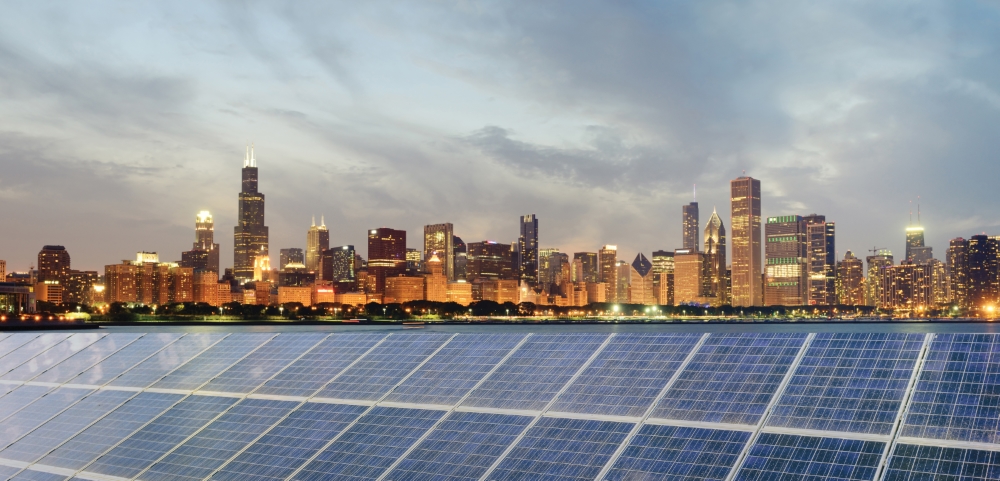
Clean energy projects strengthen state’s resiliency and efficiency.
Since the Climate and Equitable Jobs Act (CEJA) was signed into law in September 2021, Illinois has supported the development of more than 6 gigawatts (GW) of renewable energy, and an extra 6 GW are currently underway. The state has also seen a diverse supply of clean tech and manufacturing projects occupying its landscape. The Clean Jobs Workforce Network Program, also known as the “CEJA Workforce Hubs,” includes 14 locations across the state that offer training, certification preparation and other professional development opportunities for entry-level jobs in solar, wind, energy efficiency and EV maintenance.
Governor JB Pritzker’s signing of the Clean and Reliable Grid Affordability Act (CRGA) in January 2026 also aims to lower electricity costs for Illinois residents and adds more cost-efficient and clean sources of energy to the state’s portfolio. Under the CRGA, the Illinois Solar Bill of Rights was also enacted, preventing the ban of rooftop solar installation by local governments and preserving residential and small commercial customers’ rights to connect renewable systems to their structures.
Case Studies in New Tech
About 50 miles south of Chicago is Manteno, Illinois, where lithium-ion battery manufacturer Gotion’s $2 billion facility is helping power the state’s clean energy future by creating battery technologies supporting electrification and energy storage, says Andrew Wheeler, director of public affairs at Gotion Illinois.
“Beyond that, Gotion is helping shape a sustainable future by providing mobile and stationary energy storage solutions,” he adds. “But our contribution goes beyond what we make. We’re also investing in workforce training, STEM education and partnerships with schools and universities to help build the next generation of clean energy professionals. As one of the state’s largest clean energy manufacturing investments in recent years, we’re proud to play a role in strengthening Illinois’ leadership in this space.”
Gotion chose Manteno for many reasons: Its central Midwestern location offers access to major transportation routes, customers and suppliers in North America. A large industrial site in the community (housing the company’s 1.5-million-sq.-ft. manufacturing facility) supports current operations and future expansion. And the company has a strong partnership with local leadership, including Illinois Economic Development Corp. (Illinois EDC).
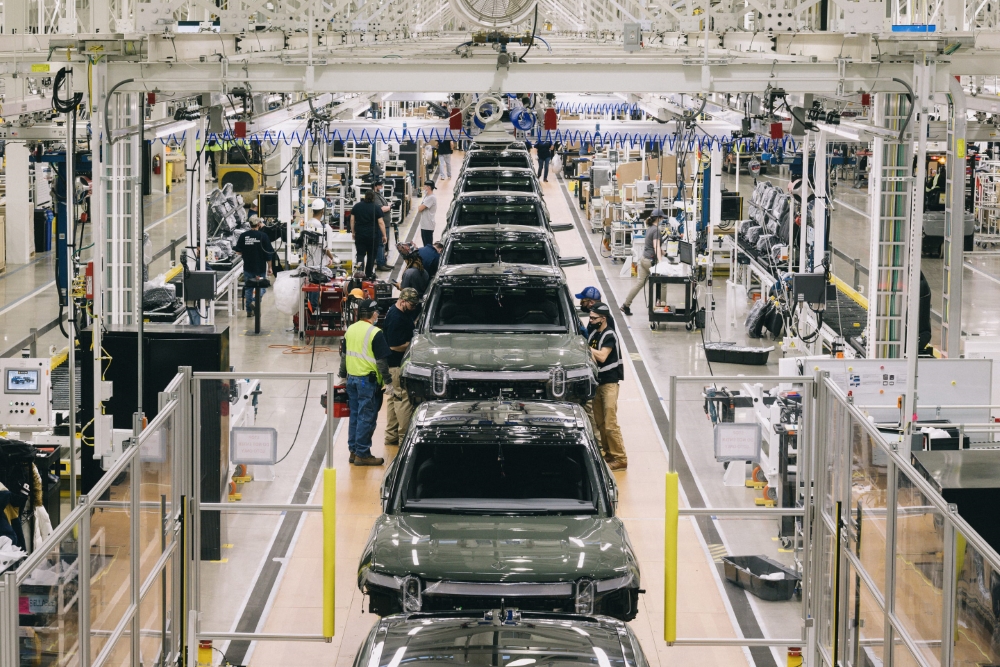
Rivian is investing into a 1.1 million-sq.-ft. plant expansion in Normal, Illinois, designed to support R2 production and scale capacity to 155,000 vehicles per year.
Photo courtesy of Rivian
“Illinois EDC’s commitment to manufacturing, workforce development and clean energy innovation aligned closely with Gotion’s long-term vision of innovation,” says Wheeler. “We also were able to convert an empty warehouse into a modern manufacturing plant which boosted the local economy and tax base.”
Gotion Illinois specializes in advanced lithium iron phosphate (LFP) battery technology used in energy storage and electric mobility applications, supporting residential energy storage systems to large-scale commercial and utility projects to EVs. Grid resilience, renewable energy integration, commercial transportation and other emerging electrification technologies are also on the docket for the company. Gotion Illinois also plans on transforming its new site into a major innovation hub and chose the facility with growth in mind. “As demand continues to rise for energy storage solutions and electric vehicle technology, having a strong manufacturing presence in Illinois allows us to produce closer to our customers while building a more localized and resilient supply chain,” explains Wheeler.
Another company pushing for a no-emission future is Motive Power Resources, who manufacturers battery-electric locomotives designed by Innovative Rail Technologies (IRT) in Minooka, Illinois. The Governor announced Motor Power Resources’ Reimagining Energy and Vehicles Act incentives to support their work last fall as they were readying a locomotive they built as part of a resiliency project for Fort Hood, a U.S. military base in Texas, in collaboration with Dominion Energy, with the capability of pulling Abrams tanks and providing 2.4 megawatts of backup emergency power. IRT has also been able to localize many parts of their supply chain with other Illinois companies.
In October 2025, vertically integrated battery technology company Pure Lithium relocated its headquarters from Boston to Chicago’s West Loop neighborhood. The company’s lithium metal vanadium (LVO) battery aims to replace lithium-ion batteries.
Pure Lithium invested $46 million to produce the product in Illinois, pivoting into the commercialization phase of battery production. The technology developed by Pure Lithium removes the need for graphite, cobalt, nickel and manganese — meaning less strain and more simplicity in the critical minerals supply chain. Applications of Pure Lithium’s technology include drones, energy grid storage, consumer electronics and EVs. The company received an $8.5 million inventive package from Illinois, including from the Reimagining Energy and Vehicles in Illinois (REV Illinois) program.
Energy Projects Rev Up
NANO Nuclear announced in late 2025 that it would establish an R&D hub in the Chicagoland area, investing $12 million in the site and creating 50 new full-time jobs. The property includes a 23,537-sq.-ft. facility and 7,400-sq.-ft. area for non-nuclear demonstrations. Nuclear engineers, component manufacturers, researchers and other employees will work closely with the University of Illinois Urbana-Champaign on NANO Nuclear’s nuclear energy system, dubbed the “KRONOS MMR.” The investment was made possible with the support of the REV Illinois program.
Clean energy storage tech start-up Cache Energy also announced last year that it would expand its manufacturing operations in Champaign with a $2.5 million investment under the REV program. Cache develops long duration, clean energy storage technology using limestone as its feed material and a thermochemical process involving steam generation to produce electricity.
“I’m proud to stand with my team and the State of Illinois as we launch this great partnership,” said Cache Energy Founder Arpit Dwivedi when the expansion was announced in Central Illinois. “Together, through Cache, we’re creating high-quality jobs and advancing cutting-edge energy projects right here in Illinois. This further strengthens our commitment to a fully domestic energy supply chain, reinforcing both Illinois’ and America’s leadership in energy security and resilience.”
Global manufacturer of engineered solutions and green energy products Richardson Electronics will expand in Kane County and is spending $8.5 million over four years, with support from REV Illinois. The capital investment will help retain almost 200 skilled employees, create 54 new full-time jobs and allow for equipment and structural upgrades to support R&D and produce next-generation battery energy storage systems that will strengthen grid resilience, reduce brownouts and electrical costs and support the integration of renewable energy systems into Illinois power infrastructure.
Rivian Grows in Normal
In spring 2025, electric car manufacturer Rivian announced its intention to invest almost $120 million to build a 1.2-million-sq.-ft. supplier park near its manufacturing plant in Normal, Illinois. Light manufacturing, assembly and warehouses will be located there and will support production scaling of the R2 SUV.
The project is receiving $16 million in state incentives, including a 20-year tax credit from REV Illinois. Some of Rivian’s partnering suppliers include Adient and OPmobility. Adient, which is headquartered in Ireland but bases its manufacturing in Plymouth, Michigan, is the largest manufacturer of automotive seating in the world. The company has a facility in Normal, assembling seat components for Rivian.
OPmobility also established its first facility in Illinois. The French automotive supplier leads in sustainable mobility and technology and makes bumpers at its Normal plant for the Rivian R2. OPmobility has 150 industrial sites and 40 R&D centers across the world, developing everything from exterior and lighting systems to energy storage, battery and hydrogen electrification solutions for automotive applications.
“This step reflects OPmobility’s commitment to scaling innovation and delivering value across key markets,” said OPmobility Exterior & Lighting’s President of North America Thibaut Stern when the partnership was announced last year. “The U.S. is a key pillar of our strategy, and we’re excited to deepen our presence in a market that continues to shape the future of mobility with this facility in Illinois.”