Students learn from the best at this New York school focused on workforce readiness.
Between 2022 and 2023, community colleges conferred 800,958 associate degrees, 628,838 certificates and 22,104 bachelor’s degrees (American Association of Community Colleges/Fast Facts 2025). Among all U.S. undergraduates in 2023, 39% attended a community college. The draws for attending an institution with typically lower tuition, transferable credits to four-year colleges and smaller cohorts are clear to students starting higher education.
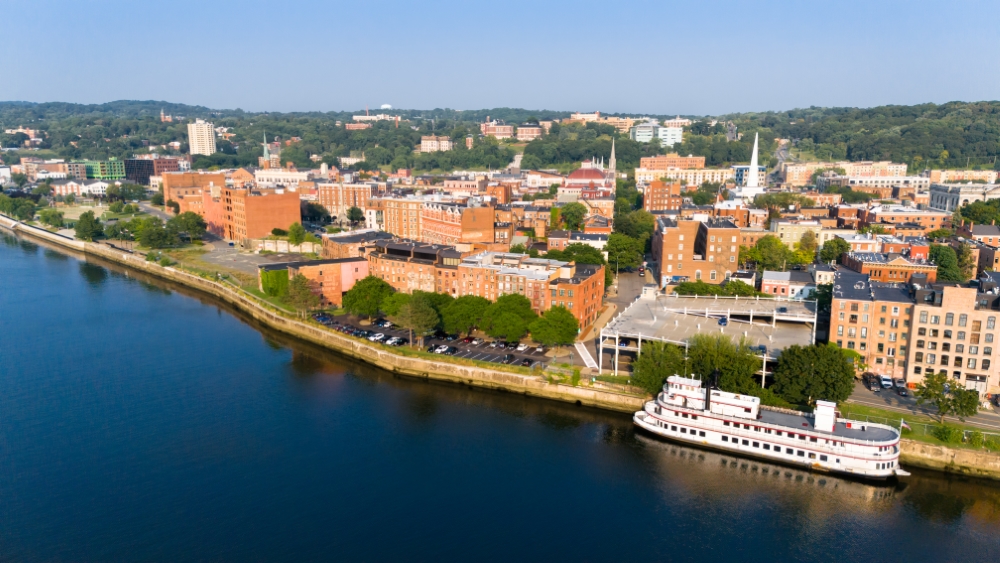
In the city of Troy, just northeast of Albany in New York, Hudson Valley Community College (HVCC) has been offering opportunities to pupils looking to leverage skills and education into jobs for 75 years, starting as a vocational school for veterans returning from World War II.
A Highly Skilled Community
Dr. Christopher McNally, department chair of the Applied Technologies Department at HVCC, has seen big changes in the courses offered during his 30 years of teaching at the college. McNally came to the college in 1996 when an instructor role was posted that perfectly matched his experience and interest in teaching up-to-date skills to diverse student populations, especially with his time working in the automotive industry.
“I worked in industry for about 15 years before I started teaching. I had a degree in teaching, but I did my student teaching in a high school and decided I couldn’t do that for a living,” he recalls with a laugh. “I went out and worked with industry and then this job at the college-level opened up, and this has really become my niche. This is really where I belong.”
The region around HVCC has a history of automotive and advanced manufacturing, which makes the curriculum taught by McNally and his colleagues go far. GlobalFoundries, a multinational semiconductor contract manufacturer and design company, is headquartered 30 minutes north in Malta. In June 2025, the company announced plans to spend $13 billion to modernize its facilities in Malta and Essex Junction, Vermont, with the bulk of investment going toward its New York operations.
McNally notes that “the majority of our students are working in the semiconductor industry.” Students at HVCC will also have opportunities at other companies in this field. IBM has a research facility in nearby Albany, and state program NY Creates, also based in Albany, boasts the largest non-profit semiconductor R&D facility in the country — the Albany NanoTech Complex. HVCC works directly with NY Creates, training people who are going to be servicing the equipment at that location.
The Applied Technologies Department at HVCC has specified instructions for manufacturers, and broader educational programming for other technical fields.
“We have one of the first electric vehicle programs in the country,” McNally says. “We’ve got a Honda-specific program here. We’ve also got clean energies that gets into solar, wind and energy storage, and then we have mechatronics.”
“So, whether I’m teaching electricity for HVAC, mechatronics, electrical, construction maintenance or automotive, it’s still electricity. Seeing those crossovers and being able to identify these basic skills that all these industries need, and then taking that as educators, we can focus on those transferable skills.”
— Dr. Christopher McNally, Applied Technologies Department Chair at Hudson Valley Community College
Mechatronics covers any electrically controlled mechanical device, integrating the fields of mechanics, electrical/electronics, motor control systems and computer science/information technology. In addition to this, HVCC runs a deep and evolving program on heating, air-conditioning and refrigeration technical services.
“Residential and industrial HVAC, geothermal, mini split heat humps,” McNally notes about some of the HVAC elements taught. “A little bit of refrigeration, including grocery stores. The whole gamut in the industry. The faculty have been training on the refrigerant phase-out for the more flammable sustainable refrigerant. There was a lot more concern about going toward the more flammable refrigerants. Being in an education environment, we really had to convince our safety people that this was something we are training students on, and it’s in the buildings anyway. It’s going to be used in these systems anyway.”
Beginning in January 2025, the U.S. Environmental Protection Agency set a directive for companies and manufacturers to phase out the use of refrigerants with high global warming potential (GWP) such as R-404A, R-410A and R-134a. A new class of low-GWP refrigerants, A2Ls, are being phased into HVACR systems and are mildly flammable.
Ready to Work
Ultimately, the focus of the department McNally leads at HVCC is focused on getting students skilled and ready to work, particularly at local companies. The quickness of developing new programming to meet ever-changing industry needs is also an asset.
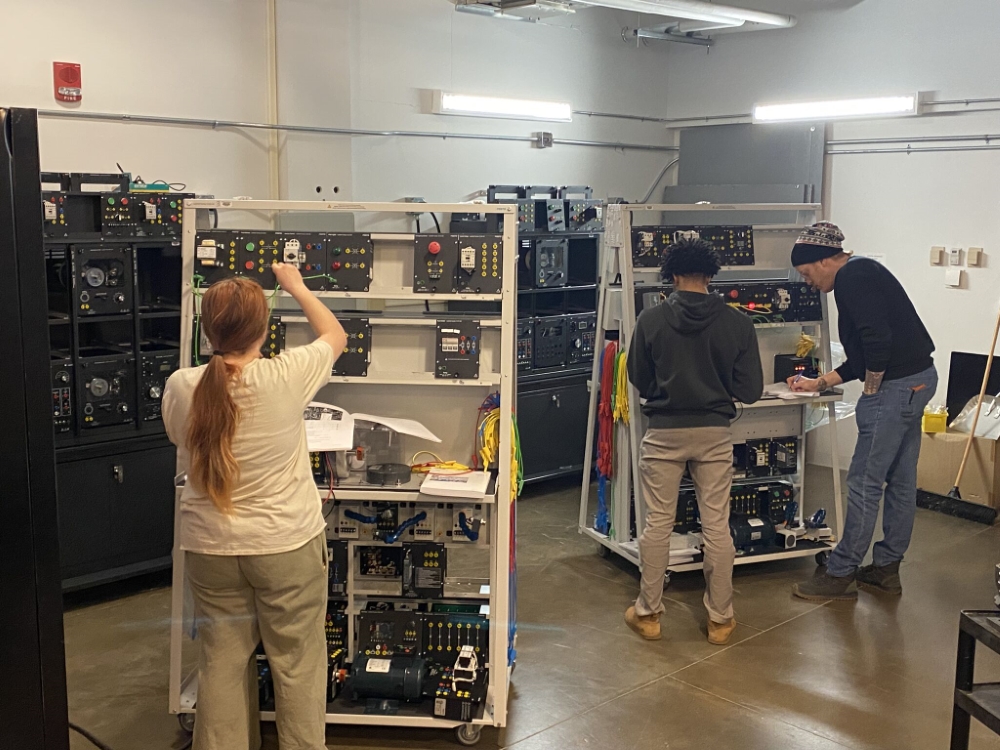
After 10 weeks of developing their skills on low voltage circuits, HVCC students in the Clean Energy course get the chance to work on 120/240V systems.
Photos courtesy of Hudson Valley Community College
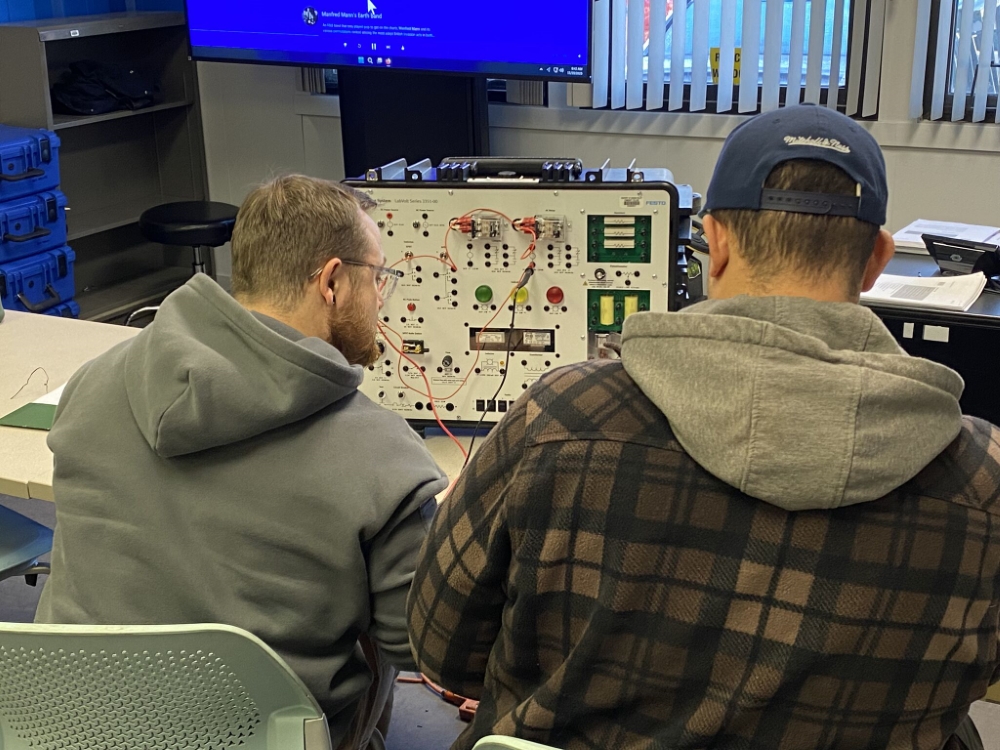
“We have established programs [in clean energies and mechatronics] where people can come in and take just a handful of courses and be prepared to enter into the industry, working with New York State and one of the larger power companies up here, NYSERDA, who are going to be establishing internships for these people,” McNally explains. “So, they can end up with ‘microcredentials.’ The students will come in, and they’ll complete these microcredentials. They’ll get a couple of courses that will make them employable in their industries so that they can start working right away, and these are also credit-bearing courses so that they can come back and continue and complete their degree if they choose to. That’s one of our biggest initiatives — getting the microcredentials up and running just to get people working as quickly as possible.”
Further, the college offers educational programs and training quickly through its workforce arm, paving a path toward credentialed courses in high-demand industries.
“My department works really well with our workforce development office,” McNally says. “We have a really good relationship. I know with most of my colleagues in other colleges it can be a competitive thing between the academic departments and workforce. We are able to work together really well and work off each other’s strengths.”
Jack of All Trades
The hard work is not without its occasional laurels. In May 2025, McNally was presented with the EV Educator of the Year Award by the Electric Vehicle Association. Asked how he felt about the surprise nomination and eventual win, he described feeling both appreciative and almost a little guilty, noting how he felt others on HVCC’s staff should have been nominated for the accomplishment instead — a modest observation from the consummate automotive educator at the college.
Still, McNally is a jack of all trades, teaching in all the programs offered in the department he leads, which include 13 different courses.
“I get everybody their classes and whatever is left, I teach,” he explains. “It has been great because I have been able to open up and do new things. And it’s also been good because I get to see the shared skillsets. So, whether I’m teaching electricity for HVAC, mechatronics, electrical, construction maintenance or automotive, it’s still electricity. Seeing those crossovers and being able to identify these basic skills that all these industries need, and then taking that as educators, we can focus on those transferable skills.”
Asked about the success of students in his departments, McNally notes that any number of students go on to open their own businesses. “Most of my current, full-time faculty are graduates of our program. So, we see people going on and continuing their education and going into engineering and so on. It’s a very successful program and most students go on to do very, very well.”
Long-term value is also an important component of the education HVCC students receive. McNally stresses that he isn’t just training pupils for what’s currently needed in the job market, but with all the skills one would need to remain employed for many years to come.
“So, you’re ready to go out and be employed in this industry now, but if you choose [to pivot professionally] in 10 years, you got the fundamental skills that will allow you to change and go into a different industry,” he notes about the teaching philosophy in the Applied Technologies department. “One of the big things we’re seeing right now is electrical vehicle chargers. There’s a big push for people to install and maintain EV chargers. But that’s a flash in the pan. In a couple of years, that market is going to be saturated. We’re not going to need that many people anymore. So, my focus is not training them to be EV charger installers. My focus is to give them the skills to do that job but also make sure that they’re going to be employable five or 10 years from now. That is what I really love about being able to mix and match from all the programs we have — it’s being able to see where all the commonalities are and where we should really be focusing for our students.”
HVCC graduates over 100 students a year from its standout electrician training program. There are about 230 students enrolled in it at any given time, and it always has a waiting list. At the time that Dr. McNally and I spoke in December 2025, he noted that anybody applying to the fall semester of the electrician program would likely be put on the waitlist.