
If the motto of the Boy Scouts of America is “Be Prepared,” then scouts may want to take notes on what’s happening in Kentucky, where a commitment to community preparedness is delivering record-breaking performances in economic development statewide.
A pillar of the Kentucky Blueprint strategy that was adopted two years ago by the administration of Gov. Andy Beshear and the Kentucky Cabinet for Economic Development (CED), Community Preparedness includes a heavy emphasis on collaboration at every level of leadership — state, regional and local.
The Collaborative Blueprint is being used by economic developers throughout Kentucky to lay the foundation for growth in every major region of the state and ensure that every Kentuckian has the opportunity to prosper from economic growth over the next five years.
The Blueprint is a product of collaboration between CED and the Kentucky Association for Economic Development (KAED). In short, it is a strategic plan written by economic developers for economic developers in the Bluegrass State. While it does not lay out policy areas, the plan does identify key industries and prioritize the growth factors that will be pursued to make prosperity happen.
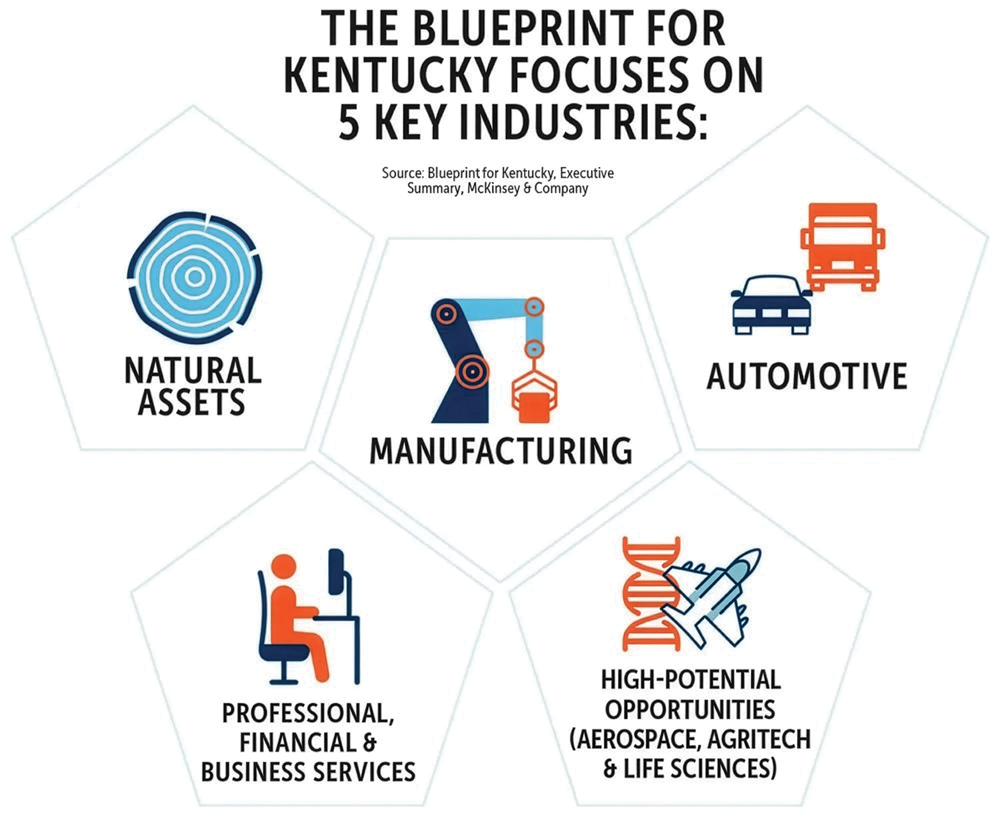
Target sectors identified by the Blueprint are:
- Automotive
- Manufacturing
- Natural Assets
- Professional, Financial and Business Services
- High-Potential Opportunities (Aerospace, Agri-Tech and Life Sciences)
The five priorities that will help Kentucky achieve growth in these sectors are:
- Workforce
- Competitive Products
- Infrastructure
- Placemaking
- Entrepreneurship and Innovation
Turf Meetings Produce Results
Kristina Slattery, Commissioner of Business and Community Development for CED, says that Turf Meetings are a critical element of this plan.
“As a part of our commitment to collaborate with local economic development partners, we have completed 25 ‘home turf’ meetings since the start of 2024,” she says. “These meetings are extremely valuable in allowing the Secretary and I to hear directly from the communities that we serve and have become a critical part of how we operate and gather input.
“At this stage, the five regions are well established, and we’ve tackled some core economic development functions together as a team,” Slattery adds. “Going into our third year of the Blueprint, we will continue to visit with our local economic developers, on their turf, to discuss critical issues such as innovation and target industry outreach. I look forward to the opportunity to learn from my peers on the local level and bring those learnings back to CED to initiate change.”
Putting Money into the Cause
Noel and Slattery do not come to these meetings empty-handed. Rather, they reinforce the message from Frankfort by giving every community in Kentucky an equal opportunity to secure needed funding.
“Placemaking and infrastructure are two of the key enablers that were established through our Collaborative Blueprint,” says Noel. “To date, our $200 million GRANT program has leveraged federal funds to achieve investments of over $700 million in our local communities. Another focus is workforce, and after two years of work, involving all state, local and chamber workforce programs, we have a truly integrated delivery system. Today, we have project managers and workforce project managers working together with newly located companies and existing businesses looking to expand to assure our promise for speed to market and ease to workforce is made a reality.”
Noel adds that “CED knows our success comes from world-class execution of economic development at the local level. Our priorities and our teamwork are shaped by countless sessions we engage in with economic developers at the local level across all 120 counties. We have written business retention and expansion programs and coordinated marketing strategies that truly reflect a New Kentucky Home.”
Funding Sites, Setting Records
Another key part of the Blueprint involved working with local groups to identify sites that can be improved and made into shovel-ready pads for development through the use of Kentucky Product Development Initiative (KPDI) funding. “We are getting ready to announce the next round of funding soon,” Slattery says.
“Each round of applications that are received are stronger than the last,” Slattery says. “More communities are participating, and the process has become more and more competitive.”
Efforts like these enabled Kentucky to set numerous records in economic development achievement in recent years. Site Selection magazine in March 2026 announced that Kentucky ranked No. 5 in the nation for the second year in a row in corporate facility projects per capita with a total of 182 in calendar year 2025.
Several Kentucky communities also delivered standout performances. Lexington-Fayette ranked No. 5 among Tier 2 metros with 27 projects, while Bowling Green ranked No. 3 among Tier 3 metros after finishing No. 1 in 2024. Louisville placed No. 6 per capita among Tier 1 metros; Lexington-Fayette placed No. 6 per capita in Tier 2; and Bowling Green placed No. 6 per capita in Tier 3.
Among Site Selection’s annual compilation of Top Micropolitan Areas or small towns, Glasgow went from unranked the year before to No. 9 in the nation with eight projects. Among the states with the most small towns in the Top 100, Kentucky moved from No. 6 to No. 2 (behind only Ohio) with 13 such communities that tallied a collective 42 projects.

Gov. Andy Beshear, his family, Lt. Gov. Jacqueline Coleman, and others from around the state pitched in to help families in Eastern Kentucky rebuild and recover from the devastating floods of 2022.
Photos by Charity Hedges courtesy of Team Kentucky
A Region Rises with Resiliency
Landing job-creating capital investments is not the only evidence that Kentucky’s collaborative approach to community preparedness is working. That collaborative spirit can also be seen in the way people from all over the state rally in support of each other following devastating natural disasters, such as the historic floods that claimed the lives of 45 people and destroyed nearly 10,000 homes in Eastern Kentucky in 2022.
Lt. Gov. Jacqueline Coleman joined state and local leaders from the region on January 15 for the Louisville screening of “RISING,” a documentary from Team Kentucky that tells the story of the strength and resilience of Eastern Kentuckians in the wake of that tragedy.
“ ‘RISING’ is a story of resilience and what we can accomplish when we work together,” says Lt. Gov. Coleman. “The world saw the worst of Mother Nature with these floods but the best of humanity in Kentucky’s response.”
The 65-minute film chronicles the commitment of Gov. Andy Beshear, Lt. Gov. Coleman and other state and local leaders to rebuild homes for survivors on abandoned coal mine sites out of the floodplains. To date, eight high-ground neighborhoods have been completed or are in progress. These are quality, safe houses that are built on higher ground and protected from future flooding.
“Whitesburg saw historic flooding in 2022 that left so many without homes and forced us to think about long-term rebuilding plans,” says Whitesburg Mayor Tiffany Craft. “The new sites in Letcher County and across Eastern Kentucky provide our people with safe housing options. People from Whitesburg are proud to be from here, and these new neighborhoods are making sure our people can stay home in their new, high-ground homes.”

“As a part of our commitment to collaborate with local economic development partners, we have completed 25 ‘home turf’ meetings since the start of 2024. These meetings are extremely valuable in allowing the Secretary and I to hear directly from the communities.”
— Kristina Slattery, Commissioner of Business and Community Development, Kentucky Cabinet for Economic Development
New York Times best-selling author and former Kentucky poet laureate Silas House reviewed the film and said, “This deeply moving documentary combines archival footage and retrospective interviews to illuminate the heroic efforts of rescue and recovery performed by grassroots efforts and the phenomenal response of the team headed by beloved Gov. Andy Beshear during a devastating Kentucky flood. The film leaves the viewer feeling hopeful and inspired by what people and government can do when they work together and when elected officials truly care about and serve their constituents.”
A trailer of the film can be viewed at https://rising.ky.gov/Pages/index.aspx.