

By King R. White, CEO, Site Selection Group
The contact center industry has never been simple to read. Markets that looked saturated a decade ago surprised with new investment. Countries that seemed poised for explosive growth ran into infrastructure walls and attrition ceilings. What has always been true is that the industry moves — and the geography of where it moves reflects deeper economic and operational forces that site selectors ignore at their clients’ peril.
In 2026, those forces are more complex than at any point in the past two decades. Industry growth has slowed considerably from its pre-pandemic pace. Artificial intelligence is reshaping how agents work, raising genuine questions about long-term headcount trajectories. Federal regulators are for the first time proposing direct restrictions on offshore customer service operations. And a gradual return-to-office trend is beginning to reverse some of the real estate decisions companies made when work-from-home appeared permanent.
The result is an industry that is not contracting — but is not growing at the rate that defined the 2010s, either. According to Site Selection Group’s 2026 Global Contact Center Location & Outsourcing Trends Report, which tracks conditions across eight global regions, the dominant strategic theme has shifted from expansion to portfolio management: distributing operations across multiple geographies, balancing cost with workforce stability, leveraging AI and aligning program complexity with market capability.
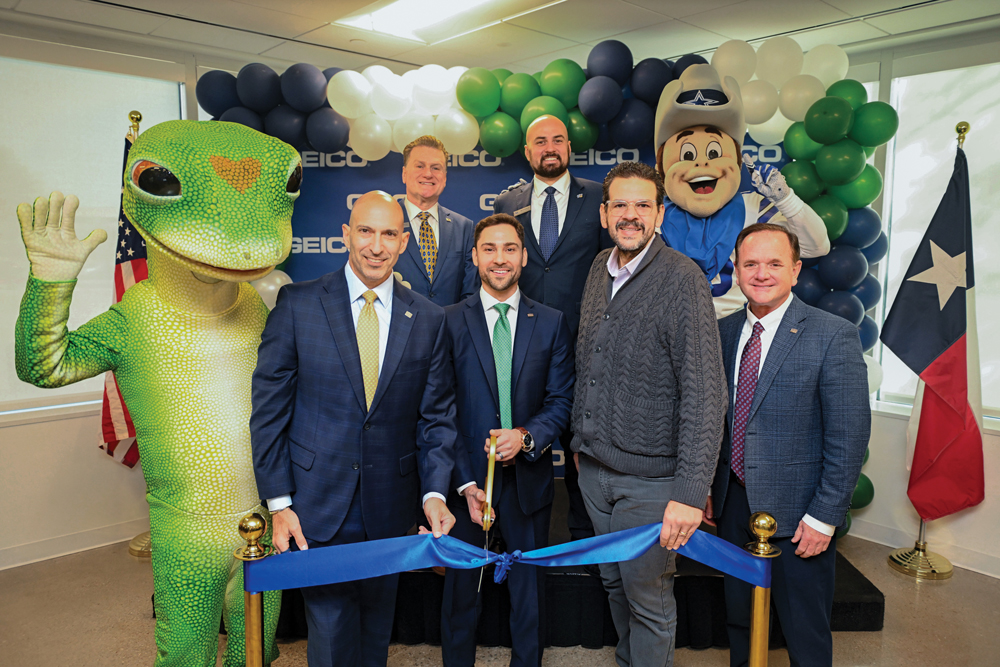
GEICO’s Richardson Campus Leader and Head of Commercial Insurance Operations Jason Andrukonis alongside Richardson Mayor Amir Omar and members of the Richardson City Council celebrate the opening of the company’s second North Texas building in January 2026 at GEICO’s new 165,000-square-foot building in Mapletree’s Galatyn Commons. Founded in Fort Worth, GEICO this year celebrates its 90th anniversary.
Photos courtesy of GEICO

The Domestic Picture: Selective Investment and a Return to the Office
The United States remains the world’s largest contact center market, employing an estimated 3 million workers in the industry. Growth is essentially flat. Legacy contact center hubs that built their reputations on deep, affordable labor pools are contending with tighter workforce availability and persistent turnover. Captive operations report attrition in the 10–30% range, while outsourced programs face considerably steeper retention challenges.
Where investment is occurring, it is concentrated in lower-cost Sun Belt metros with favorable cost structures and younger population bases. The Dallas–Fort Worth Metroplex has been particularly active. Geico recently committed to a 1,000-employee operation in Richardson, Texas, joining AT&T, which separately announced a 1,000-employee contact center in the same community. Nearby in Carrollton, Pennymac announced plans for an 1,800-person operation — one of the larger single-market captive commitments in the country in recent months. In the Midwest, Fiserv selected Overland Park, Kansas, for a 2,000-employee center, reflecting continued demand from regulated industries where proximity, compliance capability and workforce depth outweigh the appeal of lower-cost offshore alternatives.
One trend worth noting: After several years in which work-from-home and hybrid delivery models were treated as permanent fixtures, a meaningful return-to-office push is now underway across the industry. Employers are finding that agent quality, training effectiveness and supervisory oversight are more manageable in physical environments — and that the fully distributed model introduced significant attrition and performance challenges of its own. This shift has real estate implications. Companies that deferred facility decisions during the pandemic era are re-entering markets, and quality turnkey space has become scarcer than many anticipated.
Washington Enters the Room: The FCC’s Offshore Rulemaking
No regulatory development has generated more discussion in contact center boardrooms in 2026 than the FCC’s March 26 Notice of Proposed Rulemaking on offshore call center operations. Formally titled “Improving Customer Service and Protecting Consumers through Onshoring” (CG Docket No. 26-52), the rulemaking targets the use of foreign contact centers by FCC-regulated communications providers — telecommunications carriers, VoIP providers, cable operators, and satellite broadcasters — and proposes a suite of requirements that, if adopted, would materially reshape how those companies structure their customer service delivery.
The FCC’s stated rationale centers on three concerns: customer service quality, consumer data security and illegal robocall activity originating from foreign contact centers. The key proposals include English proficiency standards for offshore call center staff, a cap on the percentage of customer service calls that covered providers may route offshore (with a proposed starting point of 30%), mandatory disclosure when a call is handled outside the United States and a consumer right to request transfer to a U.S.-based representative.
It is worth being precise about what this rulemaking is — and what it is not. The NPRM is at the proposed rule stage, not a final order. The rules as currently drafted apply specifically to FCC-regulated communications providers, not to the broader universe of enterprises — retailers, financial institutions, healthcare companies — that operate or contract offshore contact center capacity. The FCC has explicitly acknowledged the limits of its jurisdiction. That said, the Commission is actively seeking comment on whether to extend some provisions to all businesses covered by the Telephone Consumer Protection Act, which would dramatically broaden the reach.
Parallel legislative activity reinforces the direction. The Keep Call Centers in America Act of 2025 (S. 2495), currently pending in Congress, would extend location disclosure requirements and consumer transfer rights to all companies using offshore contact centers and would create a public registry of employers moving significant contact center work offshore, with consequences tied to federal grant and loan eligibility.
For enterprise location strategists, the appropriate response is not to wait for final rules. The direction of travel is clear. The contact center programs most exposed are those with the highest offshore concentration in voice-based, consumer-facing, and regulated-data-handling functions — and the time to stress-test delivery portfolios against a more restrictive regulatory scenario is before rules are finalized, not after.
Nearshore Still Growing, But with More Discipline Required
No region has captured more contact center investment momentum over the past several years than the nearshore Americas — Mexico, Central America, Colombia, the Caribbean island nations and parts of South America. Employment across Latin America and the Caribbean now stands at approximately 1.5 million workers, and the region continues to grow even as saturation pressures build in its most established markets.
The core appeal remains intact: time-zone alignment with U.S. operations, a large bilingual workforce, primarily on-premise delivery infrastructure and wage structures that offer meaningful cost advantages relative to domestic markets. The region also carries strategic relevance in light of the FCC’s rulemaking direction — nearshore programs carry lower regulatory exposure than deep offshore operations, and some enterprise clients are treating Caribbean investment as a form of portfolio hedging against a more restrictive U.S. regulatory environment.
Saturation and wage inflation in top-tier markets like Costa Rica, Colombia and the Dominican Republic are pushing clients toward secondary and tertiary geographies. Advensus recently announced a 1,000-employee expansion in Trinidad and Tobago, a market that has historically sat at the edges of the nearshore conversation but offers genuine diversification for operators seeking alternatives to overheated primary hubs. Caribbean investments carry real weather exposure risk that disciplined site selection must account for, and a multi-market portfolio approach has become the operating standard for large-scale programs.
The Offshore Anchors: Scale and Staying Power
The Philippines and India together account for more than 2.8 million contact center workers and remain the backbone of global offshore delivery. Both markets are categorized as “very mature” yet continue to register industry growth — reflecting the enduring demand for large-scale labor pools capable of handling back-office, voice and multi-function operations at costs that onshore and nearshore markets cannot match.
In the Philippines, growth is expanding into secondary provinces as primary metros approach saturation in select worker categories. India continues to attract back-office and tech-enabled service investment, with operators running large operations despite persistently high attrition and intense competition for skilled labor. For both countries, long-term success depends on attrition management, workforce planning discipline and secondary city expansion strategies that prevent cost escalation in primary hubs.
Africa: The Highest-Growth Market on the Map
Among the eight regions tracked in SSG’s global report, Africa registers the highest growth rate — a distinction that reflects both the scale of untapped labor potential and the infrastructure constraints that remain real limitations in many markets. With approximately 1 million workers already in the sector, Africa is home to a mix of mature markets — South Africa, Morocco, Egypt — and genuinely emerging ones attracting aggressive investment from global BPO operators.
The recent announcements illustrate how quickly this geography is evolving. Teleperformance, one of the world’s largest BPO operators, announced a 5,000-employee operation in Kenya, one of the continent’s most competitive markets for English-voice and back-office work. CCI’s announcement of a 2,000-employee facility in Botswana reflects the diversification appetite pulling investment into markets that would have been considered frontier destinations just a few years ago. Botswana brings labor cost advantages, political stability, and time-zone alignment with European clients.
Infrastructure challenges remain the primary constraint across much of the continent, and attrition during rapid scaling phases is elevated. For operators building long-range capacity plans, however, Africa’s young and growing English-capable workforce makes it a strategic priority rather than an optional destination.
The AI Question: Augmentation, Disruption or Something in Between?
No conversation about the contact center industry in 2026 is complete without confronting artificial intelligence — and no topic generates more uncertainty among enterprise operators, economic developers and workforce planners trying to understand what the next five years actually look like.
The honest answer is that nobody fully knows. What is clear is that AI is already reshaping how contact centers operate, and that its effect on employment and location strategy is more nuanced than the headlines suggest.
The most visible near-term impact is agent augmentation, not agent replacement. Tools that monitor calls in real time, flag compliance risks, surface knowledge base answers and coach agents mid-interaction are now widely deployed. The effect is measurable: Agents handle more complex interactions with fewer escalations, and training cycles compress. The result is a more productive agent — but also, over time, potentially fewer agents needed to handle the same volume.
Accent neutralization software — companies like Sanas and Krisp have emerged as notable players in this space — is addressing one of the longstanding friction points in offshore voice delivery. By modifying agent voice characteristics in real time, these tools are reducing the perception gap between offshore and domestic service. For markets like India and the Philippines, this technology has meaningful location strategy implications: It partially neutralizes an argument that has historically pushed some enterprise clients toward more expensive nearshore or domestic alternatives.
Fully autonomous AI agents — capable of handling end-to-end customer interactions without human involvement — exist in limited form today but have not yet proved reliable enough for broad deployment in complex service environments. The industry’s working hypothesis is that the near-term destination is a “super-agent” model: a smaller number of highly capable, AI-assisted agents handling a more demanding mix of interactions. That model implies some reduction in total headcount over time, but not the wholesale elimination of the occupation that some AI vendors have forecast.
“No region has captured more contact center investment momentum over the past several years than the nearshore Americas — Mexico, Central America, Colombia, the Caribbean island nations and parts of South America.”
Those forecasts deserve scrutiny. The companies most aggressively predicting the end of the human contact center agent are, in many cases, also the companies whose valuations depend on that narrative. The industry’s actual investment data — the new facilities, the large-scale hiring commitments visible in markets from Richardson to Kenya — tell a more measured story.
Enterprises are not behaving as though they expect agent headcount to collapse in the near term. They are, however, building with more flexibility than they did a decade ago, and making location decisions with an eye toward markets that can support a higher-quality, more adaptable workforce rather than simply the largest or cheapest one.
What AI has already accomplished is a reduction in low-complexity call volume — the transactions that automation and self-service handle efficiently. That reduction is real, and it is one of the clearest drivers of the slower industry growth that defines the current market. The interactions that remain are harder, and they require more from agents and the labor markets that supply them.
The Core Takeaway
The contact center industry in 2026 is not in decline. But it is not the growth engine it was in the decade before the pandemic, either. Slower volume growth, AI-driven efficiency gains, and an evolving regulatory environment are collectively reshaping how enterprises think about capacity, geography, and workforce investment.
The announcements of the past year — from Richardson to Overland Park to Trinidad to Botswana to Kenya — confirm that location decisions are still being made and made at scale. They also confirm that the criteria driving those decisions have shifted. Labor quality and sustainability have moved ahead of raw labor cost. Regulatory risk has entered the equation for the first time. And AI capability — in the markets, vendors, and workforces that can actually deploy it effectively — is becoming a differentiator.
King R. White is CEO and Founder of Site Selection Group, a Dallas-based location advisory, corporate real estate and economic incentives firm that has advised on contact center location strategy for more than two decades, tracking global market conditions across every major delivery region. SSG provides integrated services including site selection, economic incentive negotiations, contact center outsourcing advisory, and corporate real estate services. For more information, visit siteselectiongroup.com.