HERE’S WHY LARGESCALE DATA CENTER COMPANIES HAVE THEIR EYES ON NORTH DAKOTA.
When asked what makes North Dakota an ideal place to site a data center, Applied Digital’s chief development officer Todd Gale lists the common denominators: the cool northern climate, plentiful power capacity and infrastructure, and multilevel government support.
“That’s true statewide,” Gale says. “Just sensational power availability and support from North Dakota in general. That applies to our Polaris Forge 2 campus in Harwood where we have this fantastic relationship with our local utility provider, which is different from the utility provider at our Polaris Forge 1 campus. They are equally supportive, cooperative, and work with us on getting that power delivered to the sites as we construct the facilities there.”
North Dakota made data center investment even more attractive after it approved landmark incentive legislation in 2025.
The act passed by state lawmakers provides a sales and use tax exemption for enterprise information technology equipment and computer software purchased for use in a qualified data center.
Making Progress
Gale has worked with data centers and hyperscalers for 48 years and applies that storied experience to scaling Applied Digital’s projects, especially in North Dakota. The rate at which the company is scaling its buildout in North Dakota and other states has been impressive — aided by the company’s uncompromising commitment to its production schedule.
After breaking ground on the Polaris Forge 1 data center in September 2022, the site was powered and operating six months later. In November 2025, Polaris Forge 1 achieved phase 2 “ready-for-service” status at the first of a trio of buildings planned for the campus located in the southeastern part of the state. Phase 1 was completed a month earlier. The first building has a capacity of a 100 MW, and Polaris Forge 1 is contracted to deliver 400 MW of critical IT capacity for AI cloud-computing company CoreWeave in a long-term lease.
Gale had toured the Polaris Forge 2 facility a few days before we talked, noting the exceptional headway made on the site.
“We were seeing just excellent progress,” he observes. “The weather has cooperated, which is sometimes one of the challenges of building in the northern tier states — the winters can be fairly harsh. But we’ve had some pretty good luck with weather, so we’re about where we exactly should be. The shell is nearly complete, and then once the shell of the building is complete, we start installing all the equipment that goes inside of the critical infrastructure.”
As discussed last year in a Site Selection magazine interview with Applied Digital’s Chairman and CEO Wes Cummins, a cold climate can provide an advantage for data center companies and operators looking to save on cooling costs while also boosting efficiency and sustainability on-site once the facilities are operational. Yet very cold winters can also be a barrier when prepping sites for early construction work.
Luckily, due to excellent planning and the relatively temperate winter in North Dakota recently, Polaris 2 is right on schedule to deliver on its $5-billion leasing contract in October 2026 and reach full capacity in early 2027.
“I’m a huge fan of our locations up in the northern tier states,” Gale notes about the ideal temperatures for data center projects. He also acknowledges “the government support from all levels of government … starting with the governor all the way down to city councilmen and mayors, firefighters and EMTs, and people in building departments” as being critical in getting Applied Digital projects started and worked on in a timely fashion.
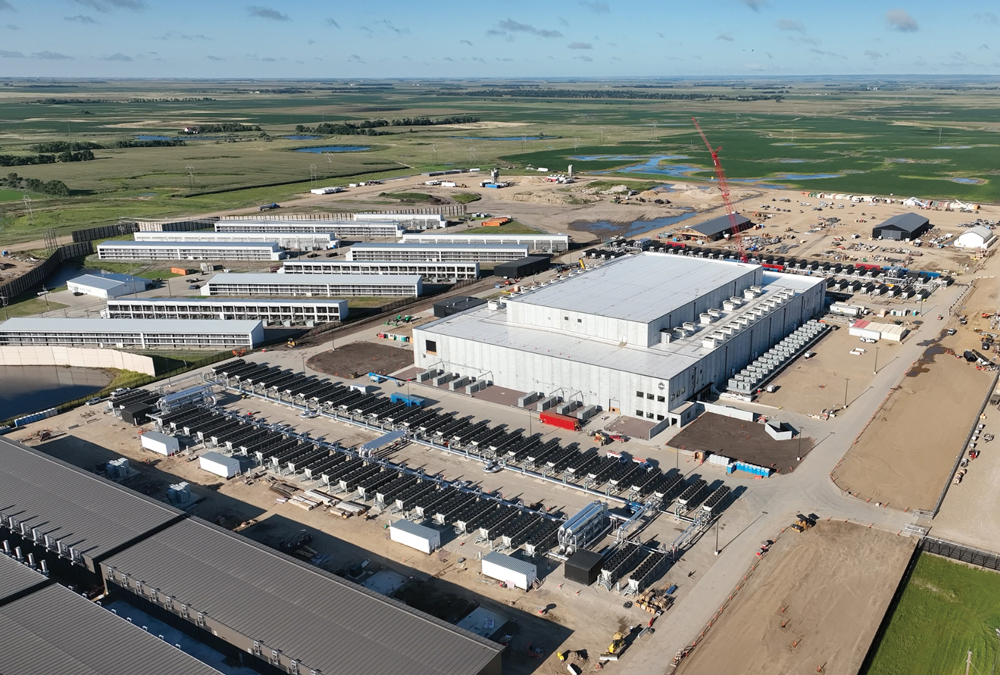
Polaris Forge 1 data center campus in Ellendale, North Dakota.
Photo courtesy of Applied Digital
The development of AI factories is not easy, requiring complex, high-density systems. The power demand to operate the sites is also high, and the Peace Garden State is optimal ground for supplying electricity in-state and exporting it. Nearly 40% of electricity in the state is created from renewable resources, with a good amount produced by wind generation.
“North Dakota generates way more power than it can consume,” Gale explains. “We take advantage of that excess power, and it creates a win-win for the consumers because it keeps their prices low. It’s a win for us because we have access to that power. And it’s a win for the power producers to have an off-taker or a consumer for that power.”

“North Dakota generates way more power than it can consume. We take advantage of that excess power, and it creates a win-win for the consumers because it keeps their prices low. It’s a win for us because we have access to that power. And it’s a win for the power producers to have an off-taker or a consumer for that power.”
— Todd Gale, Applied Digital, Chief Development Officer
Polaris Forge 2 also has an eye on sustainability, employing a closed-loop liquid cooling system common in most contemporary data center builds that significantly reduces water usage on-site. In an August 2025 public meeting with Harwood residents, Applied Digital’s Vice President Nick Phillips answered questions for 90 minutes, and noted that both facilities at Polaris Forge 2 would have a water usage equivalent to about two-thirds of water used by an average home.
According to a press release, total contracted revenue across both Applied Digital’s Polaris Forge campuses in North Dakota is around $16 billion.
Equipped to Scale
Polaris Forge 2 is the third data center site from Applied Digital to be built in North Dakota after Polaris Forge 1 in Ellendale and a 100-MW facility in Jamestown, which opened in 2022. Headquartered in Dallas, Applied Digital also has a data center in Texas and has plans to build in South Dakota, Iowa and an AI factory campus in the Southern U.S. region, “Delta Forge 1,” which will support 430 MW of total utility power to start and the ability to scale significantly in 2028.
According to Gale, Applied Digital’s site strategy team is looking at more campuses to add in the northern tier states, including sites in North Dakota, South Dakota, Minnesota, Montana and other Midwestern states.
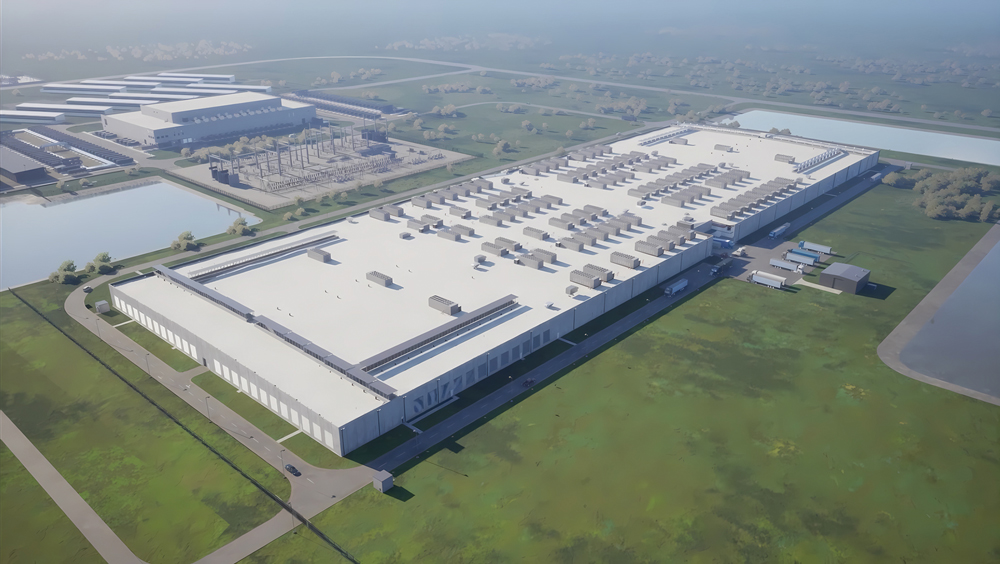
Rendering of the planned Applied Digital data center in Harwood, North Dakota.
Rendering courtesy of Applied Digital
“We believe Polaris Forge 2 represents the next stage in Applied Digital’s rapid growth and our position as a leader in delivering high-performance AI infrastructure,” said Wes Cummins, Applied Digital CEO, at the Harwood groundbreaking in September 2025. “The demand for AI capacity continues to accelerate, and North Dakota continues to be one of the most strategic locations in the country to meet that need. We have strong interest from multiple parties and are in advanced negotiations with a U.S.-based investment-grade hyperscaler for this campus, making it both timely and prudent to proceed with groundbreaking and site development. We believe this new campus will strengthen our operations, increase our ability to scale, and create lasting value for both our customers and the communities we serve.”
Applied Digital’s power pipeline includes 100 MW of current live capacity, 900 MW of critical IT load capacity under construction, about 3.5 GW of utility power at active pipeline sites, and over 5 GW of utility power in its extended pipeline.
At Polaris Forge 1 and 2, the number of construction jobs during buildout reaches or is expected to reach 1,500 to 1,800 at each site at its peak, with a low of 500 to 600 construction roles during transition. During operations, Applied Digital can have as many as 30 to 50 employees on-site and tenants will average about 50 to 70 employees. All jobs in construction or operations are noted to be well-paid.

“These are long-term infrastructure assets, and having committed capital allows us to move forward with construction while maintaining financial flexibility as we scale our pipeline.”
— Wes Cummins, Chairman and CEO, Applied Digital
In early March, Applied Digital announced its subsidiary, APLD Compute 2, priced a $2.15 billion offering of 6.750% senior secured notes at an issue price of 98% that were sold in a private offering to interested, qualified institutional buyers over the course of about a week to help fund the development of Polaris Forge 2. “The offering is part of our strategy to fund the buildout of our AI factory campuses,” says Cummins. “These are long-term infrastructure assets, and having committed capital allows us to move forward with construction while maintaining financial flexibility as we scale our pipeline.”
When asked what the company’s long-term goals for its North Dakota data centers, Gale answers, “continued growth and operation” and “creating that economic benefit for a given locality” for long-term tenants, with a focus on operating leased space over 10 to 20 years.