
BUILDING INFRASTRUCTURE AND IMPROVING TAX POLICY LAID THE FOUNDATION FOR SUCCESS.
When North Dakota shocked the world by hauling in the Site Selection Governor’s Cup for attracting the most new and expanded corporate facility projects in the nation on a per capita basis in 2025, the person who was the least shocked was North Dakota Gov. Kelly Armstrong.
As he told Site Selection Editor in Chief Adam Bruns, “From your side, we came out of nowhere. I don’t think we really did come out of nowhere. This is how we approach things — build the infrastructure out, make sure you’re ready to create the infrastructure before you bring these things in. I’m the first governor in my lifetime that didn’t run on jobs, jobs, jobs. We want a holistic approach to economic development, and so you have to build out the infrastructure.”
Build out the infrastructure they did. The result was a record-setting year in which North Dakota tallied 145 corporate facility investment projects — good for 15th overall in the country and No. 1 on a per capita basis.
How significant is this win? Consider this: With a population of just under 800,000 people, North Dakota outperformed many of the largest metropolitan areas in the country and many states that are double or even triple their size.
In the West North Central region, North Dakota blew out the competition, besting Kansas (137 deals) by eight projects and all others by dozens or more. Neighboring Minnesota, with a population of 5.87 million — more than seven times larger than North Dakota — tallied 112 projects, 33 shy of North Dakota’s total.
The remainder of the region fell way short of North Dakota’s total, with Missouri registering 93, Iowa 91, Nebraska 45 and South Dakota 31.
And that’s not where the dominance stops. When you look at how North Dakota’s cities measure up versus their competition, the winning continues. In the Tier 3 Metros category, which measures the performance of MSAs of 200,000 residents and smaller, North Dakota places two cities in the top 10: Grand Forks ranks second with 19 projects; and state capital Bismarck ranks seventh with 11.
The biggest winner, however, is the small town of Williston in the upper northwest corner of the Peace Garden State. In Site Selection’s annual ranking of the Top 100 Micropolitan Areas in America (a category that measures the performance of small towns under 50,000 in population), Williston and its 30,000 residents rank No. 1 out of 542 U.S. micros with a nation-leading haul of 21 corporate facility investment deals.
How North Dakota Became the Western Star
Williston’s performance in 2025 is remarkable for multiple reasons, not the least of which is the fact that this northern Central Plains oil boomtown unseated 11-time defending champion Findlay, Ohio, to take home the crown. Adding to the luster is that Williston’s 21 projects represent more than $30 billion in private corporate facility investments — a figure that surpasses the cumulative sum of many U.S. states.
Statewide, North Dakota hauled in more than $60 billion in new capital investment projects last year.
How did North Dakota pull off this bounty in 2025? The difference-making recipe can be found in the formula that the Governor’s Office and the North Dakota Department of Commerce use to appeal to corporate executives and site selection consultants.

“This is how we approach things — build the infrastructure out, make sure you’re ready to create the infrastructure before you bring these things in. I’m the first governor in my lifetime that didn’t run on jobs, jobs, jobs. We want a holistic approach to economic development, and so you have to build out the infrastructure.”
— Kelly Armstrong, Governor of North Dakota
Here’s how North Dakota consistently wins when pitted against competing states:
- The state provides a low-cost, low-barrier operating environment that appeals to corporate investors who want to get their projects up and running quickly.
- Led by Gov. Armstrong and his team at Commerce, North Dakota provides a pro-growth, pro-business policy environment that is anchored by responsive, accessible and nimble state and local government partners.
- Strong workforce performance is supported statewide by innovative talent programs and worker training.
- North Dakota offers a comprehensive suite of incentives designed to accelerate relocation and expansion.
According to the Department of Commerce, North Dakota competes to win. “With competitive business costs, reliable infrastructure and a proven track record of supporting industry, North Dakota offers a strategic advantage for companies seeking stability, growth and long-term success,” Commerce states.
One factor keeping business costs low is North Dakota’s tax structure. According to the Tax Foundation, North Dakota ranks as the 11th most competitive state in overall tax policy. That includes property taxes that are the sixth lowest in the U.S.
In its annual report, the Tax Foundation noted that “North Dakota performs above average across all tax categories, ranking just outside of the top 10 states overall, as well as on the property tax and corporate tax components. While North Dakota’s corporate and individual income taxes have a graduated-rate structure, both rates are low, with North Dakota’s top marginal individual income tax rate tied with Arizona’s as the lowest in the country at 2.5%.”
In May 2025, North Dakota lawmakers passed additional tax relief when they voted to limit the growth in local property tax collections by placing a 3% cap on annual property tax revenue increases.
A Steadily Improving Business Climate
Tax policy improvements like these are a big reason why North Dakota continues to improve its overall competitive standing. Site Selection magazine confirmed as much in the publication’s annual ranking of the most competitive states. North Dakota now ranks No. 7 based upon its performance across the board in economic development. Within the West Central Region, North Dakota ranks No. 1.
This improved competitive position extends to individual cities within the state too. When the Milken Institute recently revealed its annual ranking of the Best Performing Cities in the country, Bismarck showed the fifth-best improvement in the nation from 2025 to 2026 among small cities. Bismarck also recorded the nation’s strongest single-sector growth, with construction employment rising 9.5% year-over-year.
Grand Forks, meanwhile, registered one of the country’s biggest two-year improvements, rising nearly 100 places in the Milken Best Performing Small Cities ranking to No. 58.
North Dakota also provides the tools that site selectors need to evaluate prospective business locations, including everything from a comprehensive database of available sites and buildings through LOIS/Lasso, to competitive workforce development programs such as Job Service North Dakota.
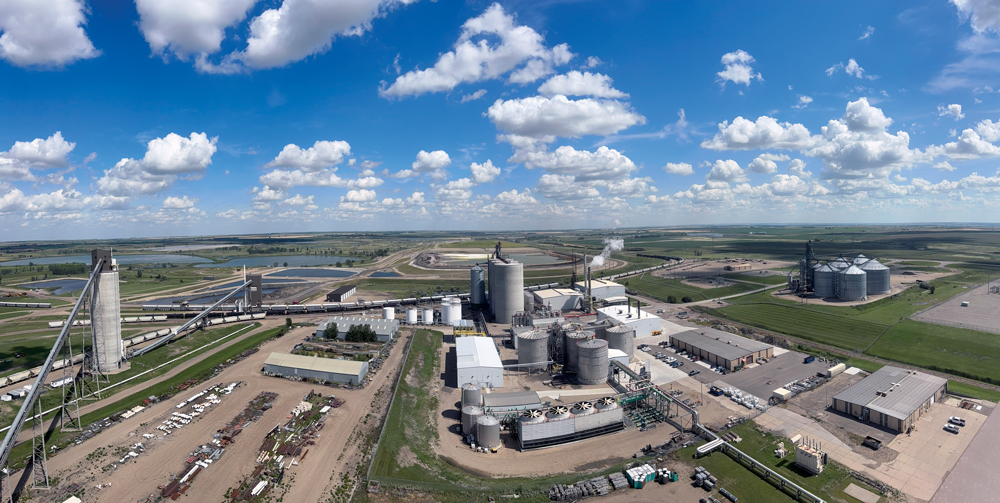
Blue Flint Ethanol in McLean County is part of North Dakota’s No. 1 industrial sector: energy.
Photo courtesy of North Dakota Commerce
These and other tools enabled North Dakota to land some of the most competitive private corporate investment projects in the nation last year. Among them is Los Angeles-based Critical Data House LLC (CDH), which will invest $10 billion to establish a seven-building data center campus on 300 acres in Williston. Each of the seven CDH structures will be 275,000 sq. ft. to 500,000 sq. ft. and use a closed-loop cooling system with direct-to-chip cooling. Construction of phase one, consisting of the first two buildings, will run through the fourth quarter of 2027. The full three-phase buildout is set to take 10 years. The company plans to spend $5 billion on construction and another $5 billion on IT hardware before it even gets to payroll.
The deal-closing factors, according to documents and city officials, were a prime parcel of available land, a city administration eager to do business with the company, and three fiber carriers that provide dark and lit fiber from Williston to Denver, Chicago, Minneapolis-St. Paul, Seattle and two markets in Nebraska: Lincoln and Omaha.
The 455-MW campus is being built at the intersection of U.S. Highway 2 and 56th Street N.W., a tract that previously had been targeted for a 2,000-home development known as Northstar Center. Instead, the parcel is going to be home to one of the largest data center complexes in North America.
Another mega-project chose Trenton in Williams County. Calgary-based Cerilon GTL announced it will build a gas-to-liquid complex, capable of producing 24,000 barrels of high-grade fuel products per day, with an investment of $3.2 billion. Cerilon executives said they chose the site in western North Dakota “because of the abundant natural gas supply, suitable geology for carbon sequestration, and transportation access to markets.”
Project startup is slated for 2030, and the firm plans to hire 100 people.
Other huge deals last year included Atlas Data Systems announcing a $1.2 billion data center campus in Williston and Basin Electric Power revealing plans for an $805 million energy investment in the same region.
From manufacturing, energy and logistics plants to data centers and headquarters/back-office centers, companies that want to grow quickly are choosing locations in North Dakota as their preferred business destination.