
by Dany Bahar and Greg Wright
The following is an adapted excerpt from “Data Centers and Local Labor Markets,” a report authored by Dany Bahar and Greg Wright. It appears here by permission of the authors and Brookings Institution.
On March 25, 2026, Senator Bernie Sanders and Representative Alexandria Ocasio-Cortez introduced the AI Data Center Moratorium Act, a bill that would pause all new large-scale AI data center construction until Congress passes legislation addressing AI safety, worker protections and environmental standards. The bill reflects a sharp turn in the national conversation. Five years ago, data centers were ribbon-cutting events. Today, more than 100 local communities have enacted moratoriums, more than 300 state data-center bills were filed in the first six weeks of 2026, and several states that once competed to offer the largest tax incentives — Virginia, Georgia and Oklahoma — are now reconsidering those programs entirely.
The backlash is not hard to understand. Data centers consume enormous amounts of electricity and water. In the PJM grid region, which serves 65 million people across 13 states, power supply costs jumped from $2.2 billion to $14.7 billion in a single year, with data centers accounting for nearly two-thirds of the increase. Residential electricity rates nationally rose about 32% between July 2020 and July 2025. Communities near proposed facilities face noise, strained infrastructure and the loss of farmland, costs that are immediate and visible.
Proponents counter that data centers bring high-paying jobs, construction activity and tax revenue. A single hyperscale campus can become one of a county’s largest taxpayers. Supporters also argue that the United States cannot cede AI infrastructure to geopolitical competitors, and that pausing construction amounts to surrendering technological leadership.
Critics respond that these benefits are overstated, in part because data centers are among the least labor-intensive structures in the economy. And the tax incentives are costly: In Virginia alone, the data-center sales-tax exemption cost an estimated $1.6 billion in fiscal year 2025. These incentives may simply be subsidizing investments that would have happened anyway.
What the Evidence Says About Jobs
What has been largely missing from this debate is rigorous evidence on the economic effects that data centers actually produce. To this end, we assembled a dataset of approximately 770 U.S. data center facilities linked to county-level employment and wage data from the Bureau of Labor Statistics (2003-2024). The dataset covers 93 counties that received their first large data center between 2008 and 2024 and approximately 3,000 control counties that never received one.
We estimate the impact of the data centers on jobs using the synthetic control method (SCM), which constructs a counterfactual for each treated county by finding a weighted combination of control counties that matches the treated county’s pretreatment employment trajectory. This approach is important because before the facilities arrived, data center counties were growing faster than other counties. As a result, a naive comparison of treated and control counties, as some industry-sponsored reports have done, would overstate the impact on jobs by a factor of three.
We find that data centers do create local jobs, with caveats. Counties that receive their first large data center see total private employment rise by 4%-5% over five to six years, with Construction employment rising 11%. Wages rise by 3%-4% for both existing workers and new hires, accompanied by a modest rise in home prices.
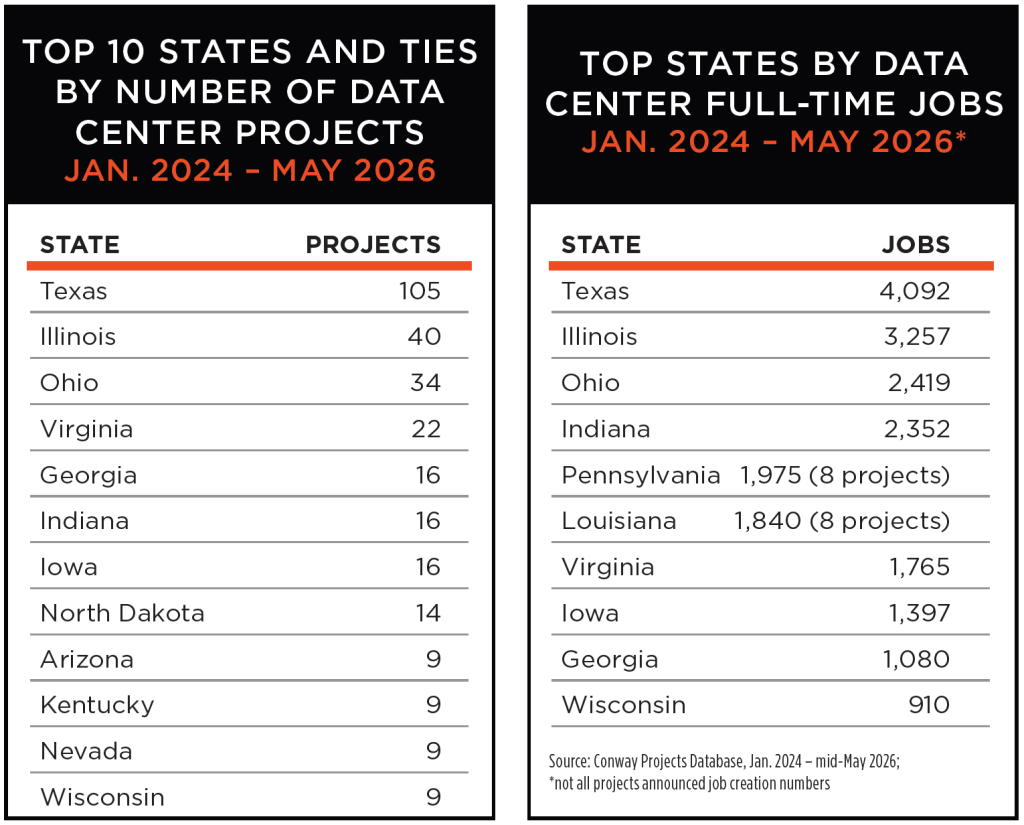
We also find that employment in the information sector — the broad category that also contains data centers themselves — rises by about 22%. However, this number is the least settled of our findings. Data-center counties were already growing faster than comparable counties before any facility arrived. So part of what looks like a hyperscale ‘spillover’ may instead reflect the kind of place that attracts hyperscalers in the first place. So these counties do see genuine information-sector growth, but how much the data centers cause — rather than merely accompany — remains an open question.
If economic developers take one finding from this work, it should be that the incentives appear poorly aimed. State subsidies are small relative to private investment overall — but how small depends entirely on facility type. For hyperscale campuses, the ones associated with the larger local gains, incentives amount to only about 2% of total construction investment, and siting is driven by power, land and fiber, not tax breaks; these are largely investments that would have happened anyway.
For colocation facilities, incentives represent roughly 62% of total investment — meaning the largest public subsidies flow to precisely the facilities that generate the smallest local benefits. The right question is not how to win more data-center projects, but which projects actually repay the public investment — and whether incentives are priced to the capital and tax base these facilities bring, rather than to a jobs-and-ecosystem story that is real for some facilities, absent for others and harder to pin down than the headlines suggest.