
From AI agentic operations to broadband, Mississippi is building for capacity and accessibility.
Mississippians are getting wired and connected like never before.
The Magnolia State is modernizing and improving its digital infrastructure for Mississippians while attracting big ticket investments from industry. In April 2026, Gov. Tate Reeves announced an additional $12 billion in data center buildout from Amazon Web Services (AWS), adding to the $13 billion the company had already announced. The new data centers are in Ridgeland and Clinton, adding to the state’s overall eight confirmed existing or developing data center projects.
Connecticut-based AVAIO Digital, which builds sustainable hyperscale facilities, broke ground in September 2025 on its $6 billion data center campus in Brandon east of Jackson. The site will have 116 MW of capacity when complete and provide direct access to multiple long-haul fiber routes connecting to Dallas and Atlanta.
Preparing Mississippi for the Future
Another tech company advancing Mississippi’s digital future is C Spire, a telecommunications company based in Ridgeland, Mississippi, that provides wireless and fiber-to-home services for people living in Mississippi, Alabama and Tennessee. The company is also the largest privately held wireless carrier in the United States and provides cloud computing and other IT services to commercial end-users.
Recently, C Spire spent two months developing an agentic AI system with AWS to support its network operations, helping identify outages faster. The newly updated operations component will include three task agents, a supervising agent and the potential of future AI agentic technology that will help identify issues in C Spire’s network before they become problems for residential and commercial end-users.
“It helps our network operations team,” says C Spire Senior Vice President & Chief Network Officer Alan Jones about the company’s emerging AI agentic project. “And the layout of that is different AI agents running in the background that are gathering data — they may be gathering weather data, power data, alarm data, knowledge-based data — all of those things in the background so that our technicians are freed up to focus on what’s in front of them. We have not completed a full rollout of it yet, mainly just because we want to make sure that we have got something that we can also help others operationalize. But it has definitely impacted our mean time to detect and that ultimately rolls up into mean time to repair.”
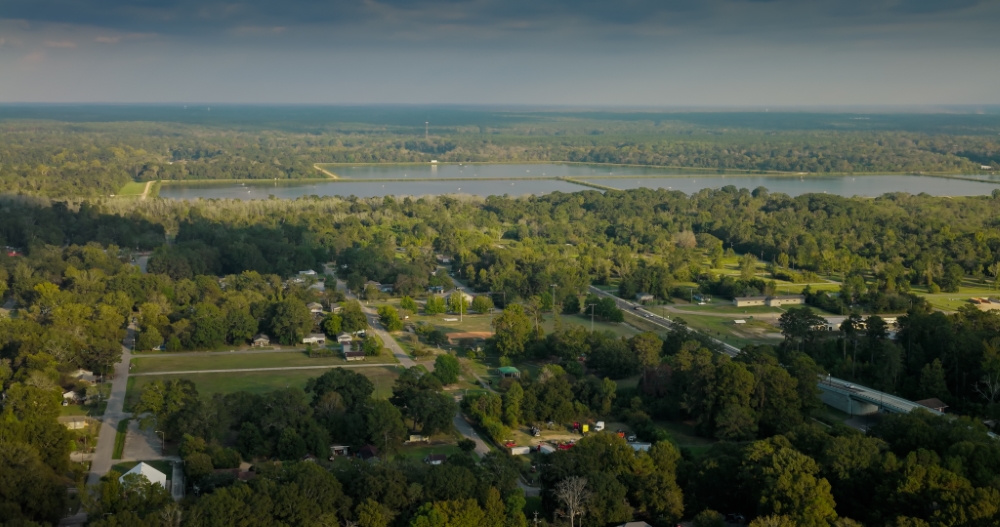
C Spire operates three enterprise data centers in the state of Mississippi, located in Hattiesburg (pictured), Ridgeland and Starkville.
Photo: Getty Images/halbergman
Notably, C Spire has over 23,000 miles of buried fiber and has worked on strengthening rural broadband expansion in Mississippi over the long term while also building out new enterprise and residential digital groundwork.
“Because of our wireless network, we started building a fiber broadband infrastructure quite some time ago,” says Jones. “Because of that, our wireless sites are not necessarily density-based. They are not all in the big cities. The natural evolution of our network led us to build fiber to more places and in a lot of places where others didn’t necessarily have it readily available. The more near-term answer is starting with the Cares program. We’ve been really pursuing a lot of the places for underserved communities.”
“The natural evolution of our network led us to build fiber to more places and in a lot of places where others didn’t necessarily have it readily available.”
— Alan Jones, Senior Vice President & Chief Network Officer, C Spire
The C Spire Cares program started in 2020 as a response to COVID-19 and its impact on Mississippi communities, assisting customers impacted by the pandemic to ensure they had access to services with reduced or waived wireless plan fees as well as establishing a Work From Anywhere Toolkit to support businesses with a newly remote workforce. The program also provided emergency bandwidth for regional hospitals and other critical operations as well as upgrading interconnectivity for all state universities, through the Mississippi Optical Network, to provide the support needed for online education.
Jones also mentions grant funding from the U.S. Department of Commerce National Telecommunications and Information Administration (NTIA). In 2023, C Spire was awarded an NTIA Middle Mile Award of $26.2 million to increase broadband expansion in neighboring Alabama. The award added to the company’s $52.6 million fiber construction project connecting its existing network in Birmingham to 28 southern counties in the state. The project was also part of C Spire’s overall $500 million investment in fiber infrastructure and network enhancements in Alabama to provide ultrafast broadband consumer internet and other advanced voice and data business services, according to C Spire’s news room.
“Part of our business plan is to help bring connectivity to those data centers that are in different parts of the state, from the Mississippi–Tennessee line all the way to the Mississippi–Alabama line, and southern Mississippi.”
— Chris Champion, SVP, Government Relations, C Spire

In May 2026, C Spire announced that it had completed its allocation of the Mississippi Capital Projects Fund, a company initiative that means providing home fiber access to more than 14,000 residences and 18,530 undeveloped lots in many Mississippi counties, including Amite, Lamar, Madison, DeSoto and Hinds, according to The Enterprise-Tocsin.
The grant money came via the U.S. Department of Treasury’s Capital Projects Fund, which has awarded about $10 billion in grant money since 2022 for critical infrastructure projects, especially in reliable and affordable fiber broadband.
An Emerging State for Data
C Spire operates three enterprise data centers in the state of Mississippi, which comprise a 23,800-sq.-ft. facility in Ridgeland, a major corporate enterprise operations hub in Starkville and a location in Hattiesburg that provides localized colocation and network access to the South.
C Spire SVP of Government Relations Chris Champion explains that the work Mississippi is doing in the data center arena reaches beyond the work they do at their own sites.
“Outside of our data centers that we own, the state of Mississippi has seen enormous success with recruiting the data centers to operate in the state for a variety of different companies,” says Champion. “Part of our business plan is to help bring connectivity to those data centers that are in different parts of the state, from the Mississippi–Tennessee line all the way to the Mississippi–Alabama line, and southern Mississippi. Connecting the data centers that the Mississippi Development Authority has helped recruit to the state is a big part of our plan going forward.”
C Spire’s data centers are primarily driven by the company’s capacity usage and some customer colocation and disaster recovery needs. The facilities are built for standard data center storage and processing support, not large AI workloads — though the company does think it can meet some of the service needs of companies running hyperscale operations.
“I think the biggest thing for me when you’re thinking about the actual data center and site selection — we have had multiple conversations where the number one thing everybody is going to ask is: Where’s the power?” says Jones. “The number two thing is how much fiber is run into it. I think that’s why the ability for a company like us to serve dark fiber becomes more and more important. Because that is an immediate follow-up question that I get — if I can get power to a data center, how much fiber can I get? They’re hand in hand at this point.”
Champion notes that some of the commercial end-users C Spire works with includes small mom-and-pop businesses and Fortune 50 and 100 companies alike, spanning the entire board of wireless customers to enterprise and wholesale customers and bringing fiber and other retail services to their service base.
“Being located in Mississippi, we serve a lot of Mississippi customers, but we also have customers in 49 states across the United States,” says Champion.
“The number one thing everybody is going to ask is ‘Where’s the power?’ The number two thing is how much fiber is run into it … they’re hand in hand at this point.”
— Alan Jones, Senior Vice President & Chief Network Officer, C Spire