Multifaceted and highly connected, economic growth finds many paths in the Midwest.
“The Great Lakes region has been viewed as more of a historic heavy manufacturing center and logistics operation,” says Teresa Nortillo, president of EcoDevo360, a consulting firm specializing in the repositioning and growth of the region’s economies. “It’s becoming more sophisticated by innovation-driven industrial ecosystems, and it is moving to a much more modernized and cutting-edge technology region of development.”
Digital technologies, AI, additive manufacturing, automation, advanced materials, robotics: The list of advancements transforming the legacy manufacturing economy of this region is long and ever-growing. Engineering becomes more critical. A highly skilled workforce is constantly modifying and improving best practices in making and shipping things, and world-class universities dotting the Great Lakes pump out R&D and the brains to service maturing processes, suppliers and end-users in the region.
Competing Globally
“What really needs to be addressed is the fact that we are competing on a global scale with other countries that are also producing in the same digital space,” says Nortillo about how the region is transitioning from being known as a mostly manufacturing area to becoming an advanced manufacturing powerhouse. “Our competitors are ramping up, and our manufacturers are also ramping up. This has been an ongoing conversation for many years, and there are some reshoring and nearshoring strategies that help with leveraging manufacturing expertise. Advanced manufacturing is such a broad term, but it spans aerospace, medical devices and defense, which is going to be increasing substantially in the next coming years. EV batteries, precision machinery and plastics. Food processing for one is huge in advanced manufacturing. There are so many ways that they’re looking at how we produce food more efficiently using advanced manufacturing and digital technology.”
From an ecosystem perspective, the Great Lakes region comprises a dense, highly interlocked web of industry activity spanning many sectors. There’s a quantum research anchor in Illinois, buoyed by the Illinois Quantum and Microelectronics Park. Minneapolis–Saint Paul is a strong hub in advanced medical device production (Minnesota firms raised $982 million in venture capital in 2025, with nine of the 10 largest funding rounds going to medical device companies, according to the Minneapolis–St. Paul Business Journal).
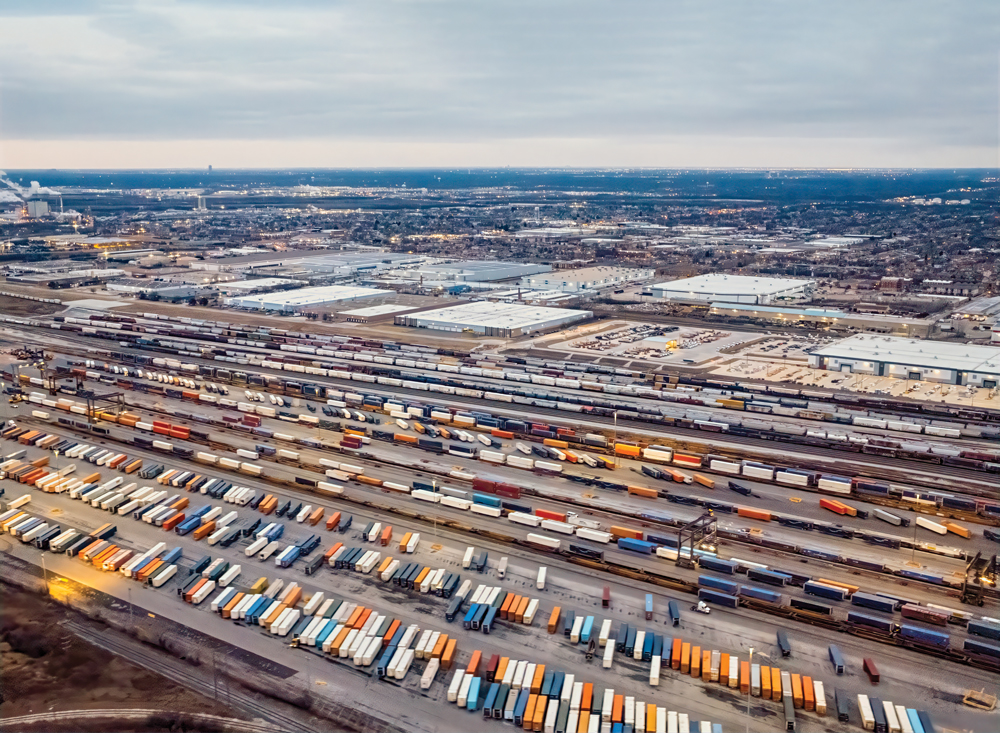
Detroit’s historic automotive manufacturing connects to Canadian and Mexican stakeholders in a trinational supply chain. Union Pacific’s Global 4 Intermodal Terminal in Joliet, Illinois, is a lynchpin transload logistics site, shifting product from one location and diverting it to many other destinations — whether it comes in on rail from Prince Rupert in British Columbia, Canada, through Chicago, or a Class 1 rail taking cargo to the U.S. and Mexico.
Nortillo adds that rather than depending on a single dominant industry, the Great Lakes supports interconnected clusters and that companies are leaning on regional logistics networks that provide redundancy while improving delivery and mitigating risk.
“We’re not just a homogeneous clustering of homogeneous industries,” she says. “We have interconnected automotive, aerospace, advanced agribusiness, chemicals, life science, medical devices and pharmaceuticals. These are all of what we would consider a heavy industry ecosystem. A concentration of that develops a shared ecosystem with shared suppliers, shared workforce, infrastructure research institutions and innovative networks.”

“The whole Great Lakes ecosystem has been undervalued, and it’s becoming much more noticed and getting a lot of attention from corporate America.”
— Teresa Nortillo, President, EcoDevo360
One industry player in the area is GE Aerospace, which will spend $9 million upgrading two Illinois manufacturing facilities (Bedford Park and Loves Park) as part of the company’s $1 billion investment strategy in the U.S. The Bedford Park site produces precision gears, transmissions, gearbox assemblies and drive systems for helicopters and fixed-winged aircraft while Loves Park manufactures components for military and commercial aircraft. South of Chicago, South Korean semiconductor company SK Hynix broke ground in April 2026 on its $3.9 billion facility in West Lafayette, Indiana (home to Purdue University).
“The whole Great Lakes ecosystem has been undervalued, and it’s becoming much more noticed and getting a lot of attention from corporate America,” says Nortillo.
A Wealth of Resources
Dean Prestegaard, economic development strategist at DMP Development Analytics and chair of the Great Lakes Economic Development Council’s advisory board, cites research and education institutes, including the Big Ten, producing not only the high-quality workforce needed to grow future economies, but the product development and R&D necessary to transform industry and local supply chains in the region. Energy availability is also top of mind for companies and sites located in the Great Lakes, as is the case everywhere else.
“In the Great Lakes region, there’s a wealth of resources. Power is a huge issue,” says Prestegaard. “Some of the sites may not have adequate power being distributed to them for development of modern advanced manufacturing types of systems. There is a relationship between Ontario and the states bordering or near Ontario for sharing power off the grid to stabilize the grid system so that they’re not overloading a grid. That’s an interesting and very important trade relationship when we think about some of these industries that demand high amounts of power and stable delivery of power, so the aspects of trade are much more dynamic than just thinking about manufactured goods.”
He adds that “when we talk about historical manufacturing, running a factory from early morning to late evening is one thing. A data center doesn’t shut down at 5 o’clock, right? That power demand is still there, so it’s continuous. It’s 24/7. That’s a different kind of energy demand than what some of these places traditionally have used.”
The Great Lakes region also has the benefit of previously developed sites that can be redeveloped and, in some cases, combined. “We have more greenfield-type areas that can be developed,” adds Prestegaard. “There are both types of development opportunities that you can look at throughout the region. It’s matching the infrastructure with the actual sites to make sure that a firm can have what they need on those sites.”
Prestegaard notes the free flow of trade between states in the area, especially in the Detroit-Windsor Corridor. Total numbers show 25% of all U.S.-Canada merchandise trade (approximately $900 billion worth of trade annually) happens in the Great Lakes region within that corridor, making that route worth a hefty $150 billion in trade dollars annually. Gordie Howe International Bridge’s opening in July 2026, connecting Detroit in Michigan to Windsor in Ontario, may move that profitable trade needle even further.