THE ENERGY ECONOMY ABOUNDS IN THE PEACE GARDEN STATE.
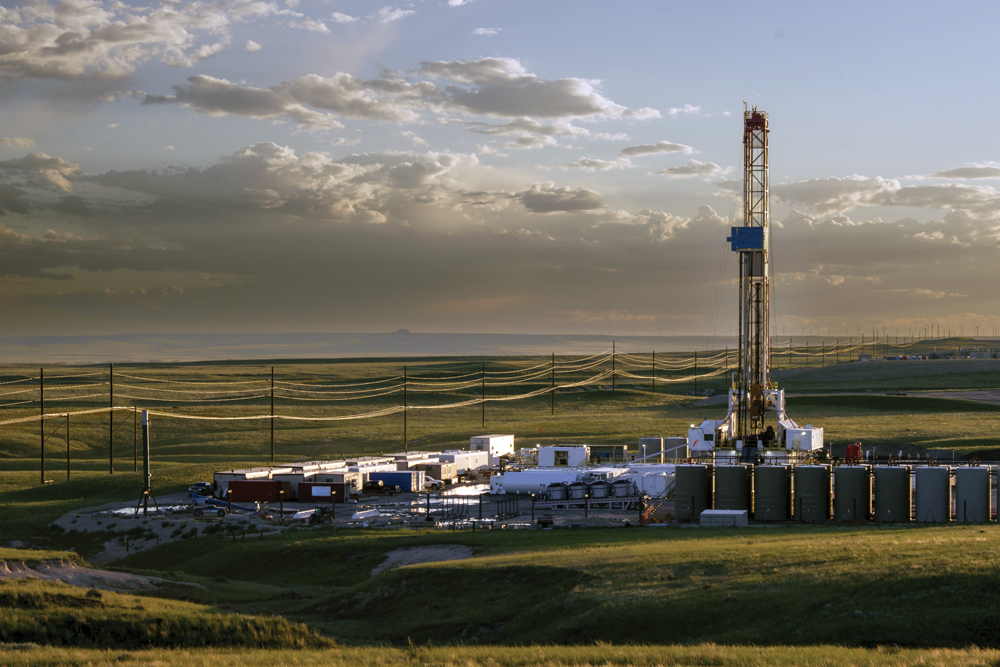
North Dakota is widely recognized for its vast energy reserves, a prized resource for companies that need reliable, long-term power capabilities. The state is second only to Texas in the U.S. in producing energy overall, ranks as the third largest state for national oil production and generates more energy than it can use, often storing and exporting energy assets. Forty percent of electricity in the state is created from renewable resources, with 35% of that from wind generation (sixth in the U.S. for wind power).
As of early 2026, North Dakota is No. 1 in the country for having the lowest cost in electricity. This puts North Dakota at the front of the line for site selectors in a landscape where energy availability and affordability often rank high on the list of priorities for corporate and manufacturing real estate decision-making.
North Dakota U.S Representative Julie Fedorchak, a fourth-generation North Dakotan and the first woman to represent the state in the House of Representatives, notes what makes North Dakota an energy powerhouse.
“North Dakota has long known that energy leadership and economic growth go hand in hand,” she says. “Our success comes from focusing on the fundamentals: strong baseload production, responsible resource development and a regulatory environment that supports long-term investment and innovation. Our state produces the oil, natural gas and coal that power America while supporting thousands of high-paying jobs and strengthening our rural communities. North Dakota is also leading in the next generation of energy innovation — from carbon capture and enhanced oil recovery to the technologies needed to power the rapid growth of data centers and advanced manufacturing.”
Advanced manufacturing and data center companies certainly have the incentive to build in the state. Texas-based Applied Digital has billions invested in its multiple data center campuses in North Dakota. The manufacturing industry provides over 28,000 jobs in the state.

“As global demand for reliable, affordable energy continues to grow, North Dakota is uniquely positioned to lead. Our energy producers, workers and communities understand that energy security is national security, and we’re committed to continuing to develop our resources responsibly while helping power America’s future.”
— Julie Fedorchak, North Dakota U.S Representative
“As global demand for reliable, affordable energy continues to grow, North Dakota is uniquely positioned to lead,” Fedorchak continues. “Our energy producers, workers and communities understand that energy security is national security, and we’re committed to continuing to develop our resources responsibly while helping power America’s future.”
Natural Gas Buildout
North Dakota has over 30 gas processing facilities. Natural gas is produced with crude oil, which is brought to the surface and must be extracted and processed for use. The infrastructure and planning required for these processes are informed and supported by the buy-in of natural gas companies and exporters.
“They’re not out there building projects on spec,” says Justin J. Kringstad, executive director of the North Dakota Pipeline Authority, a non-regulatory state agency formed to support the development and facilitation of natural gas infrastructure projects. “So, you have to have companies willing to sign up for long-term commitments to these projects [and] signing up for pipeline capacity.”
When guiding natural gas pipeline projects in the state, there are a lot of questions on how to effectively leverage the resources North Dakota has to offer. How are the wells performing? How are operators looking at schedules? What are the reactions to different price environments? How do North Dakota’s market prices compare to other places?
“No one wants to build new processing too soon,” says Kringstad. “They certainly don’t want to see it too late because then you start to run into constraints limiting that upstream sector. One of the key things about gas processing, though, is this is all handled at a local level, so [with] our state public service commission, we can get these sited and put in place relatively quickly.”
The natural gas industry in North Dakota has been very aggressive in infrastructure buildout, reducing natural gas flaring, which is the controlled burning of excess gas associated with oil extraction and gas extraction and processing. Flaring is down to 4% from over 30% across the state even with a growing volume of natural gas production.
“You can’t produce the natural gas without the oil,” Kringstad says. “They go hand in hand, and so does the infrastructure that has to be in place. We must have systems in place to accommodate both.”
The state got a boost in pipeline infrastructure last year. In August 2025, WBI Energy received $500 million to build a natural gas pipeline, called Bakken East, which is expected to move approximately 1 billion cubic feet of natural gas daily to the eastern part of the state and secure the state’s power supply, according to a statement from North Dakota Governor Kelly Armstrong when the funding was announced.
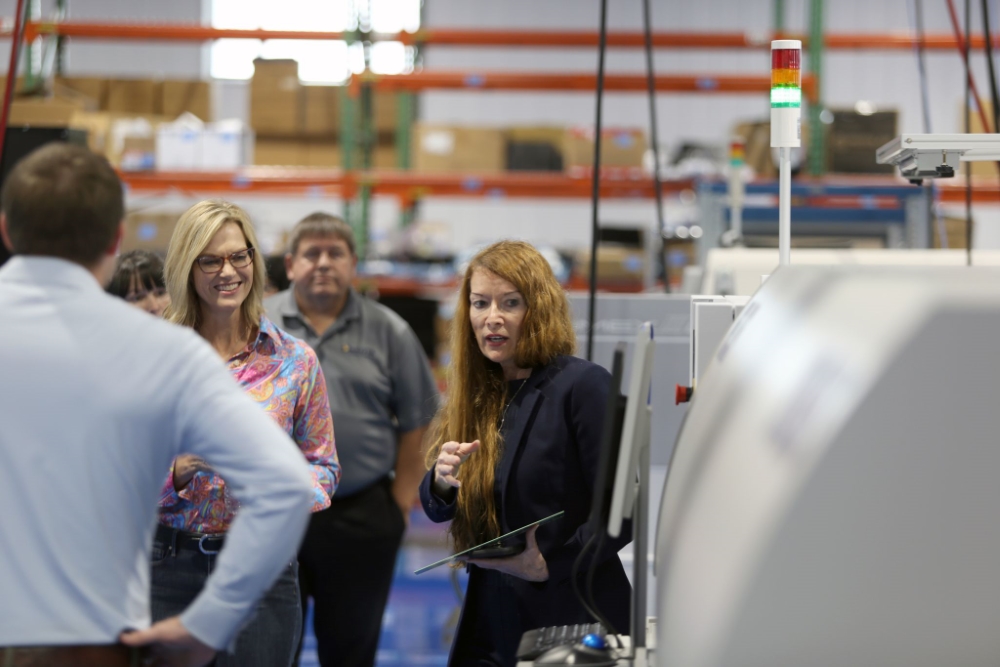
North Dakota U.S Representative Julie Fedorchak (left) tours the battery manufacturing facility at Packet Digital with the company’s CEO, Terri Zimmerman.
Photo courtesy of Packet Digital
When asked about technological advancements that have helped facilitate the natural gas pipeline, Kringstad cites improvements in more efficient drilling. In the Bakken Formation, when an oil well is drilled, those well lines can usually go about two miles deep and two miles horizontally. Now, with new tech, horizontal drilling can go faster and also extend as far as three or four miles laterally, meaning lower capital intensity and a lower footprint of disruption at the surface level.
Nuclear, Lithium and Lignite
Despite boasting the second largest reserve of lignite (a type of coal) in the world, North Dakota has many feathers in its cap when it comes to powering sites and delivering power to customers locally and outside of the state.
In September 2025, Canadian company Nucleon Energy was chosen by the North Dakota interim legislative committee to chart the state’s path to a nuclear-powered future, according to the North Dakota Monitor. This followed the approval of House Bill 1025 in early 2025, which authorized $300,000 in state funding for a nuclear energy study.
“We’re believers that nuclear will be an affordable source of power that does not need subsidies that can be competitive with other fuel types,” said Will Bridge, Nucleon Energy Chief Technology Officer about the 12-month-long study. “That hasn’t proven itself out yet. But we also believe we need to start now.”
That same month, North Dakota State University and RAND Corporation, a global policy think tank, research institute and public sector consulting firm, released a scoping analysis of the feasibility, siting and deployment of advanced nuclear power in North Dakota. The study sets out to accomplish many things over the course of 15 months, including sizing future demand for new and replacement generating capacity in North Dakota, evaluating advanced nuclear technologies to meet future demand and screening potential sites for nuclear power plants. Impacts on local communities, potential connection challenges, economic benefits for the state, disposal of nuclear waste and potential regulatory hurdles and solutions were also included in the siting study. Notably, buy-in from local communities is a key element of bringing more nuclear energy to the state.
Lithium is also a valuable resource in the energy storage industry. One battery and drone manufacturer, Packet Digital, is set to start producing U.S.-made battery cells this year at its Badland Batteries manufacturing facility in Fargo. In November 2025, the company was awarded up to $50 million from the U.S. Department of Defense’s Accelerate the Procurement and Field of Innovative Technologies (APFIT) program, which is designed to accelerate development of high-performing batteries for uncrewed aerial systems (UAS). The APFIT award was a boon for Packet Digital and the company’s reputation in the industry as a leading American manufacturer of UAS batteries.

“North Dakota doesn’t just support innovation — we operationalize it through a highly collaborative statewide ecosystem. The Badland Batteries cell plant reflects how state leadership, industry, higher education, and businesses work together here to move critical energy and defense-related technologies from concept to capability at scale.”
— Terri Zimmerman, Packet Digital CEO
“The award sets the stage for us to scale production faster for an industry desperately in need of an American solution,” says Terri Zimmerman, Packet Digital CEO. “On a more local level, the ramifications locally, as well as in North Dakota, are enormous. Our facility is not only the first battery cell factory in the Upper Midwest, but also the largest in the country that focuses solely on battery cells for autonomous systems. With this facility we will be able to bring in more high-paying advanced technology jobs for the state while simultaneously providing a secure supply chain for a vital component in our country’s national security complex.”
The state offers a cooperative environment for stakeholders across private, public and government sectors to work together to grow related sectors and technologies in the energy industry.
“North Dakota doesn’t just support innovation — we operationalize it through a highly collaborative statewide ecosystem,” says Zimmerman. “The Badland Batteries cell plant reflects how state leadership, industry, higher education and businesses work together here to move critical energy and defense-related technologies from concept to capability at scale.”
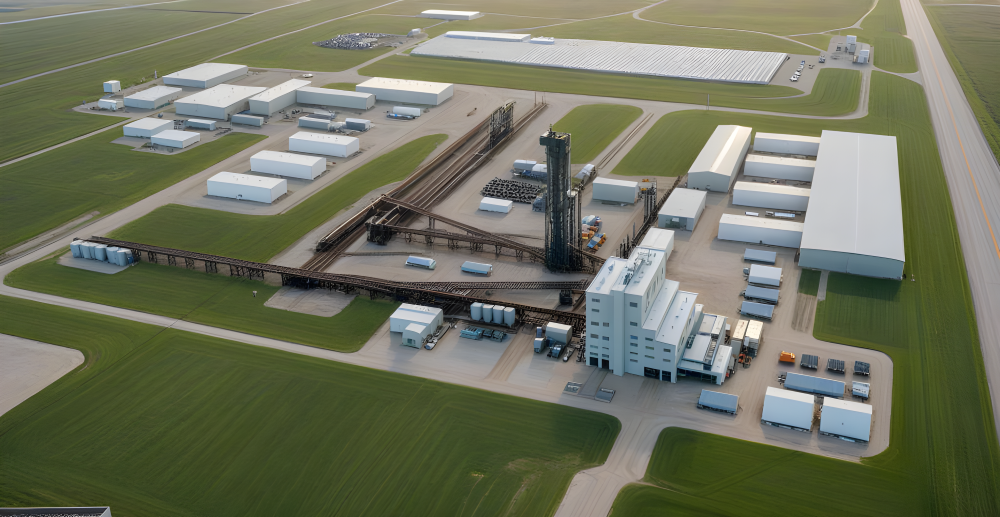
The Minot pig iron processing plant from North American Iron is set to open in late 2029.
Rendering courtesy of Calumet Reclamation Company
Packet Digital has partnered with water recycling and mining company Wellspring Hydro and LibertyStream, which specializes in lithium extraction technology, on domestically sourcing lithium carbonate. The companies have researched how to extract lithium carbonates out of oilfield brine, Zimmerman explains. She notes that “this is no easy challenge, but if successful, this new, local source for one of our most critical cell materials could be a massive win for the industry as well as the state of North Dakota.”
LibertyStream and Wellspring Hydro have been awarded $7.5 million in grants and loans from the North Dakota Industrial Commission already, and there are plans for the companies to use $4.2 million of that funding to develop commercial direct lithium extraction operations in the state.
When asked what makes Packet Digital a powerhouse not only in the energy industry, but in aerospace & defense, Zimmerman replies that “North Dakota stands out because it consistently turns scale and practicality into national advantage. The state has built a reputation as an energy leader not only through production but through innovation. That same formula powers North Dakota’s rise in aerospace and defense. With uncongested airspace, extreme weather testing conditions and military grade infrastructure, the state has become a proving ground for uncrewed systems, counter-UAS technologies and advanced airspace integration. What truly differentiates North Dakota is collaboration — state, military, academia and industry working as one to move ideas from testing to deployment quicker than almost anywhere else.”
With the opening of Packet Digital’s new R&D facility, the company will have the ability to explore new and novel cell chemistries, Zimmerman explains. “We’re excited about the opportunities [this] could bring, such as tackling the immense challenges of batteries in space applications,” she adds. Notably, the company has done significant work in developing power solutions for submersibles and space operations, allowing customers to fly UAS and drones longer and with heavier payloads, allowing for a wider range of missions.
Critical Resources
A key crossover collaboration between the energy storage, critical minerals and next-gen drone power sectors in North Dakota is also underway between Packet Digital, Minnesota-based mining company Talon Metals and the University of North Dakota (UND). Researchers at the university are working with Packet Digital and Talon Metals, which mines nickel, copper and cobalt, to make better battery materials and open a new testing lab for American-made drone batteries, according to a UND press release published in early February 2026.
When deployed on a mission, whether for emergencies or long-range assessments, a drone’s scope is only as powerful and long-lasting as the battery that powers it. This requires improvements in the components that go inside the lithium-ion batteries. High-performing minerals like lithium cobalt oxide and nickel manganese cobalt oxide, which are commonly used in battery design, are the focus of the UND team looking to create that North Dakotan supply of critical minerals for technology applications. The project will also include the creation of a Battery Materials Qualification & Testing Lab in collaboration with Packet Digital, which will then use those UND lab-tested and developed materials at its battery facility in Fargo.
Another key resource in the energy, critical minerals and domestic supply chain is iron and steel. In Minot, located in the central-northern part of North Dakota, domestic pig iron and steel production will soon be underway at North American Iron, which is building a 730-acre, $2 billion industrial plant that will process the material sourced from Minnesota’s Iron Range. The target opening is late 2029.
Asked how the manufacturing facility will add to North Dakota’s critical minerals industry and the domestic supply chain of iron and steel, North American Iron CEO Jim Bougalis says that the company “is focused on strengthening the domestic steel supply chain by producing high-quality merchant pig iron inside the U.S., something the industry has relied on imports for for decades. By building this asset in Minot, we’re putting a strategic piece of early-stage steelmaking back on U.S. soil.”
Bougalis also notes that for the state of North Dakota, the project adds a new anchor industry in the strategic minerals space.
“Merchant pig iron is an essential input for electric arc furnace steelmakers, including producers of plate, bar and specialty steels that support defense, energy, manufacturing and infrastructure,” he explains. “Instead of relying on overseas supply that can be disrupted overnight, steelmakers will have access to predictable, domestic, logistics-friendly volumes right here in the Upper Midwest. It’s also a diversification opportunity for North Dakota, moving the state further into value-added minerals processing rather than exporting raw materials out of the region.”
The Minot iron plant is right on schedule as North American Iron continues to work side-by-side with local partners on site readiness and infrastructure. Building a world-class facility aligning with the state’s industrial strategy that encompasses reliable power, efficient logistics and long-term scalability was a company goal, notes Bougalis. Sustainable on-site operations at the Minot plant include the selection of a responsible energy mix, incorporating heat-management into engineering systems and leveraging modern furnace tech that significantly lowers emissions compared to traditional smelting methods. The company is also looking to tap into the state’s carbon sequestration ecosystem.
“The facility is being designed with expansion in mind,” Bougalis adds. “We’re approaching this as a multi-phase development. The first phase gets high-grade merchant pig iron to market quickly, and the site layout allows us to add capacity or complementary processing modules over time. As the domestic market continues to shift toward EAF steelmaking and as demand for clean, secure feedstock increases, we want to be ahead of the curve.”
When asked about locating the facility in North Dakota, Bougalis noted that the state’s overall energy strength was part of the decision-making, but reliability and stability drove the choice home.
“For a project of this scale, we need long-term certainty around energy availability, cost and permitting,” he says. “North Dakota delivers that. The broader energy ecosystem, abundant natural gas, strong midstream capacity in the state and a regulatory environment that encourages industrial development all make North Dakota a smart place to build value-added manufacturing. Minot checks those boxes, which reduces risk and helps ensure we can operate consistently for decades.”
Against the backdrop of U.S. federal policy expanding the critical minerals list and increasing investment in domestic mineral supply chains, the Upper Midwest and North Dakota offer regulatory stability that supports long-term industrial projects, rail-first logistics that connect Minot to the broader Midwest manufacturing corridor, and energy and infrastructure reliability to support multi-phase growth.
“All of this positions North Dakota as the place where North American Iron can translate the region’s strategic momentum into secure, domestic iron production that strengthens both U.S. economic development and national security priorities,” says Bougalis. “In a world where geopolitical tensions can disrupt global supply chains overnight, having reliable, U.S.-controlled feedstock for steel isn’t just economic policy, it’s national security.”