
Glance at the energy news these days and there’s no getting around the fact that the U.S. is going all in in another nuclear energy wave. The federal government has also swung back from renewables, backing other routes to energy diversification.
On December 1, the Trump administration and U.S. Department of Energy announced the renaming of the National Renewable Energy Laboratory to the National Laboratory of the Rockies, with lab director Jud Virden stating that “the new name reflects the Trump administration’s broader vision for the lab’s applied energy research, which historically emphasized alternative and renewable sources of generation, and honors the natural splendor of the lab’s surroundings in Golden, Colorado.”
The Nuclear Options
Canadian-based uranium company Cameco, which acquired Westinghouse (one of the largest nuclear services businesses globally) in late 2023 with Canadian investment management company Brookfield, together with Brookfield struck an ambitious $80 billion deal with the U.S. government in October to construct new nuclear reactors across both countries. The deal will not only add to the Trump Administration’s plans to invest in the oil, gas, coal and nuclear sectors, but also support the grid as the sprawl of AI and data centers generates more and more power demand.
It’s also one of many projects that may very well shepherd the next atomic age in the country and abroad.
“As the global energy landscape evolves, nuclear continues on a path towards robust expansion and meaningful transformation,” said Tim Gitzel, Cameco CEO, during the company’s Q3 earnings meetings in early November. “We’re seeing significant attention across all areas of the nuclear fuel cycle, beyond uranium mining — but a good narrative won’t turn a turbine.”
The agreement between Cameco and partners and the U.S. government will facilitate financing, permitting and approvals of new nuclear reactors by Westinghouse, specifically AP1000 nuclear power plants. The AP1000 is a pressurized water reactor that has been built in several places globally, with more on the way.

“We’re seeing significant attention across all areas of the nuclear fuel cycle, beyond uranium mining — but a good narrative won’t turn a turbine.”
— Tim Gitzel, Cameco CEO
There is also room for more compact designs in the nuclear scene. Less powerful than traditional reactors, small modular reactors (SMRs) leverage nuclear fission to produce an energy output of up to 300 megawatts (approximately one-third of the capacity of a traditional nuclear power reactor). The appeal is their small size, quicker build time and cheaper overall construction cost. According to the International Atomic Energy Agency, SMRs can be manufactured and shipped and installed on site, allowing nuclear energy generation in locations not typically suitable for larger nuclear power plants.
Notably, Amazon will be one of the first to venture into SMRs in the U.S., with plans to build the Cascade Advanced Energy Facility in Richland, Washington, using the technology. The 12-unit site will power AI and digital tools in a partnership with utility Energy Northwest and SMR developer X-energy. Local Pasco-based school Columbia Basin College will also launch an Energy Learning Center with funding from the U.S. Department of Energy, which will have an education simulator replicating X-energy’s nuclear control room planned for the Cascade facility and allow for specialized training in this key workforce sector that will support carbon-free energy solutions like nuclear.
But can nuclear get more modular? In fact, it can. Micro-modular nuclear reactors (MMRs) are a subset of SMRs that typically have a capacity of up to 20 megawatts electric (MWe) and are more transportable and applicable for off-grid use than a standard SMR. They are suited for remote locations, military bases, disaster relief and industrial projects like hydrogen production, data centers and more. In November, nuclear technology company Terra Innovatum Global and integrated AI technology provider Uvation announced their intent to launch a 1-MWe pilot program comprising up to 100 of Terra Innovatum’s MMRs, called 1 SOLO units. The pilot project is planned to support Uvation’s data center expansion and AI infrastructure needs.
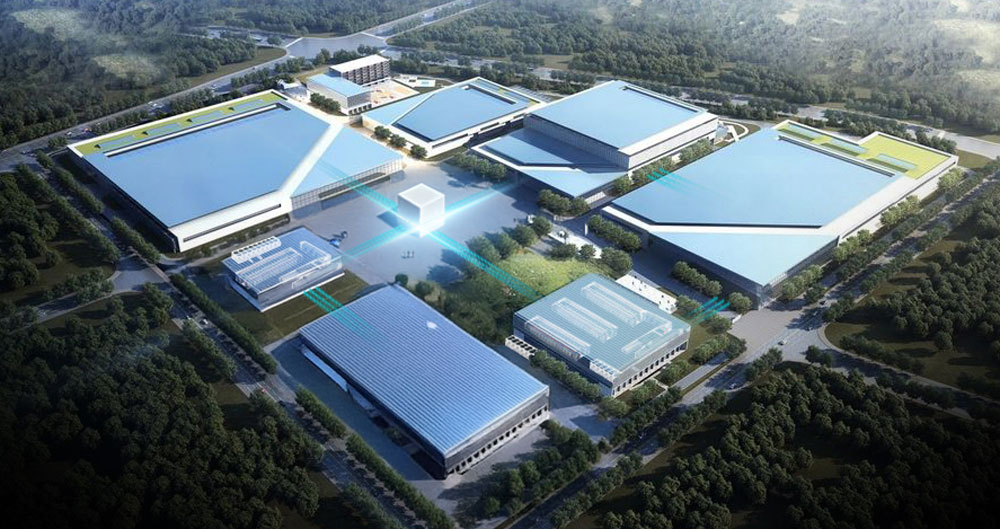
Conceptual rendering of 1MWe data center pilot program powered by 1 SOLO unit.
Photo courtesy of Terra Innovatum
Energy & Environment Startups
The energy and environment industry does not take up a huge slice of the startup and unicorn pie; nonetheless, innovation is still pushing smaller companies in these industries.
In StartupBlink’s 2025 Energy & Environment Startup Ecosystem Report, developed in partnership with Crunchbase, Smart City Expo World Congress and Semrush, the U.S. still leads the top countries for energy & environment startups, beating out Sweden, which jumped four spots from its 2024 position, now ranking No. 2 in the sector. The U.S. contributed approximately 24% of total activity from the top 10, while Canada (No. 3) contributed almost 10% of activity. Europe also had a strong showing, with eight of the 10 companies on the energy & environment startups countries list based there.
Another notable finding is Estonia’s leap to ninth place on StartupBlink’s list, the only country in the top 10 with a population of less than 5 million. Ireland also moved up a notch to No. 5 in the ranks, just one step below the UK’s spot at No. 4 despite being a smaller country with a smaller startup base. Outside of the top 10, other countries bring in surprises.
The United Arab Emirates made its debut at No. 21, the highest new entry to the industry rankings for 2025. Solar and renewables dominate the startup scene in the UAE, with solar developer Yellow Door Energy and Dubai-based solar hybrid/off-grid power systems provider Enerwhere showcasing top startup talent.
In Dubai, Yellow Door Energy is collaborating with Emicool, one of the city’s top district cooling providers, to construct four solar power plants with a total capacity of 1.2 megawatts-peak. Yellow Door is also developing a rooftop solar project in Bahrain with industrial holding company Foulath Holding, in what will be the largest single-site rooftop solar power facility to be built not only in the country, but in the world.
Energy Across the Globe
Renewables and other sectors in the industry are still seeing their fair share of growth despite changing political headwinds. In November 2025, the International Energy Agency (IEA) declared the current era as the “Age of Electricity,” marked by growing energy demand across all sectors globally. According to the IEA 2025 World Energy Outlook, investments in electricity generation have advanced by almost 70% since 2015 to reach $1 trillion per year, but annual grid spending has risen at less than half the pace to $400 billion.
Increased battery storage and renewable projects have provided support where deficits exist in energy availability. China is the global leader in producing renewable energy, leading in wind and solar and on track to account for 45% to 60% of global deployment of renewables over the next 10 years. By the end of 2024, the country had installed 887 gigawatts of solar power capacity, double that of Europe and the U.S. combined. The country remains the largest manufacturer of most renewable technologies. The U.S. and Brazil are No. 2 and No. 3 in the renewable energy market, though other regions are making strides.
Mexico has proved to be an emerging energy powerhouse for renewables and battery storage integration in Latin America. In March 2025, the country announced a first-of-its-kind regulation requiring solar and wind power plants to install battery systems equal to 30% of their installed capacity. In October 2025, the government also set new rules around the regulation of private energy investments, aligning projects in solar and battery storage with the country’s regulatory framework.
“Private sector participation — especially from manufacturing, real estate and technology companies — has been crucial in driving renewable integration, digitalization and energy efficiency projects,” says Eleazar Rivera Mata, executive director at Monterrey-based energy solutions company Clúster Energético de Nuevo León. “At the same time, international cooperation, particularly with the U.S. and Europe, is supporting capacity building in clean technologies, green hydrogen and workforce development.”
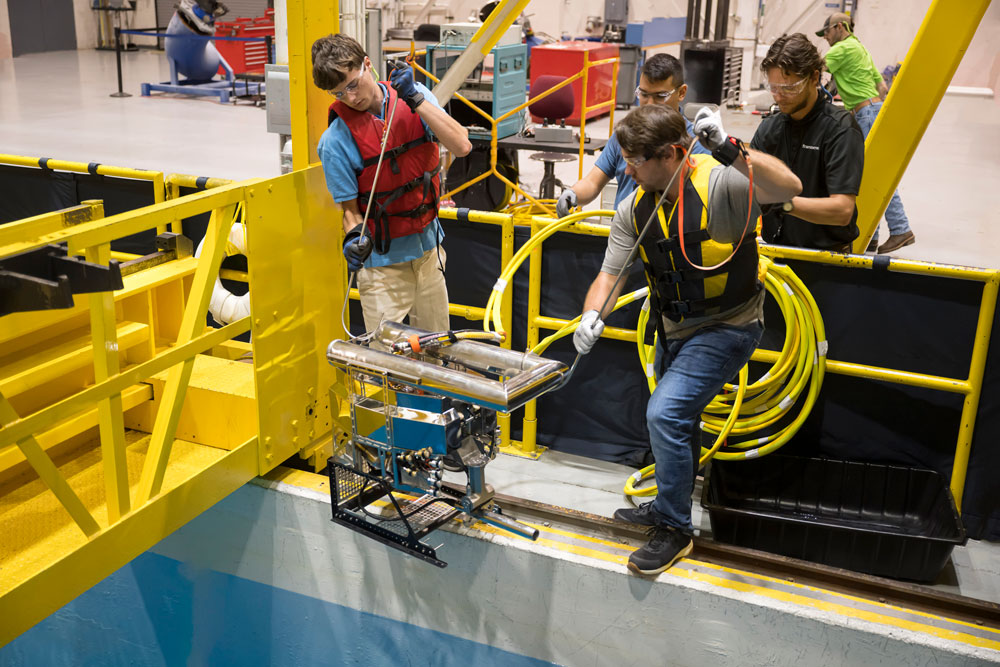
Hundreds of nuclear power plant service technicians are trained each year at this Framatome nuclear tech training center in Lynchburg, Virginia..
Photo courtesy of Framatome Inc
How Framatome Equips the Next Generation of
Nuclear Technicians
by RON STARNER
Anuclear-powered future for America is not only possible; it is likely if firms like Framatome keep expanding and keep adding trained workers. Here’s how that is already happening in one mid-sized town in south central Virginia.
Framatome Inc., the North American subsidiary of a Paris conglomerate that is the world’s largest servicer and supplier to the nuclear energy sector, is now able to train the growing North American nuclear workforce that services nuclear power plants at a brand new technical training center in Lynchburg in the heart of the Blue Ridge Mountains.
Part of a multi-year, more than $50 million capital investment, this new 27,000-sq.-ft. facility on Mill Ridge Road, which is in addition to the existing industry-leading center, is considered the crown jewel of nuclear tech training in the U.S. A recent tour of this plant demonstrated exactly the level of care and precision that went into creating it.
The site selectors fam tour was hosted by the Lynchburg Regional Business Alliance and included a two-hour stop at this new Framatome facility in Lynchburg, a region of 262,124 people at the foothills of the Blue Ridge Mountains about 90 minutes north of Greensboro, North Carolina.
Here, they train and equip the technicians who are called upon to refuel nuclear power plants around the world when those facilities are regularly powered down for scheduled maintenance every 18 to 24 months. Framatome Inc., whose North American headquarters is based in Lynchburg, has been doing this work since the dawn of the nuclear age and the advent of nuclear power generation 67 years ago.
With U.S. electricity demand expected to grow by a CAGR of 2.1% from now until 2050, Framatome is poised to capitalize on what is expected to be the fastest-growing energy sector in the world. Nuclear power currently supplies about 20% of the power consumed in the U.S. and around 31% of the total used in Virginia.
Framatome employs more than 20,000 workers in over 20 countries, including 2,500 employees in North America, to supply and service that sector. Globally, the firm reported revenues of $5.4 billion in 2024 — up 11.8% from 2023. From 2023 to 2024, the firm added 220 hires in Lynchburg. “Over a 5-year period, from 2023 through 2027, we will grow our headcount by 30%,” says Tony Robinson, president and CEO of Framatome Inc.
“We are the OEM for 105 nuclear power plants in operation worldwide,” he said as he guided us through the most advanced nuclear technical training center in the world. “Over 500 people will be trained here annually at our new Technical Training Center. That is the primary nuclear workforce that will be trained to support 65% of the outages in North America. We had 132 new hires last year, and we will add many more this year. Our applicant pipeline was up 300% in 2023 and 2024.”
But the training does not stop there. A new Nuclear Training Academy launched by Framatome at Central Virginia Community College will produce 100 new hires through 2027. This is a fully paid work-study program that currently has 53 enrollees. It is a way, Robinson says, for Framatome to constantly replenish its mission-critical workforce.
Framatome is an international leader in nuclear energy and one that designs, services and installs components, fuel, and instrumentation and control systems for nuclear power plants worldwide. More than 1,450 people are employed at the firm’s base in Lynchburg.
The company’s more than $50 million expansion project includes a 42,000-sq.-ft., two-story addition to the front of the existing Mill Ridge Road Center of Excellence in Lynchburg. The firm has corporate administrative, fuel design, and instrumentation and control offices on Old Forest Road at a site which is also home to the Nuclear Parts Center supporting the industry’s spare part needs. In addition, it has production facilities on Mount Athos Road in the area.