Site Selection Online
Go to www.sitenet.com
A  SITE  SELECTION  SPECIAL  FEATURE  FROM  NOVEMBER 2001
Quebec


Research Develops
Strong Business Climate

    For R&D, Quebec has developed support programs that are among the most generous in the world. The Canadian government provides a 20 percent R&D tax credit, while the province of Quebec gives another 20 percent refundable tax credit (read cash back) on R&D salaries. For small businesses, the basic rate of 20 percent rises to 40 percent on the first $1.3 million in R&D salaries.
Ringing Up Quebec

      "We are extremely pleased with our decision to locate our call center in the province of Quebec," says Stuart MacMillan, general manager of Excel Canada. "There were many factors that influenced our decision such as the quality and availability of the work force, real estate and government subsidies. Our Quebec call center will be paramount in our expansion into the European calling market. We were first attracted to the province by the plethora of languages spoken, the availability of skilled workers and the dedication of the work force."
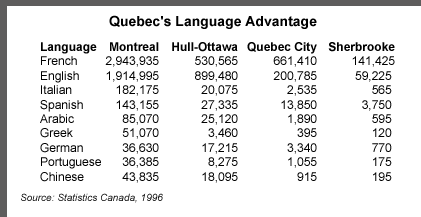
      There are, in fact, 80 different languages spoken in Quebec, and between 15 and 20 are spoken by a large base of people. The multilingual work force is a key reason behind Quebec's success as a customer contact center haven. The province is seeing growth in the industry at a 20 percent to 25 percent clip.
      Yves Rocher is also taking advantage of the multilingual work force. The French pharmaceutical company recently created 177 new jobs at its second call center in Montreal. p798_02.gif - 10167 Bytes
      "Yves Rocher is answering calls on a daily basis in 14 languages," reports Alain Riendeau, president and general director of Vision Quebec, a private provincial marketing firm that specializes in call center attraction. "Microcel, Speedware, Telecom Vision, these are all companies coming here to benefit from this base of different cultures." And it's an available work force, with unemployment still remaining higher than much of the U.S. at 8 percent.
      But there's more to Quebec's appeal than a multilingual labor pool. "Another advantage is the availability of prime real estate and very reasonable rates," explains MacMillan. Contact centers, operating in Chicago may pay somewhere in the range of $30 (US) per square foot for space, but in downtown Montreal, class B buildings run more in the $20 (Canadian) per square foot range, which with the exchange rates comes out to be closer to $12 per square foot. Call center agents also are less expensive because although the agent in Canada will earn $18 per hour just as in the U.S., the company will be paying in Canadian dollars, thus saving approximately 45 percent on payroll costs.
      "A call center is usually a cost center," explains Riendeau. "Companies are usually very aware that it is costing money to provide this service, so by telling an American that by establishing the call center in Montreal he will automatically save around 40 percent, it makes a difference."

      In addition, Quebec offers a 40 percent refundable tax credit on 80 percent of all expenses incurred on behalf of the business, regardless of size, by a recognized research center or as part of a pre-competitive research project if the work was carried out by an R&D consortium. To boost foreign R&D contracts for Canadian subsidiaries, the provincial government does not use funds engaged in R&D to offset expenses when calculating the Canadian and provincial tax credits.
      "We have decided to do more and intervene downstream from R&D to specifically support innovation in especially promising sectors," says Pauline Marois, Deputy Prime Minister and Minister of State for the Economy and Finance of Quebec. "These measures have, in particular, led to the creation of the Cite du multimedia (Multimedia City) in Montreal, the Cite des biotechnologies (Biotechnology City) in Laval and the Cite de l'optique (Optic City) in Quebec City as well as information technology development centers and new economy centers throughout Quebec. In these designated locations, companies have access to infrastructures adapted to their needs and receive major tax benefits that essentially correspond to 40 percent of salaries paid to eligible employees."
      In Marois' 2001-2002 budget, another $236 million will be invested in research and innovation. Included in the program are:
  • $160 million over three years for the development and implementation of projects with a developmental effect in basic and applied research and in technological, social and organization innovation
  • $22 million for the Institute national l'optique (INO)
  • $9.6 million to increase the number of degrees in optics and photonics
  • The creation of a biotechnology center in Laval
  • $32 million for the purpose of financing research initiatives

      On the work-force side of things, $466 million has been allocated to education, which surpasses the government's previous commitments. "More has to be done for our young people to enable them to realize their full potential, which is our most important asset for the future," Marois says.

TOP OF PAGE


©2001 Conway Data, Inc. All rights reserved. SiteNet data is from many sources and not warranted to be accurate or current.