A discussion of Quebec is not complete without mention of its aerospace industry -- the sixth biggest aerospace concentration in the world. Today Quebec's aerospace industry supports some 250 companies and more than 40,000 jobs. Over the past five years, sales in Quebec's aerospace sector have risen by more than 50 percent and employment by 21 percent. And in terms of aerospace R&D spending in Quebec, the numbers top $500 million annually. Montreal has become the world's third-largest aerospace center, behind Seattle and Toulouse, France.
"Aeronautics is a growing sector here," says Claude Blanchet, president and CEO of SGF, Quebec's industrial financial holding company. "We're working with a number of companies to develop subcontracting here."
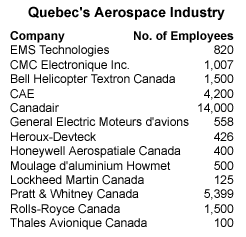
Some of the leading aerospace companies with operations in Quebec include: Pratt & Whitney, CAE Electronics, Air Canada, Bell Helicopter Textron, Rolls-Royce Canada, EMS Technologies Canada, BAE Systems Canada, Honeywell Aerospace and Lockheed Martin.
And you can't forget Montreal's own Bombardier Aerospace. Bombardier is the third-largest aircraft builder in the world, and it isn't slowing down any time soon. As of Jan. 31, 2001, the homegrown company has a backlog worth $23 billion, and it employs some 37,000 workers internationally. In August 2000, Bombardier selected the Montreal Foreign Trade Zone at Mirabel as the site for its new $108 million regional aircraft manufacturing and assembly plant, which will create 1,700 jobs.
Bombardier is not alone. General Electric Canada Inc. is also investing $9.6 million to expand its operations in Bromont. The expansion will create 100 new jobs over the next two years.
"Obtaining this new production mandate for more than 600,000 airfoils confirms the global profile of GE Bromont, in particular because of its strong performance," says Plant Manager Philippe Simonato. "Our productivity is improving each year thanks, in particular, to the many advantages Quebec offers. The expertise and availability of the manpower, the quality of the infrastructure and the competitive operating costs are some of the factors that allow us to expand our activity and improve our position on the international aerospace market."