

 Industries Discover The Secret to Quebec's R & D Success (cover) Research Develops Strong Business Climate R&D-based Industries Head to Quebec Lasers Light Quebec's Future All That Glitters Is Not High-tech Aerospace Still Flying High Quebec's SFG Takes Leap of Faith with Investors Request Information 
|

Lasers Light
Quebec's Future 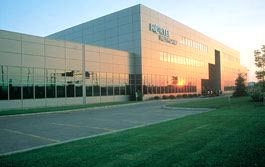
As proof of Quebec's growing optics and photonics industry, Nortel Networks has invested $52 million to expand its operations in Montreal.
Quebec is developing a cluster of companies in the optics/photonics sector that are well established and others that are emerging, especially in Quebec City. Such groups as ABB Bomem, CorActive, DiCOS Technologies, Doric Lenses and others have operations in the Quebec City area.
The cluster began with the Canadian Army's research center at Laval back some 40 years ago. The city has since decided to build on that group's focus on optics and develop a game plan for industrializing the knowledge in the area. The provincial government has since pinpointed Quebec City as its Optic City, where optic and photonic firms can establish operations and receive substantial tax breaks. Already in place, of course, is the provincial and federal basic R&D refundable rate of 40 percent. The government has now added a production and marketing reduction of 40 percent as well. "These are not tax reductions, but tax rebates," says Regis Labeaume, the official representative of Optic City. "You get a check at the end of the year." Labeaume says that he has worked with four California companies recently that are coming to town due to the amount of turnover they've experienced in the U.S. This is a problem that companies worry less about in Canada. "When you're researcher or technicians leave to go to competitors, and they usually do, then they bring with them the knowledge that your company has developed," says Roquet. "So you're really feeding your competition your proprietary knowledge. If you have a turnover rate of 3 percent to 5 percent instead of 25 percent as in the U.S., you don't have to invest constantly in rebuilding teams, integrating people, giving them awhile to become efficient and learning to work together." Today, there are 2,000 people working in the optics/photonics industry in Quebec City, and there is $160 million in optics/photonics business in the area. The success of the industry is based on the area's research institutions such as INO, Optics National Institute in Quebec City and Laval University, which has established a "very unique curriculum," says Roquet. "It is the only university faculty in North America where science and engineering are in the same faculty. They have decided that the overriding focus on photonics so that the people in engineering will be studying with chemists who have a photonics bent to their program -- same thing for biology and all the sciences. They all have the focus on photonics in all the science disciplines. They're turning out graduates unique in North America for that industry." Funding for startup optics/photonics firms is also available in Quebec City. Innovatech-Quebec, a venture capital agency of the Quebec government, for example, in-vested approximately $1 million in Gentec Electro-Optique Inc. in Quebec City. This contribution by Innovatech supported the creation of the company that specializes in making laser beam power and energy measurement instruments. It's not all Quebec City, however. Investments such as Nortel Networks' $52 million in Montreal and Lumenon Innovative Lightwave Technology's (LILT Canada Inc.) $37 million in Ville Saint-Laurent in October 2000, show that the industry is doing well throughout the province. LILT's Vice President of Corporate Development Reginald Ross told Fiber Optics Online that the "relatively low cost of the building, the local labor force and the manufacturing process will enable Lumenon to be very competitive immediately, and to dominate the growing metro market with its requirement for small, inexpensive components."
TOP OF PAGE
|
|
©2001 Conway Data, Inc. All rights reserved. SiteNet data is from many sources and not warranted to be accurate or current.
|