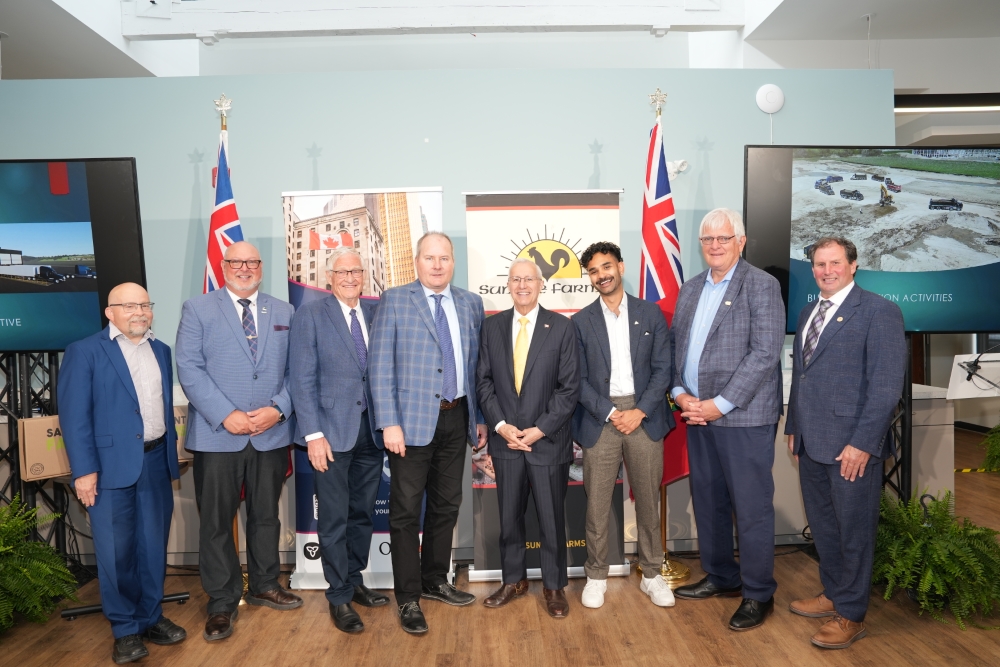
How Canada’s Sunrise Farms shook hands with Woodstock.
Choosing a factory location can be a complicated process, especially when the industry is food processing. But at times even the simplest of things makes a huge difference.
Sometimes, a community wins by its attitude.
“We wanted to find a municipality that was interested in having us. We didn’t want to move where we were not wanted,” says Sunrise Farms CEO David Shoore when discussing the factors that led his firm to select Woodstock, Ontario, Canada, for a C$100.5 million* investment into a 155,000-sq.-ft. poultry processing plant that creates 100 jobs.
“Woodstock has been great to partner with and have been accommodating with our needs as we have been with theirs,” Shoore says. It helped that the Canada-based Sunrise Farms already had a positive relationship with Woodstock, a city of 57,371 people in southwestern Ontario, 159 miles northwest of Detroit and 86 miles southwest of Toronto.
“Finding a location that was closer to farms supplying us as well as along a major highway was key,” says Shoore, whose farm-to-table firm employs 3,000 people. “We needed to be in a city that had plans to attract people and room for them to move as we wanted to ensure our team wanted to make the journey with us.”
The company’s familiarity with the region was pivotal, he notes. “We are in British Columbia, Alberta and Manitoba, and we have facilities in Ontario,” says Shoore. “Woodstock was the main contender in Ontario as we already had a partnership in a hatchery in Woodstock and were familiar with the area.”
The 43-year-old Surrey, British Columbia–based firm did its own research. “We have experience with greenfield projects and expansions across Canada,” he says. “We have a great internal team and some externals that we use for all our projects. This, paired with help from the municipality, was enough to get this project to where it is today.”
Invest Ontario played a crucial role by supporting the project with a grant of up to C$4 million from the Invest Ontario Fund, subject to reaching a definitive funding deal. When I asked Shoore how important incentives were to the deal, he said, “We had long ago outgrown our locations in Milton and Mississauga. Rebuilding was required to continue keeping up with our industry’s growth. Provincial and local incentives helped speed up our process as it encouraged us to bump this project ahead of others we have across our company.”
The new plant is expected to be one of the most technologically advanced poultry processing facilities in Canada, and it adds to Ontario’s considerable legacy in food and beverage processing.
Pots of Plenty in the Province
Already the second-largest food cluster in North America in employment, Ontario ranks as the No. 1 agri-food exporter in Canada with C$19.6 billion annually in exports. More than 4,500 business locations in Ontario make food and beverage products. Another 50,000 farms grow crops and livestock throughout the province. More than 118,000 people in Ontario work in food and beverage processing, generating C$52.3 billion a year in revenue.

“Rebuilding was required to continue keeping up with our industry’s growth. Provincial and local incentives helped speed up our process as it encouraged us to bump this project ahead of others we have across our company.”
— David Shoore, CEO, Sunrise Farms
Last year, Ontario landed one of North America’s biggest expansion deals in food processing when Ferrero, a global chocolate candy maker, announced a C$445 million expansion of its facility in Brantford, creating 500 new jobs.
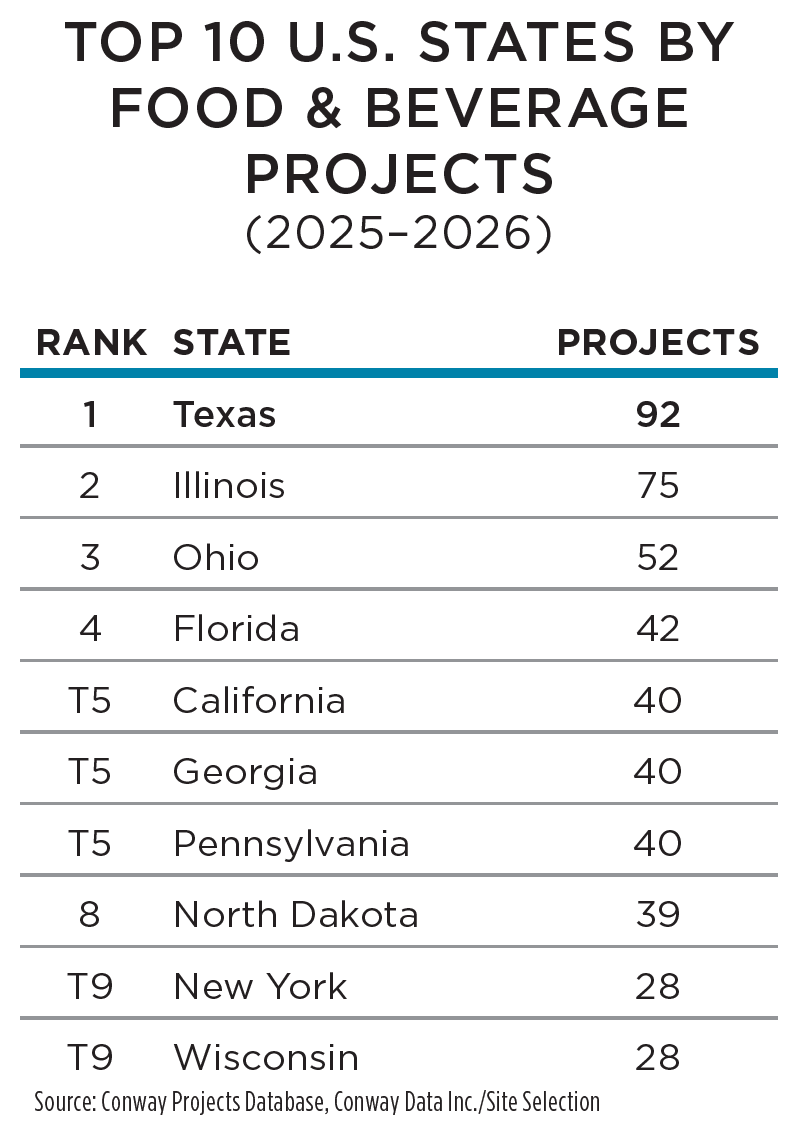
What’s happening in Ontario reflects broader trends in North America. According to the latest Industrial Sales Leads report by ROI Marketing, 51 new food and beverage projects were reported in North America in May 2026, representing an 8.5% increase from the 47 projects reported during the same period in 2025. ROI said Michigan led all U.S. states with eight food and beverage projects in May, followed by New York with six, California with five, and North Carolina and Wisconsin at three each.
The Conway Projects Database of Site Selection shows that, since the start of last year, Texas leads all states with 92 food and beverage projects. Second-place Illinois has tallied 75, followed by Ohio with 52, Florida with 42, and three states with 40 each: California, Georgia and Pennsylvania. During that same period, Ontario secured 35.
To learn more about what produces top-performing locations, I turned to Kornelia Kostka, research director for site selection consulting firm Global Location Strategies in Greenville, South Carolina. “The main location factors for food processors usually include proximity to raw materials and customers, access to a reliable workforce, strong water and utility infrastructure, and overall operating costs,” says Kostka. “Many food manufacturing facilities require significant water for processing, cleaning and sanitation, while electricity and natural gas costs can materially affect operating expenses.”
She adds that companies also pay closer attention today to safeguarding food safety. That means they scrutinize surrounding land uses and take into account water quality, environmental conditions, workforce experience with food safety practices, and access to food-grade logistics infrastructure. “Supply-chain resilience and long-term operational risk are becoming increasingly important,” says Kostka. “Incentives and real estate costs can influence the final decision, but a location must first demonstrate that it can support the workforce, infrastructure and quality standards required for long-term success.”
A Land Flowing with Milk & Sugar
The world’s largest cane sugar refiner has been making sugar in Louisiana for a long term of its own: 117 years. Now it’s committed to a project that will set up the firm to produce sugar there for at least 100 more years.
Domino, part of the American Sugar Refining (ASR) conglomerate that is headquartered in West Palm Beach, Florida, announced in early May that it will invest $785 million in the Chalmette Refinery in Greater New Orleans, Louisiana, to upgrade and modernize the plant, retain 500 jobs and create more than 50 new direct and indirect jobs.
The project, located in Arabi in St. Bernard Parish, is the largest food manufacturing project to date in 2026 and ranks as one of the five largest food sector deals in the U.S. in the last five years. Construction is underway and is slated for completion in 2028.
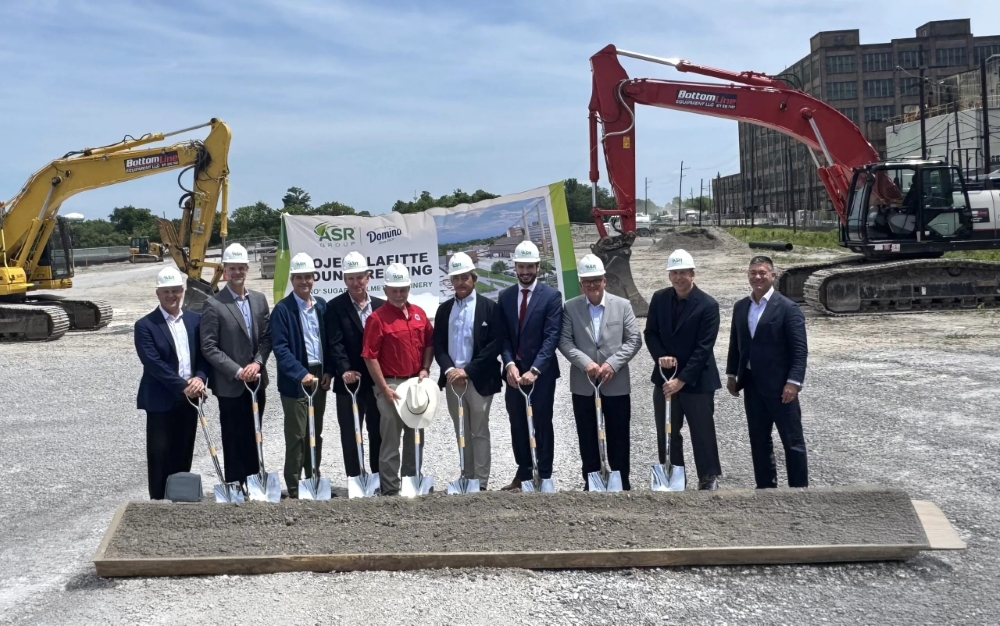
Leaders of Domino Sugar joined Greater New Orleans Inc. and Louisiana Economic Development to break ground on a $785 million refinery project in St. Bernard Parish.
Photo courtesy of GNO Inc.
The second-largest project of 2026 is an expansion of fairlife LLC, the milk-making subsidiary of Coca-Cola, in Coopersville in Ottawa County, Michigan. This $650 million investment will create 150 jobs. The Michigan Strategic Fund committed $17 million in Strategic Site Readiness Program funds to improve the regional water system used by residents and businesses in Coopersville, Polkton Charter Township and Allendale Charter Township just west of Grand Rapids.
The fairlife plant has operated in Coopersville since 2012 and employs 400 workers, making it one of Michigan’s largest dairy factories. The expansion adds 245,000 sq. ft. of production space and opens in 2028.
According to the Michigan Economic Development Corp., agribusiness is annually a $125.8 billion economy statewide.