
Two companies from Belgium and Japan find Georgia feels like home.
In November 2025, on the way back to Atlanta from a field trip to the deep archives at the Richard B. Russell Building Special Collections Library at the University of Georgia in Athens, Site Selection Senior Editor Alexis Elmore and I made a stop along Highway 316 at a place that would soon be making history all its own.
We wanted to see progress at the 2,000-acre development named Rowen, whose launch was first chronicled in these pages many years ago. Positioned in Gwinnett County 35 miles from Atlanta, 33 miles from Athens and near the booming north Georgia communities of Dacula, Commerce, Gainesville and Jefferson, Rowen (whose name means the second harvesting of a field in the same year) was still in its early days, but the quality of the development, its focus on high-end prospects and the keen interest from those prospects were palpable.
We had paused to grab a glimpse of the future. Little did we know the future was so close at hand.
Four months later, Brussels, Belgium-based biopharma company UCB, which had launched a salvo last year announcing its intent to make a U.S. investment, revealed that it had selected the Rowen campus for a new $2 billion, 460,000-sq.-ft. biologics manufacturing facility designed to be a cornerstone of the company’s global biologics manufacturing network. UCB has achieved 16 FDA approvals or indication expansions, nine of which were secured in the past three years, demonstrating what it calls “sustained scientific progress and commercial delivery for people living with severe diseases,” including psoriasis.
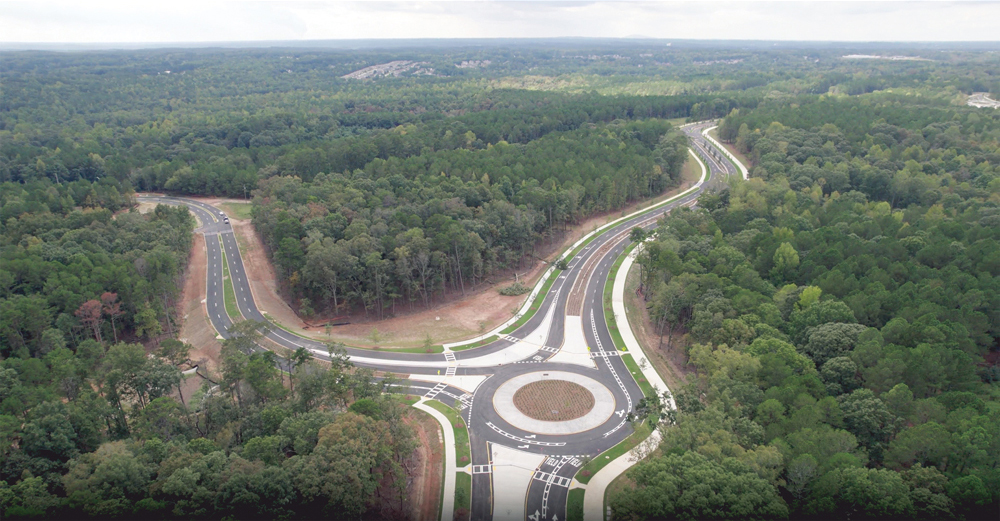
Rowen’s two-mile, $33 million Phase 1 roadway and infrastructure project is Georgia’s first officially certified Greenroads Pilot Project and one of several elements showcasing the development’s sustainability and living laboratory principles.
Photo courtesy of Rowen Foundation
“This decision reflects our confidence in UCB’s long-term growth and our deep-rooted commitment to the United States,” said UCB CEO Jean-Christophe Tellier. “By investing in Gwinnett County and the Rowen Foundation in Georgia, where our U.S. headquarters have been based for more than three decades, we are strengthening our biologics manufacturing capabilities, supporting our innovation pipeline, and creating high-quality jobs in a state that offers outstanding talent, a strong manufacturing tradition and an ecosystem designed for sustainable, long-term success.”
The company established its U.S. HQ in Greater Atlanta in 1993 after doing business in the country since the 1930s. The company’s location in Smyrna in the northwest Atlanta metro area serves as a hub for commercial, research and corporate operations and recently underwent an upgrade to its warehouse and office space that received gold certifications in both the LEED and WELL building programs, which UCB Head of Engineering, Sites & Facilities Philippe Mantelet says was a first in the pharma industry. Since 2017, UCB’s U.S. workforce has grown by 73%, including a 121% increase in R&D roles, bringing the company’s U.S. employee base to nearly 2,000 people.
Expected to generate 330 new jobs and an overall economic impact of around $5 billion, the Rowen campus could be the catalyst that elevates the Atlanta-to-Athens corridor to the next level. But the company was careful to say the location is “between Georgia Tech and the University of Georgia,” thus providing access to a deep and expanding talent pool across science, engineering, and advanced manufacturing.
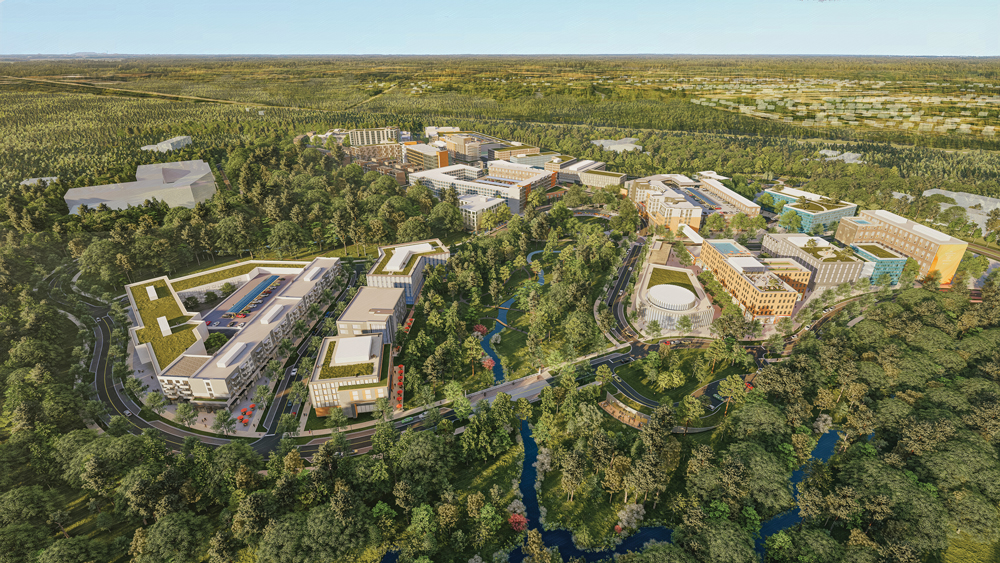
The long-term vision for Rowen across 2,000 acres includes mixed-use and residential components, as well as trails connecting to the larger region’s trail system, aspects appreciated by Rowen partners visiting in fall 2025.
Images courtesy of Rowen
A New Center of Gravity
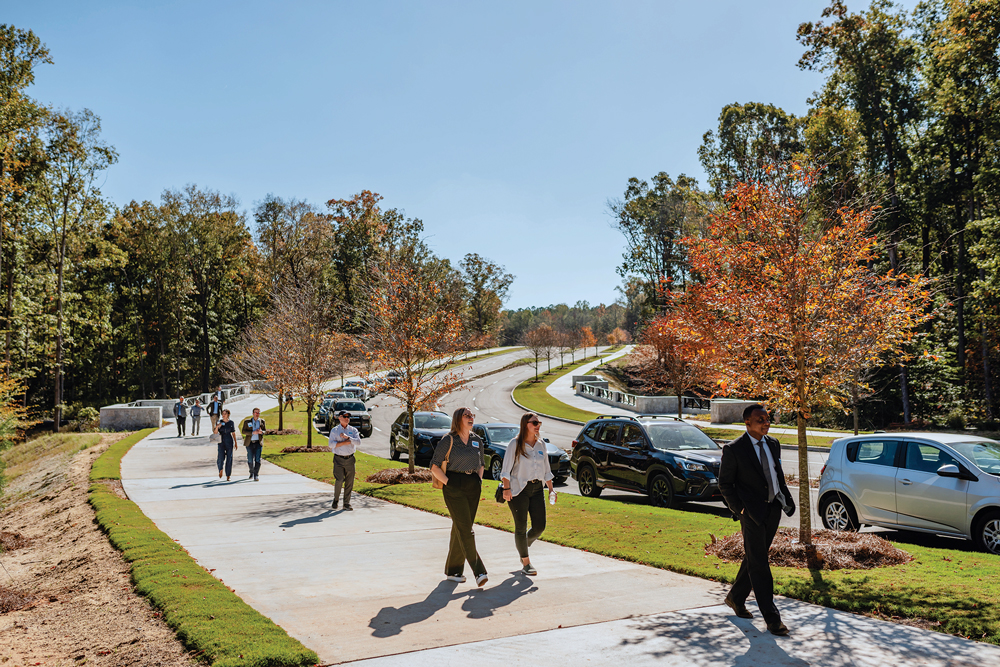
During our November visit to Rowen, Bob Hughes, principal and founding partner of landscape architecture and design firm HGOR, and Rowen Foundation Director Christina De Giulio cited a study performed by the Carl Vinson Institute of Government at the University of Georgia that examined an 11-county region with Rowen at the center. “Forty-three percent of the growth in Georgia between 2023 and 2050 will occur in our 11-county Rowen region,” Di Giulio said, “almost half the state’s growth. Over the next five years, 46% of working-age population growth [ages 25-64] will be in this region.”
No wonder Rowen’s entitled for up to 22 million sq. ft. of mixed-use development, even as 20% of the land is reserved for nature preservation. Rowen also was approved by Gwinnett County for an Innovation Overlay Zoning District designation. What this means, says Hughes, is when a project meets Rowen’s design guidelines, “we send a letter to the county, and within 10 days the county issues a permit to disturb the land,” a process that normally takes three or four months. “That’s huge when we’re competing with state X or state Y.”
Data centers, warehouses and battery plants need not apply. R&D, science and technology and collaborative corporate environments are more apt matches for Rowen’s “knowledge community” principles and aesthetic. Moreover, its commitment to sustainability is authentic. De Giulio today says Rowen continues to work with schools such as Spelman College and UGA’s Odom School of Ecology on watershed, wildlife and environmental topics. A “bio blitz” was scheduled for April when some 60 community volunteers were expected to divvy up Rowen to inventory plants, animals, insects and fungi.
Total Alignment
From his office on a UCB campus about 13 miles south of Brussels, Mantelet says UCB is one of the last remaining jewels in the Belgian pharma universe. He aims for the Rowen campus to be another jewel in the company crown.
“UCB is a family-owned company, and we found in Rowen Foundation’s project something that was long-term-driven for economic and community development. We made the parallel with our UCB ambition being focused on science and patient, but also a long-term strategy … It’s not just making business somewhere, it is really a journey, an inspirational journey. We were seduced by that.”
Mantelet says the company began with SelectUSA and then worked closely with local economic developers keen to help the company navigate the layers of federal, state, county and local government and remove all the complexity they could, an attitude Mantelet says was much appreciated by his team. He says incentives were important and tariffs are something the company is aware of as part of the overall economic picture but were not a deciding factor in the location decision. “The decision was a long-term strategic decision we have taken because we want to produce bio products for the U.S. patient.”
Rowen Foundation President and CEO Mason Ailstock, whose experience at North Carolina’s Research Triangle Park planted the seed for his Rowen vision, says Rowen was brought onto UCB’s radar as a possibility through Gwinnett County and its economic development team at Partnership Gwinnett working alongside the Georgia Department of Economic Development. What he calls “a great RFI” ensued.
“It was clear from the beginning the uses they anticipated around clean manufacturing,” Ailstock says, “which totally aligned with why Rowen was created. The company started to learn more about the real estate and the ‘why’ behind Rowen and get clarity around what Rowen was.” A cover letter from Ailstock and his board further articulated the place Rowen is intended to be, explaining specific covenants and design guidelines and why so many universities and colleges (including the Technical College System of Georgia) were on the Rowen board. The overall message: Yes, this was a place to build a facility, but it was also a place to thrive long after the ribbon-cutting. “When that sticks, then things get really exciting,” says Ailstock.
Long term is on Mantelet’s mind, as his team designs the facility to initially produce two drug substances but to be flexible and scalable enough to accommodate six or seven products eventually. He wants the site to be innovative in its technology and in its sustainability, as the company aims to recycle between 70% and 80% of the water the operation will consume while also deploying renewable energy where viable. “We really want to preserve natural resources for the community,” he says. “UCB wants to be net zero by 2050.”
UCB welcomed a visit to Belgium from Gwinnett and Rowen leaders in April. “They were happy to see it’s a clean industry, producing mainly water with cells.”
The company was advised by Colliers, which announced that the process involved a comprehensive search across 12 states and more than 1,200 counties, ultimately narrowed to 62 with high potential and then 29 that aligned best with UCB’s requirements. Colliers says it guided UCB “through a focused assessment of semi-finalist states and approximately a dozen qualified sites. Technical site visits involving Colliers, UCB and its engineering teams evaluated site and infrastructure readiness, permitting, utilities, workforce and community support. By the fourth quarter of 2025, the team narrowed the list of locations for executive site visits, moving forward to a structured RFP and negotiation phase.
UCB Head of US Engineering Nicolas Debruyne stated, “Our partnership with Colliers was critical to guide us through a very complex process. Their team skillfully managed a rigorous set of criteria and negotiations to achieve our desired outcome within a six-month timeframe.”
Time zone meant something too, says Mantelet, which is why finalists were on the East Coast. “When we have to collaborate with our teams and have connections or meetings to make, it’s easier when there are six or seven hours of time zone difference than when there are nine hours.”
The UCB team included quality, supply chain, HR, finance and external affairs personnel, Mantelet says. Access to talent and a strong life sciences ecosystem were primary criteria, as were easy access to infrastructure and utilities. The company also needed to see a willingness from the state to speed execution.
As for supply chain, “We need to have specific supply chain capacities for storing our drug substance at minus 70 degrees Celsius,” Mantelet says, “so we need to be sure there is a cold chain availability close to the site. Lastly, we wanted the ability to become a strong community partner and contribute to the economic growth of the location we would choose.”
It’s safe to say UCB is already doing that and will be doing so for some time to come. Which bodes well for Rowen and for Georgia. Since the announcement, says Ailstock, “We’re hearing from folks in Ireland, Europe and other parts of the world who have seen this.” With UCB as a founding partner, “now there is a level of market confidence that builds as we talk to other folks in life sciences, ag-tech and other innovation industries. Now there’s the point of validation and discussing in more detail something they have in the pipeline.” — Adam Bruns


The old and new: Yamaha YA-1 1955 motorbike (left) and Yamaha YZF-R1M 2015 motorcycle.
Photos courtesy of Yamaha Motor Company
Why Yamaha Jumped from California to Georgia
If there’s one thing motorcycle and ATV maker Yamaha knows, it’s the terrain. By announcing February 26 that it’s moving its U.S. headquarters from California to Georgia, this $17 billion global Japanese brand signaled that it now considers the Peach State to be the best terrain for guiding its continental growth for years to come.
Without any fanfare and largely buried on its corporate website, the headquarters relocation announcement barely registered a blip on the national media radar when the news came down from the global corporate headquarters of Yamaha Motor Company, the world’s second largest motorcycle manufacturer, in Iwata, Shizuoka, Japan.
The company’s official statement was simple and succinct: “Yamaha Motor Co., Ltd. has decided to relocate its U.S. group company, Yamaha Motor Corporation, U.S.A. (YMUS), currently located in Cypress, California, to Kennesaw, Georgia. This relocation will be happening, by function, over the period from the end of 2026 until the end of 2028.”
The statement noted that Yamaha will sell all fixed assets owned by YMUS in Cypress in Orange County, including land, offices and warehouses. “This initiative is positioned as one of the company’s key measures aimed at improving asset efficiency and enhancing profitability in the United States,” the firm said.
The move is significant because Cypress has served as YMUS headquarters for 47 years, ever since Yamaha acquired the land in 1978 and established its office there one year later.
Georgia first came into the picture two decades later when the company relocated its Marine Business Unit to Kennesaw in Cobb County in Metro Atlanta. Yamaha said it made this move to better serve its customers. The firm then relocated its Motorsports Business to Kennesaw as well in 2019.
The Cypress offices currently house the corporate functions of Yamaha and its financial services business. Those facilities cover 279,000 sq. ft. in three buildings on a 25-acre campus on Katella Avenue in Cypress, a town of 50,000 people about eight miles west of Anaheim in northwestern Orange County.
“In connection with the sale of these assets, the company plans to utilize a sale-leaseback arrangement to ensure business continuity and to facilitate a smooth relocation to Kennesaw,” the firm said, adding that “details such as the sale price, purchaser and timing of the transaction are currently under review.”
How Tariffs Impacted the Timeline
The company mentioned tariff pressures as a driving factor: “Yamaha is undertaking structural reforms aimed at improving the profitability of its U.S. operations in response to cost increases resulting from U.S. tariffs and changes in the market environment. In addition to implementing cross-business cost reduction initiatives, the company seeks over the medium to long term to build a profit structure that is not solely dependent on top-line growth, thereby transforming itself into a more resilient and robust organization capable of adapting to change.”
While the news represents a big loss for Southern California, it’s but the latest gain for Georgia — especially as it pertains to Yamaha. The 70-year-old company already owns and occupies a 458,760-sq.-ft. office building on 37 acres just off Chastain Road in Kennesaw, a city of 40,000 people on I-75 about 30 miles north of downtown Atlanta. In 2023, Yamaha opened a 75,000-sq.-ft. Marine Innovation Center at this same site. In addition, Yamaha Motor Manufacturing Corp. of America has operated a 1.3 million-sq.-ft. assembly plant in Newnan in Coweta County southwest of Atlanta since 1986.
Bisnow Atlanta reported recently that Yamaha leased an additional 25,000 sq. ft. at TownPark Commons in Kennesaw last November. That facility is part of a four-building, 350,000-sq.-ft. office park that was bought out of foreclosure last March by RGRE for $42 million, just seven years after it traded for $73 million.
When Georgia Gov. Brian Kemp announced the corporate relocation news on March 10, his staff said the state did not offer any incentives to Yamaha to convince them to move to Georgia. What did sway them? A face-to-face visit from the governor himself.
“We’ve spent years building a pro-business environment in Georgia that doesn’t just attract job creators but allows them to grow,” Kemp said in an exclusive March 25 Site Selection interview. “We offer the infrastructure and workforce companies like Yamaha need to succeed. We pair that with a proactive approach to listening to and meeting companies’ needs. That’s why we met with Yamaha in Japan while on economic development travel there — to listen and learn how we could keep growing together face-to-face.”
Kemp added the Yamaha win “further solidifies Georgia’s status as a leader for corporate hubs, including headquarters and across diverse industries. Our headquarters truly run the gamut. As we continue attracting companies like Yamaha, especially ones who established a presence in Georgia before moving more operations here and expanding, we are setting example after example that our state is a place you can succeed in for decades.”
What This Win Means for Georgia
It’s an especially big win for Cobb County, a northern Metro Atlanta county of over 800,000 people, third largest in Georgia. “Cobb County is home to global companies, major sports teams, one of our state’s largest universities and a great quality of life,” says Kemp. “It continues to see tremendous growth, welcoming 40 state-worked projects since 2019. That represents 5,400 new jobs and $550 million of investments, just from projects the state had a role in. We always emphasize that communities like this one are creating their own organic growth thanks to the pro-business environment of our state, and Kennesaw is no exception as we see with the Yamaha announcement.”
Statewide, Georgia has experienced considerable success by working with California-based companies on expansion and relocation projects. Since 2021, a total of 103 Caifornia-headquartered firms have announced corporate facility investment projects in the Peach State, including one announced in February 2022 by Yamaha Marine Systems Company Inc. in Kennesaw, according to the Conway Projects Database of Site Selection magazine. That project created office, research and development space in Cobb County.
More recently, health technology company Glytec announced that it would relocate its headquarters from Waltham, Massachusetts, near Boston to just off Windy Ridge Parkway in the Cumberland Community Improvement District in Cobb County. The company, which was founded in Georgia, is returning to its roots and will create 500 jobs in coming years.
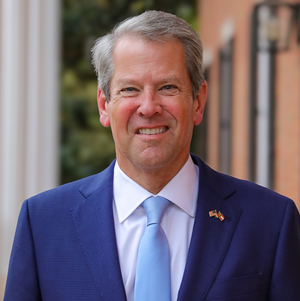
“We offer the infrastructure and workforce companies like Yamaha need to succeed. We pair that with a proactive approach to listening to and meeting companies’ needs.”
— Georgia Gov. Brian Kemp
Kemp said Georgia lands deals like Yamaha and Glytec because the state invests in its workforce. “We’ve heard from companies that they are in need of workers to fill the positions coming to our state, and we’ve taken action by making workforce development a top priority,” Kemp says. “We’ve passed legislation improving alignment between business, government and education stakeholders while finding innovative ways to let Georgians know what opportunities are available to them. For example, the Georgia MATCH program sends a letter to every high school senior letting them know we are holding a spot for them at the universities and technical colleges they qualify for based on their GPA. Many of these students would never know what options they had, and this allows them to see clearly what doors are open to them right here in their home state.”
Kemp: We’re Not Done Tinkering
Kemp says other business climate improvements have helped too. “We’ve worked at making Georgia’s risk environment more predictable and competitive. We enacted meaningful and historic tort reform, taking action after years of hearing from businesses that the litigation environment in our state was contributing to runaway costs,” he says. “These common-sense measures have already helped stabilize insurance costs for businesses and consumers alike, without closing the courthouse doors to those who need to pursue claims in court. We’re not taking our eye off the ball, however, and we’re continuing to look at ways to bring predictability and stability for our job creators, such as legislation this year that will modernize corporate governance litigation in Georgia, so that companies who invest in physical facilities here also consider moving their state of incorporation. And we will continue to look for other innovative ways to make sure Georgia’s legal environment is as conducive to job creation as possible.”
When asked whether Georgia intentionally targets California companies for business recruitment, the governor said, “We’re always open to listening to companies interested in locating in our state and working to find a good fit for them. We let our record speak for itself, which is that we work with job creators in Georgia, not against them. We believe that approach yields mutual prosperity, and we’re happy companies like Yamaha see the benefits of that approach as well.”
The Yamaha deal adds to a series of recent automotive headquarters wins in Georgia — a list that now includes Porsche, Mercedes-Benz, Asbury, Cox and others.
When I asked Kemp why Georgia lands so many large automotive companies, he said that “part of that success is the cooperative approach, and another part is that we have a unique mixture of low cost-of-living, reliable transportation and infrastructure, and a pro-business environment that appeals to companies and workers alike. Georgia is a place where employees can achieve success both professionally and personally, and companies can meet the needs of their employees while growing themselves.”
— Ron Starner
‘Transaction Alley’ Is Just One Part of the Georgia Fintech Scene
The Georgia Department of Economic Development reports that 70% of all U.S. transactions are handled by payment processing firms located in Georgia. The state’s “Transaction Alley” is home to more than 240 companies offering banking, blockchain, information security and data analytics services.
According to the department, Georgia State University’s FinTech Lab was one of the first university fintech labs in the country. It’s part of the larger Georgia FinTech Academy, a collaboration between the region’s fintech industry and the 26 public institutions of the University System of Georgia that was created in 2019 and has reached more than 10,000 students across the state, with 2,400 of them moving into roles across fintech, payments, banking, risk, cybersecurity and related sectors.
Among other playerse is FinTech Atlanta, a coalition of companies working to advance Atlanta as the recognized global capital of financial technology. Site Selection Managing Editor Kelly Barraza recently conducted an email Q&A with FinTech Atlanta Executive Director Ania Lackey. The following is an excerpt of their conversation.
Site Selection: What are some of the factors that make Atlanta a fintech capital?
Ania Lackey: Atlanta’s rise as a fintech capital stems from a rare combination of deep payments infrastructure, high-density corporate presence, and a steady pipeline of fintech-ready talent. Decades of leadership from companies like Global Payments, Fiserv, Deluxe, FIS and others created an industrial backbone that processes the majority of U.S. card transactions. Layered on top of that is a talent engine powered by Georgia Tech, University of Georgia, Kennesaw State University, Georgia State University and the region’s HBCUs — producing the engineers, product leaders, cybersecurity experts and operators that fintech companies depend on. In fintech, the Georgia Fintech Academy provides industry curriculum across the University System of Georgia. It all helps build an ecosystem with both the skill and the scale to keep growing.

Ania Lackey
FinTech Atlanta Executive Director
What truly sets Atlanta apart, though, is the proximity between enterprise buyers and emerging innovators. Fortune 500s/1000s, global fintech leaders, scaling startups and university teams all operate within the same orbit, making collaboration natural rather than aspirational. FinTech Atlanta programs like Run it by the Buyers, Ask an Advisor, FinTech Forward, GenNext Insights and the Ambassador Program create structured collision points that turn conversations into real partnerships. This corporate-startup engagement is active, not passive — buyers show up, founders get access and the ecosystem accelerates as a result.
Add in a diverse and globally-minded community, a supportive regulatory environment, lower operating costs and a culture that actually invests in connection, and you get a fintech hub with real momentum. From international companies choosing Atlanta as their U.S. landing pad to home-grown startups like Rainforest, Verdata, and EvidentID, Ditch, Arcum scaling quickly, the region keeps proving that innovation, talent and partnership are part of the city’s DNA.
Which fintech hubs nationally and globally are on the rise and seeking to do business in Atlanta?
Lackey: Argentina has become one of Latin America’s most energetic fintech hubs, powered by world-class engineering talent, widespread digital payments usage and a startup culture that’s been battle-tested for years. That strength was on full display during the recent delegation to Atlanta, led by Ambassador Alec Oxenford, where high-growth Argentine fintechs spent time exploring market entry and partnership opportunities. NXTMOVES, a FinTech Atlanta Board member, hosted the group for lunch and a candid conversation about doing business in Atlanta, offering a clear view into the city’s payments leadership, corporate access and collaborative culture.
Ireland is one of Europe’s most established fintech and financial-services hubs, with a deep payments footprint, a highly skilled workforce and a regulatory environment that regularly draws global players to Dublin. That strength extends directly into Atlanta. Stripe recently opened an office here, adding one of the world’s most influential fintech companies to the city’s roster. On top of that, IDA Ireland and Enterprise Ireland are highly active in Atlanta, supporting Irish fintechs ready to scale in the U.S. and deepen transatlantic ties. And the relationship goes both ways — in the past two years, Atlanta fintech leaders have traveled to Ireland through the American Transactio Processors Coalition’s Transatlantic Fintech Exchange, meeting with Irish industry and government partners to collaborate on policy, payments innovation and workforce development. The Georgia Fintech Academy was even highlighted as a model for Ireland’s emerging talent initiatives.
What trends in the fintech industry have impacted your operations or growth strategy?
Lackey: A few industry trends have directly shaped how we run FinTech Atlanta and where we’re putting our energy. First, corporate buyers are moving faster toward fraud prevention, AI-driven risk tools and compliance automation — and that shift is influencing our programming. It’s why Run it by the Buyers has leaned more heavily into themes like financial crime and data security.
We’re also seeing a clear trend around talent mobility. Companies aren’t just chasing technical talent; they’re trying to build teams that understand payments, identity, risk and enterprise sales. That shift is part of why programs like GenNext Insights and our work with the Georgia Fintech Academy have grown so quickly. The ecosystem wants connection points for rising professionals, and we’ve made that a core piece of our strategy.
And finally, global expansion is picking up again. Fintechs from Ireland, Argentina, the UK, Switzerland and others are looking for a U.S. entry point that’s affordable, connected, and rich in payments infrastructure. That trend has pushed us to strengthen our international partnerships and build more intentional pathways for companies landing in Atlanta.