
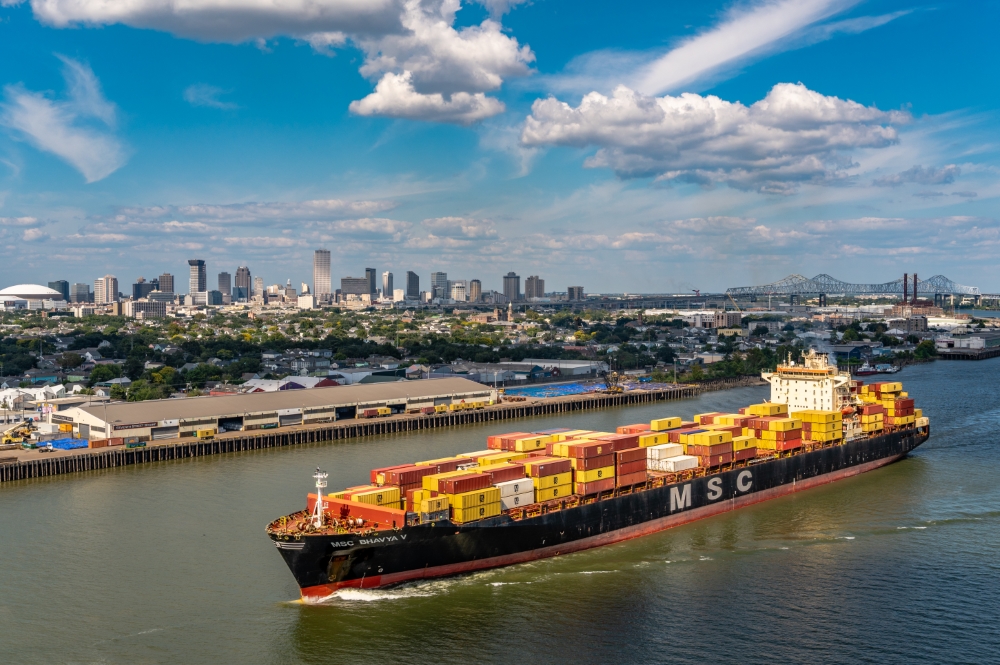
Deeper channels, faster terminals and expanding inland networks are reshaping how companies evaluate Gulf Coast locations.
by Savannah Yawn
Gulf Coast ports are expanding with deeper channels, more capacity and better rail connections to move larger ships with fewer delays. For companies looking at Gulf Coast locations, the basics are clear: deepwater access, reliable operations and strong connectivity. The difference is which ports can actually deliver.
To see how that plays out in practice, Site Selection spoke with leaders at the Port of Corpus Christi, Port of Mobile, Port of New Orleans and Port Houston about how they’re investing to attract industry and strengthen supply chains along the Gulf Coast.
Port of Corpus Christi: Throughput, Certainty and Structural Advantage
At the Port of Corpus Christi, recent channel improvements have already changed how cargo moves. The Channel Improvement Project widened the ship channel to 530 feet and deepened it to 54 feet from the Gulf to the Chemical Turning Basin, increasing capacity for crude exports and allowing larger, deep-draft vessels to transit more safely and efficiently.
Strategically positioned near the Eagle Ford Shale and the Permian Basin, the port has become a primary outlet for U.S. energy exports. As volumes have grown, so has the need to accommodate larger ships. The completed project supports that shift, helping reduce bottlenecks while reinforcing the port’s role as a key link in global energy supply chains.
The impact shows up in volume. The improvements support nearly 1 billion barrels of crude oil annually, while reducing vessel trips, lowering risk and cutting emissions. The project also positions the port as one of the most improved channels on the Gulf Coast and a contributor to reducing the U.S. trade deficit.
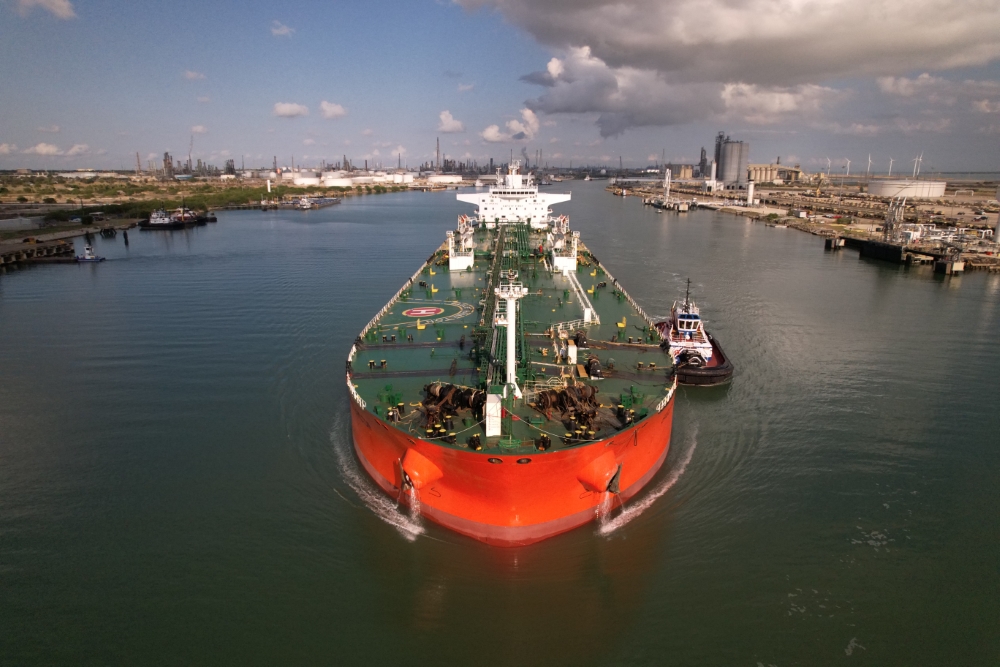
Channel improvements at the Port of Corpus Christi are enabling larger vessels, increasing export capacity and improving efficiency for high-volume energy shipments.
Photo courtesy of Port Corpus Christi
“The deepening and widening of the Corpus Christi Ship Channel has materially changed how shippers assess the Port of Corpus Christi,” says Port of Corpus Chief External Affairs Officer Christi Omar Garcia. “Larger, fully loaded vessels can now move more efficiently and safely, reducing light-loading, transit delays and per-unit transportation costs. For companies moving high volumes, especially in energy and bulk commodities, this translates directly into competitive advantage and has made Port Corpus Christi one of the most attractive deepwater options along the Gulf Coast.”
Pipelines from the Permian Basin and Eagle Ford Shale feed into Corpus Christi and Harbor Island, where new crude terminals are planned. As volumes rise, the ability to fully load vessels becomes a key differentiator.
“Over the next three to five years, the winning port locations will be those that deliver scale without congestion, efficiency without disruption and growth without uncertainty,” said Garcia. “At Port Corpus Christi, site selectors and corporate decision-makers should focus on how channel improvements, scalable infrastructure, favorable weather, low congestion and coordinated execution continue to translate into throughput certainty and long‑term competitive advantage.”
Port of New Orleans: Connectivity, Capacity and the Logistics Ecosystem
In New Orleans, recent investment centers on capacity and resilience. The Louisiana International Terminal (LIT), a next-generation container facility, is designed to handle the largest vessels transiting the expanded Panama Canal while increasing overall cargo-handling capacity.
“The new container terminal, along with significant investments in our bulk and breakbulk facilities, are designed to strengthen the supply chain reliability and flexibility that companies increasingly prioritize given the current trend in trade volatility. Additionally, because Port NOLA directly connects to all six Class I railroads, we are also prioritizing rail investments, reinforcing the gateway’s seamless link to river, rail and roads.” says Port of New Orleans Director of Real Estate Kyle Gilmore.
Those investments extend beyond the waterfront. The Port’s access channel deepening to 50 feet allows more consistent calls by fully loaded vessels, reducing light-loading and improving schedule reliability. On the landside, ownership of the New Orleans Public Belt Railroad links ocean cargo to six Class I railroads, while new gantry cranes and intermodal development are increasing berth productivity and speeding cargo transfer.
Connectivity remains the throughline. The terminal links to four interstate systems, including the planned St. Bernard Transportation Corridor, and to a network of inland waterways spanning 14,500 miles across 31 states, with access to more than 30 inland hubs including Dallas, Memphis, Chicago and Canada.
“We are seeing the convergence of the logistics, energy and value-added industrial sectors driving demand for sites near the Port of New Orleans,” says Gilmore. Fabricated metals, plastics, liquid bulk transfer and equipment manufacturing are expanding near port facilities, alongside growing demand for industrial outdoor storage to improve truck turn times and reduce drayage.
“What is most overlooked about the Port of New Orleans is its location and connectivity to inland America,” says Gilmore. “Many site selectors evaluate port locations based on population and vessel call volumes. However, the Port of New Orleans’ unique ability to move cargo beyond the dock and deep into the interior of the U.S. is often underappreciated. While supply chain strategies become more environmentally guided, the Port’s unmatched access to rail and inland waterways reaching all parts of the U.S., as well as Mexico and Canada, becomes an even more critical node in the trade chain. This inland reach translates into reduced congestion compared to larger coastal ports, faster and efficient multimodal transfers, and more predictable transit times into key markets like the Midwest.”
Port of Mobile: Integrated Supply Chain Performance
At the Port of Mobile, recent investments are centered on integrating deepwater access with inland connectivity. The Mobile Harbor Modernization Project delivered a 50-foot channel, making it the deepest container port in the Gulf and allowing larger, fully laden vessels to move more efficiently.

Doug Otto, Port of Mobile
“What is truly influencing site selection decisions is how these assets are connected,” says Port of Mobile Director and CEO Doug Otto, “Through our Mobile America Express (MAX) platform, we’ve integrated deepwater access with terminal capacity, on-dock rail and inland reach.”
That integration extends beyond the waterfront. Through MAX, the port connects five Class I railroads, Interstate highways, inland waterways and a growing network of inland intermodal facilities, positioning Mobile as a logistics gateway to the Southeast and beyond.
“For containerized cargo, this translates into real performance — our terminal operator, APM Terminals Mobile, can move cargo from ship to Chicago in just three days,” Otto says. “That level of speed and reliability directly impacts inventory strategies, transportation costs and ultimately, a company’s bottom line.”
Demand is following that model. Advanced manufacturing (particularly automotive) and distribution and e-commerce users are expanding in inland markets while maintaining port-level performance.
“Waterfront is a premium, but through our MAX platform, companies no longer have to locate directly on the coast to benefit from port access. With the expansion of our inland intermodal network, they can operate from inland markets while maintaining the performance of a port-adjacent location,” Otto says.
Operational improvements are reinforcing that position. More than $1.3 billion in recent investments — including on-dock rail, inland intermodal expansion and an interterminal connector bridge — are reducing congestion, improving transfer efficiency and enabling the port to scale beyond one million TEUs.
Port Houston: Scale, Capacity and Industrial Depth
Upgrades along the Houston Ship Channel and within container terminals are redefining how companies evaluate Gulf Coast locations. Instead of focusing on proximity, companies are prioritizing access, vessel capacity and the ability to move cargo at scale.
“At Port Houston, channel improvements and terminal enhancements are giving companies confidence that Houston can support larger vessels, higher volumes and more complex supply chains without disruption. As a result, we’re seeing site selectors place greater emphasis on future-ready infrastructure, not just current capabilities, when evaluating Gulf Coast locations,” says Port Houston Director of Economic Development Rina Lawrence.
That shift is supported by ongoing infrastructure work. Project 11, the Houston Ship Channel expansion, is widening the channel and adding safety enhancements to improve vessel transit times and navigational efficiency. At the terminal level, capacity is expanding to keep pace with demand. Projects such as Wharf 7 at Bayport Container Terminal added 1,000 feet of berth space and increased capacity by more than 500,000 TEUs, allowing the port to handle sustained cargo growth while maintaining service levels.
Operational improvements extend to the gate as well. Investments in cargo visibility systems and truck processing are improving flow through terminals, reducing bottlenecks and helping shippers move goods more reliably.
Demand is led by advanced manufacturing, petrochemicals, energy transition industries and large-scale distribution users. Population growth across Texas is also driving interest in import distribution, particularly for temperature-controlled and perishable goods.
“One of the most overlooked aspects of Port Houston is the depth and integration of its surrounding industrial network,” says Lawrence. “Beyond the port itself, the region offers a highly specialized network of suppliers, service providers, logistics operators and industrial developers that enable companies to stand up operations quickly and scale efficiently. This ecosystem reduces time-to-market and lowers operational risk, two factors that are often underestimated during the site selection process. This is where Houston consistently delivers value.”