
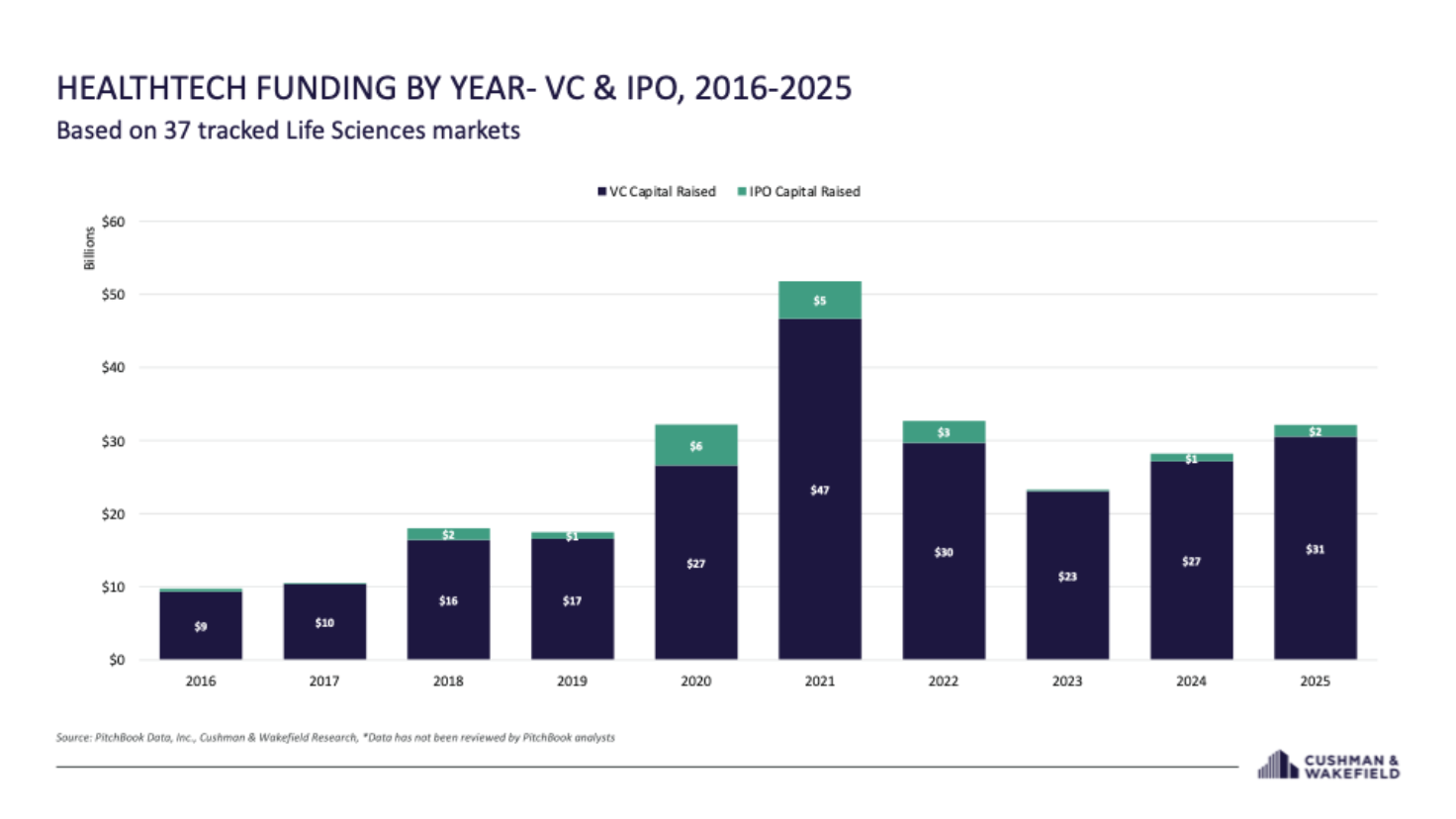
The sixth edition of Silicon Valley Bank’s Future of Healthtech Report last October projected that $18.5 billion was expected to be invested in the sector by year-end, with more than half of deals involving AI and a projected $8.25 billion invested in provider operations — activities that support the delivery of healthcare, such as scheduling, documentation, and billing. Among other findings, the report stated that 2025 was on pace to see a record high of 13 health tech private equity exits.
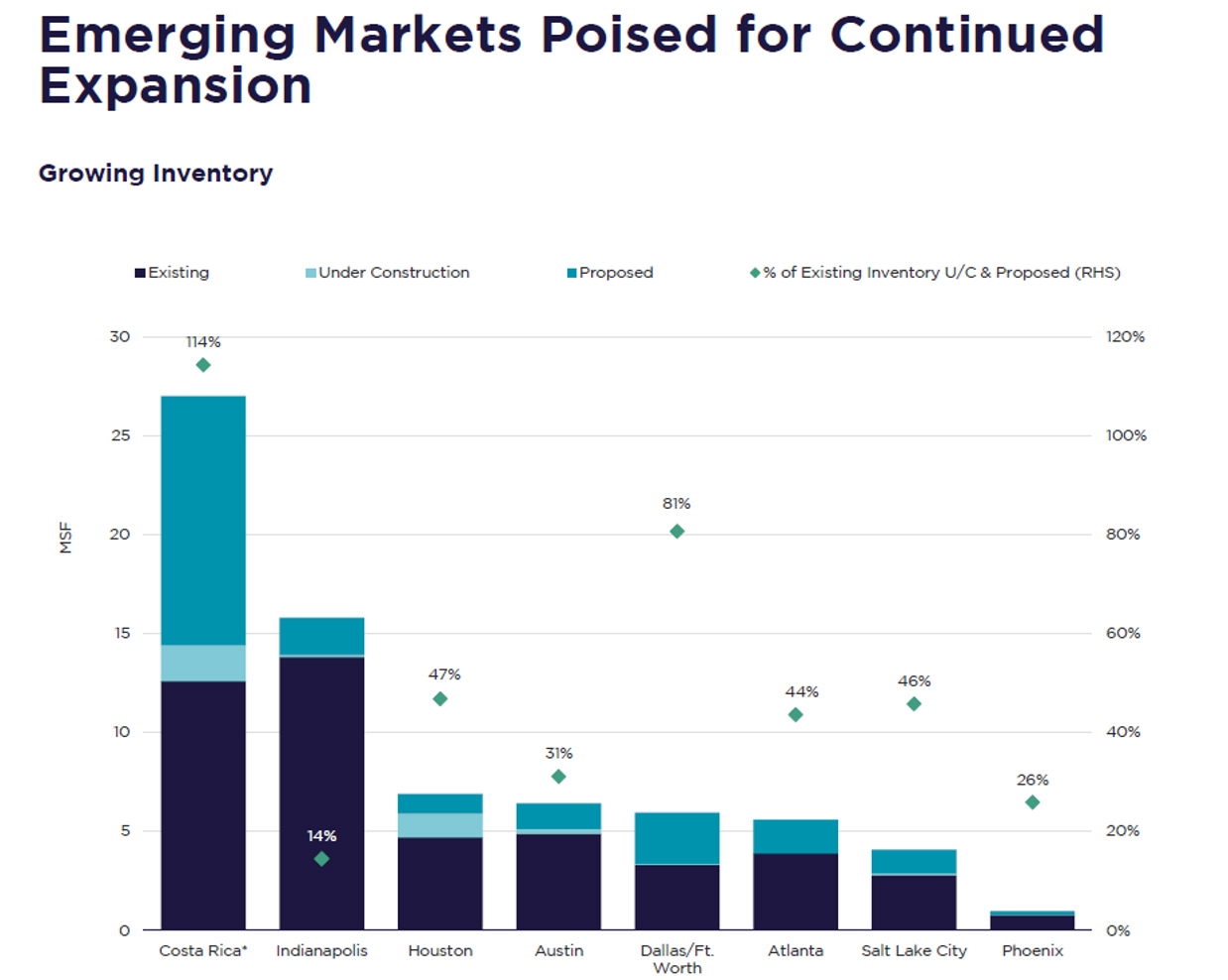
As Site Selection’s May issue contribution from Cushman & Wakefield on health tech trends indicated, funding is on the uptick, and emerging markets continue to grow:
Momentum is also strong among women-led health tech firms, if attendance and buzz at the recent PACE Healthcare Capital Midwest Women in Digital Health conference in Chicago were any indications. More than 175 people attended from across the country.
Leading off the event, PACE Healthcare Capital Founder and Managing Partner Julia Monfrini Peev noted how hospitals in such Midwestern cities as Minneapolis, Chicago, St. Louis, Cleveland and Kansas City have 45% of the hospital beds in the country, and that the Midwest is also home to major medical device and other health tech and health provider companies such as Medline, Cerner and Epic. “I still don’t understand why any entrepreneur would locate in the Bay Area,” she said. “There are no customers there.”
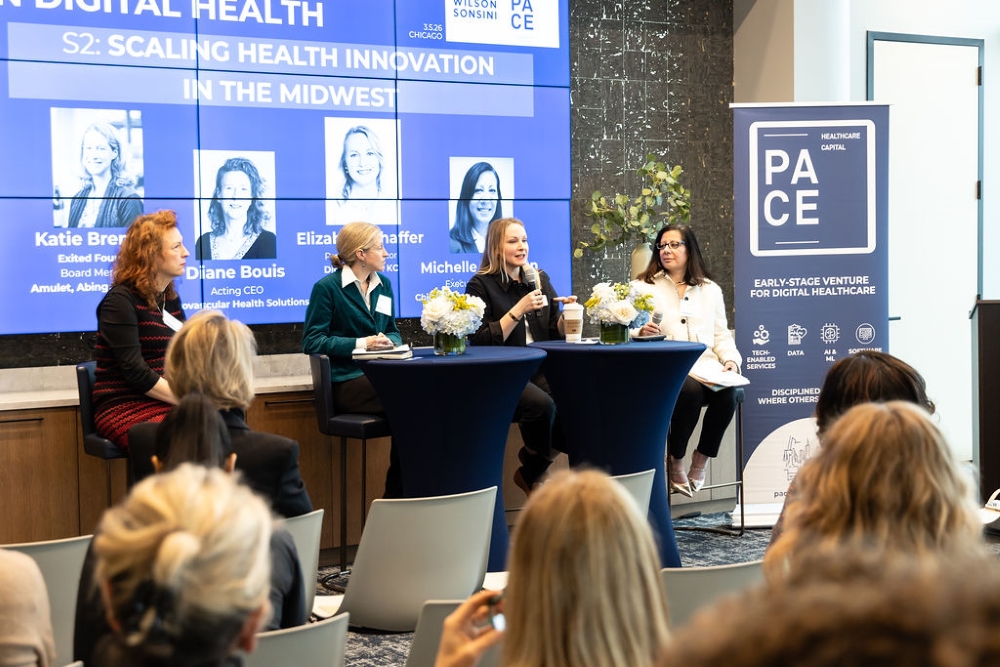
A session titled “Scaling Healthcare Innovation in the Midwest” featured Digital Health KC Program Director Elizabeth Shaffer, Microvascular Health Solutions Acting CEO Diane Bouis from Michigan, Founder and Abingdon Health & Amulet Board Member Dr. Katie Brenner from Wisconsin and Chicago Biomedical Consortium Executive Director Michelle Hoffmann, who said when it comes to building companies in the Midwest, “I roll that boulder up the hill every day.” But even with the vast, spread-out geography of the Midwestern health tech ecosystem, it’s getting easier because of a critical mass of players, including distributed hospital systems looking for solutions and a bevy of world-class institutions such as Mayo Clinic, Cleveland Clinic and Nationwide Children’s Hospital. “If you are building in digital and health tech,” she said, “your customers are here.”
Moreover, said an unnamed attendee said from the audience, “Somebody in executive search for a long time said, ‘The two hardest placements to make are getting someone to leave New York to come to Chicago, and the second hardest is moving back to New York.’ The coasts are more competitive and the Midwest is more collaborative, people say. We are leaning into our Midwestern-ness — Chicago is New York with lower prices and nicer people. And I stand by that.”
Spinoffs and Clusters
Shaffer, herself a former Cerner employee, said Cerner is an important part of the Kansas City region’s health tech origin story, with multiple healthcare IT companies starting in the area, which “eventually grew this naturally occurring digital health cluster” of more than 125 companies.
Brenner, who sold her startup bluDiagnostics to Amazon in 2020 and remained there until 2024, holds a PhD in Bioengineering from Caltech and has a BS and MS from Stanford University in Electrical Engineering. But she pointed to Madison, Wisconsin, as “a really interesting place to be. I didn’t know this when I moved there sight unseen.” The area’s biotech roots, she explained, go way back to its manufacturing roots, then biotech pioneers such as Promega, which spun off startups.
“Then of course there’s Epic,” she said, meaning Epic Systems, the legendary Madison healthcare software company whose culture is as robust as its business. “A variety of other companies came out of Epic related to digital health,” Brenner said. “Many stay put. It’s a great place to live with a great cost of living. You benefit from being able to build companies with less capital and then still exit them at market values. It’s an exciting place to be in Wisconsin in general,” she said, noting that the region was designated a Tech Hub last year, “which gives us additional funding and opportunities to build up our ecosystem.”
Brenner said community support started with the University of Wisconsin. “We couldn’t have done it without people from UW coming in and saying, ‘Hey, come in and use our tools for free’ and opening their networks to us … People care. They want to see stuff get built. And we’re capital-efficient here. We can hire people for less.”
One thing she’d like to see from “Midwest nice” individuals with wealth is a bit more investing in their own regions. When it comes to high-net-worth individuals, she said, “in a lot of cases women are more comfortable with charitable giving than investing. Get comfortable with the idea that investing is another way to help your community. That is something I wish I could figure out how to change. If even a piece of their portfolio would go toward investing, man, would it make a huge difference.”
In a similar vein, Bouis said funds and angel investor groups specifically geared toward women help bust stereotypes about what an investor looks like. Plus, “by joining an advisory board, I immediately pulled in other women,” she said. “Open the door and bring other people in with you.”
That phenomenon has applied to the animal health corridor that runs through mid-Missouri and Kansas, Shaffer said, noting a plethora of converging intersections where a thriving animal health industry means a thriving digital health sector as well. And this feeds into the need for digital health solutions in rural America. “If you’re in Kansas City, go out in any direction not very far outside the city and you’re in rural areas.” Challenges abound, but so does carve-out funding from both Kansas and Missouri.
As for talent, Hoffmann cited an entrepreneurial fellowship program the Chicago Biomedical Consortium backs that trains PhDs for two years and then releases them into the wild. “A lot of them are looking to stay in Chicago,” she said. “Everybody who has experience in the Midwest wants to stay here. We need more programs to train these kids … they’re not kids, but they need the opportunities to apprentice and to learn.”
“The early-stage talent is definitely here,” said Bouis. “One of the preconceived notions is we don’t have the seasoned talent. So one of the ingredients is people with large organizations bringing the muscle memory, asking ‘How do I repeat that?’ That is where organizations like ours and people like us make the difference. It is designing the door and showing people the door and saying, ‘Here, we are here, come here.’ I’m sure all four of us get calls all the time. And we don’t fight each other. We fight the coasts.”
For her part, Brenner said, thanks to the Epic campus and a tendency among Midwesterners to stay where their family is, dwindling talent is less of an issue than in other locations. “They sold out to Merck but they stayed,” she said of one scenario. “Madison has a little bit of cachet I think we benefit from, a little je ne sais quoi about Madison. These are brilliant people who have chosen to come and stay in our cities. Quite honestly, I don’t even need people to move here because we have UW graduates.”
That talent may possess the same attributes PACE Healthcare Capital Director of Platform E.J. Reedy noted in a post-conference message to attendees: “This was a morning grounded in substance, not surface.” That substance appears well on its way to attracting its fair share of increasingly substantial health tech capital investment.