EDUCATING THE NEXT GENERATION OF NORTH DAKOTAN WORKERS FOR A BRIGHT FUTURE.
In North Dakota, workforce investment starts in the classroom and is earned. One existing education program exemplifying this is the Higher Education Funding Formula, a performance-based method started in the state in 2013 that uses a weighted student credit-hour model to determine funding based on completed credit hours, incentivizing student success and retention.
In a conversation with North Dakota University System (NDUS) Deputy Commissioner Lisa Johnson, she observes that the higher education system in the state is also interested in getting an inventory of students’ interests at the K-12 level, having signed a contract with Golden Path Solutions, a company that connects schools and high school students with employment opportunities and matches them with fields of study and curriculum that interest them.
“If you’re interested in a particular field, our institutions will show up as providers for degrees and credentials in that area,” says Johnson about the partnership with Golden Path Solutions. “And we signed on because this is where we could also place job opportunities, whether it’s internships, co-ops, apprenticeships, but even culminating in post-graduation job opportunities.”

“At the system level, the use of AI is very program specific. While the board says you must have a digital literacy course, we all know that a single course will not be sufficient to navigate the workplace. It looks different in health care, business, and STEM and research fields.”
— Lisa Johnson, Deputy Commissioner of Academic and Student Affairs, North Dakota University System
Always Something to Learn
More students are seeking education beyond high school in North Dakota. Last year, the NDUS saw the highest level of enrollment in over a decade. For the 2026 spring semester, all postsecondary institutions saw a rise in enrollment, averaging a 2% increase overall.
The NDUS has been strategizing to not only keep enrollment at a healthy and growing level but also capture other student populations with cost savings and more flexible paths to completing higher education. In January 2026, the university system approved a pilot program for reduced-credit undergraduate degrees, specifically in bachelor’s in applied science degrees. These degrees are typically tailored for students seeking to get to work right away after completing college. The program does not apply to degrees requiring professional licenses.
The reduced-credit program will keep core classes as requirements for students on this path, instead reducing electives for college enrollees who may be bringing dual credit already earned from high school courses. The program also saves students money on housing and food by offering a shorter timeline to earning a degree. According to the North Dakota Monitor, up to two pilot programs for reduced-credit bachelor’s degree programs are now allowed at Bismarck State College, Dickinson State University, Mayville State University, Minot State University, North Dakota State College of Science, North Dakota State University (NDSU), the University of North Dakota (UND) and Valley City State University, with the new policy taking effect in fall 2026.
Notably, to enhance educational programs and prepare students to enter the workforce, the State Board of Higher Education also established the Workforce Education Innovation Fund (WEIF) in 2023. Johnson notes that WEIF support totaling $10 million has been awarded to nine of 11 public colleges and universities.
“The state’s two research institutions received similar funds to start up new programs — each of the two research schools receiving $16 million,” she continues. “That is an incredible injection of funds and conveys the legislative support for new programs aligned with workforce needs.”
Other moves in the state include educating students on new technology. Johnson explains that NDUS prepares “students by developing a board policy around AI and digital literacy.”
“At the system level, the use of AI is very program specific,” Johnson says. “While the board says you must have a digital literacy course, we all know that a single course will not be sufficient to navigate the workplace. It looks different in health care, business, and STEM and research fields. All of them are doing it, but it looks different from program to program.”
Digital credentialing is also another avenue being explored by North Dakota college students, wherein digital credits are placed in an “educational wallet” to show employers where a student may have received a certification. The credits are interactive but unalterable, supplementing or improving upon the traditional concept of a paper transcript listing course credits and continuing education classes. Digital wallets have been available to North Dakota high school students since 2022. At UND, the program is issued under the university as digital badges via Pearson’s digital platform Credly.
Tribal Colleges’ Economic Impact
Five tribal colleges make up the North Dakota Tribal College System (NDTCS): Nueta Hidatsa Sahnish College in New Town, Cankdeska Cikana Community College in Fort Totten, Turtle Mountain Community College in Belcourt, Sitting Bull College in Fort Yates and United Tribes Technical College in Bismarck. In early 2025, NDTCS announced findings from its 2024 Economic Impact Study, conducted by Lightcast, that details the impact of the colleges on the state of North Dakota.
From FY 2022 to 2023, tribal colleges in the state added $169.5 million to North Dakota’s economy, which is equivalent to supporting about 2,100 jobs. For each invested dollar in tribal colleges, a return of $1.30 was received by taxpayers. Added tax revenue and public sector savings of $30 million in North Dakota can be credited to tribal colleges’ work and presence in the state for that fiscal year.
“This data proves how valuable tribal colleges are to all of North Dakota,” said NDTCS Executive Director Dr. Tracey Bauer in early 2025. “North Dakotans benefit from the money Tribal Colleges bring to and keep in North Dakota, particularly in our rural communities. Students and staff, and the colleges themselves, are a vital part of keeping our economy strong.”
In FY 2022-23, NDTCS employed over 650 full-time and part-time faculty and staff across its campuses and spent nearly $50 billion annually on facilities, supplies and professional services. NDTCS student expenditures also added another $3.6 million to the North Dakota economy that year, and alumni from the colleges employed locally were recorded as contributing a further $104.4 million in income to the state.
Research Powers North Dakota
UND and other universities in the state have seen a wide range of research that covers energy & environmental sustainability; human health; rural health & communities; autonomous systems; computational & data science and national security & space.
Research conducted at UND has a state-wide economic impact of $300 million and 1,600 jobs created in the state. Testing of uncrewed aerial systems (UAS) started last year at the UND Center for Innovation under the program Project RuralReach and state senator Jeff Barta’s direction. The research project started in 2022 with federal grants from the U.S. Economic Development Administration to target applications of UAS in rural delivery, sustainable power and emergency response services. More detailed reporting on UND’s Project RuralReach and its successful test flights can be read in Site Selection’s November 2025 Aerospace feature.
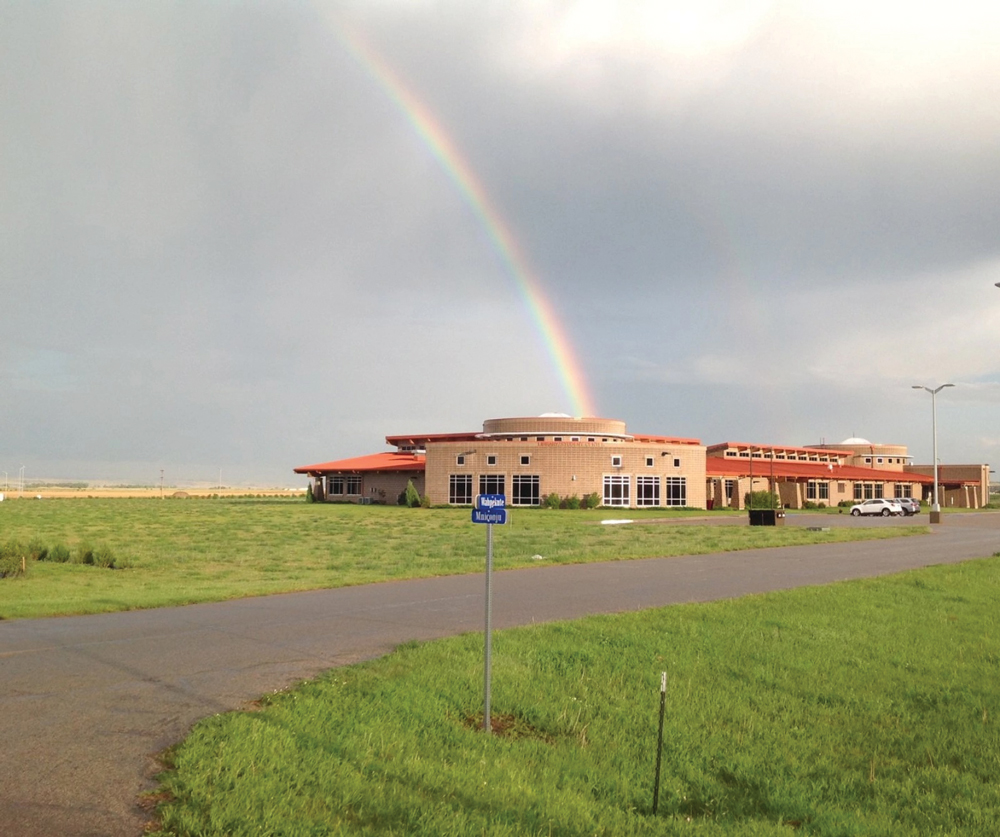
Sitting Bull College in Fort Yates (pictured) is one of five tribal college that makes up the North Dakota Tribal College System and operates under the guidance of the Ochethi Sakowin culture. The college offers master’s degrees in environmental science, teaching and business administration as well as eight bachelor’s degree programs and 16 associates and certificate programs in the arts and humanities, construction technology, math and education and social and behavioral sciences.
Image courtesy of the NDTCS
UND is also home to the Energy & Environmental Research Center (EERC) in Grand Forks, an R&D facility, and North Dakota’s State Energy Research Center (SERC) since 2019. The EERC, which sits on over 15 acres of UND’s campus and encompasses over 250,000 sq. ft. of lab space, fabrication and technology demonstration facilities, and offices, has funded 79 projects since its inception and is home to the Energy Hawks summer internship program. The Energy Hawks program has shepherded students from all levels and fields of study in higher education through the state’s energy landscape via immersive field experience and research projects in coal-based energy, petroleum operations and wind farms, as well as visits with regulatory bodies and lawmakers working with broader energy policy.
The SERC also has several projects and partnerships under its belt, with $33 million in awarded R&D to date and $24 million in pending awards, mostly from the U.S. federal government. Two strategic initiatives have been launched under the SERC: “Enhance Energy Resilience for North Dakota’s Military Installations” and “Critical and Novel Materials for North Dakota’s Energy Growth.”
Commercialization of SERC technologies has been developing, with 11 U.S. patent applications submitted and six U.S. patents received to date.
Overall, the higher education system in North Dakota works to connect students with real-world jobs and careers while also boosting the workforce pool for the state’s commercial and industrial sectors.
“North Dakota’s higher education ecosystem stands out because of its deep connection to the state’s people and industries,” says North Dakota University System Commissioner Brent Sanford. “Our universities combine world‑class research with a practical, hands‑on approach that prepares students to lead in energy, agriculture, technology and beyond.
“What makes North Dakota unique,” Sanford says, “is our ability to innovate without losing sight of community, and that spirit is reflected in every campus and in every student across our state.”