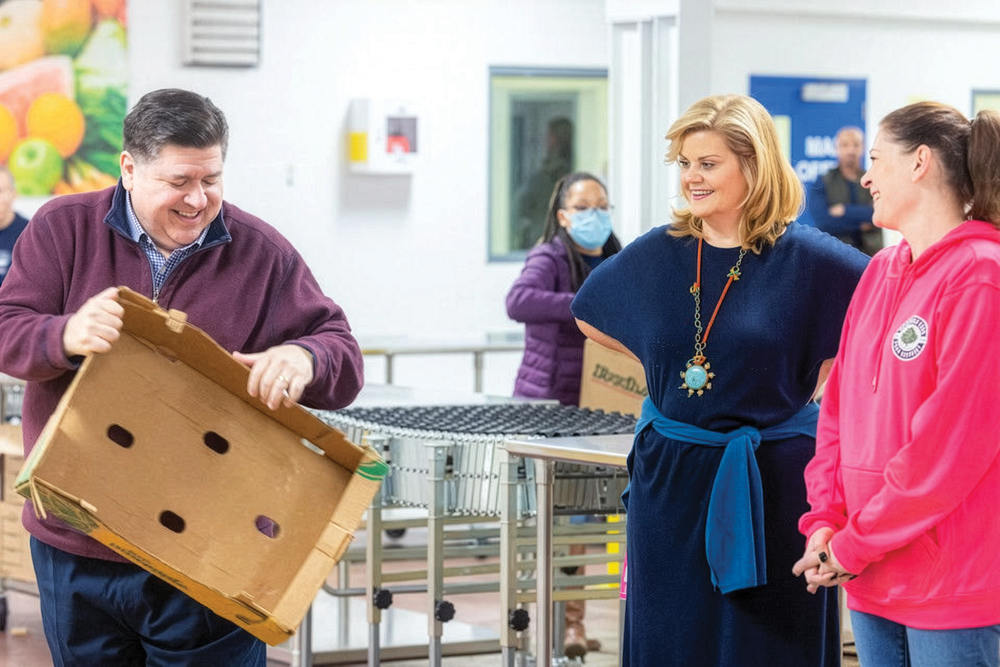
Gov. Pritzker shows America how to build a globally competitive state.
When Zero Point Cryogenics announced on July 22 that it would establish its first U.S. location at the Illinois Quantum and Microelectronics Park (IQMP) on Chicago’s South Side, the news reinforced exactly how much the Illinois economy has changed since Gov. JB Pritzker took office on January 14, 2019.
This is not your grandfather’s Illinois anymore. Rather, it is a state that leads from the front of the pack in technology, quantum computing, life sciences, advanced manufacturing and other forms of knowledge-based capital investment.
“Illinois is building the world’s leading quantum ecosystem by bringing together the companies, researchers, manufacturers and suppliers needed to turn breakthrough discoveries into real-world technologies,” Gov. Pritzker said at the announcement. “Zero Point Cryogenics’ decision to establish its first U.S. location at the Illinois Quantum and Microelectronics Park is another example of that strategy delivering results. Their investment strengthens the supply chain that supports quantum innovation, creates high-quality jobs, and reinforces Illinois’ position as the global capital of quantum technology.”
With support from the State’s Manufacturing Illinois Chips for Real Opportunity Act (MICRO) Program, ZPC will establish its first U.S. location at the IQMP, co-locating its U.S. research and development, sales and service operations. Additionally, as a supplier of cryogenic hardware, ZPC will support the needs of companies locating at or collaborating with the IQMP, strengthening the park’s growing quantum ecosystem.
In the following interview, we catch up with Gov. Pritzker to learn more about the changing nature of the Illinois economy and how his administration is preparing to lead America into the next decade of high-tech progress.
With 680 corporate facility investment projects last year, Illinois placed second in the nation but easily outdistanced all other states in total project performance. Illinois, in fact, has finished second or third in the country every year since 2020. What factors enable your state to consistently perform at this elite level in economic development?
GOV. JB PRITZKER: It starts with the fundamentals. Illinois has one of the best workforces in the country, unmatched transportation infrastructure, world-class universities and a location that gives companies access to markets across the nation and around the world.
But we’ve also been very intentional about building on those strengths alongside our economic development partners. We’ve made our incentives more competitive, invested in getting sites ready for development and expanded workforce programs so companies know they’ll have the talent they need to grow here.
And we approach economic development as a team. My administration’s Department of Commerce and Economic Opportunity (DCEO) and Illinois Economic Development Corporation (Illinois EDC), as well as our local and regional partners, work together to make the case for Illinois, both here at home and through our international trade missions. That coordination has helped us consistently compete for and win major investments in every part of the state.
A lot of people credit Greater Chicago for this effort, but Illinois actually performs very competitively in every region. How did you build a network of economic development leadership statewide?
GOV. PRITZKER: Chicago is obviously a tremendous economic engine, but Illinois’ economic strength extends across the entire state. We have a deep manufacturing base in communities large and small, one of the nation’s strongest agriculture and food-processing sectors, and regional economies built around industries like logistics, life sciences and advanced manufacturing.
Our approach is to build on the strengths that already exist in each region. Through the team at Illinois EDC and DCEO’s Regional Economic Development Team, we work directly with local economic development organizations, utilities, colleges and universities, community leaders and businesses. Those partners understand their local workforce, industries and opportunities better than anyone.
Team Illinois brings those partners together so companies see a unified state ready to help them find the right site, connect with workers and suppliers, and navigate available incentives. Whether it’s a manufacturer expanding in Central Illinois or an agriculture-related business investing downstate, our goal is to make it as easy as possible for companies to invest, hire and grow in Illinois.
You have been a big backer of EV production and alternative energy projects. How is that sector growing in Illinois today?
GOV. PRITZKER: I’ve always believed that the transition to clean energy is not only an environmental necessity; it’s also a generational economic opportunity. And you can see that opportunity taking shape in communities across Illinois.
Bloomington-Normal is a great example. Rivian’s continued investment and its new supplier park are helping turn the region into a major center for electric-vehicle manufacturing. Companies like OPmobility are locating nearby to serve Rivian, bringing additional investment and jobs to the region. That creates an entire economic ecosystem around the plant, supporting suppliers, workers and local businesses.
“The biggest misconception is that Illinois is still the state it was a decade ago — fiscally unstable and unable to compete for major business investment. That story may have been grounded in real challenges, but it no longer reflects where Illinois is today. We’ve balanced eight consecutive budgets, earned 10 credit upgrades, eliminated the bill backlog and rebuilt our Rainy Day Fund.”
— Gov. JB Pritzker
But this growth extends well beyond one company or one community. Wieland is making a $500 million investment in advanced copper manufacturing in East Alton, supporting a material that is essential to electric vehicles and renewable-energy infrastructure. Pure Lithium is investing $46 million to establish battery manufacturing operations in Chicago. And in Decatur, TCCI is developing an electric-vehicle innovation center and workforce training academy.
That is exactly what we envisioned when we worked with the General Assembly to create REV Illinois. We aren’t simply trying to land individual projects. We’re building the full clean-energy supply chain here — from vehicle assembly and batteries to critical materials, component manufacturers and workforce training.
Illinois has the skilled workers, manufacturing heritage and infrastructure to lead this industry. These investments show that clean-energy manufacturing is already becoming an economic engine for communities across our state, and we intend to keep building on that momentum.
What were the most impactful pieces of economic development legislation that you managed to push through and sign into law this year?
GOV. PRITZKER: Our eighth consecutive balanced budget was probably the most impactful. Responsible budgeting gives businesses confidence that Illinois is stable, reliable and prepared for the future. Companies making long-term investments want certainty, and our balanced budgets, improved fiscal position and 10 credit upgrades demonstrate that Illinois is a dependable partner.
When companies are deciding where to locate or expand, they need confidence that they’ll be able to find qualified workers. That’s why we’re continuing to invest in workforce development programs that prepare Illinoisans for in-demand jobs, including Area Career Centers, Manufacturing Training Academies and Illinois Works. These programs provide hands-on training, connect employers with skilled workers and create pathways into apprenticeships and good-paying careers.
We’re also building on years of investment in site readiness. Last year’s budget included a historic $500 million commitment, and this year we’re investing another $100 million through Site Ready Illinois. When companies are deciding where to build, they need sites with the necessary infrastructure, utilities and transportation access, and they often need them quickly. These investments allow communities to prepare sites in advance so Illinois can compete for large-scale domestic and international projects.
Taken together, we’re giving businesses greater certainty, building the skilled workforce they need and ensuring communities across Illinois are ready to capitalize on the next major investment opportunity.
Governors in other states often chirp about how they recruit Illinois companies to relocate to their states. Yet Illinois still maintains a very strong roster of Fortune 500 headquarters and other major operations. What keeps your state’s competitive position so strong?
GOV. PRITZKER: Governors are always going to compete, and I don’t blame them. I see one of my most important roles as serving as the chief marketing officer for Illinois, and I’m constantly making the case for why businesses should invest, expand and create jobs here.
The truth is that Illinois offers a combination that is difficult to match: a highly skilled workforce, world-class universities, modern infrastructure and one of the best transportation networks in the country. Companies can reach their customers, find the talent they need and build for the long term here.
Our incentive programs are an important tool, and so far in 2026 they have helped attract more than $2.5 billion in private investment from global companies. But those projects represent only one piece of Illinois’ broader economic momentum. Many businesses choose to locate, expand and hire here without receiving state incentives because the fundamentals make Illinois the right place for them.
We’re proud of our progress, but we’re not taking it for granted. I’m going to keep telling Illinois’ story and competing for every company, every investment and every job.
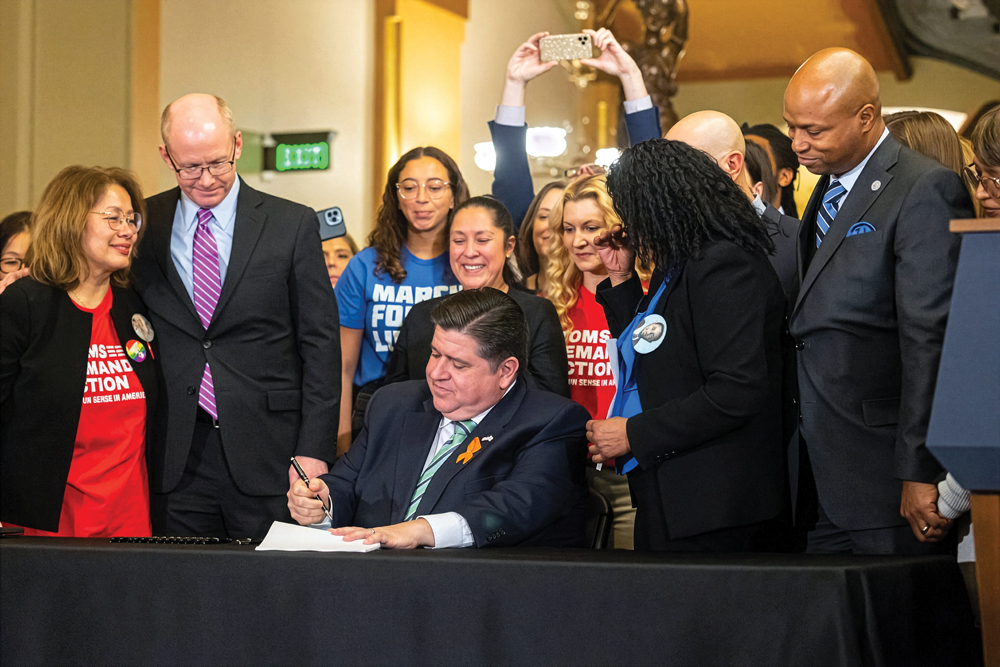
Gov. Pritzker in 2023 signed a bill banning assault weapons in Illinois.
Photo courtesy of the Governor’s Office of Illinois
What is the biggest misconception that some people have about Illinois?
GOV. PRITZKER: The biggest misconception is that Illinois is still the state it was a decade ago — fiscally unstable and unable to compete for major business investment. That story may have been grounded in real challenges, but it no longer reflects where Illinois is today.
We’ve balanced eight consecutive budgets, earned 10 credit upgrades, eliminated the bill backlog and rebuilt our Rainy Day Fund. We still have work ahead of us, particularly when it comes to our long-term pension obligations, but we have made enormous progress and restored stability and predictability to state government.
Businesses are recognizing that change. Illinois consistently ranks among the top states for corporate investment projects, and companies continue to locate, expand and create jobs here. The Illinois of today is fiscally stronger, economically competitive and investing in the workforce and infrastructure businesses need to succeed.
My job is to make sure people understand how far we’ve come — and that they take a fresh look at everything Illinois has to offer.
Many people believe that access to water and energy will be the great differentiator for states in the coming years. How is Illinois positioned to be a national leader in these two critical resources?
GOV. PRITZKER: Illinois is exceptionally well positioned because we have both abundant freshwater resources and a large, diverse energy portfolio.
On water, we border three major rivers and Lake Michigan, and we have significant groundwater reserves. Illinois is part of a region containing roughly one-fifth of the world’s surface freshwater. At a time when many parts of the country are facing water scarcity, that gives our communities and businesses an important long-term advantage — and a responsibility to protect and manage those resources wisely.
On energy, Illinois is already one of the nation’s largest electricity producers and generates more nuclear power than any other state. We also have rapidly growing wind and solar industries and regularly produce more electricity than we consume.
But we know demand is increasing, so we took action to bring more energy resources onto the grid while protecting affordability and reliability. The Clean and Reliable Grid Affordability Act builds on the Climate and Equitable Jobs Act by accelerating energy storage, expanding energy-efficiency programs and improving long-term planning for our power needs. It puts Illinois on a path to add three gigawatts of storage by 2030, allowing us to store energy when it is abundant and deploy it when demand is highest.
We also lifted the moratorium on the construction of large nuclear reactors, opening the door to new nuclear development as we continue expanding renewable generation. Together, these actions will help Illinois meet growing demand from families and businesses while maintaining our clean-energy goals.