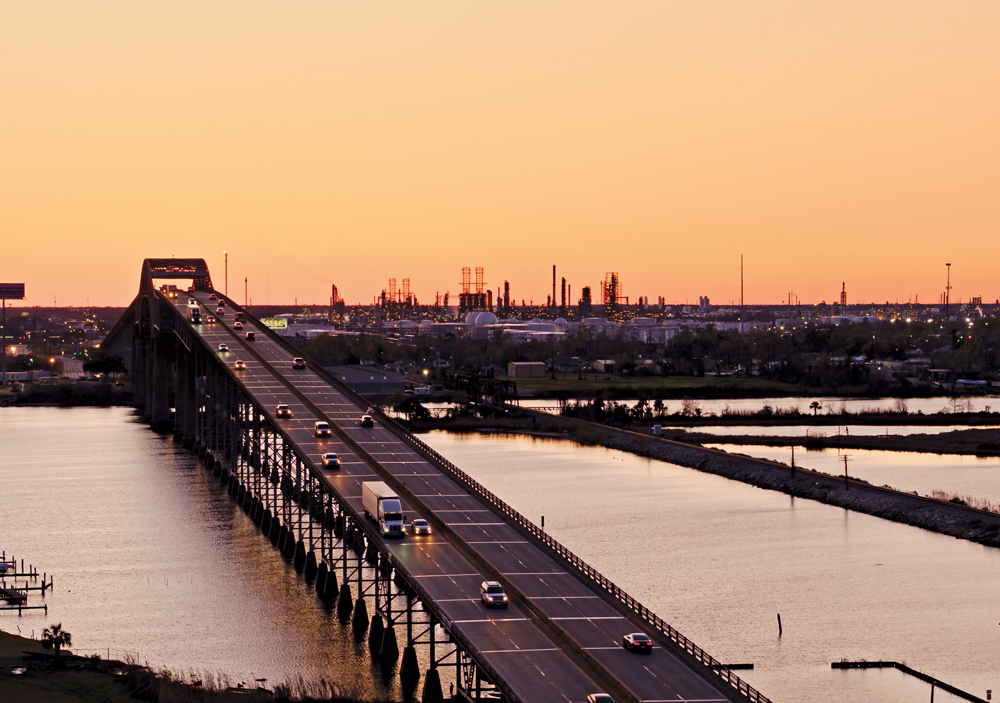
Louisiana’s investment portfolio deepens from parish to parish.
Louisiana has welcomed a windfall of tech economy this year, including Amazon’s $12 billion commitment to new data center campuses in Caddo and Bossier Parishes, the first for the company in the state.
Another first is landing in Rapides Parish in central Louisiana, where Dallas-based technology company Applied Digital announced in May it will locate a $3.6 billion AI factory to be named Delta Forge 1. In an exclusive interview, Applied Digital CEO and Chairman Wes Cummins explained why the company chose Rapides Parish for its first venture into Louisiana and the southern United States.
Checking Every Box
Applied Digital considers several things when scouting new locations for its next campus. The company’s top two criteria during the site selection process? Power and fiber availability, in that order. The third criterion? If the company’s presence is wanted.
“This location had all three of those boxes checked for us,” says Cummins about the Rapides Parish project. “We were able to work a customer into that site, and we are excited to build it.”
Applied Digital has three campuses already in North Dakota: Polaris Forge 1 in Ellendale, Polaris Forge 2 in Harwood and another site in Jamestown. The day after I spoke with Cummins about Delta Forge 1, Applied Digital announced a $5.2 billion deal to partner with a yet-to-be-named hyperscaler in a yet-to-be-named location somewhere else in the South. The data center, which will be the fifth for the company overall, will take on the title of Delta Forge 2.
“We think that strip — Louisiana, Mississippi and Alabama — is really attractive right now,” Cummins says when asked if the company is considering other sites in Louisiana and neighboring states. “It has fiber connectivity that typically runs from Atlanta to Dallas. The states really seem to want all the benefits that data center development brings to their areas and communities. It seems to be a really good setup there, and so we are looking at additional locations.”
Founded five years ago, Applied Digital designs, builds and operates high-performing, sustainably engineered data centers and colocation services for AI and cloud computing. Delta Forge 1 will have the same build as its predecessors — that means a closed-loop cooling design that uses very little water. The way Applied Digital’s data centers are designed is informed by where they are located — in rural areas where excess power is eagerly sold off and water is highly prized.
Cummins, who grew up on an Idaho farm, tells me he knew “going into farming communities, you cannot use water. Water is the precious resource that you cannot use. That’s why our facilities were originally designed the way they were, but it has a broader benefit and broader impact than the fact that the farming communities won’t let us use water. I’m glad we were forced into that early in the life cycle of the company so that we had to design that way.”
The sustainability component is key to Applied Digital’s business approach to geographic diversification, which means targeting large campus builds in small rural communities. Further, when it comes to site selection decision-making, the less competition, the better. The company specifically avoids building in areas already dealing with data center saturation (think western Texas and northern Virginia), instead choosing places where Applied Digital does not have to compete as fiercely for labor.
Notably, the company’s usage of excess power at its Polaris Forge 1 site in Ellendale, North Dakota, has saved ratepayers there over $38 million in the last four years. AI cloud computing company CoreWeave currently leases at the Ellendale site. In Louisiana, ratepayers will not be asked to shoulder any additional costs of data center infrastructure needed for the 430-MW Delta Forge 1 site, which will instead be paid for by Applied Digital. Cummins also cites the state’s Lightning Speed Initiative as being helpful to the company’s Louisiana expansion. The program, announced last year, ensures projects move at the speed of business.
“This location had all three of those boxes checked for us. We were able to work a customer into that site, and we are excited to build it.”
— Wes Cummins, CEO and Chairman, Applied Digital, on the company’s new $3.6 billion AI factory campus in Central Louisiana
“Companies also want certainty,” Louisiana Economic Development Chief Business Development Officer Paige Carter says. “They need to know the site can work, the infrastructure can support the project and the state can help move issues forward. That is where Louisiana has changed the way we compete. Through Louisiana Lightning Speed and our Whole-of-Louisiana approach, we are bringing the right partners to the table earlier so companies get clearer answers and a more direct path from evaluation to investment to operations.”
Operations at the Delta Forge 1 site are expected to start in mid-2027 and will support over 400 new job opportunities in Central Louisiana.
“We are super excited about a new state — about another place that really wants all of these benefits,” adds Cummins at the end of our call. “The great thing that we have is our site at Ellendale that has been running there and consuming electricity for over four years now, and we see all the benefits for these small communities. We are proving now all these community benefits that we talk about. We get to take that into another community that wants us in another state that is excited to have us, and we are excited to be there.”
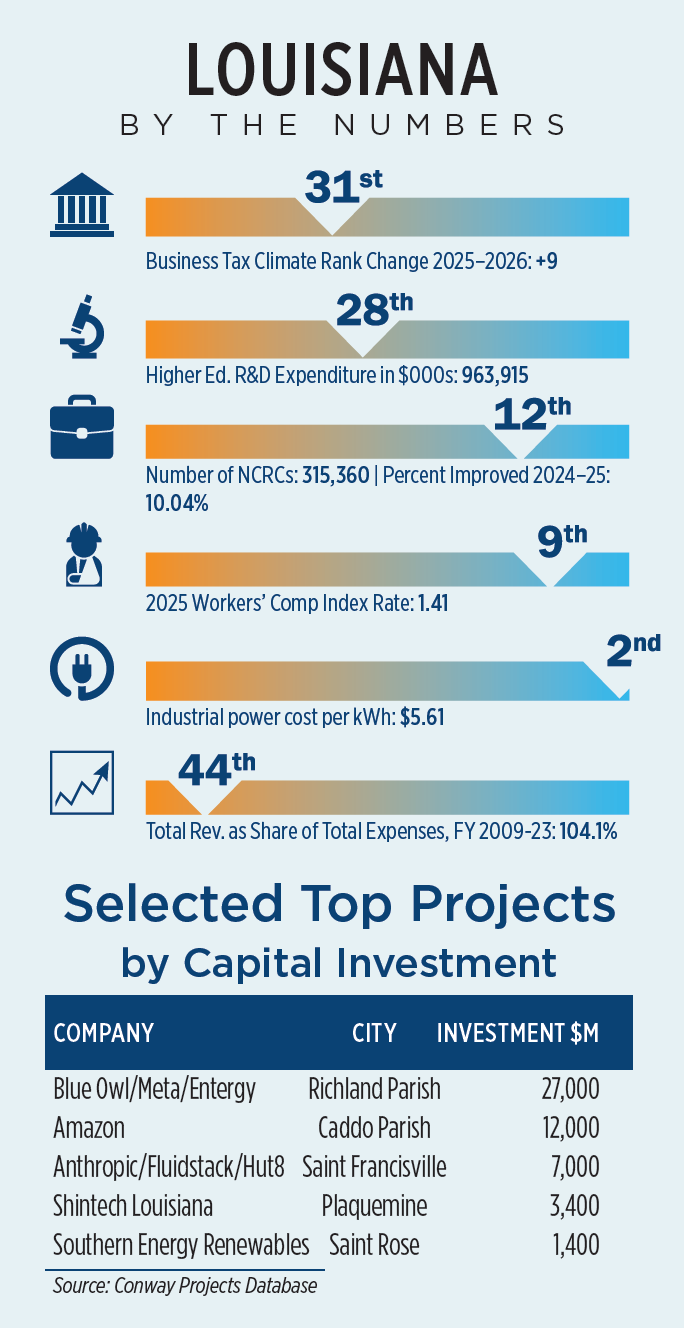
Other major tech investments in Louisiana include Meta’s Hyperion data center in Richland Parish, located in the northeastern part of the state. It is, to date, the largest data center project Meta has under its belt. The scale of Meta’s Richland project is nearly mythic, with an estimated build cost of $10 billion to $27 billion by most reports and a footprint covering 4 million sq. ft.
Since January 2024, Louisiana has had $107 billion announced in capital investment projects. The state placed No. 8 in Site Selection’s 2026 Prosperity Cup Rankings overall and No. 2 in the South Central regional ranking, behind only Texas.
Carter tells Site Selection that the impact of these major tech investments does not stop at the facility, and these projects are already reaching Louisiana business directly. She says that “in its first year, Meta’s Richland Parish project generated more than $875 million in contracts with 160 Louisiana companies. That is the outcome we want to see: major investment coming into Louisiana and more Louisiana businesses and workers taking part in what it creates.”
Fluidstack and Hut8 will also be building Anthropic’s $7 billion data center campus in Feliciana Parish, which was announced in late 2025. Anthropic signed a 15-year lease for the 245-MW River Bend site in the southeastern part of the state, which will also see development support from Google.
Built for Energy Production
The expansion of LNG in Louisiana is critical for the U.S. energy supply chain, especially given the ongoing Iran War fuel crisis impacting the cost, supply and movement of LNG globally.
Meanwhile, Louisiana is experiencing a rapid boom in LNG project wins, with multibillion-dollar LNG operations currently underway or expanding in Calcasieu and Cameron Parishes. More than 60% of U.S. LNG exports move through Louisiana, which exports more LNG than every other state combined, explains Carter.
“Louisiana is built for LNG,” she says. “It is one of the clearest examples of where our natural resources, infrastructure, workforce and access to global markets come together in a way few, if any, states can match. With abundant natural gas supply, direct Gulf of America access, major ports and one of the most extensive pipeline systems in the country, Louisiana offers companies the foundation they need to operate and grow at scale.”
Venture Global, a company based in Arlington, Virginia, that builds LNG infrastructure, announced in March 2026 it would start the second phase of its CP2 LNG project in Cameron, Louisiana, an expansion that will cost $8.6 billion. The project, which is the third LNG site in Louisiana from the company that has an overall price tag of $28 billion so far, will be located on a 1,150-acre site adjacent to Venture Global’s Calcasieu Pass LNG facility in Cameron Parish. The natural gas pipeline to be built for this project will originate in Jasper County, Texas, connecting through Newton County in Texas and Louisiana’s Calcasieu Parish before concluding at the CP2 LNG terminal in Cameron Parish.
Venture Global is also planning to double capacity of its Plaquemines LNG facility, which is undergoing construction 20 miles south of New Orleans on the Mississippi River. The 630-acre site is expected to have an export capacity of 20 million metric tons annually. The company expects to start fulfilling long-term contracts in late 2026 at Plaquemines, with operations to be fully underway in mid-2027.
More than 60% of U.S. LNG exports move through Louisiana, which exports more LNG than every other state combined.
Carter notes that the local workforce is one of the strongest competitive advantages for Louisiana, given its generational energy and industrial experience that give LNG companies the ability to draw from workers who understand complex operations, safety, logistics and large-scale construction. The LNG Center of Excellence at McNeese State University in Lake Charles, a 23,000-sq.-ft. building that opened in April 2026, will be a hub for LNG-focused education and workforce training as well as a place for industry stakeholders to meet and collaborate.
Australian company Woodside Energy is also developing a $17.5 billion LNG export terminal in Calcasieu Parish near Lake Charles, which is set to be the largest foreign direct investment in Louisiana’s history. The facility is targeting a 2029 start date for producing natural gas.
GREATER NEW ORLEANS, INC.’S
MATT WOLFE TALKS LNG
Site Selection: What are the factors that make New Orleans attractive to LNG investors?
Matt Wolfe: A few factors converge here that you don’t find many other places. You have deep-water port access, proximity to the Gulf, and one of the most extensive pipeline networks in the world to move product safely and efficiently to export terminals. Add in a skilled industrial workforce that has decades of experience and a regulatory environment that Louisiana has worked hard to make competitive, now you’re looking at a region that can move a project from concept to export faster and more effectively than almost anywhere else in the world. The Greater New Orleans region sits at the center of all of that.
Matt Wolfe, Chief Marketing Officer, Greater New Orleans, Inc.
How important is Port NOLA for Louisiana’s LNG industry?
Matt Wolfe: Port NOLA is part of a broader port system that makes Louisiana the top energy export state in the country. Louisiana’s ports together carry 20% of U.S. waterborne commerce, and that infrastructure backbone — the waterways, the ship channels, the intermodal connections — is what makes LNG export viable at scale. The LNG terminals themselves sit along dedicated ship channels in southwest Louisiana and Plaquemines Parish, but they depend on the same statewide logistics network that Port NOLA is a part of. You can’t separate one from the other.
How is the Venture Global Plaquemines LNG facility project coming along?
Matt Wolfe: Plaquemines LNG is one of the most significant energy infrastructure projects on Earth. Venture Global has been moving through commissioning and has already begun exporting LNG, which is a major milestone for the region. The facility’s modular design was a deliberate choice to accelerate the build timeline, and it’s proving itself to be a significant advantage in delivering on speed-to-market. For Southeast Louisiana, this is a multi-billion-dollar investment that’s creating thousands of jobs and cementing the region’s role as the global LNG export hub.
What does the workforce for the LNG field look like in the New Orleans area?
Matt Wolfe: Louisiana has a deep bench of petrochemical and industrial workers, people with the exact skills LNG facilities need. These are technicians like pipefitters, instrument technicians, process operators and engineers. The next step for growth is ensuring that remains the case. The pipeline of projects coming online is creating real demand, and we’re working with partners at community colleges, the building trades and workforce development programs to grow that pipeline of talent. The workforce is there, and now the task at hand is making sure supply keeps pace with demand.
Do you have any local incentive programs that are proving to be successful in attracting LNG companies or helping them expand?
Matt Wolfe: Louisiana has some of the most competitive industrial incentives in the country, and they stack in ways that bring real impact to large capital projects. The Industrial Tax Exemption Program reduces property taxes on new manufacturing investment, which moves the needle on project economics that can be costly. Louisiana Economic Development’s High Impact Jobs program provides payroll rebates for companies that create well-paying jobs and offer benefits, which for an LNG facility means hiring hundreds of workers at strong wages — costs that add up fast. And FastStart is arguably Louisiana’s most recognized workforce incentive: The state designs and delivers customized training programs at no cost to the company, which for a technical field like LNG operations is a genuine differentiator.
At the regional level, GNO, Inc. works with companies on site selection support and connects them to the right state and local resources from the start. The pitch to an LNG investor isn’t just tax incentives in isolation. It’s a full suite of infrastructure, workforce and market integration in a region that knows how to execute on projects at this scale. That combination is what closes deals.
The government of South Korea recently announced that it would build an LNG export terminal in Louisiana as its first U.S. investment in this industry. How important is foreign direct investment to your local economy?
Matt Wolfe: Foreign direct investment signals something important: The world sees Louisiana as a reliable, competitive place to put capital. South Korea choosing Louisiana for their first U.S. LNG terminal isn’t an accident. It reflects the local infrastructure, workforce and frankly, a track record of delivering on these projects. For the region, FDI like this translates directly into construction jobs, permanent operations jobs and long-term economic activity. It also tends to be a leading indicator of future deals because when one major international player moves in, others pay attention.
Can you walk me through some of the efforts being made to mitigate the negative environmental impact of LNG development in southern Louisiana?
Matt Wolfe: This is a real conversation the industry and our region are having. LNG, when compared to coal or oil, burns cleaner, and that’s an established fact. But we take the broader environmental picture in coastal Louisiana very seriously. Projects in our region are subject to federal environmental review, and the state has increasingly tied permitting and incentive eligibility to environmental performance standards. Longer term, the energy transition work we’re doing through initiatives like Louisiana Future Energy is about making sure the region captures the economic benefits of the energy sector while moving toward lower-emission technologies. That growth goes hand in hand with playing a critical, but also environmentally sound, role in the global energy supply chain. — Kelly Barraza