This summer, the UN Conference on Trade and Development (UNCTAD) released its latest World Investment Report, which showed that foreign direct investment (FDI) in Latin American countries increased by 14% in 2025 even as greenfield projects saw a decline in the region. One thought leader working in this space says the reason for caution in committing capital in these markets comes down to investment becoming more selective overall.
“The fact that there is growth means that Latin America is still an attractive market,” says Raimundo Diaz, executive vice president, Americas at Vistra, a global provider of corporate services. “Investors are just being more selective, and that is impacting everything that is greenfield. What they’re doing is developing on the basis of what is there already, which is not a bad thing. It would be bad if there were fewer greenfield projects and less money invested in the region. The fact that there’s more is a sign of confidence in the market.”
Leveraging Manufacturing Capacity
Diaz notes that Mexico’s economic bond to the U.S. is still a stable and strong one, even in the face of shifting political and macroeconomic sands. Data centers and AI infrastructure are finding footing in the country, helped by Mexico’s energy availability and pricing and less resistance to data center projects than what may be seen elsewhere.
“Mexico is a major focus of manufacturing fundamentally for the U.S. and Canada but also for other regions. With the break of the supply chain due to COVID, a lot of companies realized that it might be worth having some manufacturing capacity nearby,” says Diaz, adding that El Salvador, Honduras and Guatemala are places near the U.S. market that companies may also look at to reduce supply chain disruptions.
According to a report published by Latinometrics in June 2026 with data from the U.S. Bureau of Economic Analysis, the U.S. trades twice as much with Mexico as with China. About 83% of Mexico’s exports were shipped to the U.S. from 2024 to 2025.
“I don’t see today how you can untangle the supply chain that there is in the automotive sector,” observes Diaz. “The automotive sector treats Canada, the U.S. and Mexico as one market. The engines are built in Canada. The body might be built in the U.S., but a lot of the inputs are made in Mexico or vice versa. A lot of elements from the best-selling car in the U.S., the Ford F-150, are made in Mexico, and the biggest factory for the F-150 has traditionally been in Mexico.”
Diaz adds that “another area that we see a lot of activity in is industrial parks,” recalling that Mexico had recently seen $5.8 billion announced in investments in the industrial real estate sector. This tracks with what Diaz calls a “long-standing culture of manufacturing in the country. Mexico had maquilas for the U.S. for many years. There is a culture, and there is a huge workforce that is prepared for manufacturing. Alignment with the United States, a physical border with the United States, which is the largest market in the region, accounts for a lot.”
Another thing working in Mexico’s favor when it comes to securing investment wins? A relatively young population. After Brazil, Mexico is one of the main destinations for FDI in Latin America and has the second largest population in Latin America.
Brazil and Mexico are large and complex markets and the opportunity is enormous, Diaz observes. “If for your industry, Mexico is a good destination either because you want to build capacity there or you want it as a selling market, you should go,” he says, noting that the country’s more complicated approval process for projects compared to the U.S. should not be a deterrent to interested investors. “That should not be the driver of why you invest or do not invest in another country. That’s our job — to make the complexity of the region easier for you so that you can do your business.”
I asked Diaz about what he thought the impact of the United States-Mexico-Canada Agreement (USMCA) negotiations on the Mexican economy could look like. First, he told me he wished he had a crystal ball. Then he said, “What is happening right now is more negotiation tactics to improve the position of the U.S. I think the fundamentals are not going to change. What you might have are adjustments.”
Informed Decision-Making
Juan Carlos Posada, a business development advisor at Prodensa, a professional services and nearshoring company that assists manufacturing companies in conducting business in Mexico, notes that in years past, the number one concern for companies looking to locate in Mexico was finding the correct labor — general operators, technicians, engineers and the like. While labor is still a priority, attention is now more centered on electricity sustainability.
“The automotive sector treats Canada, the U.S. and Mexico as one market. The engines are built in Canada. The body might be built in the U.S., but a lot of the inputs are made in Mexico or vice versa.”
— Raimundo Diaz, Executive Vice President, Americas at Vistra
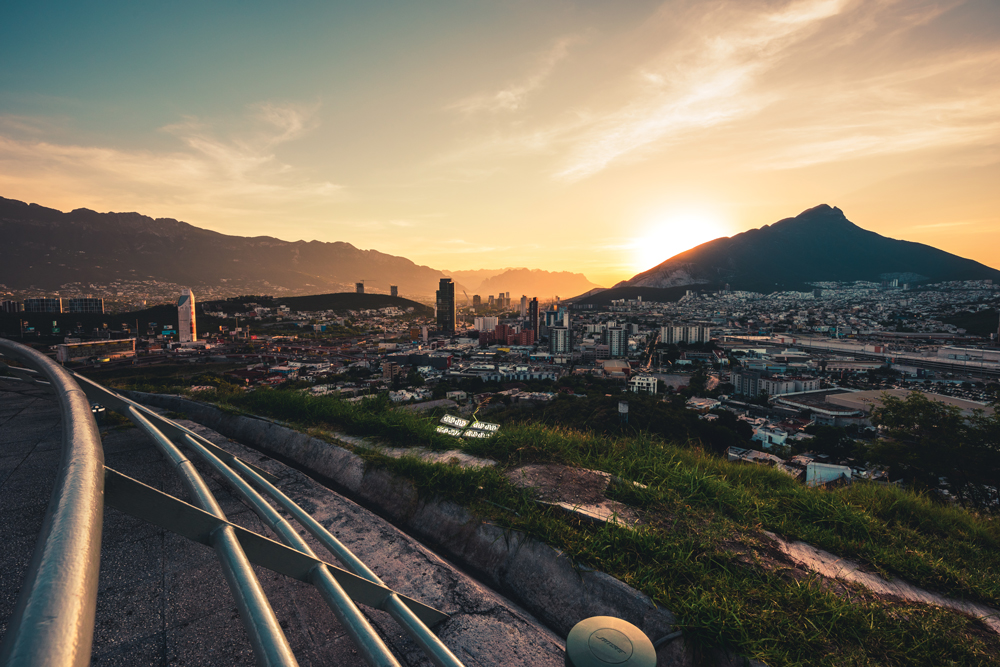
“We focus on labor, but we’re also focusing more on utilities like power, natural gas, telecommunications, road connectivity and logistics,” he says, noting that guidance is also shaped by the sector and region in which a company operates. Workforce availability still informs where foreign investors decide to put down roots. Posada points to the state of Nuevo Leon, and specifically the city of Monterrey, as a leading location due to its “mature industrial ecosystem.” He adds that “they have a highly skilled workforce. Some of the top universities in Mexico are there, and they graduate 30,000 engineers per year. It has close integration with the U.S. market. So, this is why Monterrey remains one of the most competitive manufacturing hubs in Latin America despite increasing labor costs.”
Coahuila, which borders Nuevo Leon to the northwest and Texas, has growing FDI due to its talent and utility availability, Posada says, adding that “it has a strong base of electricity, water and gas. The automotive industry has a good supplier base over there.” Another state raking in FDI is Baja California, which has sustained growth particularly in medical device manufacturing.
Mexico has been focusing on recruiting FDI since the mid-1980s, while focusing its university education and high school technician systems on meeting industrial and manufacturing labor market needs, says Posada. The electronics and semiconductor sectors have also seen a rise in popularity.
Read here on how FIFA World Cup infrastructure investments may lead Mexico to winning gold in economic development.