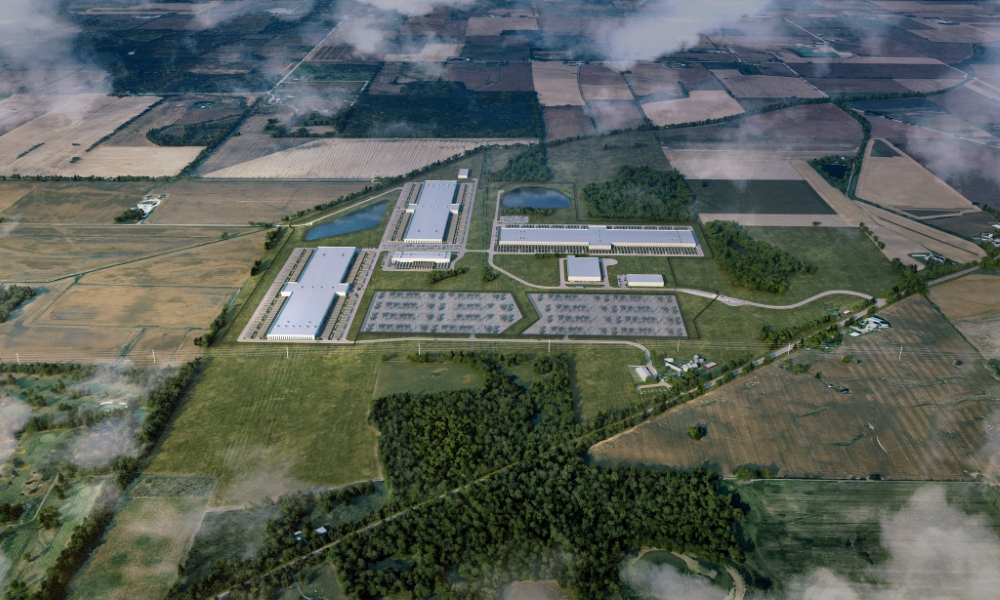
Michigan, which ranked No. 7 overall in Site Selection’s annual Prosperity Cup rankings in 2024 and No. 6 in CNBC’s America’s Top States for Business in 2025, is not only welcoming hyperscalers, but also building out infrastructure and creating jobs. One example of this is evident in Saline Township, southwest of Detroit, where a multibillion-dollar data center will be built as part of OpenAI’s Stargate project in partnership with Oracle and Related Digital.
“I’m grateful to these cutting-edge companies for betting on Michigan, building on our work to compete for and win big projects in next-generation industries from cars and clean energy to semiconductors and batteries,” said Michigan Governor Gretchen Whitmer on October 30 about the OpenAI Stargate facility. “We will continue working together at the state level to win more projects so we can create even more good-paying, local jobs for Michiganders and grow our economy.”
Data Goes Big Near Ann Arbor
The OpenAI/Stargate gigawatt campus in Saline Township, the largest economic development project in the state’s history, could also be considered the crown jewel of Michigan’s growing data center portfolio. New state sales and use tax legislation, which received bipartisan state legislature support in 2024 and gubernatorial approval in December of that year, has helped herald a new wave of interest in data center buildout in the state.
Asked if other sites were considered for the project, Related Digital CEO Brent Behrman notes that the companies “explored sites across Michigan before deciding on this site, which is ideal as it’s a contiguous flat area, set 30 feet down from Michigan Avenue and back from proximate residential buildings. The project can be served directly by the 345-kV transmission lines that run through the site, and it’s in close proximity to a strong labor force.”
The local workforce will stand to benefit from Stargate, which is expected to create 2,500 construction jobs, 450 permanent positions and an additional 2,000 permanent county-wide jobs. The LEED-certified data center will stand on 250 acres, with the remaining acreage of the area preserved as open space, farmland, wetlands and woodlands. No additional capacity is planned for this site.
Behrman explains that the data center will use a closed-loop air cooling system, common for an industry that has been questioned about sustainability practices.
“We do not use water-intensive, evaporative cooling technology that uses millions of gallons of water a day,” says Behrman. “Because of this, the project requires nominal water use, primarily for restrooms for site employees, humidity and landscaping, which will be served by two onsite wells. DTE Energy is supplying 100% of the power to the project using existing resources augmented by a new battery storage investment — financed entirely by the project — in a way that ensures there is no impact on DTE’s existing customers’ energy supply or rates. In fact, DTE’s customers will benefit from the project contributing its share to the fixed costs of maintaining and improving the grid.”
The closed loop water system will also not require any additional water from the Great Lakes.
The Saline Township project is part of OpenAI and Oracle’s previously announced partnership to deliver 4.5 gigawatts of additional Stargate capacity, notes Behrman. Stargate has plans to invest up to $500 billion in AI infrastructure in the U.S. by 2029. The venture will contribute to keeping the U.S. competitive in the global AI race.
“This is a fast moving and competitive industry,” Behrman adds.
The data center comes with benefits to the local community, including $1.6 million in annual tax revenue through 2039 and $8 million annually to local school systems, which should aid in reducing property taxes for Saline Township homeowners.
Related Digital also agreed to many requests from the Saline Township Board when Stargate project talks were held. The direct community benefits comprise $8 million for fire services, $4 million for a Farmland Preservation Trust and $2 million to establish a Community Investment Fund.
Revving Up the Future
Innovation is also marking the legacy automotive sector in Michigan, where Ford, LG and others are making huge investments in electric vehicle manufacturing and research.
BlueOval Battery Park Michigan, owned by Ford and to be run by the company’s subsidiary BlueOval, will begin producing lithium iron phosphate (LFP) batteries at the 500-acre Marshall site in 2026 for future Ford EVs. The site is expected to create approximately 1,700 jobs and will also likely benefit from the advanced manufacturing production tax credit under the U.S. Inflation Reduction Act.w
“BlueOval Battery Park Michigan will play an important role in our plan to help make electric vehicles more accessible and affordable by producing low-cost LFP batteries in the U.S. and not relying on imports,” said Lisa Drake, Ford vice president of electric vehicle programs and energy supply chain, in a company press release. “We continue to make great progress establishing America’s first automaker-backed LFP battery plant right here in Michigan.”
The road to automotive excellence is not always smooth. In late 2024, GM announced it would sell its stake in a $2.6 billion Ultium battery cell plant near Lansing to partner LG Energy Solution, exiting the collaborative project completely in a stunning turn that left the facility’s future in limbo. Lucky for Ultium, Toyota rerouted a large battery order (to the tune of $1.5 billion) in early 2025 to the Delta Township plant, a vital save for the now-solo LG asset. The batteries produced at this site are compatible with both electric and hybrid vehicles.
Asked how Michigan is building its mobility and automotive industries, Michigan Economic Development Corporation CEO Quentin L. Messer, Jr. says, “We continue to retain existing companies throughout the mobility and automotive supply chain while competing to secure investment from newer entrants whose interests in the automotive sector are more than a traditional OEM.”
Future-forward entrepreneurial spirit is also welcome in the state, which boasts a research & development tax credit for qualifying businesses that went into effect in January 2025. Virginia-based autonomous-driving software company Torc Robotics, owned by German commercial vehicle manufacturer Daimler Truck, announced in June that it would establish a 32,000-sq.-ft. engineering center in northeast Ann Arbor that will supply a wide swath of engineering roles in machine learning, software, hardware and systems engineering as well as jobs in product engineering, safety and other areas.

“Michigan has always welcomed big, bold ideas, risk-takers and dreamers and of course, doers, who are as passionate as we are about doing something significant, and doing it in Michigan.”
— Quentin L. Messer, Jr., Michigan Economic Development Corporation CEO
“This strategic location is a natural fit for Torc as we continue to advance our autonomous technology,” said Jamie Swaim, Torc’s chief people officer, in a release. “Ann Arbor’s proximity to the Detroit automotive industry and a wealth of high-tech talent, combined with the exceptional concentration of high-caliber universities and colleges, makes it an ideal environment for our growth and productization strategy. This new center will complement the strong engineering talent we already have across the nation.”
Torc is pursuing a commercialization strategy to get a new line of its self-driving trucks on American roads in 2027. In the first half of 2025, company operations were phased out in Albuquerque, New Mexico, and Stuttgart, Germany, in a pivot toward expansions in Michigan and Texas.
All of this activity will be well-served by the Michigan Innovation Fund (MIF), signed into law a year ago. Passed with bipartisan support, the $60 million bundle is designed to fuel existing early-stage and emerging evergreen venture funds in the state as well as startups, founders and others who contribute to the entrepreneurial ecosystem. July saw the debut of the first batch of MIF winners, with $52.8 million awarded to eight recipients that included ID Ventures, Ann Arbor SPARK, University of Michigan Accelerate Blue Fund, MSU Research Foundation, Western Michigan University Biosciences Research & Commercialization Center, InvestUP, 20Fathoms and Grand Valley Research Corporation. The remaining $7.2 million in the 2025 MIF allotment was used for entrepreneurial support programs and a pitch competition.
“Michigan has always welcomed big, bold ideas, risk-takers and dreamers,” says Messer, Jr., “and of course, doers, who are as passionate as we are about doing something significant, and doing it in Michigan.”