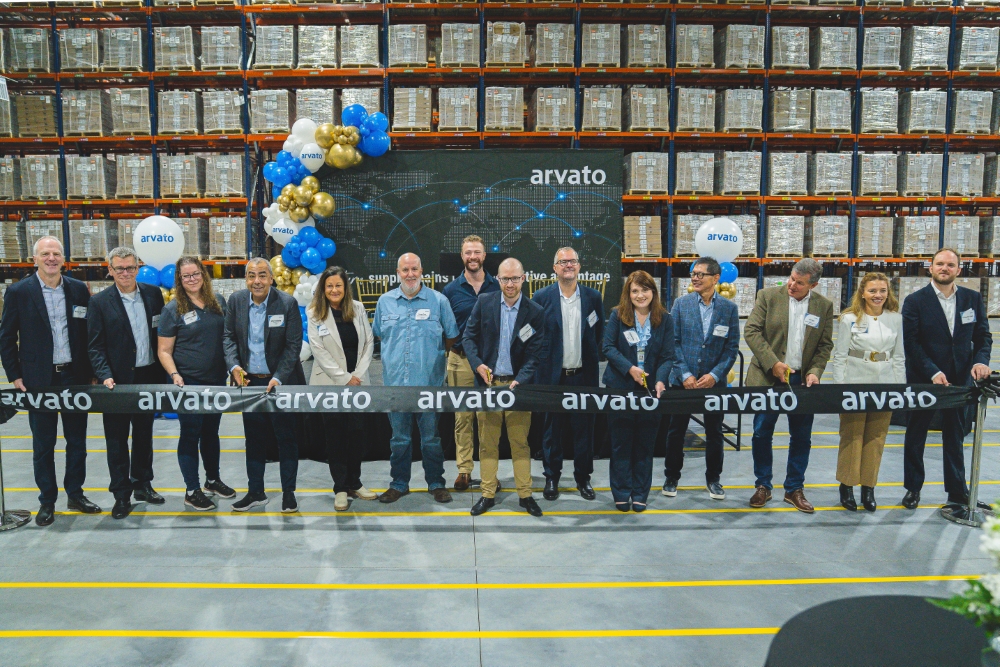
If your logistics company manages more than 9 million sq. ft. across the entire United States and more than 4 million are in one market, there must be something special about that place.
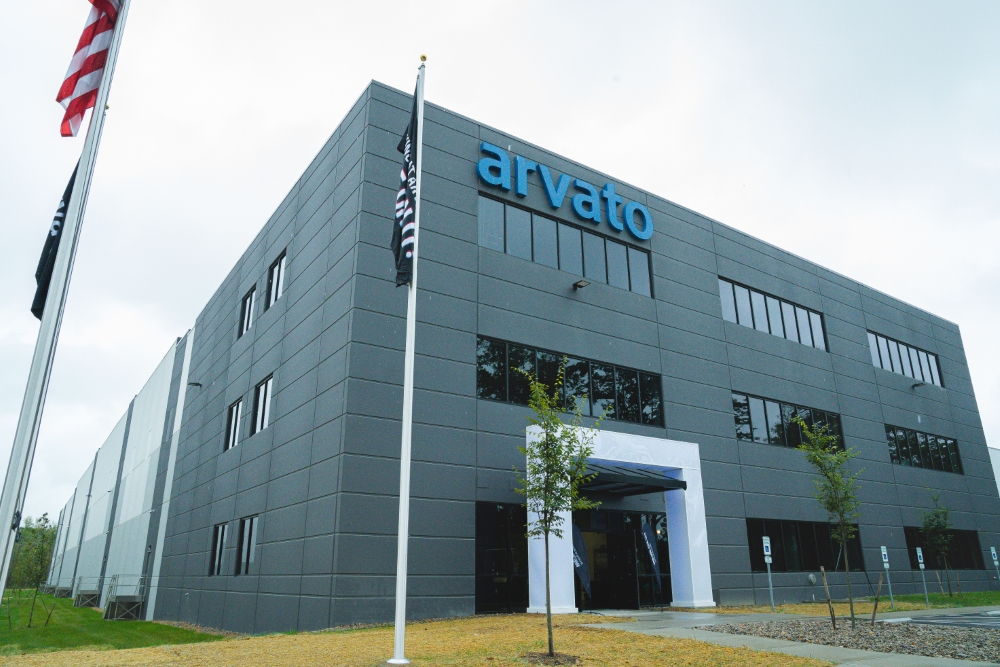
That’s the case for global 3PL (third-party logistics) service provider Arvato, which in early October opened its seventh location in the Louisville, Kentucky, region, a 400,000-sq.-ft. facility expected to create around 150 jobs. The company has been active in the market for 21 years.
“Our newest facility is especially significant because it represents a new level of commitment to the region,” says Andreas Podwojewski, managing director, North America and Brazil for Arvato. “For the first time in Louisville, we have invested in and developed a facility that we own rather than lease. That decision reflects our confidence in the market, our belief in the long-term attractiveness of the location and our intention to continue growing in Kentucky for many years to come.”
The confidence appears to be contagious.
For the fourth year in a row, the bi-state Greater Louisville region leads the way among all the metros and micropolitan areas along the Ohio River for project-based economic development performance. (The area tied for No. 1 with the Cincinnati region in 2022.)
Each year Site Selection ranks the Top 10 metros and micropolitan areas along the entire 981 miles of the Ohio River corridor. The rankings are determined by an index based on points awarded across cumulative and per-capita categories for corporate end-user facility project tallies and project-affiliated capex and job creation numbers from March 2025 through mid-August 2026 in the Conway Projects Database. Projects qualify for the database if they involve new construction and meet one of these three criteria: at least $1 million invested, at least 20 new jobs or at least 20,000 new sq. ft. of space.
With 71 projects, Greater Louisville nearly matches the 72 projects it tallied last year. With six projects, Paducah, Kentucky-Illinois, doubles its number to take second place, followed by the tri-state region of Greater Cincinnati in third with 106 projects, a slight bump up from the 100 projects counted last year.
The biggest upward move in the rankings comes from Evansville, Indiana, whose total project count went from eight to 15. No. 5 Pittsburgh saw a healthy rise in its numbers too, from 44 to 55.
“Louisville’s recognition as the leading metro area along the Ohio River Corridor reinforces what we have believed for many years,” says Podwojewski. “This region is one of the most attractive logistics locations in North America. Its combination of transportation connectivity, access to major consumer markets, a highly experienced logistics workforce and a strong business environment continues to make Louisville a strategic cornerstone of our U.S. network.”
Having Louisville International Airport and interstate highways nearby helps. Freight-related and freight-supported industries account for more than 43% of the region’s gross domestic product and 35% of its employment, according to the Kentuckiana Regional Planning and Development Agency. But Podwojewski attributes the company’s commitment to more than mere infrastructure.
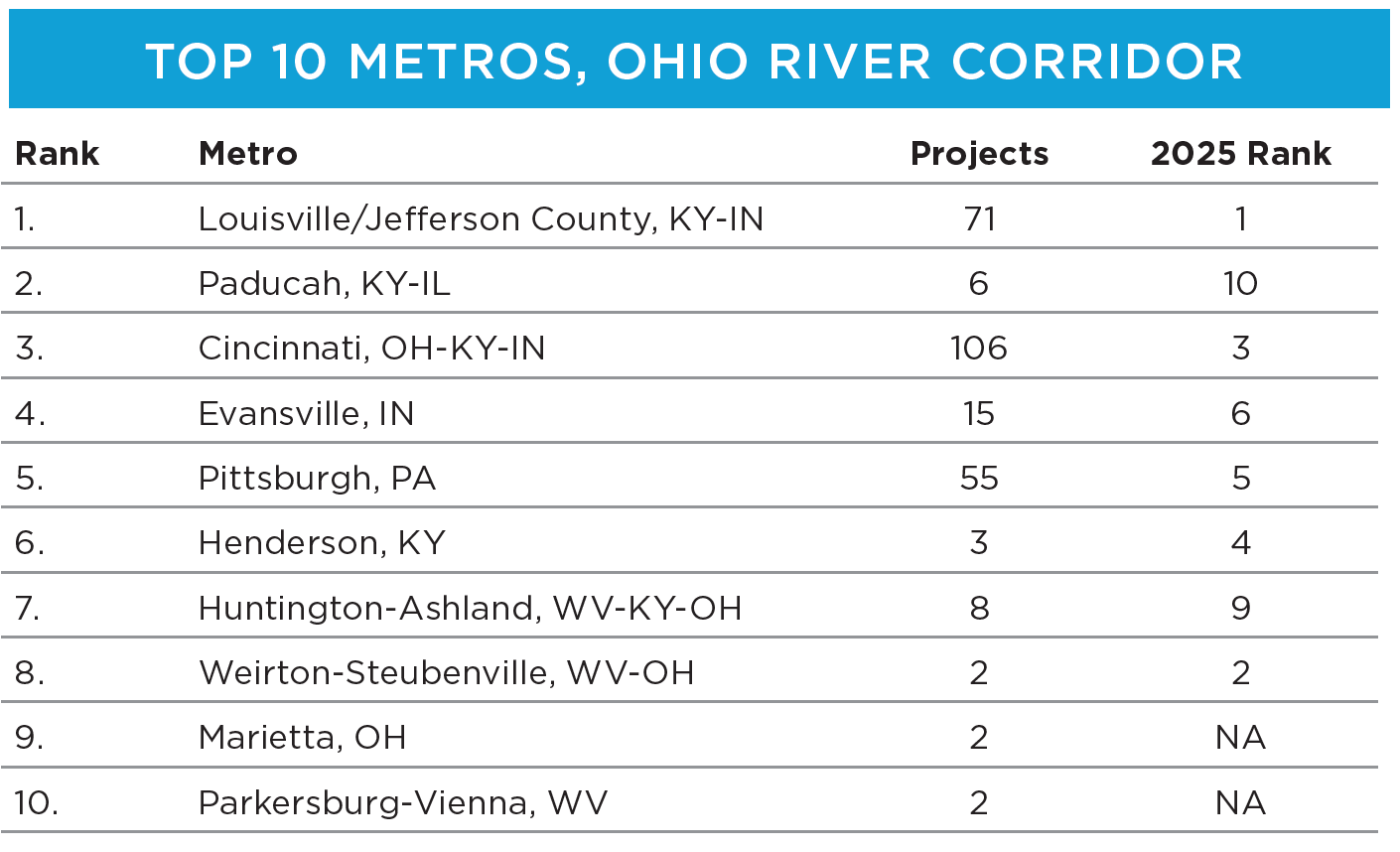
Source: Conway Projects Database, March 2025 – August 2026
“During more than 20 years in the region, we have built strong relationships with local suppliers, business partners, educational institutions and public-sector stakeholders,” he says. “Those relationships have helped us grow successfully and created an environment where we can continue to invest with confidence. We have always found Louisville and the Commonwealth of Kentucky to be highly supportive of business growth and innovation, which has been an important factor in our long-term expansion. Our experience also shows that Louisville works exceptionally well for our clients. As our clients have expanded their businesses, we have repeatedly been able to add capacity, talent and capabilities in the region to support their growth.”
For Arvato, Podwojewski says, “Louisville is much more than a logistics hub. It is a market where we have built strong teams, trusted partnerships and a foundation for sustainable growth. We believe in Louisville’s future, and we’re looking forward to be part of it.”
One Louisville … and Beyond
Stakeholders in Louisville’s future have engaged over the years with a number of different economic development organizations with overlapping — and sometimes competitive — territories, whether it was city, county or adjoining parts of the metro area across the river in Indiana.
In March 2026, One Louisville, a new organization representing 10 Louisville-area counties in Kentucky, officially formed as the “front door” for economic development in the metro region. The organization merges the Louisville Economic Development Alliance (LEDA, formed a few years ago) with Greater Louisville Inc. (GLI) and is led by former LEDA CEO Trevor Pawl. Louisville Mayor Craig Greenberg serves on its board of directors.
“We announced record economic investment in 2025, with businesses big and small, close to home and around the world, choosing Louisville as their home to grow, innovate and create good, stable jobs,” Mayor Greenberg said in One Louisville’s formation announcement. “Today’s announcement will unify our efforts, strengthen our ability to compete on a global stage and deliver even more opportunity for our community.”
One Louisville is structured around the four core pillars of economic development; talent attraction and retention; member services; and advocacy.
One Louisville Chief Economic Development Officer Joshua McKee says the organization, led by a 65-member board of directors representing employers, non-profits and higher education, among others, has hit the ground running, including talent attraction and retention. “We are taking a harder look at more intentional talent attraction activities and initiatives that align with our target sectors,” McKee says, “and how we go out and proactively build those pipelines with our university and K-through-12 partners.”
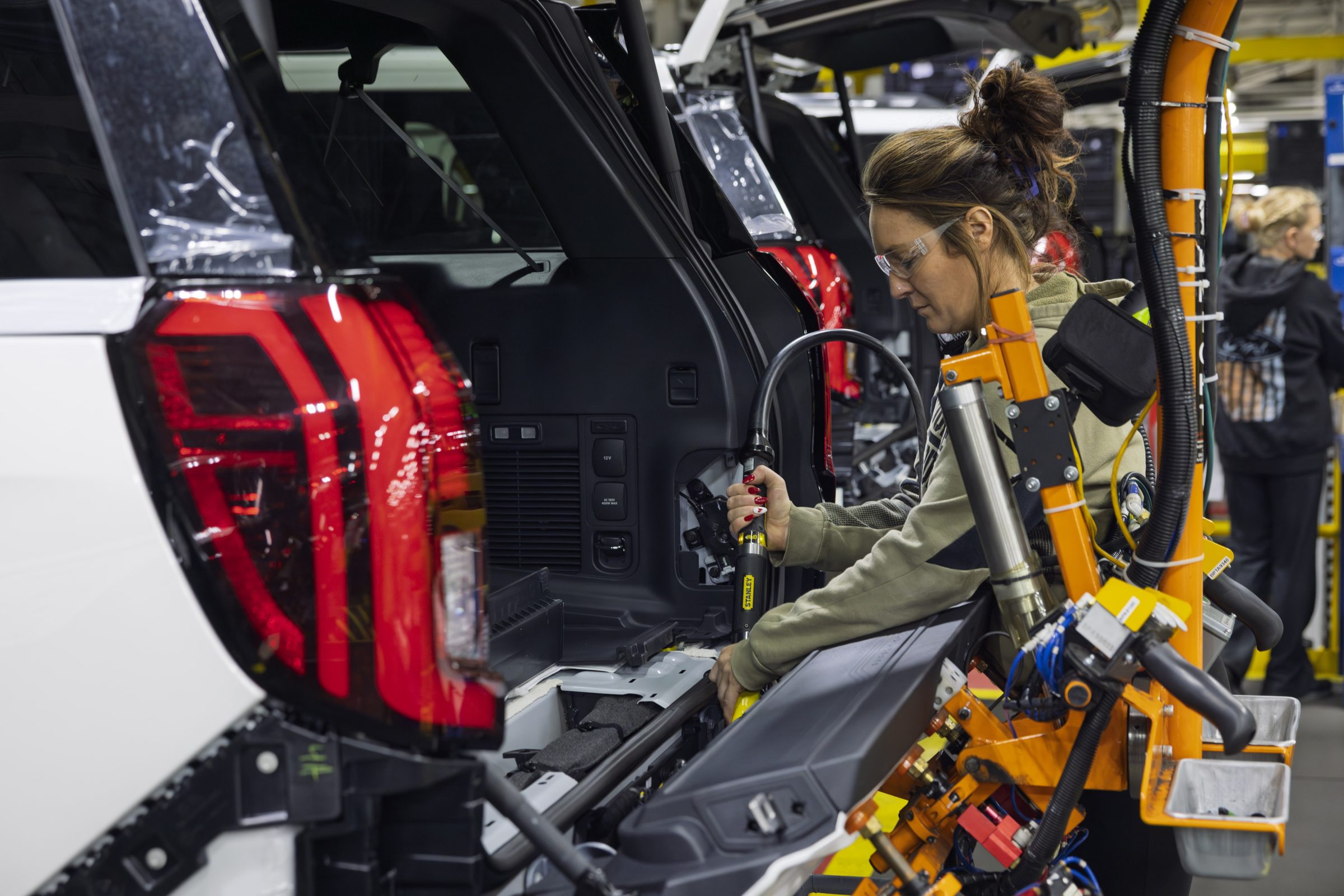
Ford Motor Co. has followed up a $2.2 billion investment announcement in 2025 at Louisville Assembly Plant with an additional $1 billion commitment to its Kentucky Truck Plant. The company employs over 11,000 people at its overall Kentucky operations, including Ford Energy Systems in Glendale (just down I-65 from Louisville), which will manufacture battery energy storage systems and has received a $2 billion investment.
Photo courtesy of Ford Motor Co.
On the advocacy front, McKee says the One Louisville team is focused on how to cultivate more opportunities for people to re-engage with the workforce. They also are paying attention to certain regulatory hurdles impacting healthcare firms, and to how incentive programs might be modified or created to help support growing tech and office-based firms in addition to the support already provided for manufacturing and production. Meanwhile, “the state is extremely focused on bringing down the state income tax,” he says. “So how do we help create new incentive tools and programs that better align with the state policies from that perspective?”
When Site Selection evaluates the region, the entire official CBSA is examined, which includes thriving activity on the Indiana side of the river. Asked why the new organization does not include them, McKee says, “We don’t do the economic development activities in southern Indiana, but we do have an MOA with them [One Southern Indiana]. So we partner with them very closely on larger advocacy-related issues that impact both states and the region, and any type of federal infrastructure programs that we might want to target. As part of our agreement, we try to limit river hopping and playing both sides off of one another. I think everybody pretty much gets that, from a regional perspective, you might live in one community but work in another, but at the same time, that money is still staying within the region. What is good for one side of the river is good for the other.
“We have a really good, strong relationship with them,” he continues. “We actually just hosted our first joint event as an organization back in August, and there were about 200 or so business leaders that registered to attend that event to hear from the CEOs of both organizations, to understand their vision and what that means for us working together collaboratively on various initiatives. As part of that, we are also tracking toward the first regional economic development plan more broadly for the region.”
Communicating about regional successes and assets more intentionally is also on the docket, including the annual familiarization tour the organizations have already been collaborating on for a number of years. “We bring anywhere from seven to 10 site selection consultants plus their guests in for Bourbon & Beyond, which is the world’s largest bourbon, food and music festival,” he says. Year after year, he says, his team hears from participants saying “it’s so refreshing and amazing to see a bi-state region collaborating in such an intentional way.”
Joint programming is always an option too. “We are talking about establishing a state of the region address, where both sides of the river would come together and talk about and celebrate the successes and the wins of the organizations and across the region,” says McKee, who himself lives in southern Indiana. “That way we can portray a really united front more broadly.”
Thinking big extends to the larger region as well — what used to be referred to as the “golden triangle” of Louisville, Lexington and Cincinnati, including the thriving communities in northern Kentucky. “We all recognize we have our own strengths and we’re better when we speak together,” McKee says.
Employers Vote With Their Feet and Their Dollars
The region’s project roll call includes major commitments from two Louisville stalwarts: Ford Motor Co. and GE Appliances, a Haier Company. In 2025, among 41 projects representing more than 2,700 new jobs and $3 billion in direct investment across 15 regional counties were Ford’s $2.2 billion investment to retool its Louisville Assembly Plant and GE Appliances’ $490 million investment to create the world’s most advanced laundry manufacturing line at its global headquarters in Louisville Appliance Park, reshoring production from China and creating 800 new jobs.
Both companies doubled down this year. In September, GE Appliances and union IUE-CWA announced a further $1 billion commitment, including a $400 million investment that will bring production from Mexico to Kentucky. GE Appliances employs more than 8,000 people full-time at Appliance Park (where it launched operations in 1953) and a nearby call center. Ford announced it will invest $1 billion of its own in a new paint shop at Kentucky Truck Plant. Ford employs more than 11,500 people at its Kentucky operations, including Ford Energy Systems in Glendale (just down I-65 from Louisville), which will manufacture battery energy storage systems and has received a $2 billion investment.
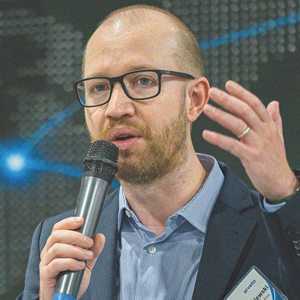
“Louisville is much more than a logistics hub. It is a market where we have built strong teams, trusted partnerships and a foundation for sustainable growth.”
— Andreas Podwojewski, Managing Director, North America and Brazil, Arvato
GE is not the only appliance manufacturer with Chinese ties to expand in the area. Midea America has quadrupled its footprint to 127,000 sq. ft. with a $36 million investment in its U.S. R&D facility, creating 110 jobs in coming years.
McKee says the growth from Ford and its suppliers is huge, but it’s not all that’s happening in the automotive space. Slate Auto is developing a sub-$30,000 electric pickup truck that is highly customizable. The company is investing $7.8 million in a national vinyl-wrap kit manufacturing and fulfillment facility in Louisville that’s slated to create 51 jobs.
End-of-runway operations taking advantage of UPS Worldport continue apace, including new spec wet lab space developed by UPS that is attracting rapid diagnostics firms such as Zoetis, HealthTrackRx and pharmacy services firm MedVantX, which in September cut the ribbon on a nearly $27 million, 122-job high-capacity distribution center. “Medvantx’s growth is a direct result of One Louisville’s work to target industries where our region’s strengths give us a real edge, and life sciences is a prime example,” said One Louisville CEO Trevor Pawl. “Companies in this space need serious logistics power, and few places can match what Louisville has with UPS Worldport and UPS Healthcare Labport.”
McKee says aerospace and defense are investing more in the area too, bolstered by the presence of organizations like the Manufacturing Extension Partnership and the U.S. Department of War Defense Innovation Unit’s new Defense Innovation OnRamp Hub, both based at the University of Louisville, which is evaluating opportunities for an innovation district on its campus.
In the city proper, Yum Brands is rejuvenating downtown Louisville with the relocation of its headquarters from the suburbs, moving 550 jobs and locating in the very same building as One Louisville.
“It’s been exciting to see the construction crews and the Yum team coming down and experiencing life in downtown, moving from a suburban office to a tower in the heart of the community,” McKee says.
Helping that heart beat are the people who live in the community as well as work there. Accordingly, there is work afoot from the Louisville Metro Government to pursue land development reform in order to encourage more housing development. “We are helping with that from the developer standpoint,” McKee says. “That is something that has been ongoing to try to narrow down the 900-plus-page document that is the land development code to a much more streamlined process. That will likely be a huge component of our work in the next several months, if not year, focusing on the business community’s involvement and perspective on development in the community.”