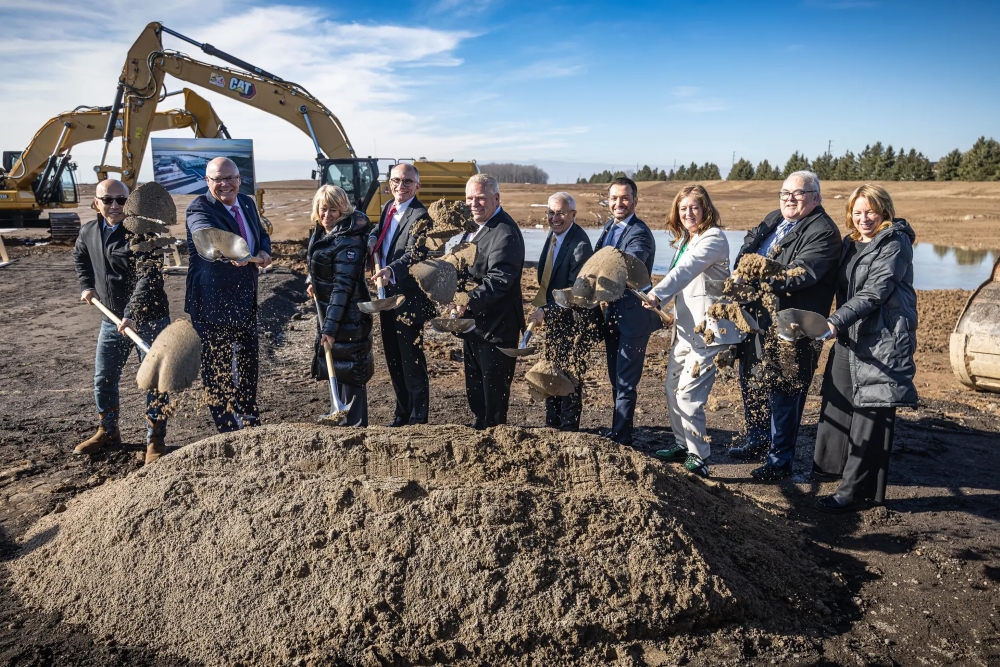
Multiplying projects show Ontario to be stable ground for investment.
“We are recognized as a safe bet,” says Invest Ontario’s CEO Khawar Nasim about the Canadian province. When asked what makes Ontario a great place investment, he tells me what he hears echoed back from business leaders — stability, predictability and talent.
“Talent drives so much in investment,” Nasim continues. “We have the best source of talent in tech. We’ve got things like Canada’s Express Entry, which gets highly skilled people working for companies and doing high-quality jobs. In a place like Ontario, 57% of working-age adults have a postsecondary degree. That’s the highest in the G7. And what it means is that when companies come in on tech, life sciences, manufacturing, robotics, AI — they have a talent pool, which is renewed on a consecutive basis. I also think that the predictability that we have in an otherwise relatively unpredictable environment is really appreciated.”
The numbers support the observation. From January 1, 2025, to December 31, 2025, 247 investment projects located in Ontario, according to the Conway Data Projects Database. Top performing sectors included machinery, equipment and construction (43), IT & communications (24), food & beverage (24), business & financial services (22), metals (20) and chemicals & plastics (20); Mississauga, Toronto, Brampton, Oakville, Windsor and Brantford led the pack for cities with highest number of projects.
All dollars in this story expressed in Canadian dollars. At press time C$1 = US$0.73

Mississauga, Toronto (pictured), Brampton, Oakville, Windsor and Brantford led the pack in 2025 for cities with highest number of investment projects,
according to Site Selection’s Conway Projects Database.
Photo courtesy of Destination Ontario/Ryan Lee
Stability Meets Talent
Nasim also credits the pro-business governance under Premier Doug Ford, steady corporate tax rates, a stable and predictive environment and strong energy infrastructure (about 90% of energy is clean in Ontario, with half powered by nuclear) for the strong investment showing in the province. Invest Ontario has attracted over C$12 billion (US$8.8 billion) in investment to the province since the inception of the agency in 2020. In Ontario overall, the overall amount of investment since 2018 totals in the hundreds of billions.
“In a rapidly shifting global landscape, investors view Canada as a trusted and predictable destination when making long‑term decisions,” says Laurel Broten, Invest in Canada’s CEO, about the Canadian business climate. “Canada stands out in North America and globally because it offers stability and certainty — qualities that give companies the confidence to plan, invest and scale without fear of sudden changes to the business environment. New federal measures — including expanded SR&ED incentives and the productivity super-deduction — lower the cost of capital and encourage productivity-enhancing investments. Clean economy supports facilitate investment, and the Major Projects Office provides a clearer path to approvals by helping coordinate federal processes and accelerate timelines. These strengths make Canada a reliable place to build and scale.”
On a provincial level, dollars are being set aside for major infrastructure work, paving the way for a business- and citizen-friendly climate. Ontario recently announced a $200 billion investment over the next decade in infrastructure projects that include hospitals, education, child care and long-term care, public transportation, highways, EV networks, and fast reliable internet.

“Across Canada, capital is flowing into tech, EV–battery, agrifood, clean energy and life sciences projects. Ontario is seeing strong momentum in the Greater Toronto Area’s tech and life sciences sectors, the Windsor–Essex EV–battery supply chain, Ottawa’s R&D cluster and Northern Ontario’s critical minerals.”
— Laurel Broten, Invest in Canada CEO
Mining in Ontario
While federal dollars have not been expressly earmarked for the mineral-rich Ring of Fire in northern Ontario (a 1,930-square-mile area marked by deposits of chromite, nickel, copper, platinum and palladium, gold, cobalt and zinc), the provincial government has noted that deals are being made to build roadways along the ring and bolster energy transmission, broadband infrastructure and telecommunications in the area. The minerals found in the Ring of Fire are critical in the manufacturing industries of EV, cleantech and everyday technology like mobile phones, computers and medical devices.
In St. Thomas, Ontario, located in southwestern Ontario near the Lake Erie shore, Norwegian company Vianode AS, which produces sustainable synthetic anode graphite, announced in late 2025 that it would spend $3.2 billion building its first large-scale North American synthetic graphite site there. Broten notes that “this multibillion-dollar commitment strengthens Canada’s EV and battery supply chain. Wins like this highlight the depth of our strengths — clean energy, strong infrastructure and the skilled workforce companies need to scale.”
The facility is expected to generate 300 jobs in its first phase, with the potential of up to 1,000 jobs when fully completed. Synthetic graphite is used in manufacturing, defense and energy, and the St. Thomas site would be key in securing a domestic supply chain of the material in Ontario and more broadly, Canada.
“St. Thomas brings together everything we were looking for: a clean energy grid, close proximity to major manufacturing hubs, a deep pool of skilled talent and world-class infrastructure,” Caroline Schmailzl, Vianode corporate development & communication vice president, tells Site Selection.
“We are finally ending the ripping and shipping of Canada’s vast resources by stepping up with a plan to build mines faster and expand domestic processing.”
— Stephen Lecce, Canadian Minister of Energy and Mines, on the launch of Ontario’s Critical Minerals Processing Fund in December 2025
In December 2025, Swedish multinational engineering and mineral processing company Sandvik broke ground on an $85 million processing facility and flagship center in Greater Sudbury, replacing the company’s longstanding site in nearby Lively. The site, supported by a $4 million provincial grant from the Invest Ontario Fund, will support the growth and modernization of its mining and rock solutions business in Canada, doubling existing workshop capacity and incorporating workshop areas, offices and welding facilities while adding 61 new jobs and retaining 400 jobs in the province. The Northern Ontario site will serve as a regional hub for equipment rebuilds, component repairs and field service operations.
The Ontario government is also doing the work to support the critical minerals industry, officially launching the Critical Minerals Processing Fund (CMPF) in December 2025, which sets aside $500 million to support projects accelerating critical minerals processing capacity in the province and strengthening domestic supply chains, supporting local Ontario workers and refiners in the industry.
“We are finally ending the ripping and shipping of Canada’s vast resources by stepping up with a plan to build mines faster and expand domestic processing,” said Canadian Minister of Energy and Mines Stephen Lecce when the CMPF was launched. “This is about protecting Ontario workers by ensuring ‘Made in Canada’ is stamped on the minerals we process, creating thousands of good-paying jobs right here at home. We will continue to lead the clean energy economy by unapologetically opening new markets for the most ethically sourced resources on Earth.”
One of the nation’s valuable resources is gold itself, with one new mine in particular benefiting from a new program aiming to streamline projects. In February, Lecce announced the Ontario government is accelerating Kinross Gold Corporation’s Great Bear Project under the “One Project, One Process” framework, the first gold mine and the third project overall to be accepted under the new framework launched in October 2025.
“As part of its plan to protect Ontario workers and communities, the government is unlocking the full potential of the province’s metals and mining sector through the new framework, with this project marking another key step in building a fully integrated and self-reliant mining supply chain,” a release from the Ontario provincial government explained. “The project represents a more than $5 billion capital investment and is expected to create 900 jobs during its operational life, with peak employment reaching 1,100 workers. Thousands of additional construction and indirect jobs will also be created during the build-out phase in 2027 to 2029, delivering new economic opportunities to the region.”
“At a time of global economic uncertainty, Ontario is choosing to build — to build faster, to build more at home, and to build Canada’s self-reliance,” said Lecce. “By fast-tracking Kinross Gold’s Great Bear Project, we’re getting shovels in the ground, proving that world-class projects can be built with speed and in partnership. Ontario’s accelerated permitting regime, reliable energy and skilled workforce is positioning our province as the world’s most attractive and predictable investment opportunity.”
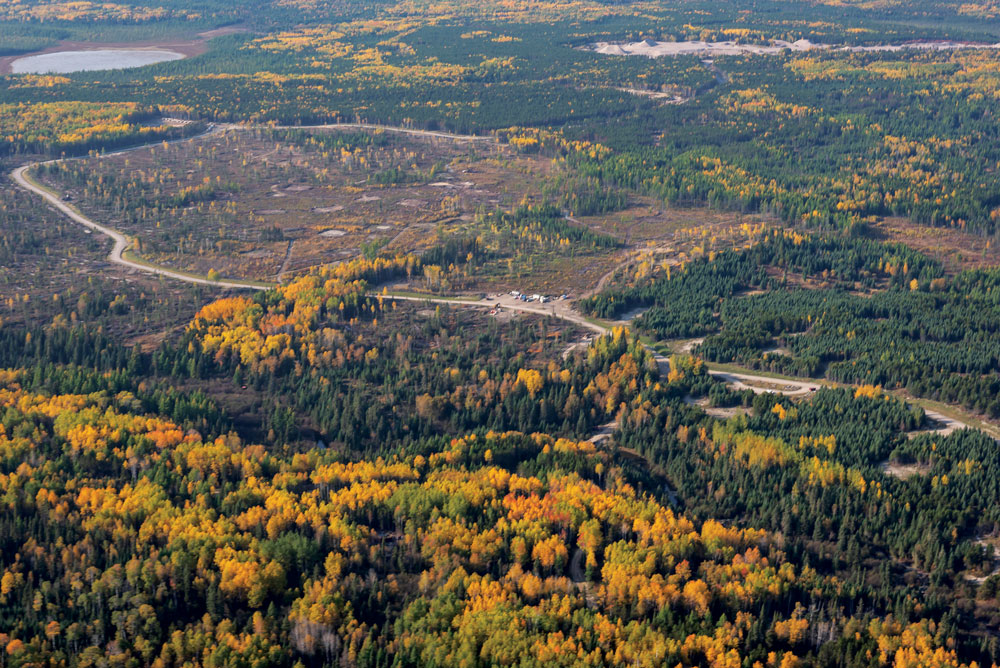
Golden fall leaves offer a hint of what Kinross aims to find at its $5 billion Great Bear gold mine in northwestern Ontario. Photo by Warren Zelman
Photography courtesy of Kinross
Located southeast of the longstanding mining town of Red Lake in northwestern Ontario, the Great Bear Project is a high-grade combined open-pit and underground mine with an initial mine life of 12 years. Kinross’ preliminary economic assessment outlines a high-grade operation producing an average of over 500,000 ounces of gold per year at its peak and a potential for 5.3 million ounces of initial production, with longer-term expansion potential supported by an ongoing regional exploration program.
“The ‘One Project, One Process’ designation marks an important milestone for the Great Bear Project and reflects Ontario’s leadership in creating the right conditions for responsible, long-term mining investment,” said J. Paul Rollinson, CEO of Kinross Gold. “For Kinross, this designation facilitates a more integrated and streamlined path forward as we advance the permitting of this world-class mine towards commercial production in consultation with Indigenous communities. Great Bear is a generational asset and positioned to become one of Canada’s largest and most profitable gold mines once operational.”
Growing Canada’s Food Supply
Broten says that “across Canada, capital is flowing into tech, EV–battery, agrifood, clean energy and life sciences projects. Ontario is seeing strong momentum in the Greater Toronto Area’s tech and life sciences sectors, the Windsor–Essex EV–battery supply chain, Ottawa’s R&D cluster and Northern Ontario’s critical minerals.”
Agrifood also is seeing continued development. Mississauga leads in food & beverage growth among Canadian provinces, home to over 128 food & beverage head offices — and the municipality will be host to another major project in the industry, led by multinational company Lee Li Holdings’s subsidiaries, First Choice Beverage Inc., Global Beverage and Logistics Centre.
The group of businesses announced a $533 million project at its Mississauga site in December 2025, which would constitute expanding an existing beverage manufacturing plant and a new facility, adding over 100,000 sq. ft. of new manufacturing capacity. The new product line there is expansive, including plastic bottle manufacturing for tea, coffee, sparkling water and flavored water products and a white-label line producing and bottling store-brand beverages made with local ingredients. The expanded site will continue to co-pack juice and dairy-alternative products.
In January 2026, the Canadian and Ontario governments announced $20 million in funding for the Market Diversification and Trade Resiliency Initiative, which will support local farmers, food processors and agribusinesses and their expansion into new and international markets; applications for funding opened on February 17, 2026.

A soybean field in Ontario, known for its deep roots in agribusiness.
Photo courtesy of Getty Images/Jun Zhang
“This investment will help our local farmers and agribusinesses sell more products grown in Ontario to markets around the world,” said Ontario Minister of Agriculture, Food and Agribusiness Trevor Jones when the fund was announced. “Our government is proud to support the farmers and businesses who drive our nearly $52 billion agrifood sector forward each and every day.”
“The government has put a priority on strengthening the critical mineral supply chain and agrifood,” observes Nasim. “All you have to do is look at the cost of living around the globe, and the importance of having a strong local supply of chicken and eggs and meat and dairy products. We’re seeing a lot of interest in agrifood, and we’re responding in kind. Those are great investments for us because they solidify our food supply chain.”
Eyes On the Future
The life sciences and tech continue to be top-performing sectors in Ontario. Broten notes that “the strengths of each region reinforce one another. Mining in the North. Finance, advanced technology and life sciences in the Greater Toronto Area. Cybersecurity and defense in Ottawa. EV and battery manufacturing in the southwest. Together, these strengths create an interconnected production ecosystem that lets companies raise capital, recruit talent and build at scale.”
In Hamilton, AtomVie Global Radiopharma will be spending $138 million on a new facility that will produce radiopharmaceuticals for targeted cancer therapies, increasing existing capacity by a factor of 10. AtomVie CEO Bruno Paquin said when the new project was announced: “We are proud to make this significant investment in Ontario’s life sciences ecosystem. … Ontario’s strong nuclear medicine infrastructure and growing radiopharmaceutical community make it the ideal home for this next phase of growth.”
The fields of tech and AI are also intensifying in Ontario — over 15,000 tech companies and 340,000 tech workers find their base there. The highly regarded Vector institute, along with the university system — including the AI expertise found at the University of Toronto — underlines the Ontario capital’s status as a major tech hub. (In Site Selection’s 2026 North American Tech Hub Index, Toronto ranked No. 18). The defense sector in Canada is also seeing interest, due to the government’s commitment to increasing defense spending as a percentage of the country’s GDP (5% by 2035). The country is on schedule to hit the NATO-directed target of 2% of GDP spent on defense by the end of the 2025-2026 fiscal year, increasing its spending in this sector by over $9 billion.

“The predictability that we have in an otherwise relatively unpredictable environment is really appreciated.”
— Khawar Nasim, CEO, Invest Ontario
“That’s a massive infusion of capital from the federal government,” Nasim explains. “What that means is that there’s going to be offset benefits, and the over 300 companies that we have already in the province are going to see increased investment as we procure submarines, fighter jets and frigates.”
Despite friction in trade deals and tariffs between the United States and Canada, the two countries’ economies are still unquestionably connected. When asked to describe the relationship between Canada and its southern neighbor, Broten replied: “Canadians and Americans share deep bonds of friendship, business and collaboration that stretch back decades. This moment has not changed that reality. Our supply chains remain closely integrated — particularly in autos, steel and advanced manufacturing — and American companies continue to invest, grow and succeed in Canada. At the same time, Canada is broadening its global partnerships and attracting investment from a more diverse range of international investors. That alignment of enduring U.S. ties and expanding worldwide reach is evident in third-party assessments: Canada ranks among the top two G20 countries for doing business over the next five years, and second globally on the 2025 Kearney FDI Confidence Index.”
As the U.S. Department of State’s own 2025 Investment Climate Statement on Canada relates, the United States invests in Canada more than any other country in the world, with a relationship supported by Canada’s strong economic fundamentals, proximity to the U.S. market, highly skilled workforce and abundant natural resources. Canada experienced its best year in foreign direct investment (FDI) in a decade in 2024 — to the tune of $85.5 billion.
In 2024, the province of Ontario received $39 billion in FDI from 409 companies, generating over 24,000 new jobs in the advanced manufacturing, life sciences, agrifood, and energy and mining industries.