
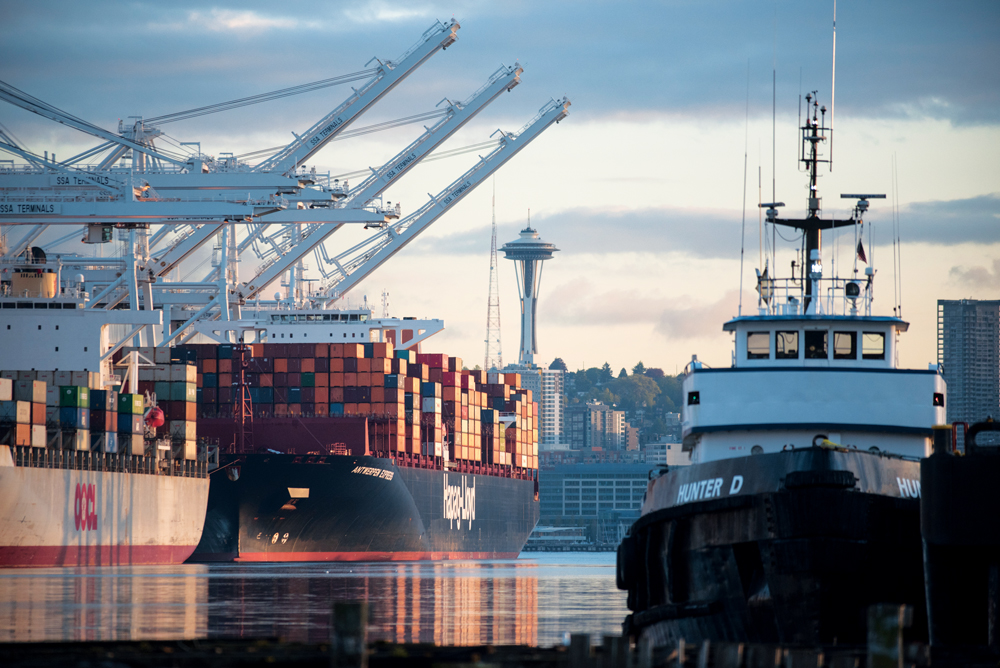
The Port of Seattle modernizes maritime infrastructure while protecting industrial opportunity.
by Savannah Yawn
On Seattle’s central waterfront, fishing vessels still tie up at the dock, crews unload their catch and maritime trades move among piers, uplands and warehouses. For over a century, it has been a working port that today remains embedded in the city’s economy and daily life. That distinction has guided how the Port of Seattle approaches growth, with an emphasis on maintaining maritime activity while modernizing the infrastructure and industrial space that support it.
While many urban ports have been pushed outward or reshaped by competing land uses, Seattle’s maritime core has remained intact. Fishermen’s Terminal, in continuous operation since 1914, has long served as the backbone of the Pacific Northwest fishing industry and a vital hub for the region’s maritime economy. Today, the Port is in the midst of a roughly $100 million investment program to update and improve the terminal.
That reinvestment strategy extends across the Port’s maritime footprint. At Terminal 91, the Port is advancing berth redevelopments and upland improvements designed to serve existing fishing fleets and a range of maritime-dependent and industrial users. In a dense urban environment where industrial land is increasingly scarce, these projects demonstrate an ongoing effort to keep working waterfront uses viable over the long term.
As well, the Port is focused on future planning for the SODO neighborhood and Duwamish region, which includes transforming the area into a global center of the sustainable maritime industry. These industrial lands make up just 12% of Seattle’s footprint, yet they generate 30% of the city’s tax revenue. They are the backbone of the area economy. The Port’s efforts are focused on partnership and efforts with local governments, business and other key stakeholders, dovetailing the Blue (maritime) and Green (sustainable technology) economies together in one place.
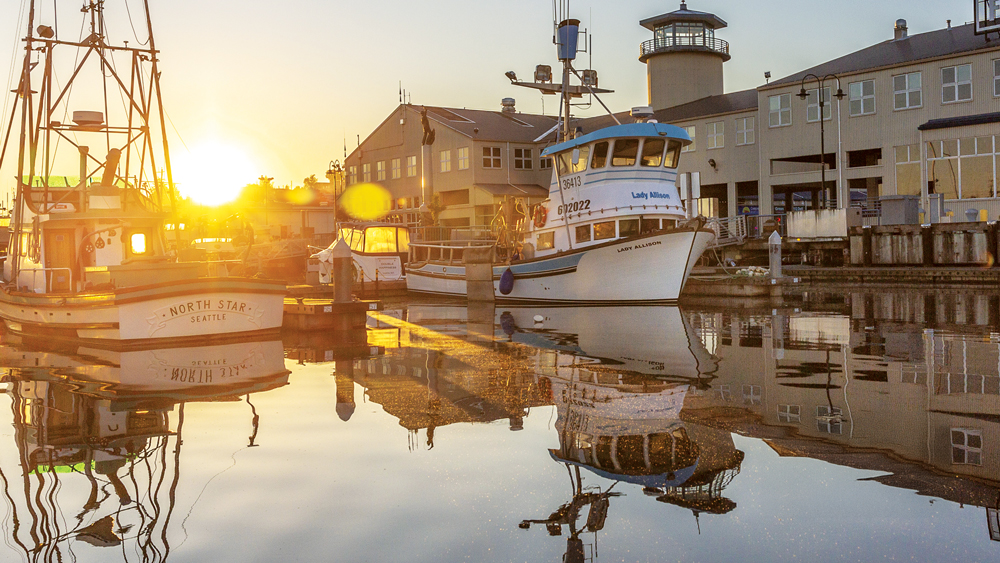
Commercial fishing vessels remain active at Fishermen’s Terminal, which has operated continuously since 1914.
The Port’s strategy centers on investments in berth-level shore power, modern terminal utilities, flexible industrial buildings and long-range energy planning. Together, these investments preserve what already works while creating capacity for future maritime and industrial activity.
Maritime Foundations of the Waterfront Economy
Commercial fishing remains one of the clearest examples of Seattle’s working waterfront and one of its most economically consequential. Facilities at Fishermen’s Terminal support a fleet that generates more than $1 billion in annual economic activity and sustains over 8,800 direct jobs across fishing, processing, maintenance and logistics, according to figures announced by the Port of Seattle.
Since its opening more than a century ago, Fishermen’s Terminal has evolved alongside the industry it serves. Recent upgrades and facility improvements are intended to keep pace with changing fleet needs while maintaining the working character that distinguishes the terminal from more recreational or tourism-oriented waterfronts. As competition for industrial land intensifies near urban cores, the continued presence of fishing and maritime activity provides a clear reason for preserving working waterfront uses. The Port’s investments send a signal to operators and suppliers that Seattle intends to remain a place where maritime industries can function efficiently and at scale.
Reliability is a recurring theme across the Port’s operations. Even during periods of federal uncertainty, the Port has emphasized continuity of service across its facilities, reinforcing its role as a dependable steward of assets that support regional supply chains and employment. For maritime and industrial tenants, that operational stability remains a critical consideration.
Terminal 91: Modernizing Core Infrastructure
At Terminal 91, the $98 million redevelopment of Berths 6 and 8 along Pier 90 includes pile replacement, new wharf structures, upgraded floats, bulkhead improvements and office consolidation for operations, fishing and industry customers. The project will provide approximately 750 feet of moorage and bring the berths back into service for large fishing vessels and other users with improved efficiency and access.
As part of the redevelopment, the new berths will be equipped with shore power for fishing and industrial vessels. This allows ships to connect directly to on-dock electrical service, reducing reliance on onboard generators while improving operational efficiency and environmental performance. According to the Port, the project ensures long-term moorage capacity for the North Pacific Fishing Fleet while modernizing aging infrastructure and improving environmental conditions.
Beyond the water’s edge, the Port is expanding its portfolio of lease-ready industrial space to support maritime-adjacent and light industrial users. The Terminal 91 uplands redevelopment is structured as a multi-phase effort to deliver flexible industrial buildings supported by modern utilities, stormwater systems and improved site circulation. The redevelopment is structured to accommodate a wide range of compatible users, from maritime suppliers to logistics and fabrication operations.
Phase-based development allows buildings to be delivered with adaptable floorplates and leasing configurations, giving tenants room to scale while maintaining access to the maritime ecosystem that supports their operations.
Powering the Next 50 Years
To support the next phase of maritime and industrial activity on Seattle’s working waterfront, the Port of Seattle is making long-range investments in electrical capacity across its facilities. In April 2025, the Port released its Seattle Waterfront Clean Energy Strategy, which outlines the infrastructure investments and planning required to support the electrification of buildings, vehicles, vessels and equipment on Port-owned maritime properties. The strategy projects that peak power demand associated with Port operations will increase fourfold by 2050, providing a framework for aligning capital programs with long-term operational needs.
Developed in partnership with The Northwest Seaport Alliance and Seattle City Light, the strategy reflects a coordinated, system-wide approach to waterfront electrification. It evaluates current and future energy use across Port-owned properties along Elliott Bay, the Duwamish River, the Lake Washington Ship Canal and Shilshole Bay, as well as the on-terminal and utility-owned infrastructure that serves them. In 2021, the Port, The Northwest Seaport Alliance and Seattle City Light entered a 10-year partnership to support joint planning and implementation of clean energy infrastructure, laying the groundwork for the strategy’s integration into capital planning.
Within the strategy, shore power for cruise and cargo vessels is identified as the primary driver of near-term growth in electrical demand. Cruise operations provide a clear illustration of that demand. Each time a cruise ship calls on Seattle, vessels remain at berth for extended turnarounds, often lasting 10 hours or more, while passengers disembark and board, provisions are loaded and onboard systems remain fully operational. Shore power allows ships to meet those energy needs using landside electricity rather than onboard diesel engines, shifting a significant portion of cruise-related energy demand onto the waterfront power grid.

Fred Felleman
The Port has invested in shore power infrastructure at its cruise terminals to support that shift. Two cruise berths at Smith Cove Cruise Terminal at Pier 91 are already equipped with shore power, and an expansion to the Pier 66 cruise berth was brought online during the 2024 cruise season. As a result, all cruise berths operated by the Port of Seattle now have shore power capability. Agreements governing cruise operations at Port terminals require shore power-capable ships to connect when power is available, embedding electrification directly into how cruise activity is managed at the dock.
“Installing shore power at marine terminals so that cruise and cargo ships can turn off their engines while at dock is a key part of the Port of Seattle’s commitment to becoming the greenest Port in North America,” said Port of Seattle Commissioner Fred Felleman. “Our partnership with The Northwest Seaport Alliance and Seattle City Light is critical to ensuring there’s enough power to meet the increasing demand for bringing electricity to the waterfront to serve ferries, trucks, cargo-handling equipment and the Coast Guard.”
To support this growth in electrical demand across cruise, cargo and other maritime operations, the Clean Energy Strategy identifies between $208 million and $457 million in combined Port and utility investments through 2050. These investments include upgrades to utility distribution systems as well as Port-owned on-site infrastructure such as transformers, switchgear, and substations. The strategy outlines eight recommendations addressing future capacity planning, site assessments, infrastructure management, grant readiness, clean technology development and financial strategies to support sustained capital investment across the waterfront.
A Working Port With Options
Taken together, the Port of Seattle’s investments reinforce the fundamentals of its maritime economy. In 2025, the Port’s maritime and industrial operations, including commercial fishing, cruise, and property leasing activities, generated more than $5 billion in regional economic impact, according to the Port. That figure reflects maritime and industrial property management activity and does not include cargo container operations managed by The Northwest Seaport Alliance or airport-related impacts.
“As a port for the future, we are moving forward with major investments to meet rising demand and support economic opportunity and environmental sustainability,” said Port of Seattle Executive Director Steve Metruck. “Our focus on long-term impact, building a more competitive, resilient and sustainable Port, ensures that we can meet the needs of today and prepare to make transformational investments for the future.”
This Investment Profile was prepared under the auspices of The Port of Seattle. For more information, visit portseattle.org.
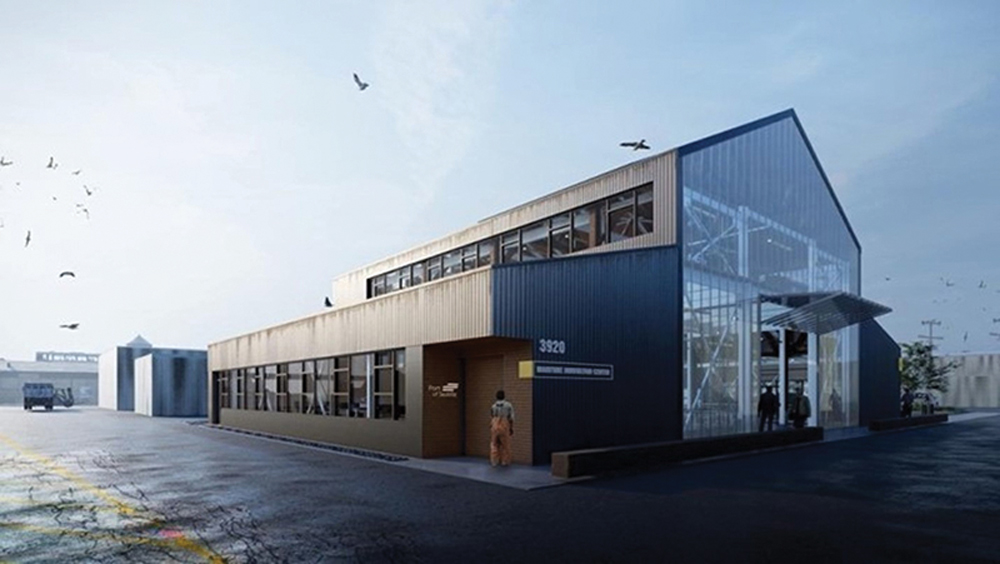
Restoration of the historic Ship Supply Building at Fishermen’s Terminal will support the Port’s maritime small business incubator program.
PHOTO Courtesy of Port of Seattle
INNOVATION ON THE WATERFRONT
To support the long term vitality of its maritime economy, the Port of Seattle is investing in practical innovation at Fishermen’s Terminal. The Maritime Innovation Center is being developed through the renovation of the historic Ship Supply Building, the oldest property in the Port of Seattle’s portfolio. Built in 1914 and damaged during the Nisqually earthquake in 2001, the building has undergone extensive structural work to ensure seismic stability, including a new foundation and deep pile installation.
Once completed, the approximately 15,000 square foot facility will provide work, fabrication, classroom, and event spaces for incubators, accelerators, and anchor tenants. At the project’s 2024 groundbreaking, Port and partner leaders framed the center as a long term investment in the region’s maritime economy rather than a new or recently formed initiative. Designed to meet Living Building Challenge standards, the Maritime Innovation Center is intended to support innovation and sustainability within one of the state’s most traditional sectors. The Port and the Washington State Department of Commerce have committed a combined $33 million to the project. The keys will be handed to Maritime Blue in mid-2026, where they will provide the tenant improvements to officially open thereafter.
The Maritime Innovation Center will serve as the home base for the annual Seattle Incubator and Innovation Accelerator Program managed by Washington Maritime Blue and partially funded by the Port of Seattle. To date, more than 30 startups have graduated from the accelerator since 2018, further supporting innovation and emerging startups in the maritime industry.
Plans call for a mix of Class A waterfront offices, co working space, classroom capacity, and event space sized to host industry convenings and demonstrations. The Port and Maritime Blue have positioned the facility to support early stage companies alongside established maritime firms, with the goal of shortening the distance between experimentation and deployment on the working waterfront.
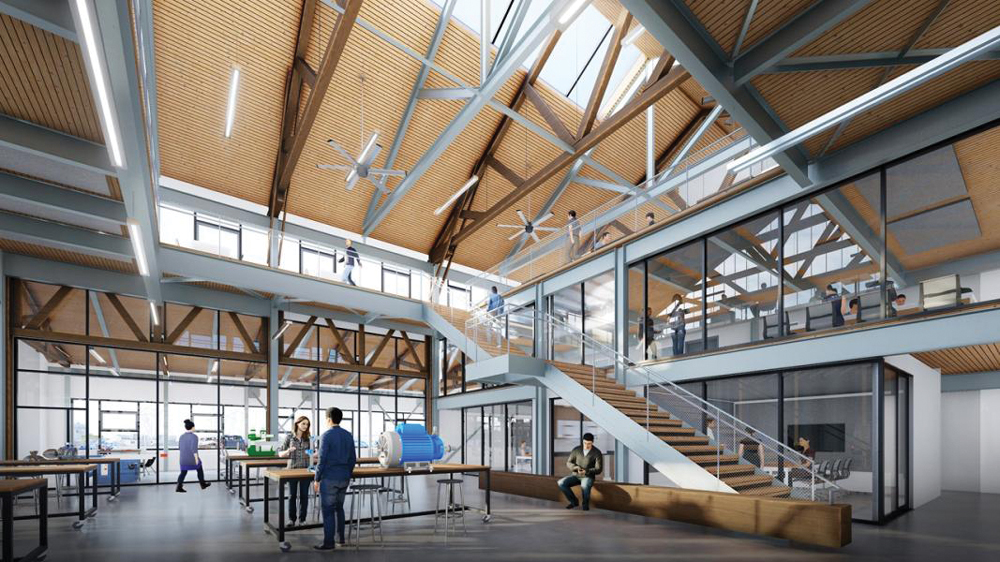
PHOTO Courtesy of Port of Seattle