
By Wendi J. Gedzun
This is the first installment of a two-part report. The second installment will be published on Thursday, July 16, in conjunction with the next edition of the Site Selection Investor Watch. — Ed.
The 58-point gap between national support for digital infrastructure and local support at a specific site is not a communications problem. It is a structural feature of how the human brain processes proposed change.
The IBM quantum campus rising on Chicago’s South Side is the first major project in this geography that appears designed to know this.
The ore walls on Chicago’s South Side lakefront are remnants of U. S. Steel’s South Works, a complex that opened along Lake Michigan in the early 1880s, was acquired by U. S. Steel Corporation in 1901 and at its peak employed more than 20,000 workers across 600 acres of made ground, much of it landfill built up from molten slag.
The mill closed in 1992. For two decades afterward, what remained of it stood in silence along the shore — mostly the ore walls, two long concrete structures that had once held taconite pellets unloaded from Great Lakes freighters. They were too massive to demolish on the steel industry’s way out, and so they stayed. In 2014, the Chicago Park District officially designated the surrounding 16.5 acres as Steelworkers Park, transformed the landscape with native prairie plantings and turned one section of the ore wall into a 30-foot public climbing wall now open to anyone aged eight or older.
The walls are, by accident and by intention, the most visible memorial to South Works and to the generations of steelworkers — Swedish and Scottish and German at first, then Italian and Polish and Mexican and African American — who built family economies along that stretch of lakefront over more than 100 years.
I have driven past those walls more times than I can count on the way to somewhere else, in the way the ground you grew up beside becomes the ground you stop seeing first. You can see them clearly from DuSable Lake Shore Drive. They ask a question every site selector should be required to answer before recommending a project. What does this place already mean, and what would we have to ask it to forget in order for our deal to work?
It is not a question the discipline is structured to hear. I have sat in too many rooms where the community arrives in the meeting notes as a slide near the back, after capital structure and after entitlements, labeled something like “stakeholder management” or “public engagement.” The slide is short. It uses verbs like “address,” “mitigate,” “navigate.” What it almost never uses is verbs like “understand,” “consult with,” “design alongside.”
The taxonomy is not accidental. It is the discipline’s quiet confession of what it has decided to treat as inside the deal and what it has decided to treat as outside. The IBM project that opened the front page of every Chicago paper on April 29 is interesting partly because someone, somewhere in the design process, appears to have moved the slide.
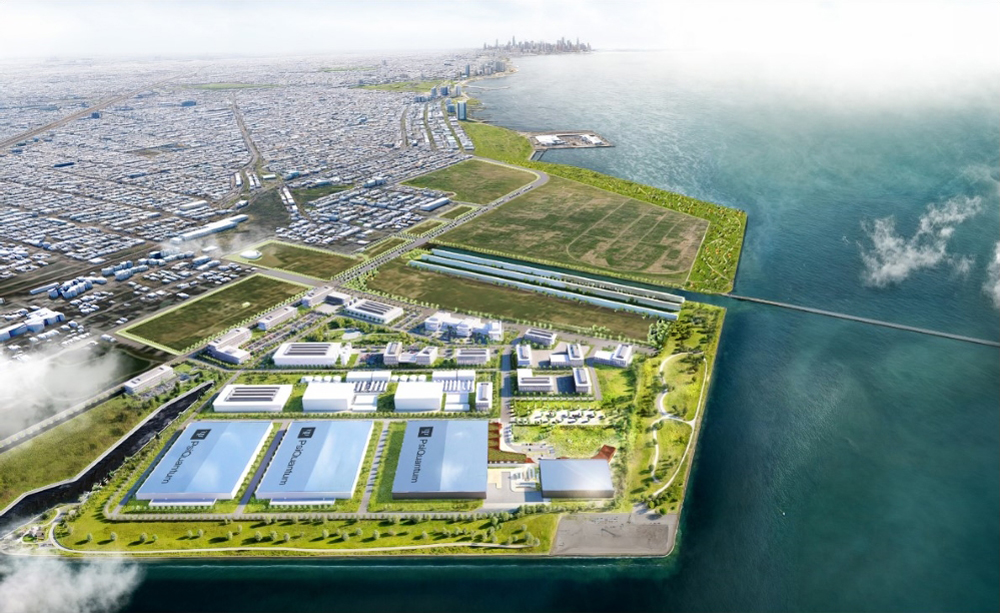
On April 29, 2026, IBM and Illinois Governor JB Pritzker stood on a portion of that same South Works ground and announced a particular answer to the question. IBM will create 750 full-time jobs over the next five years at a new innovation and delivery hub it is calling FutureNow Chicago, located on the 128-acre Illinois Quantum and Microelectronics Park (IQMP) campus at 8080 South DuSable Lake Shore Drive. PsiQuantum is the anchor tenant. Other announced tenants of the broader campus include Diraq, Infleqtion and the Defense Advanced Research Projects Agency (DARPA).
The state’s Economic Development for a Growing Economy (EDGE) agreement carries an estimated $19 million in tax credits over 10 years. City Colleges of Chicago will run a paid apprenticeship program supporting five hundred apprentices through the campus’s Quantum Works workforce development center, which is expected to open in 2028, and IBM has committed to hiring at least one-third of qualified graduates. The first phase of campus construction broke ground in September 2025 with $500 million in state funding and is expected to be complete in 2027. IBM’s Quantum System Two, the company’s next-generation modular quantum computer, will eventually operate on site. Chicago Mayor Brandon Johnson stood at the podium alongside Governor JB Pritzker and IBM CEO Arvind Krishna.
What is striking about IQMP is not the capital and not the technology. It is the quiet sophistication of the community choreography around them. More than 100 acres of expanded parkland. Recreational paths threading the campus into Steelworkers Park, Park 566, and the ore walls themselves, which are being treated as features to design with rather than around. A new 53-bed Advocate Health Care hospital at the north end of the broader 440-acre site, anchoring a $1 billion commitment to South Side health investment over 10 years. Dozens of public meetings with residents, educators, small businesses, and faith institutions. And, in continuous operation alongside the project, the Coalition for a South Works CBA, a partnership organized since 2013 by Alliance of the Southeast and a network including Friends of the Parks, ETHOS, KECS Block Club Association and Working Family Solidarity, that has been pressing publicly for a legally binding community-benefits agreement covering local hiring, job training, affordable housing and environmental protections.
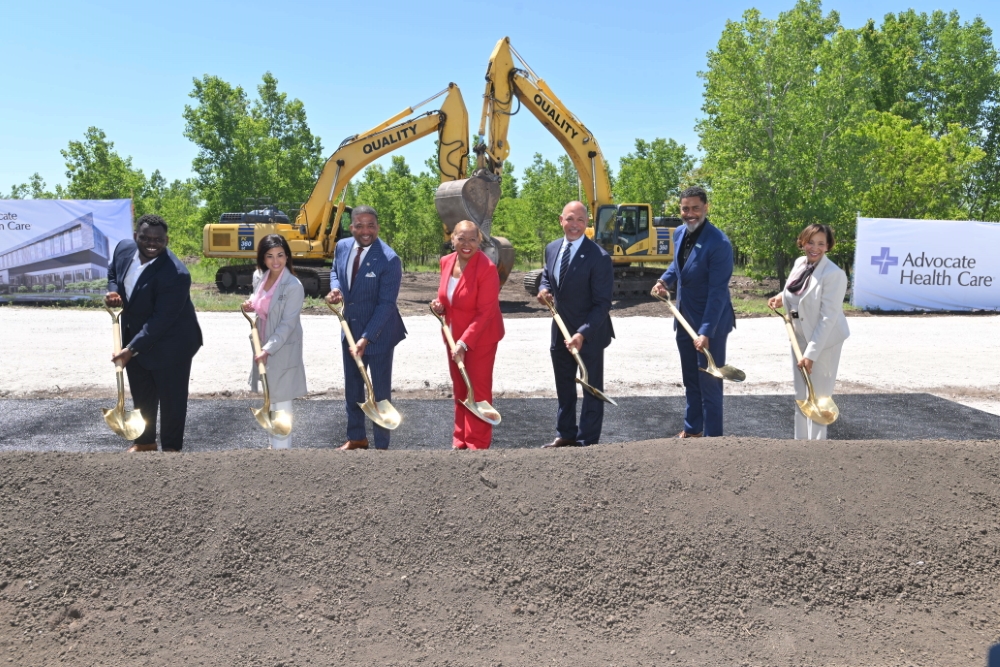
Advocate Health Care in June marked a major milestone in its long-term commitment to Chicago’s South Side with the groundbreaking of a new, $300 million community hospital at the former U.S. Steel South Works site near the lakefront.
Photo courtesy of Advocate Health Care
That choreography is not ornamental. It is, increasingly, the difference between a site that delivers and a site that becomes the next $98 billion story of capital that found a different home.
When JLL published its 2026 Global Data Center Outlook in January, the report identified what its authors call an “acceptance paradox.” National support for digital infrastructure in the United States sits at 93%. Local support for a specific data center at a specific proposed site sits at 35%. The 58-point gap between those two numbers is, in the Outlook’s framing, a perception gap that the report projects will continue to translate into blocked projects globally. Read alongside the broader Data Center Watch evidence, the gap is also something close to a leading indicator of organized local opposition. The Outlook adds a second, more telling statistic alongside the first: Only 52% of the public can correctly define what a data center is. The industry has been treating its problem as a persuasion failure on a population that is, by majority, not yet sure what it is being asked to be persuaded about. The Outlook’s own diagnosis is consistent with this reading. It calls for the industry to shift from reactive consultation to proactive co-creation and identifies the move as a strategic response rather than a communications fix.
“Community opposition to data centers has become the greatest threat to the industry’s continued growth. Project cancellations and moratoriums are increasing at an alarming pace. Data center developers must engage early with communities as partners in the project design process, not audiences for the announcement.”
— Andrew Batson, Global Head of Data Center Research, JLL
Data Center Watch, the independent research effort backed by 10a Labs, has documented two iterations of the same trend inside one year. The first report, in May 2025, counted $64 billion in U.S. data center projects either blocked or delayed during the 11 months from May 2024 to March 2025, with 142 local opposition groups in the field. The Q2 2025 update added $98 billion across 20 projects in 11 states stalled in a single three-month window from late March through June 2025 and grew the activist count to 188 groups across 40 states. The cumulative figure for delays and cancellations attributable to organized local opposition since 2023 now sits at roughly $162 billion. Project cancellations rose from two in all of 2023 to 25 in 2025, with 21 of those cancellations clustered in the second half of the year. That is not a plateau. That is the slope of a line.
The instinct across our industry has been to call this a communications failure. It is not. The right early-stage messaging did not change the outcomes that produced those numbers, and the next round of better messaging will not either. It is not a communications problem. It is a neuroscience problem. The IQMP project is interesting precisely because the people designing it appear to know that.
The pattern is wider than data centers
Data centers became the headline because the math is unforgiving. Gigawatts of load, near-instant timelines, transformer yards rising where corn used to grow. But the same dynamic is now visible across nearly every asset class moving capital today.
Industrial distribution centers face community opposition over truck traffic and light pollution the original site selection model treated as solvable through landscaping and operating-hour commitments. Hospital and life sciences expansions collide with neighborhoods that read every parking deck request as the opening move in a slow institutional takeover. Retail formats, particularly larger-footprint and 24-hour operations, are finding that what scored well in trade-area analytics scores poorly in the rooms where the variances get approved. Manufacturing reshoring projects, the very projects current U.S. policy is trying to incentivize, are discovering that an enthusiastic governor’s office is not the same as an enthusiastic township board.
Consider Warrenton, Virginia. By the time the November 2024 town council election arrived, the proposed Amazon data center had been the most-discussed thing in town for the better part of a year. Voters did not have to phrase the question out loud. Everyone who had been to the prior six months of council meetings already knew what it was. Three new members were elected, each having campaigned against the project. The lone pro-data-center incumbent on the ballot lost her seat by 23 points. The new council issued a joint statement, weeks later, pledging to investigate the 2023 decision that had cleared Amazon’s way.
Roy Francis, the newcomer who defeated the incumbent, put the result more plainly than any consultant would have. “All of the people who voted for Amazon are gone.” That is what “organized opposition before it organizes” looks like in retrospect. By the time it shows up at a vote, the actual work of it has been happening at kitchen tables for a year, and no party platform was ever required.
The pattern repeats with the consistency of a clinical finding. A project clears every quantitative gate, fails at the human gate, and the team is left calling the loss “irrational” rather than recognizing that human decision-making in the face of perceived environmental change is not irrational at all. It is operating exactly the way 30 years of behavioral neuroscience predicts it will.
Why the engagement playbook keeps failing
Most site selection playbooks were assembled from a model of public engagement that assumed people make decisions about their environment the way they make decisions about a household budget. Weigh the costs, weigh the benefits, decide. That model was already on shaky ground when prospect theory dismantled it in the 1970s. It was finished off by the social-neuroscience research of the past two decades. JLL’s 2026 Outlook describes the operational version of the same failure in two clean sentences. Current industry practice is to begin community consultation six to 18 months into the development process, after the key decisions have already been made. The consultation that follows is, structurally, an announcement with a feedback form attached.
What that research shows, in the specific context of proposed environmental change, is that three neural systems activate before any conscious cost-benefit analysis begins.
Threat detection. The amygdala processes proposed environmental change as a potential predator. This is not metaphor. It is the same neural circuitry. The proposal does not have to be objectively threatening. It has to be unfamiliar, large and outside community control, the same three properties that, evolutionarily, distinguished a possible threat from background. The faster a project moves through approvals, and the larger its visible footprint, the more reliably it triggers this system. Every accelerated timeline is, neurologically, a louder alarm.
Loss aversion. The prospect theory developed by Daniel Kahneman and Amos Tversky established that humans weigh losses roughly twice as heavily as equivalent gains. In site selection terms, the jobs and tax base your project promises are processed at roughly half the weight of the views, the school traffic and the neighborhood character your project is perceived to threaten. Every time a practitioner opens a community presentation with the economic impact slide, they are leading with their weakest argument and reinforcing the asymmetry they are trying to overcome.
Place identity. The research line running from Yi-Fu Tuan in the 1970s through environmental psychologists like Setha Low and Daniel Williams to current social neuroscience work has established that humans encode physical place into self-concept. A proposed change to a familiar landscape is processed, neurologically, as a proposed change to the self. The opposition is rarely to the project on its merits. It is to the implied identity revision the project requires the community to accept. “Who will I be after this is built?” is the question being asked under the surface of every zoning hearing the discipline has misread as procedural. The discipline has historically had no unit of measure for this question and so has tended not to ask it.
What gets counted in a site evaluation is land cost, power cost, latency, tax position, labor draw, water access and dozens of similar quantifiable inputs. What does not get counted is what the neighborhood already understood itself to be, before our project arrived to propose an amendment. The absence of a unit is not the absence of the variable. It is, more accurately, the absence of our own training to read the variable, and a 40-year discipline of treating what we cannot measure as if it were not there.
The amygdala processes proposed environmental
change as a potential predator.
This is not metaphor.
It is the same neural circuitry.
These are not communications failures. They are structural features of how the human brain processes environmental change. No amount of better messaging fixes them. What fixes them is a different operating model.
Three shifts the operating model needs
Three operational shifts are emerging in the site selection work that survives the human gate. None of them are radical. All of them are still rare.
First, lead with continuity, not change. The IQMP project is doing this in physical form. Every public-facing element of the campus design, the expanded parkland, the trail connections to Steelworkers Park and Park 566, the published urban-design guidelines calling for landscaped neighborhood setbacks, interpretive signage, public art and preservation of historic structures (including the ore walls and the two original industrial slips) answers the place-identity question before it gets asked. The South Works closure was a generational wound for the South Side. A quantum campus designed without continuity to that history would have detonated the place-identity circuit on day one. A campus designed to rest on top of the steel-making memory, rather than erase it, has a chance. The strongest projects I have read closely opened the community conversation by naming what would not change before naming what would. That is not a courtesy. That is the place-identity finding turned into a sequence.
Second, treat loss aversion as a math problem, not a tone problem. If gains are weighted at half of losses, the only way to balance the equation is to either reduce the perceived loss or radically over-deliver on the perceived gain. The Coalition for a South Works CBA has, since 2013, named the second move in plain language: a legally binding agreement that converts abstract project commitments into specific, enforceable, locally felt obligations on local hiring, training, housing and environmental protection. In neuroscience terms, that is exactly the right instrument. It converts an abstract gain (some number of jobs in some unspecified pool, distributed over some unspecified horizon) into a concrete one (specific commitments measurably going to the people whose neighborhood absorbed the change). Whether the final agreement is signed, and on what terms, the structural insight is correct.

A key part of emotional control and processes, the amygdala also plays a role in memory and learning.
Illustration by Libre de Droit: Getty Images
Picture what the City Colleges apprenticeship actually does for the loss-aversion math. IBM has committed to hiring at least one-third of qualified program graduates from a paid five-year, 500-apprentice pipeline. That is not an abstract jobs number. It is a year-by-year, named-cohort, on-paper commitment that converts the gain side of the equation from a forecast into a roster. A neighborhood can argue with a forecast. It cannot argue, in the same way, with the existence of a specific paid apprentice who lives three streets over and can name the company that hired her.
The same logic governs the broader package of community-facing commitments at IQMP that have been publicly reported, including the expanded parkland, the path connections into Steelworkers Park, the planned 53-bed Advocate hospital and the open public negotiation with the Coalition for a South Works CBA over the terms of a legally binding community-benefits agreement. None of those individually is what tips the place-identity equation. Together, they form a structure that makes the gain visible on a schedule the body can feel, while leaving the things that made the neighborhood itself — the lakefront, the ore walls, the memory of the steel work — intact rather than overwritten. Most projects attempt neither halving the loss nor doubling the gain. They present a quantitatively balanced case to a brain that is, by design, not quantitatively balanced.
Third, design the timeline to the nervous system, not the financial pro forma. The faster a project must close, the more reliably it triggers the threat-detection circuit. There is a real cost to slowing down. There is a larger and less-measured cost to moving so fast that the community’s amygdala does the deciding before its prefrontal cortex gets a turn. The discipline needs to build a deliberate “second look” period into the schedule, not for legal protection, but for neural settling. The JLL Outlook puts a number on this in another direction. It recommends extending pre-development engagement timelines to 24 months, with the language of moving from “reactive consultation” to “proactive co-creation.”
The same report lists, in its construction-cost summary, the four criteria currently driving global site selection. Speed to power is first. Community support is second, ahead of latency and proximity to customers. The industry’s own research function has already ranked the human layer above two of the variables the deal model has historically treated as its core inputs. The question is whether the deal model is reading its own research. A community whose amygdala has had time to stand down is a community whose prefrontal cortex can actually do the math the deal team has been waiting for it to do.

Wendi J. Gedzun is senior director, Solutions Development, at JLL. Her 36-year career spans technology, program, change and knowledge management, with the last 20 years applied inside commercial real estate. She is the author of “Neuropolis: Building Cities of the Future Through Neuroscience and Place” (2025) and “Building Greensboro: A Strategic Vision for Place, Potential, and People” (2025), a member of the Academy of Neuroscience for Architecture, and a licensed real estate broker in Illinois and North Carolina. She begins a doctorate at Case Western Reserve University’s Weatherhead School of Management in the fall of 2026.