When one considers the top U.S. hubs for life sciences innovation and industry, Boston, San Diego and California’s Bay Area come to mind. But the Southeast has maintained and grown its clout in this arena.
In a 2025 JLL report on life sciences real estate and clusters, Raleigh-Durham ranked No. 4 among top U.S. life sciences hubs overall when measured by talent ecosystem, funding landscape and real estate infrastructure, and No. 2 among top U.S. biomanufacturing hubs (behind New Jersey) when considering manufacturing base, production capacity (CDMO facility presence and GMP-certified square footage), talent pipeline and infrastructure readiness.
In June I participated in a tour of the life sciences in North Carolina that included Greenville and its Biopharma Crescent, Wake County, Research Triangle Park and Winston-Salem and its Innovation Quarter. In Greenville, I saw virtual reality being leveraged at Thermo Fisher Scientific to train future production line employees in manufacturing and packaging. I visited the North Carolina Biotechnology Center in Durham, founded in 1984 and now a proven life sciences accelerator. And several universities and research centers showcased workforce possibilities when it comes to this biotech cluster.
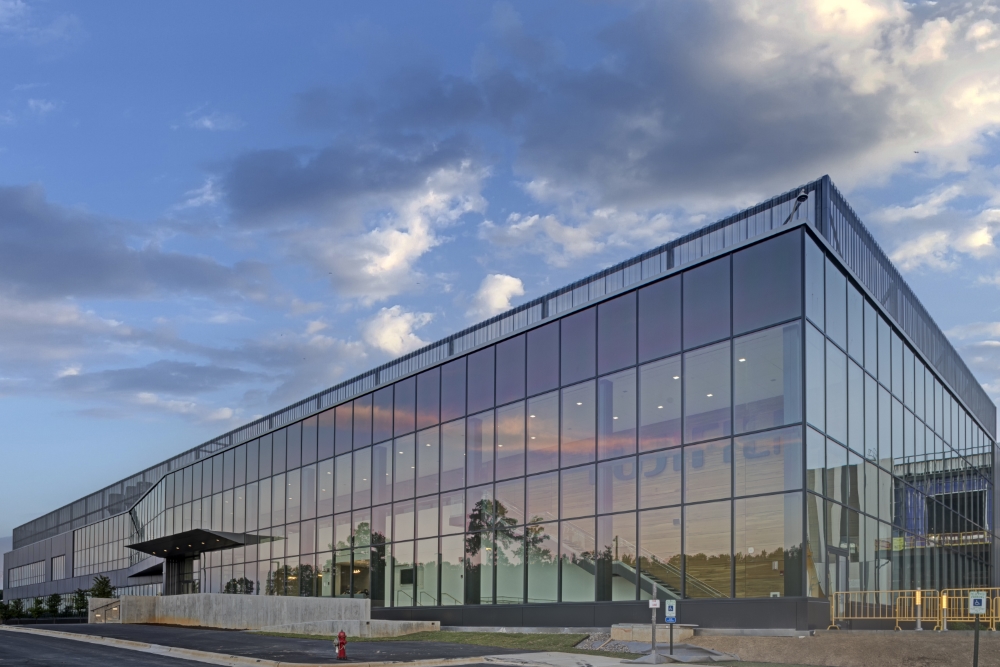
On the second day of the tour, as we set out to experience another full day of learning that would eventually land us at a FUJIFILM site in Holly Springs, near Raleigh, the news broke that the company would change its CDMO arm’s branding from FUJIFILM Diosynth Biotechnologies to just FUJIFILM Biotechnologies; FUJIFILM Irvine Scientific, which supplies products and services to the life sciences market, was changed to FUJIFILM Biosciences. We toured the cell culture facility with site director Laurie Braxton and learned the ins and outs of the $3.2 billion manufacturing site that was designed to duplicate the FUJIFILM facility in Denmark built for the European market.
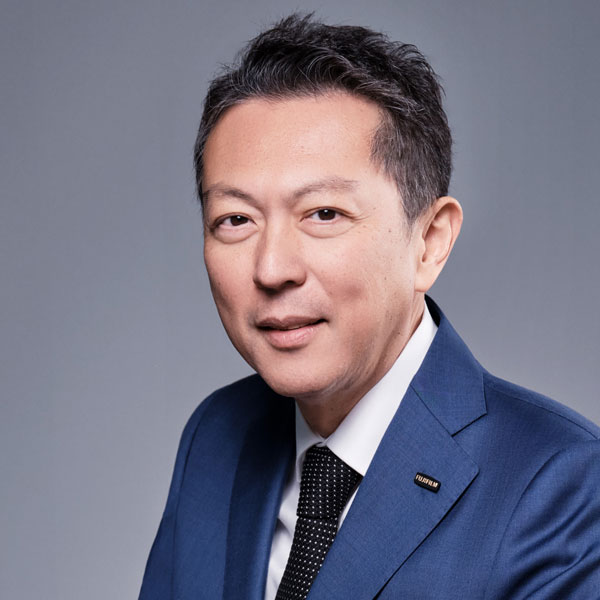
“We are continuously investing in new technologies to transform the traditional biomanufacturing process.”
— Toshi Iida, Chairman of FUJIFILM Biotechnologies, Board Director, FUJIFIM Corporation, Vice President and General Manager, Life Science Strategy Headquarters and Bio CDMO Division
The Chairman’s Viewpoint
Later, in September 2025, the company had its grand opening of the Holly Springs location, representing one of the largest commercial-scale cell culture biomanufacturing sites in North America. I was able to learn more about the facility from Toshi Iida, a long-term corporate executive at FUJIFILM Corporation, head of the life science headquarters and bio CDMO division of FUJIFILM and chairman of FUJIFILM Biotechnologies. Asked what makes FUJIFILM stand out against other CDMOs, Iida listed three things:
“First, we are end-to-end,” he says. “We are covering process development, small-scale manufacturing and 20,000-liter large-scale commercial manufacturing. … We can support all the pipelines from the discovery stage to commercialization of larger manufacturing.
“Second, we are investing in new facilities,” he says. “The benefit of that is that we can set a very standardized facility network we call ‘kojoX.’ If we acquire someone else’s facilities, it is very hard to standardize because that facility is already set for that purpose. We are building the kojoX network in turn with the heavy capital investment.”
KojoX is a FUJIFILM-specific modular facility design approach that reduces design time (by 70% at the Holly Spring site) and allows the company to duplicate successful existing sites already in their asset portfolio.
“Three, we are pretty much [investing in] onshore manufacturing,” Iida says. “We establish our asset facilities to get them as close to the patient and client as possible — we manufacture in the U.S. for the U.S. patient and U.S. client. We manufacture in Denmark and UK for the European patient. And we are establishing now the first Japanese plant for the Japanese patient. Not only [are we investing] in manufacturing, but also in key materials like cell culture media produced by our sister company, FUJIFILM Biosciences.
“We are unique not only in CDMO manufacturing but also in [developing] our key components like cell culture media,” he says. “These are the things that set us apart from the competition.”
Asked why North Carolina was chosen for the investments in Research Triangle Park and Holly Springs by FUJIFILM, Iida says the biggest driver was the people. He also recognized the area’s strengths as one of the biggest biotech hubs with 750 bioscience companies and almost 80,000 people working for those companies. The strong universities network and workforce talent were big draws for the site selection process.
Before the Holly Springs site opened, it was announced that American pharmaceutical and biotech company Johnson & Johnson would be locating at the site in a $2 billion contract that will span 10 years and bolster their U.S. manufacturing presence. Iida provided more insight on the deal with Johnson & Johnson, which was viewed as a major victory and something of a trust exercise.
“That is a very important contract and partnership,” Iida says. “[Johnson & Johnson] committed before the factory had started operations, so it is a little unusual for this industry. This is very much a trust-based agreement. So, why did they trust us? Two things. We have a top proven track record with the Danish site. A very high batch success rate. And a very high performance and [strong showing] with regulatory approvals. The second reason is I think they liked our asset, and they liked our people. They visited our site prior to their decision, and they said they were very impressed by our people. And if I could add one more thing — it’s the potential for our technologies … As a CDMO, we are of the more innovative mindset of the companies. We are continuously investing in new technologies to transform the traditional biomanufacturing process.”
Top Southeast States and Regions
Though North Carolina takes the lead when it comes to the life sciences in the southeastern U.S., there is still a large spread of investment and interest across the region in each state.
Of the 122 life sciences investments in the states of Alabama, Florida, Georgia, Mississippi, North Carolina, South Carolina and Tennessee tracked across the Conway Data Projects Database from January 1, 2024, through September 30, 2025, a total of 42 were recorded in North Carolina (34.4%), with 37 in Florida (30.3%), 14 in Georgia (11.5%) and 12 in Alabama (9.8%).
According to Avison Young U.S. Life Science and Office Agency Lead for Market Intelligence Tucker White, the Southeast ranks third behind the West coast and the Northeast regions in the U.S. in terms of the life sciences.
“Greenville and Charleston are strong emerging markets in the Southeast,” says White. “SCBio is making waves, creating industry awareness across the globe for the state and showing signs of becoming what MassBio is today — a large catalyst for what made Boston the top life sciences market in the world … The lab market has [also] softened significantly with an ample amount of wet lab available in major life sciences markets in metropolitan areas.”
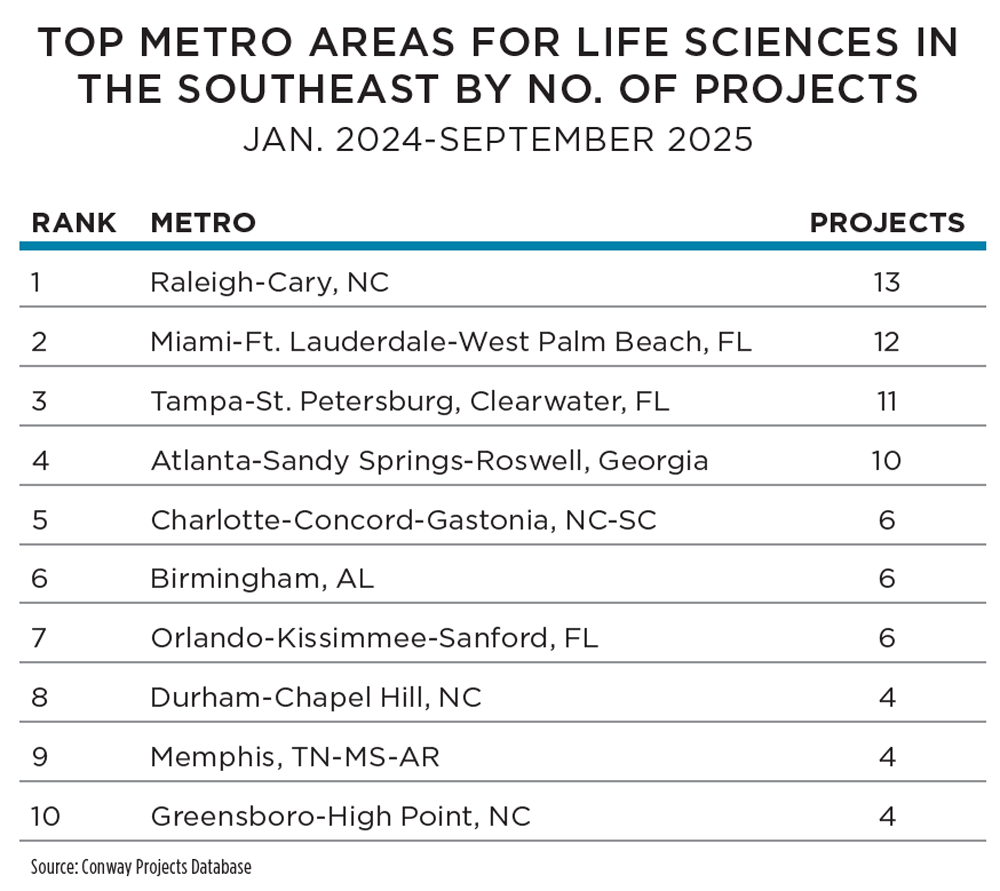
Evaluated by number of qualifying life sciences facility projects over the same time span as the states above, here are the top metro areas according to Site Selection’s Conway Projects Database:
While Raleigh-Cary and Durham-Chapel Hill are two distinct metro areas by strict Census Bureau definitions, they are perceived by most as the Research Triangle region and therefore would put even more distance between the region and No. 2 South Florida if combined. The area’s total climbs even higher when adding in nearby projects from Sanford to the southwest and Wilson and Rocky Mount (halfway to Greenville) to the east, adding up to six more projects among them.
Avison Young’s Tucker White also sees the Research Triangle as No. 1 in the region, followed by metro Atlanta and metro Nashville, where he notes, “R&D employment in life sciences grew 81% from 2019 to 2022, among the fastest in the nation,” making Music City “one to watch” among rising hubs.
Others in his upper echelon include, in order, Memphis, South Florida, and then the combined regional city pairs of Columbia and Charleston, South Carolina, and Birmingham and Huntsville, Alabama, anchored by the HudsonAlpha Institute in Huntsville and by projects such as the new $98 million biotech center opened in August 2025 by Southern Research with the University of Alabama at Birmingham. The Southern Research project received financial support from the State of Alabama, the City of Birmingham and Jefferson County, as well as a grant from the U.S. Economic Development Administration. The Alabama Legislature earmarked $45 million for the building in the 2023 state budget.
“This is the first major Southern Research campus addition since 1987,” says Southern Research chief administration officer Ricardo Brito. “The significance of this expansion is rooted in the scale of the investment and the public-private commitment it represents. The new center adds to Alabama’s life sciences industry by massively scaling our capacity to combat critical diseases and drive economic growth. This facility doubles lab capacity, significantly expanding our ability to accelerate the development of therapies.”