
The sciences, tech and engineering pick up across the U.S. and globe.
In 2012, President Barack Obama’s Council of Advisors on Science and Technology (PCAST) published a 200-page report announcing the U.S. government’s goal of increasing the number of students who receive undergraduate STEM degrees by 1 million over the next decade. This goal was set to meet the anticipated workforce needs for STEM occupations, which at the time were projected to grow 1.7 times faster than non-STEM occupations in the succeeding years.
Postdoctoral research fellow at the University of California, Santa Cruz, Haider Ali Bhatti, who primarily investigates field-based education, especially among biology students, took it upon himself to see whether the United States met this goal of 1 million more STEM graduates since 2012. According to his findings, which were published in the Journal of Microbiology & Biology Education in 2025, the United States did in fact hit this target.
A Million STEM Graduates and Counting
“We’ve seen a trajectory of growth and success reaching this goal, which was pretty big at the time,” Bhatti says about his analysis, which was developed using data from the Institute for Education Sciences (IES) and the National Center for Education Statistics (NCES). These findings also translate positively for STEM jobs, which did follow the growth projection in the PCAST report.
The number of STEM degrees issued and STEM jobs created both increased in the U.S. between 2012 and 2021, with STEM degrees being completed at comparable or higher levels than non-STEM degrees. The results of Bhatti’s study showed that annual STEM degree production grew from 391,140 degrees completed in 2012 to 520,362 in 2021, with cumulative STEM degrees reaching 4.65 million (exceeding the 3 million baseline projection and 4 million target set by the U.S. government). The goal of producing “1 million more” STEM graduates was exceeded by about 16%.

Boulder is No. 2 for STEM jobs in small metros according to a Coworking Café U.S. stem job market study, surpassing over 700 STEM establishments and offering many work opportunities in the field — 22.2% of all job openings in the city are in STEM.
Photo courtesy of Getty Images/DenisTangneyJr
Demographically, the analysis showed considerable gains in STEM education among Hispanic populations, with science & engineering (S&E) bachelor’s degrees increasing from 11.2% to 18.3%, and women (S&E bachelor’s degrees increasing from 43% to 49%); representation gaps still persist in another populations.
“For STEM research and education, we have to make sure we have graduates who can be trained and ready for the workforce that they are going to be transitioned into,” Bhatti observes. These graduates will likely find many opportunities for work. A Coworking Café market study published in June 2025 indicated the number of U.S. STEM jobs increased by 31% from 2019 to 2024 — with many offerings for people looking to work almost anywhere in the country.
STEM in Large, Mid-Size and Small U.S. Metros
San Jose continues to be the top metropolitan area for STEM professionals, followed by Boston in second place and Washington, D.C., in third, says Coworking Café. Silicon Valley and San Francisco Bay lead with job creation and income level, with an annual median income level of $142,000 and $137,000, respectively, and a 51% increase in STEM jobs in those markets. In Silicon Valley, which encompasses San Jose, Sunnyvale, Los Gatos and Santa Clara, one in four jobs can be found within the almost 3,500 STEM establishments located there, marking the area as having the highest density of STEM jobs overall and the second highest STEM job density growth.
Metrics used in the Coworking Café analysis included STEM job availability, average incomes and affordability; results were sorted into small, mid-sized and large categories according to population size (200,000 to 499,000 residents; 500,000 to 999,000 residents and over 1 million residents, respectively).
The Southern United States had a concentration of top-performing STEM hubs in Washington, D.C., and Durham, North Carolina, together having nearly 14,000 STEM establishments and almost 20% of all job opportunities aimed at science professionals. Durham topped the mid-sized metro ranking for the most STEM establishments (635) and number of doctorates earned in 2023 per 100,000 residents (135). Almost 23% of Durham-area jobs are in the sciences. Huntsville, Alabama, had the highest number of STEM roles per 1,000 jobs (233.98) for mid-sized metros. For large and small metros, this count was 263.69 for San Jose-Sunnyvale-Santa Clara, California, and 223.31 for Ann Arbor, Michigan, respectively.
In terms of number of STEM establishments overall, the New York-Newark-Jersey City metro far outclassed any other U.S. metro in the ranking with a total of 12,166. For large metros, the metro area of Seattle, Tacoma and Bellevue saw the highest growth per 1,000 jobs from 2019 to 2024 (62%). Texas, too, saw consistent wage and job growth across all metro sizes, with the highest annual wage growth from 2019 to 2024 for large metros (32.67%) seen in the Dallas-Fort Worth-Arlington area and the highest STEM jobs growth per 1,000 jobs for mid-sized metros in that same time period in the McAllen-Edinburg-Mission area (42.3%). College Station, Texas, also recorded the highest number of doctorates earned in 2023 per 100,000 residents for small metros (261). For large metros, the winner for that category was Boston-Cambridge-Newton, with 47 doctorates per 100,000 residents in 2023.
Smaller U.S. metros in the Midwest, Heartland and West also had an array of interesting results in the Coworking Café study. Boulder, Colorado, had the highest number of STEM establishments (735) for this metro category size, and Michigan scored big for STEM jobs per 1,000 jobs (223.31 in Ann Arbor) and STEM jobs growth per 1,000 jobs (82.6% in Kalamazoo-Portage). From 2019 to 2024, Fargo in North Dakota/Minnesota ranked first for small metros in average annual wage growth (39.02%). Third among all small metros, the city of Burlington, Vermont, also saw STEM wages climb by almost 38% between 2019 and 2024.
“For STEM research and education, we have to make sure we have graduates who can be trained and ready for the workforce that they are going to be transitioned into.”
— Haider Ali Bhatti, University of California, Santa Cruz NSF STEM Education Postdoctoral Fellow
STEM Around the World
When asked about the main challenges companies face when finding STEM workers, Matt McManus, president of global STEM-specialist workforce consultancy Specialist Staffing Group, notes four things: talent shortage (high demand for AI, data science and renewable energy skills outpaces supply), geographic imbalance (skilled workers concentrated in top-ranked countries; harder for firms in mid-tier regions), rapid tech evolution (skills become obsolete quickly; need for continuous upskilling) and diversity gaps (gender and age representation remain uneven in STEM roles globally).
Skills and experience are everything in the workforce, especially in the rapidly evolving STEM fields. McManus says that technical expertise (especially in AI/ML, data analytics, cloud computing, cybersecurity, renewable energy engineering), interdisciplinary knowledge (i.e., combining life sciences with data science or engineering) and innovation capability (experience in patent-heavy sectors or R&D projects) are the most valuable assets when hiring in STEM. He adds that soft skills are key when working in cross-functional teams.
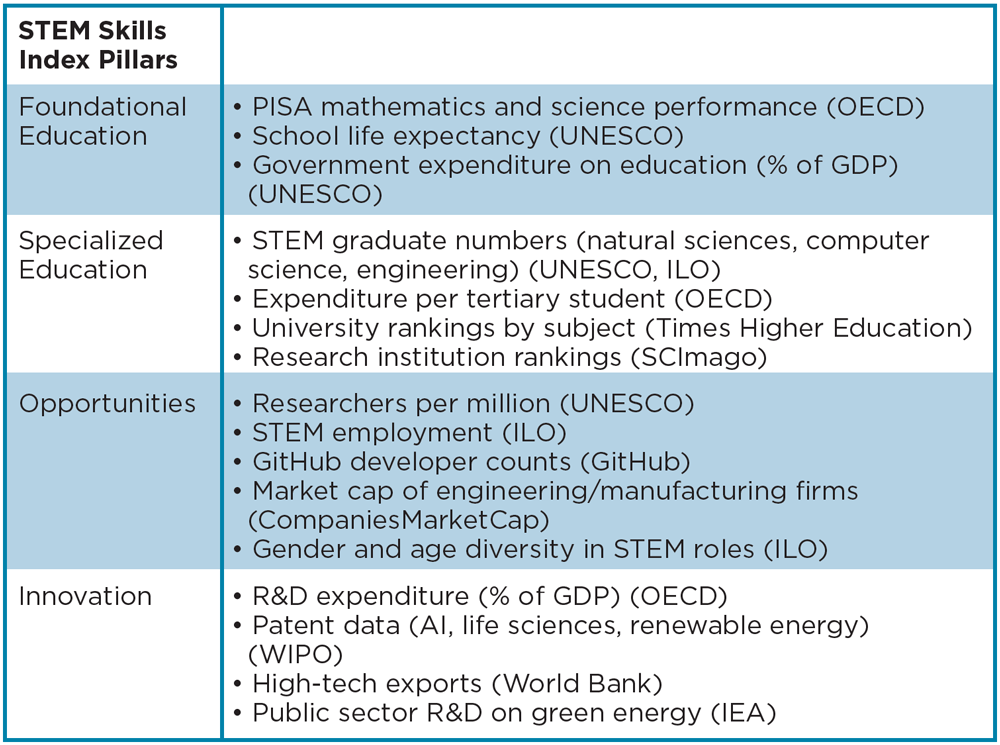
*Population data from UN Population Division was used for adjustments.
Sources: OECD, UNESCO, ILO, World Bank, WIPO, Times Higher Education, SCImago, GitHub, CompaniesMarketCap, IEA. List courtesy of Specialist Staffing Group/CEBR.
In 2025, Specialist Staffing Group published a STEM Skills Index developed with the Center for Economics and Business Research (CEBR) which drew from several global datasets across four pillars: foundational education, specialized education, opportunities and innovation. The Index ranks countries based on STEM skill prevalence. Leading globally overall was Switzerland, followed in order by the Republic of Korea, Singapore, Sweden, Finland, Denmark, the United Kingdom, the Netherlands and Australia.
Switzerland’s achievement was earned by a top 10 ranking in three of four pillars and its reputation as a powerhouse of the life sciences, supported by its world-class universities, biotech hubs and strong pharmaceutical industries (bolstered by Swiss companies Novartis and Roche).
Runner-up South Korea, which McManus notes as being “already strong in tech patents and AI innovation” and “likely to maintain upward momentum,” ranked first in STEM innovation, followed by Switzerland and Japan in that category.
Singapore, a rising global star for business development, topped the foundational education ranking with Japan, South Korea, Estonia and Australia in tow (Finland claimed the specialized education top ranking with Australia, Denmark, Sweden and Ireland rounding out the top five).
Singapore ranked no. 1 in tech, no. 5 in engineering and no. 24 in the life sciences. McManus says the country is “expected to stay in (the) top tier” likely due to its heavy investment in R&D and focus on AI, robotics and software development.
Despite strengths in innovation and tech ecosystems, the U.S. ranked 18th overall due to lower marks in both education categories, STEM workforce opportunities (workforce sustainability and gender balance in STEM roles were noted to be weaker compared to Nordic countries) and innovation (patent activity and R&D had strong showings, but relative performance adjusted for population was less competitive).
The index lacked a few regions in its assessment, mostly due to gaps in data availability, standardization challenges, irregularly updated data and limited GitHub developer data and innovation metrics in emerging economies. Potential regions for inclusion in future indexing include Mexico, Brazil, Argentina, South Africa, Nigeria, India and Indonesia.
“Employers can use rankings to guide talent acquisition and location decisions for R&D hubs,” says McManus about the STEM Skills Index’s usefulness for corporate strategy. He also notes that “universities and training providers can align curricula with high-demand STEM skills (AI, renewable energy, advanced engineering)” and “governments can target underperforming pillars (e.g., specialized education or innovation) with funding and incentives.”