Annual Lightcast index reveals a distinct migration pattern for workers.
Florida and Texas continue to lead the U.S. in talent attraction, according to the 2025 Lightcast Talent Attraction Scorecard, but fast-growing states in the Mountain West are rapidly gaining ground on the frontrunners.
“Florida has solidified its hold as the No. 1 state for talent attraction and job growth, with Texas again close behind at No. 2,” the Moscow, Idaho-based Lightcast reported. ‘However, new stories have emerged: Wyoming, a small state with a big showing in blue-collar jobs, leapfrogged into the top five. Wyoming now joins neighboring state Idaho, a previous top performer, in the top four.”
Nevada, Arizona, Utah and Montana also rank in the top 10, while two Eastern Seaboard locations, the District of Columbia and Delaware, place No. 6 and No. 8, respectively.
Among large metropolitan areas, the highest-ranking cities once again show up in familiar locations. “Five of the top 10 large metros are in Florida, and three are in Texas, including Dallas-Fort Worth and Austin at No. 1 and No. 2,” Lightcast reports.
The tenth annual Talent Attraction Scorecard does more than just rank the top-performing locations in America. It tells us why people are moving and how the best-performing geographies are achieving their wins.
TOP 10 STATES FOR TALENT ATTRACTION
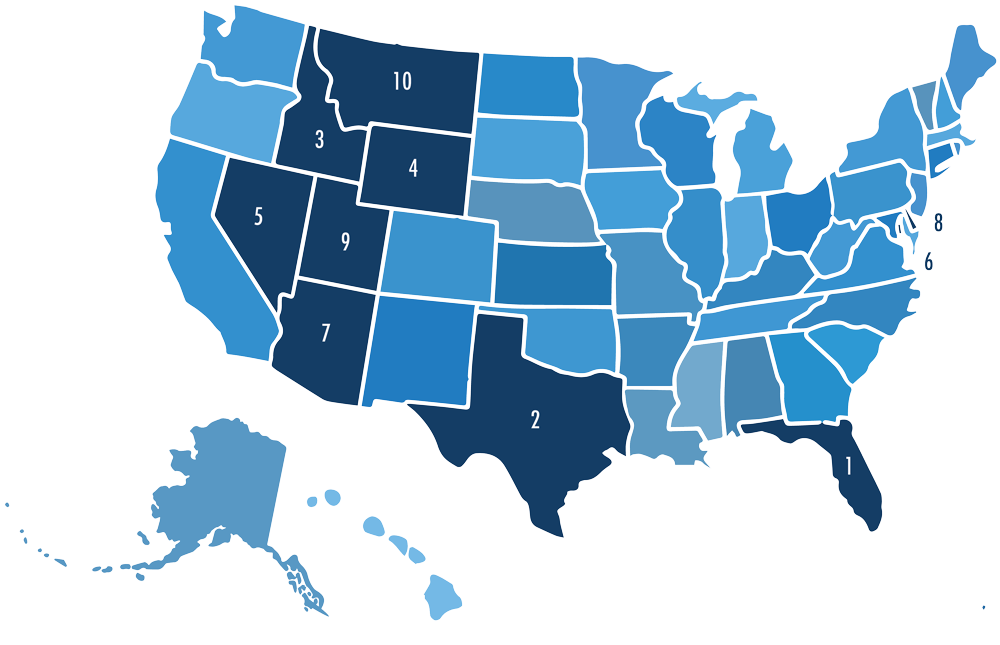
Source: Lightcast Talent Attraction Scorecard 2025
Six Key Talent Takeaways
“Talent attraction looks different for every region, but we’ve identified six overall trends that have shaped this year’s rankings,” the report states. “The 2025 Talent Attraction Scorecard reveals a complex ecosystem where talent mobility is shaped by intersecting forces: shifting demographics, the rise of remote work, evolving worker preferences for lifestyle and affordability and the nuanced financial incentives that distinguish certain regions for both individuals and businesses.”
Against that backdrop, Lightcast reported these six key takeaways from the study:
- The Sunbelt and Mountain West dominate talent attraction.
- An aging population creates short-term gains and long-term risks.
- Quality of life and affordability drive talent attraction.
- Talent magnets can’t find enough blue-collar workers.
- If you build IT, they will come: Tech jobs draw diverse talent.
- Anchor institutions attract workers, but concentration risks vulnerability.
When I recently interviewed Josh Wright, head of strategy and growth at Lightcast, he said that “the Sunbelt and the Mountain West are dominating the rankings. Idaho and Montana are seeing a lot of migration from California, and so are Utah and Montana. Idaho and Nevada have ranked first and second in population growth, and now we know why.”
Places that have both affordability and room for growth are attractive to talented workers, and that is true for both states and cities. Idaho cities like Moscow, Boise and Coeur d’Alene are hot hubs of talent, as are Bozeman, Montana, and St. George, Utah. And don’t sleep on Jackson and Sheridan. These up-and-coming Wyoming towns are challenging Cheyenne for tech supremacy.
“Blue-collar job growth is strong in these fast-rising Western cities,” says Wright. “They score highly in competitive effect on our scale of regional competitiveness. Florida and Texas, meanwhile, continue to have very strong and diverse economies with a lot of different job opportunities, warm weather climates and a lot of momentum.”
At the county level, Wright notes, Maricopa County in the Phoenix metro area has ranked No. 1 in talent attraction for three straight years, while the Phoenix MSA ranks No. 15. While North Carolina dropped from No. 5 to No. 11 in the state ranking this year, mid-sized cities in North Carolina remain hot, along with tier two places in Florida.
“These smaller areas may be lesser known in North Carolina, but they are performing very well,” says Wright. These include cities like Anderson Creek and Jacksonville — showing up at positions No. 6 and 7, respectively, among mid-sized metros.
Wildwood-The Villages, Florida, takes home the No. 1 ranking in the middle tier, joining Panama City, Punta Gorda and Sebastian-Vero Beach in the top 10. Among large cities, Miami, Orlando, Crestview-Fort Walton Beach-Destin, Northport-Bradenton-Sarasota, Tampa-St. Petersburg-Clearwater, Lakeland-Winter Haven and Naples-Marco-Island rank in the top 10.
Strength in Small Numbers
In the categories of Small MSAs and Very Small MSAs, the Mountain West flexes its talent muscle. Small towns in Colorado, Idaho, Utah, Nevada, Wyoming and New Mexico dominate these lists. The top two Very Small MSAs are Sheridan and Jackson, Wyoming.
“There is a mix of factors driving talent growth in these smaller locations,” says Wright. These factors include proximity to military bases and exiting veterans; presence of large retirement communities; and proximity to other large anchor institutions like colleges, universities and federal research installations.
Where retiring baby boomers choose to live is another factor. “The labor market is structurally shifting,” says Wright. “There are fewer people in the labor market as baby boomers retire. We’re seeing migration of high earners. For example, The Villages in north central Florida has created an entire services economy around it.”
Meanwhile, the main drivers for the best-performing small and very small metros are climate, the mountains, affordability and opportunities for growth, Wright says. “Spearfish, South Dakota, is a great example. It is a beautiful area. People want space and they want room to roam. COVID was the accelerant that made these areas explode with growth. We saw remote work explode in these communities, and that is stabilizing now.”
He also cites Clarksville, Tennessee, as an up-and-coming talent magnet. “Clarksville is a very interesting spillover community from Nashville,” he says. “It has emphasized child care in its industrial park. They have attracted a good workforce.”
Another place to watch is the region from northwest Arkansas to central Missouri, says Wright. “Northwest Arkansas has a similar vibe to South Carolina,” he says. “Fayetteville now ranks No. 40 among large metros. Fort Leonard Wood in the Ozarks in Missouri now ranks fourth among small metros.”
On the opposite side, Wright says that many large Northern cities today are not faring well in talent attraction. “In cities like Chicago and New York, the population is not growing,” he notes. “There is outward migration. It is also not a great story for the Midwest, but there are pockets of opportunity.”