
What’s driving workers to seek skills and jobs in the Upper Midwest?
The Great Lakes region boasts an impressive amount of people and skills. The watershed is home to about 34 million people, making up about 10% of the U.S. population. About a third of Canada’s population lives in the region. Beyond numbers, the workforce in this area brings a legacy manufacturing background that is constantly evolving to meet current labor market demands.
Another thing boosting talent development and mobility in the Great Lakes involves the movement of people, ideas and products across the Canada-U.S. border. “The Great Lakes doesn’t compete as individual communities,” said Great Lakes Economic Development Council Executive Director Tim Hindes in January 2026. “It competes as a region, and the strongest outcomes come when we collaborate across borders on shared priorities.”
Grit and Ingenuity
One venture trying to distill and better understand the challenges and opportunities presented by the Great Lakes region’s evolving workforce is the Great Lakes Human Capital Network, a think tank of sorts launched last year by co-founders Anthony Massa, managing partner of human capital advisory firm MM Strategy Group, and Scott Dust, CEO of Scott Dust Consulting and associate dean for partnerships at the University of Cincinnati Lindner School of Business.
Dust hails from Indiana, and Massa calls Ohio home — so starting the Great Lakes Human Capital Network to open dialogue on what is and isn’t working for workers, human capital strategy and hiring strategy for organizations in the Great Lakes region was second nature for the duo.
“In the Midwest, there has always been a culture of ‘roll up your sleeves and solve problems.’ Employers appreciate that. There’s some humility that comes with it.”
— Scott Dust, CEO, Scott Dust Consulting / Associate Dean for Partnerships, University of Cincinnati Lindner School of Business
When asked what makes workers from the Great Lakes unique, Dust offers a few ideas and ultimately lands on one word: grit. “In the Midwest, there has always been a culture of ‘roll up your sleeves and solve problems,’” he says. “And I think that employers appreciate that. There’s some humility that comes with it. [People from] the Midwest region and the Great Lakes region are not afraid to ask questions. They’re not afraid to be authentic and admit when they do or don’t know something, but they have the grit and the ingenuity to go figure it out.”
The Great Lakes region is experiencing growth in a swathe of sectors. Chemicals, semiconductors and solar generation are all expanding in places like Michigan, Illinois and beyond. San Francisco-based Linea Energy will launch a 172-megawatt solar project in Sanilac County, Michigan, with a total investment amount of $457 million. Commercial operations are expected to start at the Watertown site in summer 2027.
What does a changing manufacturing landscape look like in this area? Massa explains that the definition of success and the skills profile needed for the Midwest’s legacy manufacturing and automotive companies has changed over the last 20 or 30 years.
“Some of the talent challenges that are most top of mind for companies I work with in the Midwest and Great Lakes are around getting people who are adaptable, critical thinkers and ready to learn and grow in an organization,” Massa says. “The pace of change is so fast with tech, demographics and otherwise. It used to be that employees could join an organization and sit in a job for decades and have a solid career. That is changing for a variety of reasons. Younger generations seek more dynamic careers — they want to do different things, different roles, different challenges. The advancement of technology makes it so employees are going to need to change their skillsets and learn new skills or flex to different roles multiple times in their careers.”
Finding talented people that are constantly adapting and learning (paired with universities who are building those skillsets in their students before they enter the workforce) and building internal training and development infrastructure are top of mind for the companies Massa works with. He adds that the region is a great talent magnet due to local university systems, state and municipal governments focusing on workforce development and companies prioritizing human-first experience and professional development.
One trend in university-based workforce and professional development that Dust is seeing? “Microdosing” internships and training. For smaller organizations or businesses that may not have the infrastructure to host large co-op training undergraduate programs at an institution like University of Cincinnati, a better approach may be shorter-term programs lasting a couple weeks and focusing on one project. This allows for students to rapidly test whether they enjoy a particular line of work or company, while exposing companies to a large fold of young, keen talent.
Beyond professional development in younger populations, the application of AI in growing a Midwestern workforce is gaining popularity, with state AI taskforces popping up in Wisconsin and Michigan.
“A lot of things are moving to automation, but what we’re also seeing is that there’s a little bit of a backlash where people are like, ‘I am so tired of everything being automated and everything is about AI agents,’” says Dust about the impact of AI and automation on workforce. “Human capital people don’t want everything to just be done by technology. What they want is for people to be enhanced by engaging with technology in a way that allows them to do better work. We’re in this evolution where people are realizing when it comes to human capital challenges and issues, this isn’t something we can just automate away. We still need face-to-face conversations. We still need people to have what we would call ‘digital discernment.’ If anything, people are becoming even more fascinated with the concept of creative thinking, critical thinking, decision-making — all of those elements that are just the core of being a human being.”
Robust Training Efforts in Michigan
Michigan is home to 16 different local Michigan Works areas. The organization delivers federal workforce programs based on the needs of local employers, and works to develop standards, programs and training initiatives for high schoolers, college students, skilled tradespeople and beyond. Kristen C. Wenzel, CEO of Great Lakes Bay Michigan Works, walked through what her arm of the organization does to connect workers to new opportunities in the state.
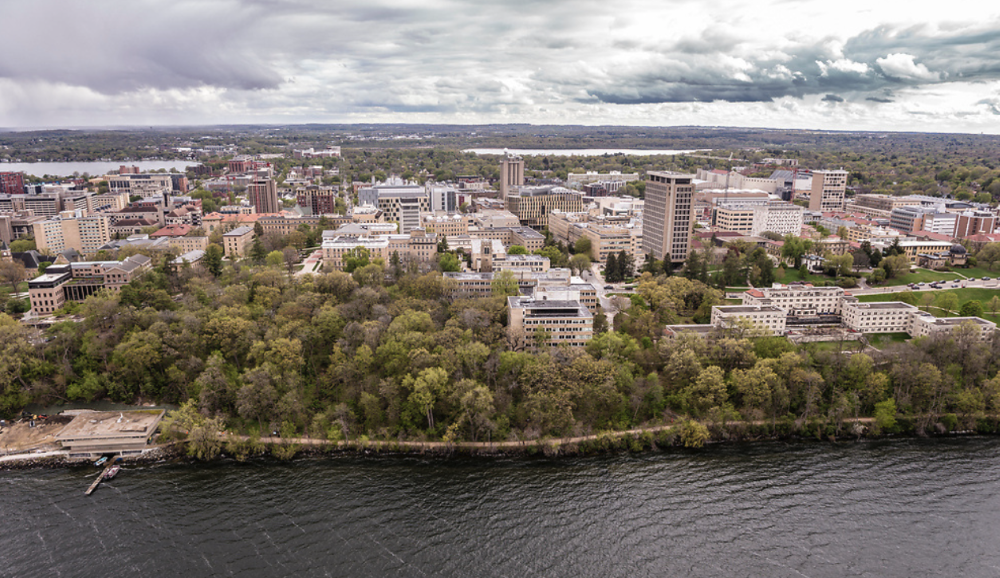
The University of Wisconsin–Madison is one of many land-grant universities peppering the Great Lakes region.
Image Credit: Althea Dotzour / UW–Madison
“We have a team of individuals that works directly with employers to support their recruitment and their retention needs,” she explains. “They act independently of the work that we do every day in our five locations to prepare jobseekers for opportunities that exist in our region. We offer a variety of services from fundamental technology training to job preparation, helping people prepare resumes and prepare for interviews. If their skill set does not align with their area of interest, we may be able to provide them scholarships so that they can receive training that will make them more competitive in the workplace.”